The next part of the Marissa Doyle tour of southern England involved a whirlwind tour of two quintessentially English places: the city of Oxford, and Windsor Castle. While we only spent a few hours in each place, it was well worth the effort...and helped break in my family to the sheer amount of walking we’d be doing for the rest of the trip!
After a quick peek at the Ashmolean Museum, we set out for a stroll up Cornmarket Street...
to the Carfax Tower--more properly, the 12th century tower of St. Martin’s church (the clock with the little mechanical guys who ring the hour are a 19th century addition)...
up High Street to get a peek at the Radcliffe Camera (alas, closed for the day)...
and the Church of St. Mary...
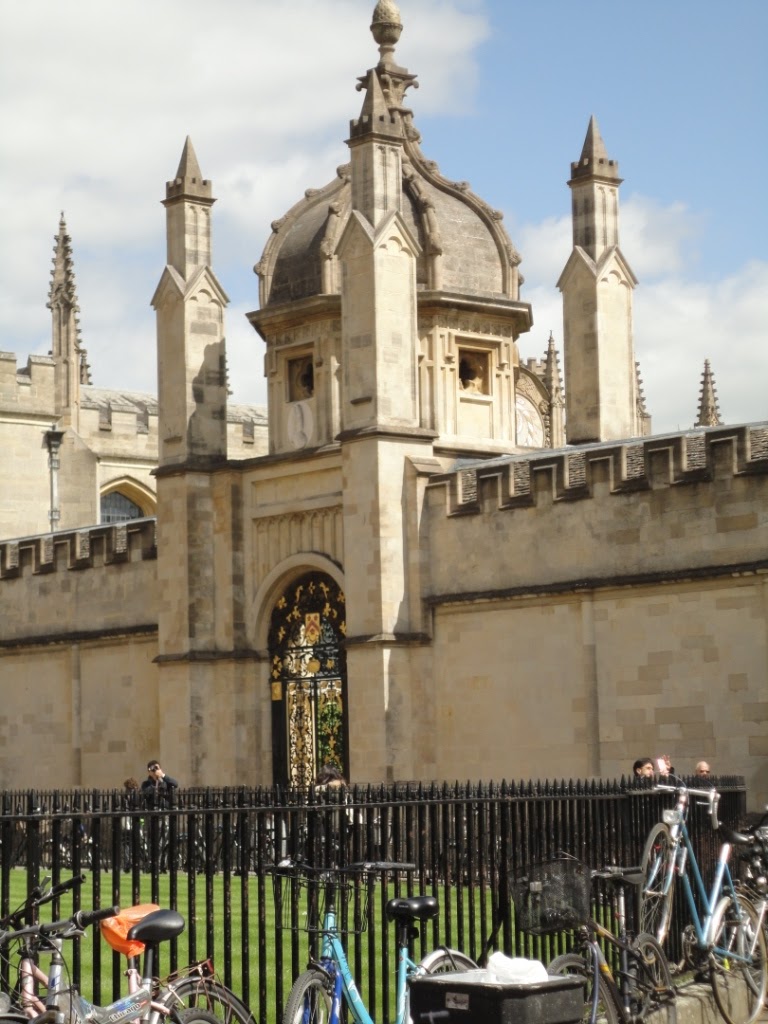
up to the Botanical Gardens, then down the Broad Walk past Christ Church Meadow (which was lovely and wild but surprisingly sheep-free)...
and Merton College, one of the oldest in the university and the college of J.R.R. Tolkien...
then on for a pleasant lunch (notice the delightfully sunny and warm weather--a feature of most of the trip) at The Head of the River Pub, on the Thames...or is it the Isis? For some reason, the Thames is called the Isis where it flows through the city. From what I’ve been able to discover, this seems mostly to have been a Victorian thing, involving some romantic but erroneous mythological and linguistic shenanigans; the old Celtic name of the river was the Tamesis, so you can see where the borrowing might have come from.
Whizzing down the M40 and M25, we arrived in Windsor and made it up to the Castle just before ticket sales closed...and I’m so glad we did. It’s a very interesting place, so old in places and yet immaculately maintained and manicured. Security was fairly tight as the Queen was in residence (her standard was flying over the Castle, which was pretty cool), so we had to go through the equivalent of airport security after purchasing our tickets.
We wandered around the grounds for a bit and got a look at this charming garden...
then made our way to view the bits open to the public: the State Rooms and...the Queen’s Dolls’ House, which I blogged about a few years ago and which was beyond amazing to see in person (alas, no photographs permitted.) The State Rooms were gorgeous, especially the Waterloo Chamber with Sir Thomas Lawrence’s portraits of the leaders of the Allies. It’s kind of amazing to see the originals of artwork you’ve only seen reproduced in books.
But probably the coolest thing we saw at Windsor was a special exhibit entitled “Waterloo at Windsor”, commemorating the 200th anniversary of the battle. Again, no photos permitted (sigh!), but here's a link to the exhibit's website. On display were portraits and Rowlandson cartoons and drawings...and then there were the letters: Napoleon’s formal letter of surrender to the Prince Regent, Wellington’s dispatch to the Prince after the battle, and more. My kids were mightily amused at their mother’s hyperventilating as she scurried from display case to display case, but honestly—what amazing things to see! I was a very happy history geek that afternoon.
Next stop on our tour: Bath!
Tuesday, June 23, 2015
Friday, June 19, 2015
How to Feed a Starving Author: Send Her to a Science Fiction Convention
How do you feed your creativity? Soak in a bubble bath
surrounded by scented candles? Listen to sweeping arias and the swelling music
of an orchestra? Take long walks along the pebbled shore?
I go to science fiction conventions.
I’m not sure why, but hanging around with amazingly creative
people, all sharing their love for a particular genre or show, just gets my
juices flowing. This past weekend I had the privilege of attending Anglicon The
Regeneration just south of Seattle, and I came back buzzing.
The original Anglicon was a media convention held yearly
from 1988 to 2004. For the last 11 years, fans have lamented its loss. This
year, thanks to a successful Kickstarter campaign, the Con not only ran for
three days but earned back enough money to book the hotel for next year’s convention.
Anglicon The Regeneration largely drew fans of Dr. Who. I
was impressed by the wide range of attendees, from eager scientists to avid
writers and artists to adoring fans from children to grandparents. I went to
several panels on such things as upcoming British science fiction and fantasy
movies and series (most were too scary for my tastes), cosplay on a budget (my
budget proved a lot smaller than the panelists’ when it comes to purchasing
items for costumes), and how to publish a book on Kickstarter (intriguing
concept, but I’m not ready). I listened to Colin Baker, the sixth doctor,
reminisce about his time on the show (charming man with an excellent sense of
comedic timing). I tasted British soda pop for the first time (much stronger than
our soda—took me two days to stop feeling the effects of the ginger beer, and
the cream soda was like drinking vanilla frosting).
My two favorite parts of the Con were the conversations with
interesting people and the costumes. One dapper vendor asked me to name the
five historical people I’d invite to a dinner party (Lord Byron, Angelica
Kauffman, Caroline Herschel, Ezra Meeker, and my great-grandmother on my
father’s side) as well as five book characters I’d invite [Taran Wanderer from
Lloyd Alexander’s Prydain series, Uncas from James Fenimore Cooper’s Last of the Mohicans, Lord Peter Wimsey
from Dorothy Sayers’s mystery series, Boromir from Tolkien’s Lord of the Rings (and not just because
the swoon-worthy Sean Bean played him in the movie), and Tom Riddle from J.K.
Rowling’s Harry Potter series (although without his nasty powers)].
And then there were the costumes. My word, but some people
know how to put together an outfit! I had attempted to dress like the tenth
doctor, with brown pin-striped suit, blue shirt, red sneakers and suitably
spikey hair. Epic fa
il. There were people dressed so faithfully like the
fourth, sixth, tenth, and eleventh doctors that you might have thought you were
meeting him in person! And my hat’s off to those who can create a replica Dalek
that could move, swivel, and speak authentically. (At least, I think it was a
replica—I wasn’t exterminated!)
All in all, I came back tired but exhilarated, and ready to
apply my own creativity to what I like best: writing romantic books that
encourage and entertain. More on that next week. J
*All photos courtesy of Isabella Hurd.
Tuesday, June 16, 2015
The Battle of Waterloo: Was it Necessary?
Two hundred years ago today, Napoleon experienced his final victory at the Battle of Ligny...and his final defeat two days later, at Waterloo. But was his final defeat really necessary?
Earlier this year, British biographer Andrew Roberts published an enormous and quite readable biography of Napoleon. And in it he wonders if the Battle of Waterloo was really necessary. After returning to France from temporary exile in Elba, Roberts argues that Napoleon had changed. He was now in his mid-forties and beginning to feel his age and the years of hard campaigning, and according to a letter sent to the Allied governments still meeting at the Congress of Vienna, had given up on reconstituting his empire and simply wanted to concentrate on continuing his reforms and modernizations within France. He set about instituting a new constitution which including something approximating a legislature, and started in on further building projects in Paris and reopening several cultural institutions that Louis XVIII had closed during his brief return to the throne.
The Allies, though, would have nothing to do with that, not trusting the word of the man who’d beaten them so soundly so many times. And, Roberts states, they had other reasons for wanting to remove Napoleon—namely, to stop the growth of democratic ideas and ideals that Napoleon had kept as a legacy from the French Revolution, even during his rule as emperor. So they rejected his mild letter in the Vienna Declaration:
That vengeance happened to occur in what is now Belgium. Napoleon chose to make his stand there, in order to prevent the British and Prussian troops from being able to join together. At the Battle of Ligny, he defeated the Prussian General Blucher and kept the rest of the Prussian army pinned down...but strategic errors committed by some of his generals, most notably Marshal Ney, sowed the seeds of Napoleon’s final defeat two days later at Waterloo.
We’ve had a look at the battle here...and the rest is history. But Andrew Roberts states that history, and European civilization, might have been better off if the battle had never happened and Napoleon had been allowed to rule France. His defeat allowed the old reactionary monarchies who were still living in the early 18th century to hold onto power and crush the nascent movements toward democracy that were sprouting across the continent. The bloody revolutions of the 1840s might not have happened if constitutional monarchies had been adopted...and the world might have been a very different place as a result.
For a fun look at a recreation of today’s Battle of Ligny, check out this article in the New York Times...and if your interest is piqued, I highly recommend Andrew Robert’s Napoleon.
Earlier this year, British biographer Andrew Roberts published an enormous and quite readable biography of Napoleon. And in it he wonders if the Battle of Waterloo was really necessary. After returning to France from temporary exile in Elba, Roberts argues that Napoleon had changed. He was now in his mid-forties and beginning to feel his age and the years of hard campaigning, and according to a letter sent to the Allied governments still meeting at the Congress of Vienna, had given up on reconstituting his empire and simply wanted to concentrate on continuing his reforms and modernizations within France. He set about instituting a new constitution which including something approximating a legislature, and started in on further building projects in Paris and reopening several cultural institutions that Louis XVIII had closed during his brief return to the throne.
The Allies, though, would have nothing to do with that, not trusting the word of the man who’d beaten them so soundly so many times. And, Roberts states, they had other reasons for wanting to remove Napoleon—namely, to stop the growth of democratic ideas and ideals that Napoleon had kept as a legacy from the French Revolution, even during his rule as emperor. So they rejected his mild letter in the Vienna Declaration:
"By thus breaking the convention which had established him in the island of Elba, Bonaparte destroys the only legal title on which his existence depended, and by appearing again in France, with projects of confusion and disorder, he has deprived himself of the protection of the law, and has manifested to the universe that there can be neither peace nor truce with him.
The powers consequently declare, that Napoleon Bonaparte has placed himself with out the pale of civil and social relations; and that, as an enemy and disturber of the tranquillity of the world, he has rendered himself liable to public vengeance.”
We’ve had a look at the battle here...and the rest is history. But Andrew Roberts states that history, and European civilization, might have been better off if the battle had never happened and Napoleon had been allowed to rule France. His defeat allowed the old reactionary monarchies who were still living in the early 18th century to hold onto power and crush the nascent movements toward democracy that were sprouting across the continent. The bloody revolutions of the 1840s might not have happened if constitutional monarchies had been adopted...and the world might have been a very different place as a result.
For a fun look at a recreation of today’s Battle of Ligny, check out this article in the New York Times...and if your interest is piqued, I highly recommend Andrew Robert’s Napoleon.
Friday, June 12, 2015
The Shocking Truth About Almack's
We’ve talked before about the magical Season in London, when
a young lady made her debut in polite society for the first time. Once you were
“out,” you could attend balls, hold parties at your own house, and, if you were
lucky, visit Almack’s. I recently had cause to dig a little deeper into the
workings of the mighty club, and I was a little surprised at what I found.
Almack’s, as we’ve also discussed, was that bastion of
society often referred to as the Marriage Mart. A club dictated by women was a
novelty in a society that still largely catered to the gentleman. The lady
patronesses of Almack’s determined who was allowed to attend each ball held on
Wednesday nights during the Season.
What surprised me was the entire process. As gleaned from
various sources, some of which are not first-hand, it seems that when a mama
knew she was bringing her daughter to London for the Season, she might write to
a patroness and request vouchers in advance. The patronesses thus had a pretty
good idea of who was going to be out and about that year. But no patroness
would issue vouchers unless she visited the prospective attendee or otherwise
knew that young lady personally. Then the patronesses met together and
discussed potential candidates.
Wouldn’t you have liked to be a fly on the wall at one of
those meetings.
“I met with Miss Charming this week. She is utterly
delightful. We must have her.”
“Tsk—not a bit of it! Her mother is a harridan, and I cannot
like her wardrobe.”
“Oh. Pity. What about Miss Newvoriche? She is polite above
all things.”
Shudder. “No. Her grandfather was a coal merchant.”
Gasp!
And it wasn’t just the ladies who waited with great
trepidation to hear whether they had been chosen. Men too had to be issued
vouchers to attend. And attendance could still be denied even after you’d
received vouchers if your behavior was found lacking for any reason.
There also appears to have been some sort of rule on the
number of people in a single family who could be granted vouchers. Some sources
say two; others three. Vouchers were non-transferrable, meaning that if you
couldn’t go one week you couldn’t just hand your ticket to another person.
I couldn’t help wondering what would happen in a family with
two daughters on the ton in one year
and a socially astute mother. Which daughter would be denied tickets? How would
that make her feel? What might she do to convince the patronesses to change
their minds?
Particularly when attending Almack’s meant everything, even
catching a French spy.
Dropping hints? Guilty. Stay tuned, because later this
month, I’ll tell you more about what Ariadne Courdebas did to earn tickets to
Almack’s after Eloquence and Espionage,
Book 4 in my Lady Emily Capers, debuts on June 22.
Tuesday, June 9, 2015
Fashion Forecast 1834, Part 2
What was the well-dressed young woman wearing in the second half of 1834?
For day wear, either at home (the Morning Dress at left) or out for a drive (the Carriage Dress at right), it’s enormous pouffy gigot sleeves and an exaggerated closed pelerine-mantelet of lace with lapels and a long lappet falling to below the knees (which could serve as a apron, I suppose, but I doubt that was the point!) Small, demure, face-framing bonnets also seem to be the "in" headgear. (Court Magazine, July):
This Court Magazine print from August features the front and back view of a Walking Dress, featuring another overgrown lace pelerine adorned with large bows and gigot sleeves caught in a mid arm to create a secondary puff above the wrist. The back view dress is made of chintz, which is a popular fabric this year for gowns:
Also from August’s Court Magazine, a very elegant Dinner Dress in gold and white, with an open skirt and white-on-white embroidered underskirt and a plain bodice, a deep lace van dyke collar, lace trim on the large puff sleeves, and a turban in the same fabric with lace lappets and feathers, all topped with what looks like a pink plaid shawl:
More Morning Dresses for September, fairly plain in style as befits an “at home” dress but with some interesting details in the pleated bodice, wide belt, the apron skirt, and the oddly drop-shouldered capelet trimmed with large bows. (Court Magazine):
For October’s Court Magazine, we have a charmingly antique-looking Dinner Dress that might not look amiss in the seventeenth century, with its deep standing van dyke collar, jeweled ornaments on the bodice and the overskirt of the pelisse-robe. Dagged lace trim on the puffed sleeves, and white net mitts. And isn’t the background on this one lovely?
A Dinner Dress and Morning Dress are featured for November. The sleeves seem to have inflated hugely and are called “imbecile” sleeves, believe it or not! The Dinner Dress is just barely off the shoulder, with horizontal gathering on the bodice and a very frilly cap. The Morning Dress features the same gathering but this time on the skirt; curious double sleeves, and what appears o be a chemisette bodice under the lace-flounced pelerine. (Court Magazine):
And for December, a look at outerwear in the Carriage Dress at right, with an embroidered mantle with large bell sleeves (the better to accommodate the gigot sleeves beneath!), a double pelerine of what looks like velvet, and heavy tasseled cord ties. Bonnet with frilled cap beneath and feathers. (Court Magazine):
What do you think of 1834’s fashions?
Friday, June 5, 2015
Retro Blast: Happy Graduation, Blue Coats and All
Congratulations to
those graduating this week and next! What a milestone in your lives! To
celebrate, I’m reposting something from 2010 and letting you know that Art and Artifice is currently on sale for 99 cents for a limited time. Find the links to purchase here.
This time of year marks graduation for many—from high
school, from trade school, from college.
Some will wear gowns in their school colors; others will wear somber
black. In the nineteenth century,
students attending school at Christ’s Hospital wore blue.
The London Bluecoat School, as it was called, opened for
both boys and girls in 1552. It was
designed to educate and house London’s poor children, but students came from
all England and Wales, and a few came from Ireland and Scotland. An average of 1,500 students were enrolled
each year. It must have been a frugal
operation: in 1815, it cost about 22
pounds per year per child to house, feed, clothe, and educate the students.
So let’s say you’re a child of a poor family, and your
mother would like to see you have a chance to do something better in life by
attending the Bluecoat School. First,
she had to petition a member of the board of governors (who were generally
officials with the City of London) or some wealthy person with influence at the
school (a benefactor) for help. She had
to gather birth and baptismal records, a sworn statement from your parish
minister, and statements from witnesses that proved you were the right age and
in a “destitute condition.” The board
member or benefactor brought the proof to the board, who reviewed and approved
these presentation papers, at which point your family was notified.
On a set day, Mother brought you down to the school and
turned you over to the registrar. I
imagine there must have been some teary-eyed farewells at that point. Much as if you were entering prison, the registrar
recorded your name in a book and gave you a new set of clothes that consisted
of a long blue coat close to the body, a yellow underskirt, yellow stockings,
and a flat, round worsted cap. That’s
what you wore the remainder of your time in the school, up to age sixteen.
At first, boys and girls were educated in the same school,
but just before the beginning of the nineteenth century, the girls were moved
out of London to Hertfordshire, and some of the youngest boys (under age 10)
joined them shortly afterward. It
appears the girls were taught to go into service or trade, but the boys in
London were educated in the classics, including learning Latin. The buildings also housed the Royal
Mathematical School to train mathematicians and teach naval officers navigation. Sir Isaac Newton, John Flamsteed the first
Astronomer Royal, and Edmund Halley (who first computed the orbit of Halley’s
comet) helped build the study materials.
The Bluecoat School was much patronized by the aristocracy
and nobility. It operated under Royal
Charter, and noted architects Sir Christopher Wren and Nicholas Hawksmoor (I so
want to steal his name for a hero!), designed the buildings after many of the
originals were destroyed in the Great Fire of London in 1666. The wealthy even left money to the school in
their wills. Famous students in London
include critic and writer James Leigh Hunt, essayist Charles Lamb, and the poet
Samuel Taylor Coleridge. Bluecoat
schools eventually sprung up in a number of other English cities as well.
So, if you are graduating or have graduated,
congratulations! Aren’t you glad you
didn’t have to do it in a blue coat and yellow stockings?
Tuesday, June 2, 2015
Green and Pleasant Land, Part 1: London
London is an amazing city. Of course the history aspect is amazing...but it’s also a remarkably livable city, at least for me who gets antsy when there aren’t trees nearby. There’s little of the canyon-like effect you get in Manhattan...and the parks are truly lovely. And did I mention the history? ☺
So the five of us arrived at our hotel in Westminster in what is probably an ideal place for sightseeing: we were at the St. James Courtyard hotel, a five-minute walk from Buckingham Palace (and on the same street as the Bluecoat School, about which Regina blogged). The hotel itself dates to the Edwardian era, and is built around a courtyard with all sorts of delightful architectural bits. London abounds in delightful architectural bits, by the way—no walk is ever dull there.
I’m happy to report that the statue of Queen Victoria at her memorial in front of the Palace still looks like a lifeguard (which I’d noticed on my first visit to London about thirty years ago)—for some reason Her Majesty’s nose is lighter than the rest of her, as if smeared with zinc oxide. And Canada Gate at the entrance to Green Park off Constitution Hill is as shiny as ever:
However, I was very sad to see that cows are no longer kept in Green Park as they were during the Regency, despite this reminder of their presence:
I found it a little surprising to see how small St. James’s Palace was, and how “right there” as well—the streets run right alongside it—considering it’s actually the official home of the sovereign (ambassadors are still accredited to the Court of St. James.) It was built by Henry VIII and added onto over the centuries, but still has that sixteenth century feel:
And then we were in St. James’s Street, Masculinity Central of Regency London, home of such places as Brooks’s and White’s Club (and yes, there’s the famous Bow Window at White’s)
What I found interesting (beside all the famous historical landmarks and stores) was the topography. St. James’s Street trends uphill, which I did not know—it’s one of those things that somehow doesn’t get mentioned very often, and which I’m glad I now know. But even more exciting to me was catching sight of King Street off St. James’s. The King Street, home of Almack’s Assembly Rooms? You bet—only, Almack’s is long gone, replaced by (sob!) an office building. But at least I can now say I was there as I scribble away at my Almack’s stories. That's me with Child #1. Yes, he's pretty tall.
What else? We dined at Wilton’s on Jermyn Street, established 1742, and had a wonderful dinner...and a delightful tea at Duke’s Hotel. We carried out a quick raid on Harrod’s and came away with tea and chocolates (alas, the presence of a husband and son necessitated the visit being brief). And we visited the Victoria and Albert Museum (glorious sensory overload—it’s the world’s largest museum of art and design) and Apsley House, the Duke of Wellington’s house at Hyde Park Corner, which was amazing.
No interior photographs permitted, alas, as my little history-geek heart was a-galloping at the eleven-foot tall statue of Napoleon at the base of the Principal Staircase on which it is rumored Wellington used to hang his hat as he went up the stairs (and the painting of Wellington in old age presenting a gift to his godson, Queen Victoria’s son Arthur)...at the astonishing Waterloo Shield, which really has to be seen to be appreciated (Google it!) Wellington came away from the wars with a ton of goodies from grateful European heads of state. And most of all at the Waterloo Gallery, the room where Wellington held his annual dinners to commemorate the battle and which held his collection of Spanish masters. Curiously, among the amazing art collection amassed here are multiple portraits of Napoleon and members of his family. After Waterloo, Wellington would be linked for the rest of his life to the former French emperor—without Napoleon, Wellington would not have been Wellington. That must have been a strange thing to have to live with for the rest of his life—so closely linked to someone he actually never met face-to-face—and he lived nearly forty more years after the battle.
And right around the corner from Apsley House in Hyde Park? Rotten Row, of course!
Next time: visiting Oxford and Windsor
Subscribe to:
Posts (Atom)


