Friday, June 30, 2017

A June Bride Again

Once upon a time, a previous publisher invited me to write a story for an anthology on the theme of June Brides. Perhaps it was that song from Seven Brides for Seven Brothers (“Oh they say when you marry in June, you’re a bride, all your life,” perhaps it was all the talk about brides being such a “thing” in romance, perhaps it was the humor that pokes up from time to time in my writing. But the title that sprang into my head was The June Bride Conspiracy.

Hm.

The story quickly grew, centered around a Regency James Bond who wanted to retire and his sweetheart who wasn’t so sure she could compete with the glamor he’d once known.

I guess I’m old school, but I can’t imagine a more dashing James Bond than Sean Connery, with the possible exception of Pierce Brosnan. My father was a huge James Bond fan—he had me read Ian Flemming when I was in high school and see all the movies even if we had to rent them. So it’s little wonder that Allister Fenwick, Lord Trevithan, should bear a striking resemblance in word, action, and looks to an idealized James Bond.

The novella was hands down the easiest story I ever wrote. The words flowed, the plot came together, the characters sparkled. When people ask me my favorite among the stories I’ve written, The June Bride Conspiracy is always near the top of the list. It was earned my first “Top Pick” from RT Book Reviews, a rare honor for the industry publication.

But as I drew the story out to polish up for republication, I found myself surprised. The novella seemed to have changed, or, better stated, I’d changed. Places that had to be tightened to fit the space for a novella cried out for more.

So I gave it more--15,000 words, to be precise.

The June Bride Conspiracy is now available, deeper, stronger, and more vibrant than ever before. I hope you’ll give it a try.

Engaged to the dark and dashing Lord Trevithan, Joanna Lindby should be the happiest of ladies in Regency London. But every once in a while she wonders—why would this enigmatic lord choose her? She’s shy, quiet, unassuming, never arguing, always polite. But when a note arrives calling off the wedding, Joanna vows that she will be married in June, no matter the cost.

England’s top intelligence agent Allister Fenwick, Lord Trevithan, is shocked when his demure fiancĂ©e demands an explanation. He never sent that note. Someone is trying to come between them. Though Allister promised himself he would leave the world of espionage behind, he cannot help but be drawn into this case, if only to protect his surprisingly headstrong bride-to-be. Yet, is it an old enemy or an old friend causing the mischief? Can a little espionage unmask hidden hearts in time for a June wedding? 

You can find it at the following online retailers:


Coming shortly to Barnes and Noble, iBooks, and Kobo as well. Enjoy, and happy Independence Day next week. Marissa and I will be celebrating with our families, so we’ll catch up with you the week of July 10th.

Tuesday, June 27, 2017

Retro Blast: A Royal Wedding


Today’s post is a re-run of a post from April 2011—a re-run because I’m busy today celebrating my 30th wedding anniversary with my dear husband. Though my wedding was nothing like Queen Victoria’s (I emphatically did not have a wedding cake nine feet in diameter!), I, like the little queen, was—and still am— “so very happy!”

Enjoy!


Surely one of the most momentous royal weddings of the 19th century was that of Queen Victoria to Prince Albert of Saxe-Coburg and Gotha. Victoria had proposed to her cousin in October—as a reigning monarch, she far outranked him—and the wedding was set for February 10, 1840—a scant three months later. Victoria had hoped for a private wedding, but her prime minister, Lord Melbourne, over-ruled her and so it was the first public royal wedding in decades—since George III’s wedding, back in 1761. The weather was beastly that morning, but it didn’t dampen the enthusiasm of the crowds of people who came out to watch the queen drive from Buckingham Palace to the Chapel Royal at St. James’s Palace. The Chapel was stuffed with as many seats as possible for visiting dignitaries and as much of the whiggish side of the British nobility as possible (of the Tory nobility, only the Duke of Wellington and Lord Liverpool, a former prime minister, were invited).

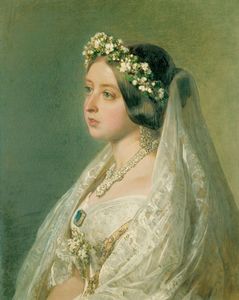
Albert, dressed as a British Field Marshal, entered the chapel first, and awaited Victoria, who walked down the aisle on the arm of her uncle, the Duke of Sussex. Her dress (viewable in the London Museum) was of her own design and fairly simple, of British-made white satin with a trim of orange blossoms. Her veil, worn with a wreath of orange blossoms, was literally one of a kind: it was made by lacemakers in Devon, and the design was destroyed so that the pattern could never be copied. She wore her Turkish diamond necklace and earrings and a sapphire brooch Albert gave her as a wedding present.

There were a multiplicity of clergy on hand, with the Archbishops of Canterbury and York and the Bishop of London all there to officiate. What there hadn’t been was a rehearsal, so that the dowager queen Adelaide was heard whispering to Albert about the proper order of the procession, and Victoria’s twelve bridesmaids (dressed in simple gowns also of Victoria’s design, with wreaths of white roses on their heads) struggled to hold onto the queen’s short train without stumbling over each other. Though Albert often seemed unsure and agitated—his English was not very good at this point, so following the service may have been difficult—Victoria was poised and calm and, as she wrote in her journal, “so very happy!” There were amusing family touches, too: Victoria’s uncle the Duke of Cambridge kept up a very audible, if cheerful, commentary on the proceedings. Her uncle Sussex, who gave her away, still wore his customary black skullcap which he always wore to keep his head warm. And like many mothers of brides, the Duchess of Kent was seen to shed tears.

After the ceremony the married pair returned to Buckingham Palace for a small wedding breakfast (relatively speaking) of family members and their households, the prime minister and a handful of cabinet members, the Royal Household, and the Archbishop of Canterbury and the Bishop of London. Over a hundred wedding cakes were made, to distribute to various family members, Royal Household members, officers of state, and foreign ambassadors. The main cake was nine feet across and sixteen inches high, and decorated with all sorts of allegorical symbols of marriage and of the queen…oh for a photograph! And then it was time to change (Victoria wore a white satin cloak trimmed with swan’s down and a white velvet bonnet with plumes and Brussels lace) and head off to Windsor for their two-day honeymoon. Yes, two days. As Victoria reminded Albert, “You forget, my dearest Love, that I am the Sovereign and that business can stop and wait for nothing.” Not even true love, it seems!

Friday, June 23, 2017

Four Things on a Friday, Summer Edition

So many interesting things, so little time! Here are four that came past my gaze in recent weeks I thought you would want to know about as we move into summer:

  • A free Regency paper doll to print and color. Flora looks like she would be oodles of fun, besides being nicely period correct. Find the doll here and her clothing here.
  • Summer reading. Not sure how long it will last, but one of the lovely Timeless Regency anthologies, Spring in Hyde Park, is on sale for 99 cents. 
  • Eye candy when you’re inside hiding from the heat. I’ve been slowly adding to my Pinterest boards, with nearly 300 tall ship pictures, more than 200 cowboys, and nearly 150 of drool-worthy English estates. I generally don’t go mad for a certain designer, but oh, the House of Worth! That board has more than two dozen historical gowns and more coming.    
  • More ideas on dealing with the heat. Check out this lovely video on how historical ladies and gentlemen stayed cool.

Here’s to a lovely summer!

Tuesday, June 20, 2017

Regency fabrics, Part 15

Here’s another post in our ongoing series on Regency fabrics.

As I have in previous posts, I’ll be examining actual fabric samples glued into several earlier editions of Ackermann’s Repository, samples supplied by the manufacturers and published by Ackermann in order to boost the British cloth-making industry at a time when exporting British goods to Europe was almost impossible because of the Napoleonic war. I'll give you a close-up scan of each sample, the published description if available, and my own observations of the color, weight, condition, and similarity to present-day materials, to give you as close a picture as possible of what these fabrics are like.


Today’s four samples are from the September 1810 issue of Ackermann’s Repository. The overall condition of my copy is pretty good, with some toning on the fabric samples but not enough to obscure their details or colors. Here we go!

No. 1. A Cashmire shawl muslin, of agreeably contrasted ground and figure, adapted for the evening robe or wrap pelisse. The latter worn over a white sarsnet slip, and embellished with white satin or thread lace; the former worn quite plain, with a wing collar, and antique cuff of lace. The satin bead, pearl, or silver filligree ornaments, can only be admitted with lively and diversified article. It is sold by T. and J. Smith, 43, Tavistock-street, Covent-garden.


My comments: A finely woven, very lightweight material—the weave is moderately open, and the fabric has a smooth and silky hand. A dress of this would definitely require a slip underneath! The red and green pattern, vaguely floral in this orientation, is woven in.

No. 2. A morine corded cambric muslin, adapted particularly for the morning robe, Grecian wrap, and children’s frocks and trowsers. This neat and simply elegant manufacture requires no embellishment, save a simple termination at its edges, which should either consist of a tambour scallop or narrow antique lace. It is sold also by T. and J. Smith, as above.


My comments: This is lovely: the ribbing looks almost like a rope pattern, and lends it a slightly sturdier air though it’s still fairly sheer. It’s more tightly woven than No. 1, and of finer and more uniform thread thickness. A morning dress of this would be very graceful and airy, just right for summer.

No. 3. An Indian shawl cambric, comprising much unobtrusive neatness and utility. This article exclusively belongs to the simple order of domestic costume. It is sometimes seen in the high morning robe, but is better suited to the embroidered shirt and foundling cap of the same, which most agreeably relieve it. It is sold by Joseph Ord, 77, St. Paul’s Church-yard.


My comments: I am often struck, when I look at the prints from these Ackermann plates, how much they remind me of 1930s prints. This cambric is finely and tightly woven though the hand is not a smooth as expected, and the print crisp and clear under the age-toning spots.

No. 4. A white velvet, of a peculiarly elegant texture, adapted for the fashionable and beautiful art of velvet painting, now the reigning amusement of the leisure hours of our elegant females. Chairs, music-stools, screens, borders for rooms, curtains, and baskets for flowers, are composed of this rich and attractive specimen of female genius. It is purchased, together with the colours, and all sorts of paper work, drawings, &c. &c., at Ackermann’s Repository, No, 101 Strand, at 7s. 6d. per yard.


My comments: Well, well, well—painting on velvet! No images of Elvis here, though, I presume.  The velvet feels almost like a velveteen, with a very thick, low nap, and rather stiff (though that could have something to do with how it has aged rather than the original feel of the fabric.)

Friday, June 16, 2017

Watching the Ships Come Sailing In

I have a book due July 31. I have galleys to proof for my 2017 Christmas book with Love Inspired Historical. My editor would like input on the cover for my spring 2018 book. I’m weeks behind in revising The June Bride Conspiracy for reissue. So, how did I spend a good chunk of my day yesterday?

Watching the ships come sailing in.

This week marks Tacoma’s Festival of Sail. More than 20 ships sailed down Puget Sound to join in. They ranged from turn-of-the-century racing yachts to replicas of nineteenth-century square riggers. Even my beloved Lady Washington was in attendance.

Here’s some I caught on camera as they arrived. (The colors appear washed out--that's because it was pouring rain on shore and shrouded with mist at sea. My family and I were some of the few who braved the storm to watch.)


Ah, my Lady Washington, our state’s tall ship. I’ve blogged previously about my short time sailing on her.  Today, she led the Parade of Sail, her canon booming. It’s enough to set a girl swooning.


Here’s the Cutty Sark (though not the original in Britain). This one was built in 1957, the first of ten ships in the Mayflower class. She’s made of teak. Such graceful lines!


And this is the Merrie Ellen, a schooner from 1922. Oh, could she skim the waves!


Finally, the Hawaiian Chieftain, the Lady Washington’s companion ship. I’ve also had the privilege of sailing on her. Such a beauty!

Marissa kindly shared the link to the Boston Tall Ship Festival, which starts this weekend. Even though the East Coast boasts many more distinguished vessels, and some came from South America and across the Pond to visit, Tacoma has one thing Boston cannot claim.

The World’s Largest Rubber Ducky.

Six stories tall. No lie. Those are the perks of living in the wilderness.

Tuesday, June 13, 2017

Now—and Soon-to-be—Here!

Book news for today, dear NineteenTeen readers, on stories old and new.

Firstly, in the “old” department, I’m thrilled to report that Skin Deep has won the Paranormal Category of the 2017 Wisconsin RWA’s Write Touch Readers’ Choice Award.  One judge called it, "One of the best books I've read in a while. Kept me spellbound!” (Thank you!) It's also a finalist in the Paranormal category of First Coast Romance Writers' 2017 National Excellence in Romance Fiction Award as well as in the Urban Fantasy category of Fantasy, Futuristic, and Paranormal Chapter of RWA's 2017 PRISM Award (which means Regina and I get to go to a cool party at RWA's national conference this year!)...more news on those next month.

Secondly, after a long learning curve during which I learned how to design book interiors and play with some nifty software, I’m delighted to finally offer readers a print version of my Leland Sisters novella, Charles Bewitched. You can find it at Amazon, if you’d like to give Chuckles a spot on your bookshelf next to his sisters.

And now, in the “new” department, I’ve written a short story titled “Alea Iacta Est” (that’s Latin for “The Die is Cast”) about a girl gamer...in 1817 London (of course!) I’m even happier to announce that it will be appearing in an anthology titled Nevertheless, She Persisted, coming August 8 from Book View CafĂ© and edited by Mindy Klasky. It will be available in both print and e-book, and will feature “nineteen stories of persistence — in the past, present, future, and new worlds. Sometimes funny, sometimes tragic, these stories illustrate the power of women overcoming the challenges of other people, of society, and of their own fears.” (You can read the rest of Mindy’s announcement here.) I'll post again when it's available...and I hope you'll check it out, because it's going to be amazing.
 

Friday, June 9, 2017

Fast Facts About Multiple Blessings

Just like last year with the sampler of stories and recipes inspired by our stories, this year my publisher has put together a sample of the Lone Star Cowboy League: Multiple Blessings series with fun fast facts about the books. I thought I'd share a few of them with you. First, from Linda Ford's The Rancher's Surprise Triplets.


I like the fact that Louisa likes to read. I know a few other ladies who fit that description. :-)

Now, for Noelle Marchand's The Nanny's Temporary Triplets.


Hm, a hero who's willing to renovate. Sign me up!

And now my The Bride's Matchmaking Triplets.


If you’d like to see the others, look for your free sampler here. 

And look here for a short summary of all six of the books set in historical Little Horn, Texas, which features small town ranchers with big hearts. 

Happy trails, partners!