Sometimes, your heroine takes over the book.

When I first started writing the Lady Emily Capers (and
didn’t realize that’s what I was doing), I made Ariadne Courdebas the girl who
perpetually has her nose in a book and her hand on the dessert. The first book
in the series, now titled
Secrets and
Sensibilities, was published before I had read any of the Harry Potter
series, but I certainly recognized Hermione Granger as a kindred spirit. So
with Ariadne’s love for all things literary, it wasn’t surprising that her
character had a great deal to say in,
Eloquence
and Espionage, which launched on June 22. Take the moment she met the man
of her dreams:
Ariadne would always remember the moment her life changed.
She’d been with her dear friend, Priscilla Tate, whose betrothal to the Duke of
Rottenford was to be announced that very night. Such a momentous occasion would
have been cause for celebration, but for two things: Priscilla had decided she
loved someone else, no less than the duke’s personal secretary, and someone had
been blackmailing her with vague threats of dire consequences. Quite clichéd,
actually. Ariadne would have added more specifics: demands for her family
jewels, perhaps an order to walk naked past St. George’s Hanover Square on
Sunday morning. Still, even with unimaginative threats, it had taken the
combined forces of Ariadne’s older sister Daphne, Priscilla, and their
acknowledged leader Lady Emily Southwell to uncover the culprits and bring them
to justice.
But that night, while trying to outwit their nemeses,
Ariadne had noticed a gentleman following her and Priscilla. He was tall and
broad-shouldered, and he carried himself like a celebrated thespian, full of
brash confidence and bravado. He’d been dressed like a Roman centurion, hair
black as midnight streaming down to his shoulders and face hidden by a dark
leather mask. And Ariadne had offered to distract him so Priscilla could make
her escape and save the day.
He’d been standing at the top of the stairs where a balcony
braced His Grace’s massive ballroom. Ariadne had approached cautiously, trying
to conceive of the appropriate opening gambit in this sort of situation.
Priscilla was the one gifted with the ability to sway a gentleman’s thoughts.
Of course, it didn’t hurt that she had long curly hair of a lustrous gold,
green eyes bright as emeralds, and considerable curves that she dressed to
accentuate.
Ariadne was not so blessed. Her straight hair was merely
light brown, and she generally wore it in a bun at the top of her head with a
few contrived curls framing her round face. That night, she’d worn it undressed
and flowing down her back, in keeping with the white diaphanous silk robes and
laurel wreath that made up her costume of Athena, goddess of wisdom. Her eyes
were an ordinary blue that was not dark enough to be termed sapphire or bright
enough to be called cornflower. And her figure, to her ongoing consternation,
tended to look more plump than perfect.
Had she been cast in one of Mr. Sheridan’s wonderful plays,
she would likely have been the understudy to a minor character. So she thought
it particularly bold of her to sashay up to the powerfully built centurion and
say, “Have you no legions to lead that you must chase after us, sir?”
He was surveying the ballroom, bare arms crossed over his
bronze breastplate, scarlet cloak draping his back, quite as if he had not
noticed her approaching. Now his gaze swung to meet hers. The mask shadowed his
eyes, but she thought they were dark, brooding.
Quite suitable, actually.
“And how could a gentleman fail to follow where beauty
leads?” he countered with a practiced drawl. The perfection of it sent
gooseflesh up inside her long white evening gloves.
“Yes, my friend is particularly lovely,” she acknowledged
with a smile. “I would offer to introduce you, but she is promised to another,
I fear.”
He straightened, raising his head above hers and making her
feel surprisingly petite. “Why would you think I meant your friend?”
His Grace’s elegant ballroom was terribly warm from all the
bodies crushed inside it, but she didn’t think its coziness was making her face
feel as if she were on fire. For a moment, she couldn’t think of a thing to
say. That was generally the case with her and boys. She remained tongue-tied;
they tended too often to speak of unimportant matters such as horses and
carriages and hunting.
As if he knew how his words had affected her, he leaned
closer, raising his hand to touch her cheek below her mask with tender fingers,
and she found herself trembling.
“You do not give yourself enough credit, my dear,” he
murmured, and her breath hitched in her chest. “I imagine entire legions would
march to the ends of the earth at one word from those pearly lips.”
Her nerves evaporated. Ariadne sighed. “Oh, and you were
doing so well. My lips are not pearly, sir. No woman would appreciate that
compliment. Who wants to think of her lips as white and round?”
His fingers touched her lips, soft as a feather, then
withdrew. “I meant because they are delectably plump.”
Ariadne rolled her eyes. “Plump? I cannot think why I would
approve of that adjective being applied to any part of my person.”
He straightened. “So you are proof against seduction.” She
thought he sounded disappointed.
“I am proof against poor imagery,” she replied. “Syntax too.
And don’t get me started on misplaced modifiers.”
Ariadne may be proof against poor imagery, but will she
truly prove immune to the charm of her centurion? Find out in Eloquence and Espionage, on sale now
from
Smashwords
And be advised, Marissa and I intend to spend next week being less than eloquent, as in we will be off celebrating with our families. Look for the next post on July 7.

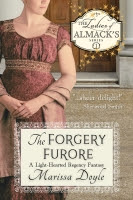



 Secrets and
Sensibilities was originally published by Kensington as a traditional
Regency romance. I’ve edited and rewritten parts since. Here was the first
cover (and title--A Dangerous Dalliance).
Secrets and
Sensibilities was originally published by Kensington as a traditional
Regency romance. I’ve edited and rewritten parts since. Here was the first
cover (and title--A Dangerous Dalliance).


