

Showing posts with label Lyme Regis. Show all posts

Friday, January 17, 2020

Nineteenth Century Heroines: Still No Bones About It


I originally posted this in November 2009, but I recently ran across a few more interesting facts and thought it a good time to update. And so, I give you anew, Mary Anning, fossil collector.

Mary was born in 1799 in Lyme Regis on the Dorset coast of England, not far from my spa town of Grace-by-the-Sea. Her father Richard was a cabinetmaker by trade, but he loved to spend his free time collecting fossils, and he took Mary and her older brother Joseph with him. The cliffs near Lyme Regis are riddled with remains from the Jurassic period—the area is now called the Jurassic Coast. But those cliffs are also legendary for landslides and sink holes. Mary spent her youth clambering over these dangerous cliffs and collecting “curiosities” that her father sold to tourists in front of his shop on Bridge Street. Jane Austen even visited. Here’s a sketch.

Sadly, Richard Anning died of consumption when Mary was only 11, and the family struggled to eke out a living by selling the fossils they found. That same year, Joseph uncovered a massive head of what he thought was a fossilized crocodile. Between tides and the weather, it was another year before the children could get back to it, and it was Mary who uncovered the entire skeleton: the first complete ichthyosaur!

Now, you’d think such a find would attract considerable attention, but Mary only earned £23 when she sold the fossil to the Lord of the Manor of Colway. He in turn exhibited it in William Bullock’s Museum of Natural History, and it wasn’t until 1814 that the Royal Society (the premiere scientific organization in England at the time) published a description in its Transactions (with little mention of Mary, thank you very much). The Annings were doing so poorly, in fact, that a professional fossil collector, Lieutenant-Colonel Birch, auctioned off his collection and donated the proceeds to them. The total amount raised was £400 (enough for a family of three to live on for a year or two). 

By the time Mary was in her twenties, she was the head of the family’s fossil collecting business. In 1824, she discovered the skeleton of a plesiosaurus. She sold it for over £100 to the Duke of Buckingham himself. That discovery put her on the map, so to speak, but many scientists were skeptical that Mary was the person making these spectacular finds. For one, she was a woman, and for another, she had only attended school a short period in her life. Yet when they came to talk to her, they could only scratch their heads at her vast knowledge of the creatures she was uncovering. One of her visitors credited her skills to divine providence. 

Even though Mary discovered a pterodactyl in 1828 and an even larger ichthyosaurus in 1832, it wasn’t until 1838 that the scientific community was willing to grant her any official standing. That year the British Association for the Advancement of Science awarded her an annuity. In 1846, she was made an honorary member of the Geological Society (honorary because women were not admitted until 1904). She died in March 1847 from breast cancer. Only after her death did the Royal Society acknowledge her, by donating a stained-glass window to her memory to the Parish Church at Lyme Regis.

It’s never easy being a nineteenth century heroine, no bones about it.

Friday, January 3, 2020

Spa Day!


I’ll say it right up front—I’m not a spa person, at least not today’s version of a typical spa. I don’t do facials; massages make me uncomfortable. But I would have loved visiting a Regency spa.

A number of cities during the early part of the nineteenth century in England had risen to the position of being considered a spa, either because of the opportunity to bathe in the sea or the opportunity to partake of mineral waters, or both. While the prominence of the city of Bath in Somerset waned as the century wore on, it was still one of the most popular. Bath had the benefit of having actual hot water baths, built in Roman times. It also boasted the Pump Room where you could drink the water and visit with friends. With assembly rooms just up the hill and parks for promenading on a sunny day, Bath would seem to have everything one could want in a spa.

Though Jane Austen is often associated with Bath, a family favorite was Lyme Regis in Dorset. The town along the seashore also had a fine set of assembly rooms and saltwater bathing. It also featured shops, tearooms, and bookstores. You can see why Jane liked it. 😊

Scarborough in Yorkshire had the best of both worlds, with saltwater bathing and mineral waters to drink. It also had a nearby castle being used as a barracks for soldiers. That red uniform can go to a girl’s head!

Other towns also made a play for the title of spa. Before he went mad, King George frequently took his family saltwater bathing at Weymouth in Dorset, and his son, Prince George, was inordinately fond of Brighton in Essex

Come back next Friday when I will tell you about one more special spa that I hope you’ll want to visit again and again, for I’m starting a new series set there!

Tuesday, September 15, 2015

Green and Pleasant Land, Part 5: Lyme Regis

We hated to leave Dartmoor. We really did. But I’d promised Daughter #2 some fossil-hunting on the beach in Lyme Regis. Those of you who are Jane Austen fans will recognize that name, I’m sure...so we once again set forth, this time for the shore.

Best pub name spotted en route: The Salty Monk. ☺

Lyme Regis itself is a charming little town, clinging closely to the shore. And I don’t use the term “clinging” lightly—there’s a heck of a drop from the main road through town to the beach itself. Blessedly, there’s plenty of visitor parking, though it did involve a very steep walk down to the shore—not bad on the way down, but uphill was definitely a challenge. Thank goodness for all those hours I’ve spent on the elliptical!

The climate of the immediate south coast of England is amazingly mild. We hardy New Englanders were astonished to see fuchsia grown as a hedge, rather than a summer-time potted plant doomed to death in the first good October frost!

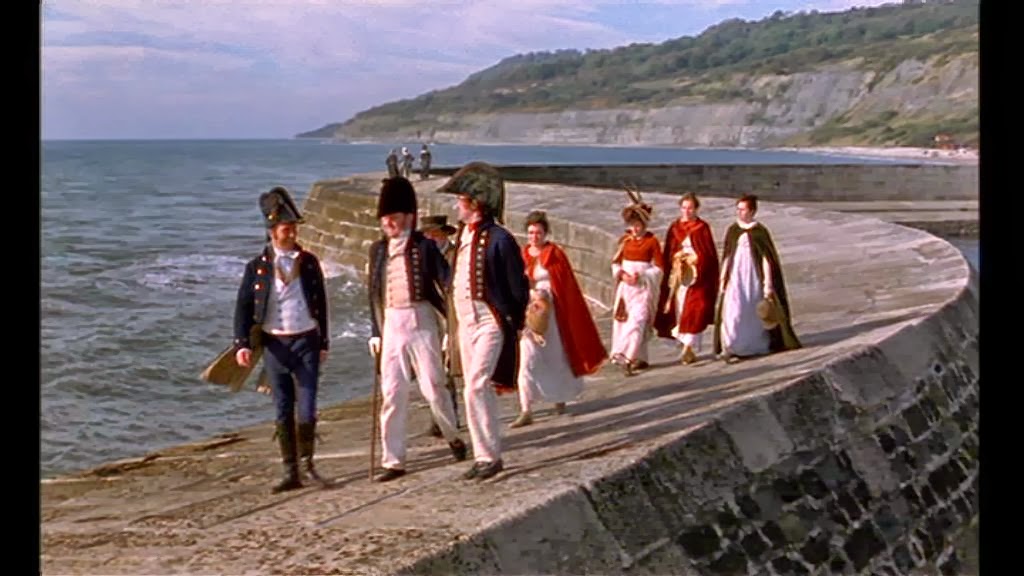
As we trundled down the hill, we were delighted with this view of the famous Cobb... famous, of course, as the location of an important scene in Persuasion—where Louisa Musgrove imprudently jumps the stairs leading down from its top. The Cobb is a partial breakwater, creating a small, protected harbor for the local fishing fleet—though now, the main denizens appear to be pleasure craft.

What I found interesting about the Cobb was the angle at which it was built: good for allowing breaking waves to run off, but a little unnerving to walk on, especially in a brisk breeze (that's Daughter #1, walking at an angle!) But even more interesting was the thought that Jane Austen knew this town and this very place—a bit of a shiver down the spine moment!

Being good Jane Austen fans, my son and husband and I spent a good long time debating which of the stairs leading down from the Cobb were the ones that Louisa jumped from. In the end, we decided it must be these (also known by the name "Granny's Teeth"!), as they were the most suitably archaic and untrustworthy looking (honestly, if I’d been Louisa, I might have preferred jumping rather than trying to negotiate them in a stiff breeze in a long skirt!

Next, it was time to go fossil hunting. This whole 95-mile section of the south coast is called England’s “Jurassic Coast”. Going east from Orcombe Point to Old Harry Rocks is like traveling in time, from the early Triassic period onward. Lyme Regis is located in the oldest part of the coast, its formations dating to 200 to 195 million years ago. Down the beach from the Cobb a great cliff face looms up, made of very crumbly black shale, the remains of an ancient ocean bed (you can see it in the pictures above of the Cobb.) And as gravity and the weather erode it, the fossils of creatures that died and left their remains in the oozy black mud of that old ocean end up on the beach, where they can be picked up from amongst the clitter of rocks and flints by geeky American tourists like us.

Here's part of our haul.
What you see here are ammonite fossils, distant and extinct relatives of today’s squid and nautiluses; the little star-shaped one is possibly an echinoid, a relative of today’s starfish and sea urchins. It was a lot of fun, actually, and reminded me of my long-ago days as an archaeology student doing field surface surveys. We had a lovely if late lunch at a pub close to the Cobb, then dragged ourselves back up the hill to our car, to go to our next destination. But I’ll be back to the Jurassic Coast some day.

Next installment: Not the Isle of Wight, sadly, but a few other sites of interest.

Friday, November 6, 2009

Nineteenth Century Heroines: No Bones About It

It has been suggested (twice QnPoohBear, cough, cough) that we talk about some real life heroines in the nineteenth century, young ladies who distinguished themselves in the sciences, arts, or other areas. I can think of no one finer to inaugurate this series than Mary Anning.

Mary was born in 1799 in Lyme Regis on the Dorset coast of England. Her father Richard was a cabinetmaker by trade, but he loved to spend his free time collecting fossils and he took Mary and her older brother Joseph with him. The cliffs near Lyme Regis are riddled with remains from the Jurassic period; they’re also legendary for landslides and sink holes. Mary spent her youth clambering over these dangerous cliffs and collecting “curiosities” that her father sold to tourists in front of his shop on Bridge Street. Jane Austen even visited.

Sadly, Richard Anning died of consumption when Mary was only 11, and the family struggled to eke out a living by selling the fossils they found. That same year, Joseph uncovered a massive head of what he thought was a fossilized crocodile. Between tides and the weather, it was another year before the children could get back to it, and it was Mary who uncovered the entire skeleton: the first complete ichthyosaur!

Now, you’d think such a find would attract considerable attention, but Mary only earned £23 when she sold the fossil to the Lord of the Manor of Colway. He in turn exhibited it in William Bullock’s Museum of Natural History, and it wasn’t until 1814 that the Royal Society (the premiere scientific organization in England at the time) published a description in its Transactions (with little mention of Mary, thank you very much). The Annings were doing so poorly, in fact, that a professional fossil collector, Lieutenant-Colonel Birch, auctioned off his collection and donated the proceeds to them. The total amount raised was £400 (enough for a family of three to live on for a year or two).

By the time Mary was in her twenties, she was the head of the family’s fossil collecting business. In 1824, she discovered the skeleton of a plesiosaurus. She sold it for over £100 to the Duke of Buckingham himself. That discovery put her on the map, so to speak, but many scientists were skeptical that Mary was the person making these spectacular finds. For one, she was a woman, and for another, she had only attended school a short period in her life. Yet when they came to talk to her, they could only scratch their heads at her vast knowledge of the creatures she was uncovering. One of her visitors credited her skills to divine providence.

Even though Mary discovered a pterodactyl in 1828 and an even larger ichthyosaurus in 1832, it wasn’t until 1838 that the scientific community was willing to grant her any official standing. That year the British Association for the Advancement of Science awarded her an annuity. In 1846, she was made an honorary member of the Geological Society (honorary because women were not admitted until 1904). She died in March 1847 from breast cancer. Only after her death did the Royal Society acknowledge her, by donating a stained-glass window to her memory to the Parish Church at Lyme Regis.

It’s never easy being a nineteenth century heroine.

Friday, August 7, 2009

Having a Ball at the Beach, Part 1: Lyme Regis

You’ve probably noticed the theme: ice cream, air conditioning, bathing. We are definitely in summer mode on NineteenTeen! And what could be better for summer than your very own faux-nineteenth century fan? Remember, every post in August is a chance to win. Just put in a comment, and you’ll be entered into a drawing for that day. Marissa will draw for Tuesdays, and I get to draw for Fridays.

Each year, thousands of Americans pack up and head for the beach for a summer vacation. That isn’t anything new. Beginning in the eighteenth century and continuing into the nineteenth, many English families took an annual trip to the seashore too. At first it was only the wealthy who went, but as the century wore on, even the middle class families picked up stakes in July or August and hurried off to folic on the shore.

But going to the seashore didn’t necessarily mean swimming. We’ve talked about how bathing in seawater was an activity more meant to improve your health than to cool off or show off your swimming suit. Some people actually enjoyed looking out at the grandeur of the sea. But most of them flocked to the seashore to continue that grand pastime of seeing other people and being seen by other people.

A favorite haunt of Jane Austen's was Lyme Regis on the western coast of England. She wrote in Persuasion, “A very strange stranger it must be, who does not see charms in the immediate environs of Lyme, to make him wish to know it better.” Jane knew what she was talking about. She visited Lyme Regis many times with her family in the early part of the century.

One of the most picturesque features of Lyme Regis is The Cobb, a huge, curving breakwater supposedly built in the 13th century from massive oak beams and boulders. It was possible to walk on part of it, but it was the daring young lady who tried. Part way along The Cobb is a steep staircase called Granny’s Teeth. One of Jane’s characters capered down those steps and fell to her death.

Lyme Regis featured a grand hall where Assembly Balls were held; a lovely seaside promenade called The Walk where you could, well, walk and show off your outfits; and shops, tea rooms, and bookstores where you could enjoy a good gossip. As a dear friend likes to say, “Wherever you go, there you are!”

So, what do you think? Are you a girl after Jane’s heart who would dare walk The Cobb and gaze at the wild sea? Or would you be found promenading to your heart’s content and gazing at the other people doing the same on a sunny day along the shore?