Showing posts with label France. Show all posts

Tuesday, March 7, 2023

Retro Blast: Queen Victoria Goes to Kokomo


I wish I were going somewhere warm where one can unironically drink things with slices of pineapple and little umbrellas stuck on top! It's the time of year when spring seems so close, but still so far...an opinion shared by Queen Victoria. Enjoy!

* * * * *

Well, not quite. But sort of. :)

I’m lucky enough to be looking forward to a visit to warmer climes in the near future—when you live in the chilly north, a few days spent in a place where it’s not necessary to wear heavy down coats is a Very Good Thing.

I’m not the only one to think so. Queen Victoria started taking an annual holiday somewhere in sunny southern Europe, usually for six or seven weeks from the beginning of March to mid-to-late April. Her first trip, in 1879, was shortly after the death of her daughter, Princess Alice; the Queen felt that she needed a complete change of scene, and decided it was high time she visited Italy, which she had never seen. She was lent a villa, Villa Clara, at Baveno, on Lake Maggiore, which though close to the Alps has a mild, Mediterranean climate year round.

The Queen was delighted with her decision. The scenery was gorgeous (though she invariably compared it to Scotland), so she spent a lot of time sketching and painting watercolors, went boating on the lake all the way up to its end in Switzerland, visited Milan to see the artwork (not a success as she was mobbed while visiting the cathedral). It whetted her appetite for more travels, and three years later, she went to the French Riviera, a trip that eventually became an annual event.

Her first visit there was to Menton, where she saw the Mediterranean for the first time. Once again she compared the scenery to Scotland, but as anything that reminded her of Scotland was definitely a good thing, it was high praise indeed. She was an indefatigable sightseer, taking little trips to Monte Carlo (though not to gamble) and other places, with her English coachman and Scottish servant, John Brown, in full Highland regalia (how the sight must have bemused the French!)…perhaps to visit a quaint nunnery, or a pottery factory, or to have a picnic in a secluded spot by the side of the road. In future years she stayed at Hyères, Grasse, and Cannes before finally settling on the Hotel Excelsior Regina (it added the “Regina” to its name with the Queen’s permission), in Cimiez, Nice. She always travelled “incognito” as the Countess of Balmoral, which of course fooled nobody but permitted her to avoid making visits of state—this was, after all, supposed to be a vacation. Family members descended on her for visits while on their own winter vacations, so that at times the poor Queen was quite exhausted from entertaining.

Her last visit was in 1899; the Boer War kept her home the following spring, which was her last before her death in January 1901. I’m sorry she had to miss that last year; she took great delight in her annual visits south, away from “the sunless north”. I know I’ll enjoy mine!

Tuesday, January 22, 2019

Not So Shabby Chic?


More fun with 19th century fashion prints. 😍

Although I mostly collect prints from Ackermann’s Repository and La Belle Assemblée, I have smaller collections of prints from other publications, including the Lady’s Magazine, the Ladies’ Monthly Museum, and the French Journal des Dames et des Modes, which was published in Paris between 1797 and 1839.  I especially love the prints from the 1830s from that last magazine—the fashion prints are wildly over the top: dresses with absolutely enormous bouffant sleeves and flowing skirts that seem to involve acres of fabric, often exuberantly printed, and millinery that would stop traffic...and they often include fun background props as well—like this particular print, from the August 5, 1833 edition (the magazine appeared every five days—!!)


Here is what I am guessing is an afternoon dress, something suitable for paying calls or shopping. The two ladies so animatedly chatting are wearing the same style; this tête-à-tête pose was often used to show the back and front of a dress. Here are the large gigot sleeves, full skirts, and large bonnets of the time, along with an elegant black lace scarf and pleated bodice.  But what grabbed my attention about this print was the furniture.

Check out the chair in the foreground: it’s a wooden armchair, covered with a fabric slipcover that’s right out of a “shabby chic” photo shoot! Maybe I’m just being silly, but for some reason this tickled me. To stay in keeping with the illustration, all I can say is, plus ça change, plus c'est la même chose...!*

*The more things change, the more they remain the same.

Friday, May 3, 2013

Nineteenth Century Heroines: Lighter Than Air

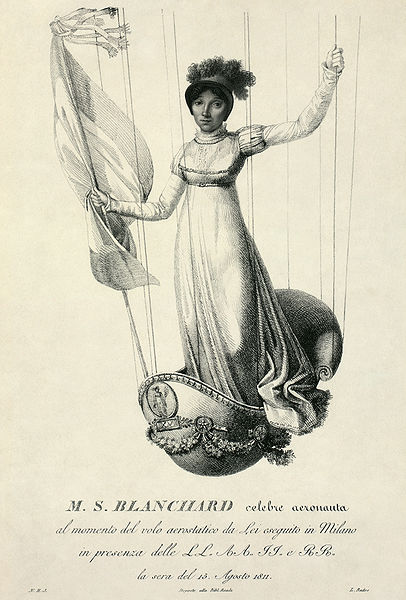
Some of you will remember a series I did a while ago at QNPoohBear's suggestion of real-life nineteenth century ladies who were inspiring enough to be heroines in a book.  We talked about Caroline Herschel’s stargazing, Ada Byron’s mathematical computing, and Mary Anning’s dinosaur hunting.  I recently stumbled upon another lady I simply had to add to the list:  the commander of Napoleon’s balloon army, Sophie Blanchard.

You wouldn’t think ballooning would be a career for a lady in the late eighteenth, early nineteenth century, much less leading a squadron of armed forces for a major power.  Sophie was one of a handful of women who ventured up in balloons, and one of the only ones skilled enough to go up alone.  Born in 1778 in France, Sophie was a nervous girl who disliked riding in carriages and startled at loud noises.  We don’t know a great deal about her early life, but somewhere between the ages of 16 and 26, she married one of the premiere balloonists of the day, Jean-Pierre Blanchard. 

Jean-Pierre was a showman who had already toured Europe and America, helped pioneer the parachute, and set records around the world.  Unfortunately, he hadn’t a lick of business sense and was always in debt.  In hopes of recovering, he added Sophie to his act, and the two were popular sights for coronations, royal birthdays, the opening of major buildings, and the like.  Sophie was undaunted by the dangers of balloon flight, claiming at one point that she’d rather sleep in a balloon than on land.  She flew high enough that she nearly passed out from lack of oxygen, she risked freezing at the cold temperatures aloft, and once she almost drown when her balloon landed in a swamp. 

She performed so many times for Napoleon, both with her husband and solo, that he made her the Aeronaut of Official Festivities.  Determined to reach England by any way possible, he also appointed her the Chief Air Minister of Ballooning and asked her to draw up plans for how he could fly his army over the Channel to attack.  Sophie is reported to have had little faith in the venture.  Balloons at that time had few ways to control them, and she recognized, even if Napoleon did not, that the wind generally blew the wrong way.

Tragedy struck the couple in 1809 when Jean-Pierre had a heart attack while performing and fell from his balloon to his death.  Sophie, however, continued to perform.  Despite the fact that she was afraid of loud noises, she perfected an act in which she lighted fireworks and tossed them by parachute from her balloon to the delighted crowds below.  Her vehicle of choice was a hydrogen-filled balloon with a tiny basket below.  She flew to celebrate the marriage of Napoleon to Marie-Louise of Austria in 1810 and on Napoleon’s 42nd birthday in 1811.  She flew over Paris and threw down leaflets proclaiming the birth of Napoleon’s son.  She also performed in Germany, Rome, and the Alps.

I wish I had a happy ending for you.  Unfortunately, it seems Sophie and Jean-Pierre had no children, or at least none that survived beyond infancy.  In July 1819, Sophie was performing at the Tivoli Gardens in Paris when her balloon caught fire and she too fell to her death, entangled in the cords of her basket.  All proceeds from the event were used to build her a monument in a Paris cemetery. 

But Sophie wasn’t forgotten.  Jules Vernes mentioned her in Five Weeks in a Balloon, proving that, nearly 50 years after her death, her amazing accomplishments lived on.

Tuesday, February 5, 2013

Queen Victoria Goes to Kokomo

Well, not quite. But sort of. :)

I’m lucky enough to be looking forward to a visit to warmer climes in the near future—when you live in the chilly north, a few days spent in a place where it’s not necessary to wear heavy down coats is a Very Good Thing.

I’m not the only one to think so. Queen Victoria started taking an annual holiday somewhere in sunny southern Europe, usually for six or seven weeks from the beginning of March to mid-to-late April. Her first trip, in 1879, was shortly after the death of her daughter, Princess Alice; the Queen felt that she needed a complete change of scene, and decided it was high time she visited Italy, which she had never seen. She was lent a villa, Villa Clara, at Baveno, on Lake Maggiore, which though close to the Alps has a mild, Mediterranean climate year round.

The Queen was delighted with her decision. The scenery was gorgeous (though she invariably compared it to Scotland), so she spent a lot of time sketching and painting watercolors, went boating on the lake all the way up to its end in Switzerland, visited Milan to see the artwork (not a success as she was mobbed while visiting the cathedral). It whetted her appetite for more travels, and three years later, she went to the French Riviera, a trip that eventually became an annual event.

Her first visit there was to Menton, where she saw the Mediterranean for the first time. Once again she compared the scenery to Scotland, but as anything that reminded her of Scotland was definitely a good thing, it was high praise indeed. She was an indefatigable sightseer, taking little trips to Monte Carlo (though not to gamble) and other places, with her English coachman and Scottish servant, John Brown, in full Highland regalia (how the sight must have bemused the French!)…perhaps to visit a quaint nunnery, or a pottery factory, or to have a picnic in a secluded spot by the side of the road. In future years she stayed at Hyères, Grasse, and Cannes before finally settling on the Hotel Excelsior Regina (it added the “Regina” to its name with the Queen’s permission), in Cimiez, Nice. She always travelled “incognito” as the Countess of Balmoral, which of course fooled nobody but permitted her to avoid making visits of state—this was, after all, supposed to be a vacation. Family members descended on her for visits while on their own winter vacations, so that at times the poor Queen was quite exhausted from entertaining.

Her last visit was in 1899; the Boer War kept her home the following spring, which was her last before her death in January 1901. I’m sorry she had to miss that last year; she took great delight in her annual visits south, away from “the sunless north”. I know I’ll enjoy mine!