

Showing posts with label Jean-Pierre Blanchard. Show all posts

Tuesday, July 11, 2023

The Ups and Downs of Ballooning

Balloon ascensions were an exciting part of the nineteenth century. Some daring individual would set up a balloon in a public space like Hyde Park, and crowds would gather to watch the intrepid adventurer take off and ascend into the skies. In most cases, the balloon would fly a short distance and come down in some field. In a few cases, the event was an attempt to set a record. For example, in 1785, Jean-Pierre Blanchard and John Jeffries left Dover in the first successful attempt to cross the Channel by balloon.

But sometimes, things did not go as planned.

I discovered the following 1895 graphic not too long ago. It was originally an uncut set of 10 cards showing the early history of ballooning. As you can see, the emphasis appears to be on disasters!

Starting from top left, we have Joseph Louis Gay-Lussac and Jean-Baptise Biot, who ascended to 4,000 meters to conduct scientific experiments on gas. They lived. So did the second fellow, André-Jacques Garnerin, who, despite the illustration, made the first successful parachute jump from a balloon in 1797. He owed much to the third fellow, Louis-Sebastien Lenormand, who had conceived the idea of a parachute and jumped from a building with his umbrella-like contraption in 1783.

The fourth card on the top row has ideas for every steampunk author! These are purportedly utopian dreams of flight from the “last century.” Some very interesting flights of fancy! Next to it we have Commander Jean-Marie Coutelle at the Siege of Mainz in 1795, where he used a balloon for reconnaissance (and seems to have earned the wrath of the enemy in the process!).

The first card on the bottom row is a balloon commemorating Napoleon’s achievements. Interesting that he is still revered nearly 80 years after his ultimate defeat. I was both delighted and saddened to see my beloved Sophie Blanchard featured on the next card. Of course the artist had to include the queen of aeronauts. But perhaps they might have shown something besides her fiery death!

Next to her is Count Franceso Zambeccari, who flew the first unoccupied balloon in England in 1783, but instead of commemorating that achievement, the artist decided to cover his crash in the Adriatic in 1804. A number of balloons took off from the Vauxhall Pleasure Gardens, but the artist chose to depict the one from which Thomas Harris fell in 1824. Finally, we have the rescue of Francois Arban by Italian fishers in 1846, after he too had crashed into the Adriatic Sea.

Doesn’t exactly make you want to jump into the next balloon, doesn’t it?

Friday, May 3, 2013

Nineteenth Century Heroines: Lighter Than Air

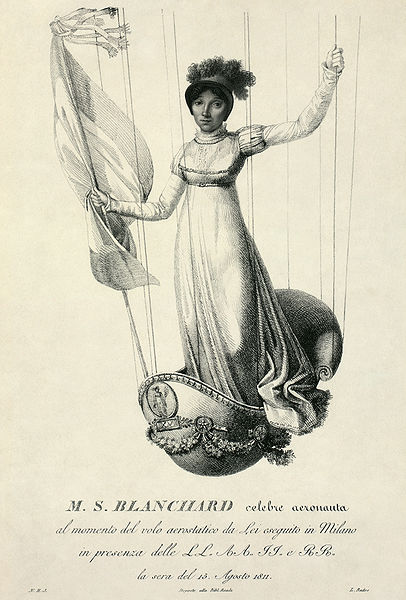
Some of you will remember a series I did a while ago at QNPoohBear's suggestion of real-life nineteenth century ladies who were inspiring enough to be heroines in a book.  We talked about Caroline Herschel’s stargazing, Ada Byron’s mathematical computing, and Mary Anning’s dinosaur hunting.  I recently stumbled upon another lady I simply had to add to the list:  the commander of Napoleon’s balloon army, Sophie Blanchard.

You wouldn’t think ballooning would be a career for a lady in the late eighteenth, early nineteenth century, much less leading a squadron of armed forces for a major power.  Sophie was one of a handful of women who ventured up in balloons, and one of the only ones skilled enough to go up alone.  Born in 1778 in France, Sophie was a nervous girl who disliked riding in carriages and startled at loud noises.  We don’t know a great deal about her early life, but somewhere between the ages of 16 and 26, she married one of the premiere balloonists of the day, Jean-Pierre Blanchard. 

Jean-Pierre was a showman who had already toured Europe and America, helped pioneer the parachute, and set records around the world.  Unfortunately, he hadn’t a lick of business sense and was always in debt.  In hopes of recovering, he added Sophie to his act, and the two were popular sights for coronations, royal birthdays, the opening of major buildings, and the like.  Sophie was undaunted by the dangers of balloon flight, claiming at one point that she’d rather sleep in a balloon than on land.  She flew high enough that she nearly passed out from lack of oxygen, she risked freezing at the cold temperatures aloft, and once she almost drown when her balloon landed in a swamp. 

She performed so many times for Napoleon, both with her husband and solo, that he made her the Aeronaut of Official Festivities.  Determined to reach England by any way possible, he also appointed her the Chief Air Minister of Ballooning and asked her to draw up plans for how he could fly his army over the Channel to attack.  Sophie is reported to have had little faith in the venture.  Balloons at that time had few ways to control them, and she recognized, even if Napoleon did not, that the wind generally blew the wrong way.

Tragedy struck the couple in 1809 when Jean-Pierre had a heart attack while performing and fell from his balloon to his death.  Sophie, however, continued to perform.  Despite the fact that she was afraid of loud noises, she perfected an act in which she lighted fireworks and tossed them by parachute from her balloon to the delighted crowds below.  Her vehicle of choice was a hydrogen-filled balloon with a tiny basket below.  She flew to celebrate the marriage of Napoleon to Marie-Louise of Austria in 1810 and on Napoleon’s 42nd birthday in 1811.  She flew over Paris and threw down leaflets proclaiming the birth of Napoleon’s son.  She also performed in Germany, Rome, and the Alps.

I wish I had a happy ending for you.  Unfortunately, it seems Sophie and Jean-Pierre had no children, or at least none that survived beyond infancy.  In July 1819, Sophie was performing at the Tivoli Gardens in Paris when her balloon caught fire and she too fell to her death, entangled in the cords of her basket.  All proceeds from the event were used to build her a monument in a Paris cemetery. 

But Sophie wasn’t forgotten.  Jules Vernes mentioned her in Five Weeks in a Balloon, proving that, nearly 50 years after her death, her amazing accomplishments lived on.