

Showing posts with label Pacific Northwest history. Show all posts

Tuesday, April 11, 2023

Nineteenth Century Heroines: Making Sure the Ayes Have It

I am always on the lookout for nineteenth century history near me, which can sometimes be challenging in the Pacific Northwest, especially in the wilds where I live. That’s why discovering a house on the National Register of Historic Places less than two miles away was such a thrill, as was learning about the lady behind it.

Washington State had a rocky road to confirming the right of women to vote. Seattle founding father Arthur Denny tried to convince the territorial legislature in 1854, but the measure lost by a narrow margin. The lawmakers rallied, however, and passed another measure some years later, only to have a territorial court shoot it down! Because “woman’s suffrage” was not specifically included in the title of the law, the court reasoned, the male legislators might not have realized what they were approving. Undaunted, they changed the title and passed the measure again. Women voted in Washington Territory beginning in 1883. Unfortunately, another legal challenge upended the law, and fears that the federal government would find women voting so offensive it would never give the territory statehood kept the idea out of the state constitution in 1889. By the turn of the twentieth century, suffragists in Washington State were entirely disheartened.

Enter Emma Smith DeVoe. Born in Roseville, Illinois, in 1848, she had supported woman’s suffrage since the day she heard Susan B. Anthony speak. She was only eight at the time. Since then, she’d campaigned for women’s rights in Dakota Territory (although women couldn’t vote there until 1918), Idaho Territory (where she helped win the right in 1896), and Oregon State (where the first measure lost, with women winning the vote in 1912). She had also helped with campaigns in another 25 territories and states. When she moved to Tacoma with her husband in 1905, she promptly set to work on campaigning in Washington.

There were, apparently, several philosophies among the suffragists. One group held that large rallies and sit-ins were the order of the day. Others, notably in England, went so far as to smash windows on abandoned buildings to draw attention to their cause. The ladylike Emma was certain there was a more effective way. By being good-natured and cheerful, women might persuade their male counterparts one-on-one. Her goal was to have women ask every voter in the state to support the suffrage movement. She also sent out postcards and put up posters. She even published a cook book, with Votes for Women on the back cover. When the National American Woman Suffrage Association met in Seattle in 1909, she organized a “Suffrage Special” train, with notable ladies giving speeches from the rear platform at stops along the way. That same year, Seattle hosted the Alaska-Yukon-Pacific Exposition, and she set up a Suffrage Day. That was when a group of suffragists climbed Mt. Rainier to raise awareness of the cause.

In 1910, the all-male Washington State legislature voted by nearly two-thirds to extend the vote to women, 10 years before the nation would follow suit. Emma had a little something to do with that too. For her work in the state as well as at the national level, she was inducted into the National Women’s Hall of Fame in 2000. She died in 1927, at the age of 79, in her lovely home near me.

And if you’d like to read about a fictional Washington State pioneer, you might want to grab an ebook copy of The Perfect Mail-Order Bride, on sale for the first time this week for only 99 cents.

When a beautiful mail-order bride jilts her groom on the way to meet him, her plainer sister Ada Williamson decides to continue the journey and tell him the truth. Yet one look at Thomas “Scout” Rankin, and the truth never comes out. Thomas can buy anything he wants, including the perfect mail-order bride. But past betrayals left him wary, so he notices Ada is not what she claims. When a stranger tries to take advantage of Ada’s secret, and his, can they discover the truth, about their enemy, about their pasts, and about the love they both yearn to share?

Reading is My Superpower called it “swoony, sweet, and full of heart.” 

Available

Directly from me 

Smashwords 

Amazon (affiliate link)

Barnes and Noble 

Apple Books 

Kobo  

Friday, August 31, 2018

Where Art and Water Collide: Historic La Conner


As I mentioned in my last blog post, I ran away earlier this week with my husband to celebrate our 30th wedding anniversary. We had planned to visit Victoria, British Columbia, but fate conspired to deny my husband the necessary paperwork to cross the border. So I Googled “Romantic getaways near Seattle.” And one of the places that came up was La Conner, specially, the Wild Iris Inn.

Now, I was familiar with La Conner as the home, with Mt. Vernon, of the legendary Tulip Festival each spring. But what I didn’t know was that the town is steeped in local history, from the heritage of the Swinomish Tribe across the channel to the early days of Washington State.

John Conner (no, not that one—no mention of Sarah) purchased the trading post in 1869 and opened a post office. The town had originally been named Swinomish for the Tribe, but John renamed it to honor his wife, Louisa A. Conner. Many of the homes and businesses in the town still show their frontier roots and are listed on the National Historic Register.


Even the toiletries at our inn has an appropriate vintage.


In its heyday, La Conner boasted more than 1,000 residents, the first courthouse north of Seattle and exceptionally fine farmland, the produce from which was sent throughout the region and shipped far south. The proximity to a waterway that runs from the San Juan Islands down into more central Puget Sound also made the town an ideal fishing spot. My husband and I noticed a number of crabbers setting out with their pots while we strolled the lovely boardwalk along the waterfront on our trip, with views across the water to Tribal lands.


Also prominent is the Rainbow Bridge, which connects La Conner with Fidalgo Island and points west.


Beginning in the 1940s, La Conner became known for something else besides abundant crops and scenic waterways: art. That tradition still stands today, with many galleries sprinkled along the boardwalk and throughout the town. La Conner is also home to the Northwest Art Museum and one of the only Quilt Museums on the West Coast. Even the pilings along the waterfront were appropriately artistic.


And speaking of art, allow me to share a piece I was given this week: the cover for the Timeless Regency collection Christmas novella. Yuletide Regency is now available for preorder. I’m honored to have one of my Fortune’s Brides stories included. This one tells the story of how Meredith and Julian fell in love, all over a very nostalgic Christmas. Look for more details when the book is released in early November.

Friday, November 3, 2017

North to ... Omineca?

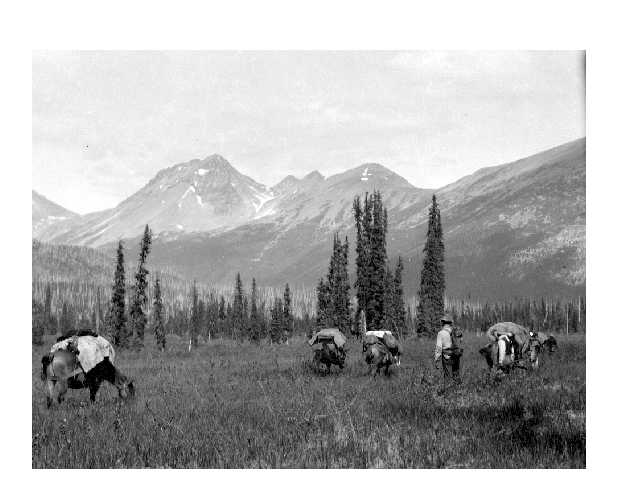
File:Swannell's pack train at the Omineca Mountains.gifWhile my heart will ever belong to early nineteenth century England, I’ve had a lot of fun the last few years delving into nineteenth century history closer to home. Those of you who have followed the Frontier Bachelors series will remember Levi, the youngest fellow in the Wallin clan, and his penchant for getting into trouble. It will come as no surprise that, once he reached manhood, he chafed under family rules and headed out to seek his fortune. Alas, the timeline of the story precluded him from being a 49er (he was born in 1849) or rushing to the Klondike (he would be 47 in 1896). Instead, I had to find another location that would have drawn him for (what he thinks are) easy riches.

I decided upon Omineca.

If you haven’t heard of it, don’t feel bad. (In fact, I can think of one of our loyal readers who might recognize the name. We’ll see if she comments.) The area is in the mountains of a quiet little corner of British Columbia, and the strike was kept relatively quiet compared to other gold rushes. But the location and timing made it possible for Levi to both hear of it and reach it from frontier Seattle.

In 1869, the Peace River Prospecting Party, organized with funding from the colonial government and local businessmen, discovered gold in a bubbling creek in the area. They named the spot Vital Creek after one of the party leaders, Vital LaForce, and vowed to return without alerting any rivals. Unfortunately, between their rush to return to the site in the dead of winter, when most prospectors headed into town, and LaForce’s lavish spending, word leaked out, and papers in towns nearest the strike urged everyone to drop what they were doing and go strike it rich.

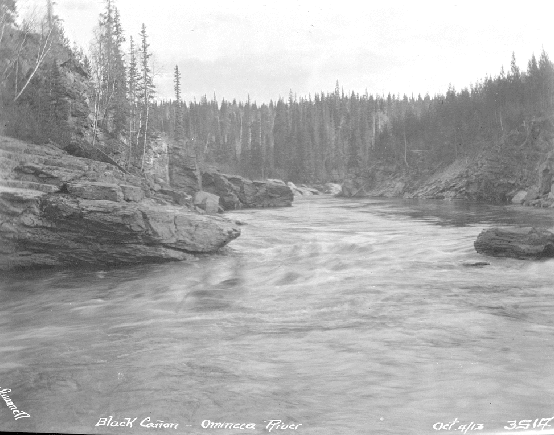
File:Omineca River.gifSoon about 250 people had claims in the area. The colonial government improved roads, laid more rail track to get closer. As the town swelled to 400, industrious types built a bakery, salon, and coffee house. One of these was Twelve-Foot Davis, a legend of a man, who gained his nickname from finding gold on no more than 12 feet of riverbank.

The introduction of sluice boxes increased the daily yield of gold, until nearly everyone was doing rather well. Estimates put peak population at 1,200, and peak gold earnings at $400,000 a year (and I wasn’t clear if that was in today’s dollars or at the time).

Gold continued to be discovered at various creeks and tributaries in the area, and the miners moved on. By the late-1870s, only a handful remained. Even though mining continues to this day, the town of Vital Creek decayed until there was nothing left.

Levi left before then, for he heard another call. More on that in His Frontier Christmas Family, which is available now for preorder and releases December 5.