

Showing posts with label servants. Show all posts

Tuesday, May 31, 2016

1810, What a Year It Was Part 3: The Duke and the Valet


True crime fans, take note. This post is for you...and is probably the strangest of the events of 1810 we’ll be looking at. Ready?

George III’s fifth son Ernest, Duke of Cumberland, was one of the least popular of the king’s unpopular sons. Unlike most of his brothers who were on the plump side, Ernest took after his mother and was rail-thin; a saber cut down one side of his face, received when he fought the French in Holland at the Battle of Tournai, gave him a rather sinister appearance despite his handsome features. And unlike all his brothers, he was an avowed Tory and never dabbled in Whiggism or any liberal causes, being particularly opposed to Catholic Emancipation. He had an unpleasant reputation from his Army days as being a savage disciplinarian, and rumors about his personal life were rife.

But those rumors were nothing compared to the gossip that ricocheted around London after the wee hours of May 31, 1810--206 years ago this very day.

According to the Duke, he went to bed around one a.m. in his apartments at St. James Palace after attending a concert earlier in the evening. He stated that he was awakened by two blows to his head, then quickly received four other blows and a saber cut to his thigh as he tried to flee to the room of one of his valets, Neale, calling out that he had been murdered. Though a small lamp burned in his room, he said he saw no one.  The valet dashed to his master’s defense, waving a poker about, until he tripped over a sword—the Duke’s own, covered with a considerable amount of blood. While Neale tended to his master, the Duke requested that his other valet, Joseph Sellis, a native of Corsica, be summoned as well. When the servants went to Sellis’s room, they found the door was locked. After various backing and forthing involving doors that should have been locked but weren’t, Sellis’s room was finally gained—and Sellis himself found with his throat slit by a razor. There was no sign of a struggle.

Ew.

So what had actually happened?


The jury called to hear the incident's inquest found, on weighing the extensive testimony and physical evidence, that Sellis had attacked his master and then committed suicide. Based on the accounts given by all the servants, that was probably what happened, though we’ll never know what inspired the attack.

But public opinion whispered otherwise—remember how disliked the Duke was? It was rumored that the Duke had seduced Sellis’s wife, and murdered Sellis when the valet threatened to go public with his knowledge, then arranged matters to look as though he had been attacked instead. Other rumors postulated an affair between the Duke and Sellis, and that the Duke had murdered him when he threatened blackmail, while others favored the theory that Sellis had discovered an affair between the Duke and his other valet, and was murdered by the Duke in order to keep the affair secret. Some who accepted that Sellis had indeed attempted to murder his master suggested that he had done so in revenge for the Duke’s seduction of his wife. Others guessed that he was tired of the Duke’s constant stream of anti-Catholic jokes and mockery (Sellis was Catholic) and had simply had enough.

The Duke survived, though it took months for him to recover (his brain could actually be seen through one of the wounds in his head, and his thumb had nearly been severed by the sabre.) His reputation, however, never recovered, and he would go on to be accused of even worse things, such as being the father of his own sister’s illegitimate child and of scheming to bring about the death of his niece Victoria, who until she had children was all that stood between the Duke and the crown.

Makes the royal scandals of today look pretty tame, doesn’t it?

(Image "SELLIS/ The Italian Assassin Attempting to Murder H.R.H. The Duke of Cumberland" by George Cruikshank, from the Rosenbach Collection of the Free Library of Philadelphia)


Tuesday, June 10, 2014

The Queen’s Indian Servants, Part 1


First, a little background.

When you think about it, being Queen Victoria was probably a rather lonely prospect. She had been raised to be very aware of who she was—basically, the very top of a large pyramid. No one was her equal, especially after Prince Albert died (“There is no one to call me Victoria now,” she said on his death.) She just didn’t have any BFFs, especially as she grew older, because how can you be BFF with someone who rules substantial portions of the planet? Her children were afraid of her even though they loved her; her half-sister, though also dearly loved, was scarcely in a position to be her chum. She was almost never alone, surrounded by ladies-in-waiting and equerries and other courtiers almost constantly...but while their relationships with her could be affectionate, there was always that certain something that kept them at arms’ length—not only on the Queen’s part, but on theirs.

One exception to this was the Queen’s “Highland Servant”, John Brown. He somehow managed to remain unimpressed by her position, called her “woman” to her face, and seems to have cared deeply for her in his peculiar, brusque way. Interestingly, all those ladies-in-waiting and equerries and her family all seem to have loathed John Brown, just because of the special place he held as her favorite servant and friend. When Brown died in 1883, the Queen was nearly as devastated as she had been after Albert’s death: she had lost her only friend. The fact that she was buried with mementoes not only of Albert, but also of John Brown, says a great deal about the depth of her feelings.

In 1877, Queen Victoria adopted the title “Empress of India.” She was fascinated by India, and in 1886, after attending the Colonial and Indian Exhibition, decided that she wanted to employ some Indian servants in her household in time for her Golden Jubilee coming up the following year. She asked the man in charge of one of the exhibits, a John Tyler, superintendant of the Central Jail in Agra, to recruit her two servants. As a result, in June 1887, Mohammed Abdul Karim and Mohammed Buksh, the former employed by Tyler as a clerk at the jail and the latter a servant of Major-General Thomas Dennehy who was joining the royal household, came into the Queen’s Service. Though she didn’t yet know it, the Queen had found a new friend...and her family and household found someone to hate as much as they had John Brown.

To be continued...

Tuesday, October 9, 2012

Mom, Sort of

If you were a member of the aristocratic or gentry classes in the 19th century, it was almost a given you’d have two (or more) mothers: the woman who gave birth to you, and the one (or ones) who actually took care of you. She might be called nanny, nurse, or something else…but she was the one who bandaged cut fingers, gave baths, toilet-trained, administered discipline and hugs as needed, and all the other bits of day-to-day child-rearing that have to be done. Indeed, outsourcing motherhood might sometimes happen as soon as a child was born. Just as today, not all mothers chose or were able to nurse their infants; baby formula would not be invented until the 20th century, and so a wet-nurse would be found to provide nourishment. Though her mother and daughters all chose to nurse their offspring, Queen Victoria preferred to find someone else to do the same for her large family, generally the wife of a tenant on one of her estates who had an infant of her own and could provide for two (or be willing to outsource her own infant’s care). Prince Albert wrote up strict protocols and procedures for the royal wet-nurses to follow, including rules for their diet, behavior, clothing, and more.

So what did a nanny do? Well, everything: she was, quite literally, the mother, and even children’s actual mothers might follow her dictates on the assumption that a professional nanny must know what was best. Nannies ordered meals for their children, set schedules for meals, naps, playtime, and airings, and with the help of nursery-maids (younger assistants who hoped to achieve nanny status themselves some day) ran the nursery.

Children generally stayed under the exclusive care of a nurse/nanny until about age five or six. In addition to taking care of their bodily needs, a nanny was also responsible for the next level of parenting duties: instilling basic manners and morals in their charges. Most also taught their charges their letters and numbers. At about this time, a governess or tutor would step in, and while the nanny continued to be caretaker, much of a child’s time would now be spent with the governess. At some point between the ages of 8 and 11, a boy would probably be sent off to boarding school, while his sisters would remain under the governess’s rule with perhaps a year or two of school to be ‘finished’.

Salaries for nannies varied, depending on the number of children and the grandness of the household; a nanny in a very exalted household might find herself with a staff of nursery maids, laundry maids, and a nursery footman or two to supervise. Or she might be the sole employee in charge of the children. As room and board were obviously provided, a careful nanny could save much of her salary…which might be necessary, as we shall see. The Complete Servant (published 1825) lists salaries for head nurses at £18-25 guineas, with “perquisites” (tips) at christenings.

What happened to a nanny when “her” children left the nursery? It depended; the younger ones would move on to another position with a new family, perhaps to come back some day and care for the children of their own former babies. Word of mouth was important, and a nanny known to be good would be snapped up fairly promptly. In the 1880s and onward, formal training schools for nurses and nannies opened in London, along with nanny employment bureaus which went on to supply nannies to aristocratic and royal houses across Europe, as the fame of the English nanny spread.

Some employers were generous to their former nannies and provided a pension or even offered a home to beloved former nannies who had reached retirement age; others were forced to fall back on what savings they’d accrued over their careers and live in not-so-genteel poverty.

Tuesday, June 12, 2012

They're Everywhere!

In fiction about the 19th century, you see them everywhere: they’re carrying tea trays, opening doors, serving dinner, or wandering about decoratively at balls wearing powdered wigs and knee-breeches with silk stockings. I’m referring, of course, to footmen.

Footmen were the main type of indoor male servant: any household with any pretension to gentility kept at least one footman. Do you remember, in Pride and Prejudice, how Lady Catherine de Bourgh is surprised to hear that Lizzie’s uncle keeps a manservant? A footman cost much more to maintain than a maid, though many of their duties could and did overlap: a footman earned more, and was generally supplied with a few different uniforms (called ‘livery’) for different occasions, which could be expensive.

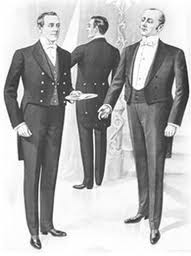
So what did a footman do? His duties might vary from household to household, according to The Complete Servant, first published in 1825, but the basic ones were listed as the cleaning of knives, shoes, plate (silver), lamps, and furniture; the laying and replenishing of fires, answering the door, going on errands, waiting at table, and answering the parlor bell. A footman rose early to get a head-start on these duties, because he would be expected to set the table for, and serve breakfast for his employers. After tidying up the breakfast parlor, he might be sent out to deliver notes and invitations, then be back to finish any tasks he hadn’t already, and then perhaps be ready to accompany the lady of the family while she paid calls—it was the footman’s job to do the actual delivery of calling cards—or accompany her while shopping to carry parcels and open doors. Here’s a delicious bit from The Complete Servant: “In going out with the carriage, the footman should be dressed in his best livery, his shoes and stockings being very clean, and his hat, great coat, &c. being very well brushed; nothing being so disgraceful as a slovenly exterior. He should be ready at receiving directions at the carriage door, and accurate in delivering them to the coachman, and though he may indicate the importance of his family by his style of knocking at a door, he ought to have some regard to the nerves of the family and the peace of the neighborhood.” Hmm—I wonder if they sometimes got a little carried away?

Then there would be setting the table for dinner and serving it under the butler’s watchful eye, sneaking down to the parlor while the family dined to make sure the fire was replenished, the lamps lit, and the sofa cushions plumped up. He helped the butler clean and put away any plate that was used at the meal, carried up the evening tea-tray (customary earlier in the century), made sure candlesticks were ready when family members were ready to retire up to bed.


Because they occupied such a public place in the household, good looks were definitely an asset to a footman, especially height—everyone wanted footmen who were at least six feet in height, because they looked so imposing when in dress livery—and a fine calf to the leg (ditto the dress livery, which usually included knee-breeches and silk stockings). In fact, ads in 19th century papers from footmen looking for positions generally included their height, so that potential employers could “match” them to existing staff members!

A footman’s career tended to be a short one, relatively speaking, as they often moved on: an ambitious footman might aspire to an underbutler’s or butler’s position some day, or perhaps to a valet’s. Or if he decided not to remain in service, he might open an inn or tavern. The heyday of the footman ended with the first world war, when most of them enlisted; it was a traumatic moment for some old-fashioned aristocrats to have maids serving at table rather than the imposing, liveried footmen they were used to.

Tuesday, November 1, 2011

The Butler Did It

This is another in our occasional series on servants young ladies of the upper classes would have encountered in the 19th century. We have already discussed ladies’ maids here and governesses here and here.

So what did the butler do?

Perhaps a better question might be, what didn’t the butler do?

In a 19th century household, the butler was often the chief of staff. In extremely grand and important families, especially where several houses were owned, there might be a house steward or comptroller whose job it was to supervise all household staff including hiring and firing and take care of all household accounting. But in an average wealthy or upper middle class household, the chief servant was probably the butler.

Looking back in history, the butler’s job revolved around the keeping of the household’s beverage supply and dishware, and in the 19th century, these would still be among his jobs. It was up to the butler to maintain the household wine cellars (including beer, ale, and other spirits, as well as the wine) and choose and serve wines for the family table…no small job, when you think about the quantities and sheer number of different wines that were served at meals as well as the fact that wine was purchased by the barrel or pipe and had to be decanted into bottles and properly recorded and stored in the correct part of the cellar for its type. Some butlers might actually be brewmasters as well, and brew the household’s beer, ale, or cider. Needless to say, alcoholism was considered to be an occupational hazard of butlery! The butler also oversaw the household plate: it was his job to keep any silver (or gold!) gleaming when in use, and safely stored under lock and key when it wasn’t.

The duties of a butler, as laid out in the fascinating book The Complete Servant, published in 1825 by Samuel and Sarah Adams, a married butler and housekeeper, were quite specific: he aided in the setting of tables, supervising the under-butler and footmen in laying out dishes and utensils, and remained in the dining room during meals with footman or two or three to assist in serving food and wine, direct clearing of the table between courses, and assist in any way needed. He also would bring tea trays in at tea time and hand round cups…and it was his job to make sure there were sufficient candles in each room where needed.

But the butler was also, as the Adamses state, “supposed….to represent his master”, which meant he also might be occupied in hiring and firing lower servants, keeping accounts and paying household bills apart from those which fell under the housekeeper’s purview, and generally keeping the household in order in addition to his wine and serving duties. Supervision of all male indoor servants (under-butlers, footmen, “boys”, and porters) was generally up to the butler, if the household did not have a comptroller. He was where the buck stopped; a good butler who could keep a household running smoothly would be treasured by his employers, and be more or less assured of a job for life, with a good pension when he retired. Butlers often rose through the ranks to achieve their positions: they started out at an early age "in service" first as boot boys or pages, then progressed to footman, then first footman or under-butler, where, if they wanted to, they could train specifically in a butler's duties.

Because of his responsible position, a butler could earn as much as ₤50-80 per year, according to The Complete Servant—not a bad salary in 1825. Just as ladies’ maids could supplement their salaries with the cast-off clothing of their mistresses, butlers could supplement theirs by selling candle ends (Yes, really! Beeswax candles were very expensive)…and a great many must have received nice tips from the wine-merchants and other tradesmen they dealt with.

So that's what the butler did.

***************************************
One thing the butler didn't do was draw a winner for a signed copy of Jennifer Bradbury's Wrapped from among last week's commenters...instead, that happy duty falls to me. And the winner is...Lynn Lovegreen! Lynn, please send me your mailing address via the contact form on my website so we can get your book sent out to you.

Friday, September 9, 2011

It Takes an Army to Manage a House Party

I seem to be bumping into servants a lot lately, at least in my entertainment choices. I finally had a chance to see a bit of Downton Abbey, which a number of friends had raved about (do not get me started on why we don’t have BBC America in my neck of the woods!). This series follows the lives of the servants assigned to a great house in the early part of the twentieth century. I also just finished reading Deeanne Gist’s Maid to Match, which stars a young lady hoping to be lady’s maid to one of the Vanderbilts in the late nineteenth century. One thing that really struck me from both of these well-researched stories is that I frequently underestimate how many servants were required for a house of any size. So, of course I went looking for more information. One estimate is that a wealthy family needed at least four servants per person. In other words, it took an army!

What would that look like if Marissa and I were living in a London townhouse together? (Never mind that we have families—we’ll pretend they are busy elsewhere for a week.) Going by the estimate above, two lovely ladies would need at least eight servants:

  1. I’d need a lady’s maid to help dress and undress, but I’d be willing to share her with Marissa. :-)

  2. We’d need a groom to tend our horses and escort us while riding. I’m tempted to include a coachman, but I don’t wish the neighbors to think us too high in the instep and I must admit to a fondness for handling the reins myself when we’re tooling about Hyde Park. Plus we can hire a carriage and driver when we need to go out to balls and such.

  3. We have a townhouse, so no need for a groundskeeper, but we better have a man-of-all-work to keep up the back garden and maintain the house.

  4. We’ll need a cook, of course,

  5. And probably a scullery maid to help her.

  6. We should probably have a footman to fetch and carry and look suitably impressive when we go out shopping,

  7. And a maid to help clean up behind us.

  8. Then of course we’d need a butler or housekeeper to keep things running smoothly.

I’m a bit amazed how easy it was to hit eight. And truthfully, one housemaid probably isn’t enough when you consider the dusting and cleaning that all had to be done by hand in homes where coal or wood was burned. And I haven’t added a laundress to clean our clothes or a personal secretary to help us with our writing (though in some cases the latter was considered an employee instead of a servant). And just think what would need to be added if we had a house in the country: definitely a coachman and gardeners, more grooms, more footmen, more maids (upstairs maids, downstairs maids, scullery maids), and a land steward, at a minimum!

And, my dears, Marissa and I will have need of all those servants, because next week, we’re hosting a house party, right here, to celebrate our blog birthday! So have your maids pack your things, hire a post-chaise if needed, and come join us. Your invitation is below. We hope to see you next Tuesday for a week of fun!

Friday, February 18, 2011

You Rang?

I’m sure it comes as no surprise that the wealthier young ladies and lads of the nineteenth century had servants for a variety of purposes, from scullery maids in the kitchen to butlers and housekeepers. There’s even a position called spider-brusher to the Master! Marissa and I hope to do a series of posts on servants this year. But no matter if you were the lowliest of the low among the serving class or at the tippy top of the servant hierarchy, you had one thing in common. At some point, someone was going to have need of your services. How did they go about notifying you?

As you can imagine, simply shouting “Hey, you! A little help here!” was far too vulgar and generally unnecessary. A personal ladies’ maid would attend her mistress if there was company and at other times of the day if needed. A valet might be on hand to tend to his master. At other times, her ladyship or his lordship might ring a hand bell to summon assistance. These could be simple brass bells or more fancifully designed like little windmills or gracious ladies.

In many of the more formal great houses, footmen were stationed at strategic points throughout the house. If you needed the fire refreshed, perhaps a cup of tea, or even to take dear little poochy for a necessary walk, you might wander to the door of the room you were in or even clear your throat and a footman would stride to your rescue. The footman might do the task himself, or, if it were of a more personal nature, locate your body servant (ladies’ maid or valet) to come assist you.

As the century wore on, it become more common to use a bell pull to summon the servants, and it was accounted chivalrous to be the one to ring for a lady who required assistance. Generally you would tug on a cord on the wall, which was connected via a wire that ran through the house to the servants’ hall where it rang a bell. Although bells were usually mounted to the wall with notes underneath to indicate which room they represented, some servants were so attuned they could tell which room just by the sound of the bell. Later in the century, bell pulls were replaced by bell buttons: ceramic or metal circular knobs set on the wall that might be pushed to call for a servant.

Now, there’s a thought: pull a cord and have bell ring for each of my sons, our dog, and maybe my husband. Think anyone would answer?

Tuesday, June 1, 2010

Maid for You

Ah, having a lady's maid. Sounds lovely, doesn't it? Someone to pamper you and pick up your discarded silk shawls and rub your temples with lavender water when you have a headache...what's not to love?

Ahem. I have to admit that the thought of having a lady's maid (also called an abigail after a character in a 17th century play, though that term died out not long into the 19th century) rather spooks me. I'm a neat person by nature and don't need anyone tidying up after me...but then again, I also don't wear a corset or hoops and don't have to change my clothes five times a day (yes, five...we'll get to that shortly). If you were a young (or even not so young) lady in fashionable society, having a maid was a necessity, not a luxury.

So what did ladies' maids do for their employers?

According to The Complete Servant, written in 1825 by Samuel and Sarah Adams (who had come up the servant ranks from the lowest to end their careers as butler and housekeeper, respectively), "the business of the lady's-maid is extremely simple, and but little varied...her education should be superior to that of the ordinary class of females....she should be cheerful and submissive...her character should be remarkable for industry and moderation,--her manners and deportment, for modesty and humility--and her dress, for neatness, simplicity, and frugality."

A lady's maid first duty revolved around getting her mistress dressed, re-dressed, and undressed each day. This was no small task; think about the multiple layers of clothing women wore throughout the century, and think about how many changes were required each day--a morning gown or walking dress for mornings at home or errand running, perhaps changing to a carriage dress or visiting dress for afternoon calls, followed perhaps by a change to a riding habit if one planned on a jaunt to Rotten Row, followed by a dinner dress, opera dress, or ball gown depending on one's evening plans...none of which had zippers or elastic or anything else that makes changes clothes a much simpler prospect today. Once her mistress was dressed, the maid would check the clothes she'd changed out of to see if cleaning or repairs were required, then would put them away (and, um...no dress-hangers till late in the century, so dresses had to be carefully folded).

In the morning a lady's maid woke her mistress, brought her hot water for washing, slipped away for breakfast while her mistress perhaps lingered over a cup of tea in bed, then returned to get her dressed and ready for the morning's activities (clothes and hair--a good lady's maid was not only handy with her needle, but had to be au courant with the latest hairstyles and know what would look good on her lady). She would tidy her mistress's belongings, clean her brushes and organize her dressing table and put away her nightclothes, then occupy herself with mending or dressmaking between being called to help with other changes through the day, which included staying up as late as necessary to put her mistress to be after balls or parties. She also supervised the housemaids' cleaning of her mistress's room, packed her trunks when she traveled, cleaned and kept safe her jewelry, washed her fine linen and lace, and served as nurse when she was ill. And if her mistress had pets, guess who got to walk, feed, and bathe them?

What did ladies' maids earn? The Smiths in 1825 state that 18 to 25 guineas per year was a standard salary; by 1895, according to The Duties of Servants, she might earn 20-35 pounds per annum (not all that different!) Of course she received room and board and possibly a dress allowance; traditionally, a lady's maid might also expect to receive at least some of her employer's cast-off clothing (except, perhaps, for the especially expensive dresses). These might be worn, dispatched off to family members for remaking, or sold to second hand clothing shops for a tidy profit to salt away for old age. The nice thing about being employed as a lady's maid was the potential job security; if a maid and her employer got along well, she could expect to be employed for life and probably receive a handsome retirement gift or bequest in her mistress's will. But I can also see that an unpleasant employer could have been quite a nightmare...

What do you think? Do you wish you had a lady's maid?

Note: Don't forget that next Tuesday the Young Bluestockings will be discussing Georgette Heyer's Cotillion. Looking forward to hearing what you thought of it!!