

Showing posts with label walking dress. Show all posts

Tuesday, August 1, 2023

Summer Cape-r


Another delightful offering from La Belle Assemblée…may I present a most delightful Morning Walking Dress, from the June 1810 edition?


No. 2.— Morning Walking Dress

A round dress of thick fine India muslin, made high in the neck, with long sleeves, which are trimmed at the wrists with a narrow edging of lace; a lace let in round the bottom of the dress between four rows of small tucks. A light sky-blue mantle, lined with pale buff, with elastic collar, which is formed with letting-in lace, and has the appearance of a full collar, but will, if required, by drawing over the head, form a very pretty and becoming bonnet; a cape of the same materials crosses the back, which is confined at the bottom of the waist, on the inside, with a pale blue or buff ribband, tied with a bow in the front; it is entirely trimmed round with [a] narrow edging of lace. A bonnet of straw, and pale-blue ribband, with plaiting of lace, worn underneath, tied under the chin; with a yellow rose in the front, and hair in ringlet curls, completes the dress. Gloves of pale-buff. Boots of the same colour, calashed and laced with pale blue.

Hmm, there’s a lot going on here. The dress itself seems straight-forward; it’s the mantle that is so noteworthy. I’m intrigued by the “elastic collar” that can be drawn up in a sort of hood: it sounds almost like an 18th century calash or calèche, a type of head covering with stiff ribs that could be folded down or drawn up over the fashionable high coiffures of the era. The crossed-over flaps of the cape are an unusual touch, I think—lending visual interest to the back rather than the front.

The bonnet is appro-priately light and airy, a not-too-extreme poke style (though a bit more of a brim might have been welcome to prevent freckles when out walking…) 


Also of interest are the boots, described as “calashed.” I’m not sure how that term applies to boots—as we’ve seen, a calash describes millinery, not shoemaking. Any guesses out there? The blue shoelaces on the buff boots are a lot of fun, though.

I know that all faithful NineteenTeen readers will rush right out to their modistes to have this ensemble made for their own morning walks…right?

Well, maybe not this summer.


Tuesday, February 21, 2023

Celebrity Endorsements, Regency Style

In November we looked at a riding habit from La Belle Assemblée for June 1816. That was clearly a good month for fashion plates, because we’re going to have a look at the month’s other plate, The Cobourg Walking Dress.


(Does anyone but me think it funny to depict a walking dress on a seated model?) Here’s the accompanying text: Round dress of fine French cambric under a pelisse of amber shot sarsnet, elegantly ornamented in a novel style with blue satin ribband. Oatlands hat to correspond with the pelisse, tied with a chequered ribband of blue on white, and the hat surmounted with a bunch of tuberoses or Passion flowers. Morocco shoes or half boots of light blue the colour of the pelisse trimming. Limerick gloves; and the hair dressed forward in curls.

What’s going on here is a royal wedding: Princess Charlotte, daughter of the Prince Regent, married Prince Leopold of Saxe-Coburg (or Cobourg)-Saalfeld on May 2, 1816. This particular issue of La Belle Assemblée included lengthy articles on gowns in the princess’s trousseau and on the Queen’s Drawing-Room held in honor of the wedding, both copiously descriptive…which was hardly surprising given the magazine’s target audience and the large number of silk warehouses and other stores given to fashion who advertised with it. And of course, the inimitable Mrs. Bell, “inventor” of the fashions depicted in La Belle Assemblée’s plates, had to get in on the act…which is why we have a Cobourg pelisse and an Oatlands hat, Oatlands being the country estate of the Duke and Duchess of York, where Charlotte and Leopold spent their honeymoon. And of course Passion flowers…need one say anymore?

Let’s have a look at what can see of the outfit (can I say I’m very cross that we can’t see the front?) The back is very handsome, however, with what looks like ruched ribbon in a yoke over the shoulders and on the garment’s edges (and even sewn into the shoulder seams. The gathering at the back of the waist is attractive as well: I wonder if the garment is actually gathered by the ribbon, or if the gathers are sewn in.

I’m not quite sure what’s going on with the hat, however. It starts out as a conventional straw bonnet trimmed with the blue ribbon…but what’s going on at the back of the crown? It rather looks like a large bag has been sewn into it… Any thoughts on what’s happening here?

We all know that Charlotte’s happy marriage was short-lived—sadly, she would die in childbirth a year and a half later. Reading the account of her trousseau and the celebrations around her wedding make for melancholy reading: they’re so full of excitement, of fairy-tale magic “and they lived happily ever after”, and of hope—Charlotte was the heir presumptive to the throne after her father. I wonder if Charlotte herself ever paged over a copy of this edition of La Belle Assemblée and examined this plate, and the walking dress created in her new husband’s honor? Alas, we’ll never know.

What do you think of the Cobourg Walking Dress?


Tuesday, February 8, 2022

A Pelisse, Please!

Oh, La Belle Assemblée. You got me right between the eyes with this one!

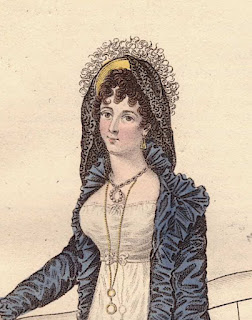
May I present, for your viewing delectation, a Walking Dress for March 1812.


The description reads

No. 2.—Dress for the Fashionable Promenades.

A purple velvet pelisse, with a full standing-up collar, worn carelessly open over a round white dress of fine French cambric; the pelisse trimmed with a broad bordering of braided ribbon, the same colour as the velvet. A Minerva bonnet of amber coloured sarsnet, with a long white ostrich feather across the front; the feather made round, and very full; long black lace veil, a-la religieuse; a chain necklace, composed of pearls with a gold ornament depending in front, representing the Apollo Lyre, set round with a circle of pearls; a gold Lisbon chain with an eye glass hanging below the waist. Plain gold oval-ring pendants. Purple half-boots, and York tan gloves.

Lots to unpack here.

  •  I’m struck by the “carelessly” style suggestion, which has appeared in other fashion prints. It’s fascinating how at times being absolutely neat and buttoned-up and pulled together is the desirable mode, while at others a dash of wind-blown untidiness is all the rage.
  • “Fine French cambric.” Hello, we’re smack in the middle of the Napoleonic wars at this time! I don’t know if its use here means it was actually imported from France (which I really can’t see, considering the embargo.) It might be worth doing some digging around to find out if “French cambric” meant a particular weave or finish…or if describing some article of fashion as “French” was just to give it a little extra desirability. 
  • Lots of description of jewelry in this particular plate, which is unusual.

Now, that amazing pelisse! I’m reminded of coats from the high heyday of evening wear in the 1950s and 1960s, aren’t you? The high collar, the rumpled, gathered look of the fabric (which seems slightly at odds with the description of the trim)—it’s scrumptious. I'm trying to tell if it’s self-lined or not—it rather looks that way, but trying to put on and take off a velvet-lined pelisse...hmm.

The dress is pretty enough, but honestly, who’s looking at the dress? 😁 The hat confuses me, however; wouldn’t wearing the lace veil over it (as shown in the image) hide the ostrich feather?

On reflection, I don’t care. I’m too in love with the pelisse.

What do you think?


Tuesday, January 11, 2022

Baby, It's Cold Outside


After a very mild autumn, my neck of the woods is finally getting a sharp dose of winter today, with temperatures hovering in single digits (which is why I did anything that needed doing outdoors yesterday.) Of course, in today’s world we have central heating and insulated homes and amazing fabrics that keep us warm…and while winter temperatures in England aren’t generally as severe as those in the more northerly parts of North America, the world was still in the grip of the Little Ice Age and the Thames still occasionally froze over. So what did a Regency miss do when winter dogged her heels and nipped at her nose?

I’ve one word in answer to that question: fur.

Since down jackets and Gore-tex had yet to be invented, the warmest thing in outerwear that one could wear was fur…and our hypothetical Regency lady took full advantage of it. She might wear fur-lined pelisses and cloaks like some of these:

Carriage or Promenade Dress, Ackermanns Repository, January 1810. Incidentally, this print and the next are among the only illustrations Ive seen of fur used in millinery in Ackermanns Repository; the other is a print from La Belle Assemblee that we looked at in detail a few years ago.
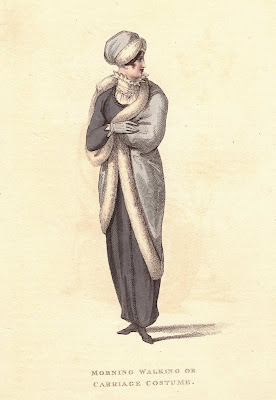
Morning Walking or Carriage Costume, Ackermann
s Repository, December 1810


Carriage Dress, Ackermanns Repository, February 1820


Or maybe just settle for fur trim, as in this Walking Dress from the March 1822 Ackermanns Repository.


She might cuddle up in a fur tippet (or what we call a boa) to keep her neck warm. (A Walking Dress, or Carriage Costume, Ackermanns Repository, February 1811.)


And of course, there were those enormous, eye-catching muffs that were popular for decades...and no wonder: gloves were worn year round, but when glovemakers boasted of the fineness of the kidskin they used, something more would definitely be wanted in winter to keep the hands and forearms warm. (Promenade Dress, Ackermanns Repository, January 1814)


Promenade Dress, Ackermanns Repository, December 1822.


So what kind of fur was worn?

Looking over years of Ackermann’s Repository images gives the impression that a lot of ermine (white fur decorated with the tufts of black tail fur) was worn. But actually reading the text accompanying the images tells a different tale (ahem): for example, the fur-lined mantle above from January 1810 is made with (are you ready?) “spotted American squirrel skin”! A coat from January 1811 (not shown here) was trimmed with blue fox fur. The February 1811 Walking Dress with the tippet and fur trim uses “astracan” (more commonly spelled astrakhan), or lamb. Other plates mention red fox, mole, leopard, sable, and chinchilla in addition to ermine.

While these prints are fascinating to look at, I have to say that Im very grateful that we dont have to follow their example any more. Now if youll excuse me, I think I’ll go have some quality time with my Primaloft quilt...