I suppose I take for granted the ability to watch our
democracy in action. The internet and cable television bring our legislators up
front and personal, and the news media provides summaries of actions taken in
the House of Representatives and the Senate. Before the pandemic, I might have
gone to sit in the gallery of my state legislature and watch proposed laws
being debated. So, I was surprised to learn just how hard it was for a young
lady to view activities in the House of Commons during the early part of the
nineteenth century.

Until 1834, when the House of Commons was destroyed by fire,
the building was a rambling, four-story structure along the Thames. The Members
of the House met in a lofty chamber with galleries around three sides, but these
spaces were for men only. Two galleries flanking each other were for Members
who did not intend to take part in the debate. Overflow was necessary, because
the main floor could only accommodate a little over half of the Members at a
time. The third gallery was for “Strangers,” or visitors. Of the 120 seats, 40
were reserved for reporters.
If a lady wanted to observe the goings on, she must watch
from the Women’s Gallery. It was located in the attic, directly above the
debate chamber. There was room for only fourteen occupants, and their view
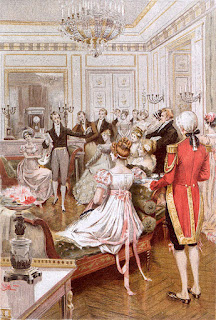
consisted of a grating in the floor that gave onto the chamber below. As near as I can tell, you can see the grating in the ceiling at the upper left of the picture above.
According
to one attendee, all that could be seen were the feet of the Speaker of the
House sitting in his chair, part of the table at which the clerks recorded the
proceedings, and one or two of the dignitaries seated nearby. The Women’s
Gallery was dark, with only a single candle in a tin lantern, and hot, with the
chamber below ventilating into it. (I will restrain myself from making a joke
about all that hot air rising from the pontificators.)
Such was the scene when Lady Calantha, heroine of February’s
Never Court a Count, attempted to identify a Member of the House by the
sound of his voice. She promised Fritz, Count Montalban and brother to the
Crown Prince of Batavaria, that she can find the man she overheard threatening
his family. But she never expected identifying him would be so difficult, or
Fritz so hard to forget. Here’s a little about the story.
Lady Calantha, middle daughter of the Duke of Wey, has the
unique ability to turn invisible in company. Well, not entirely invisible, or
the eligible Frederick, Count Montalban, wouldn’t have noticed her at all. But
Callie’s shy nature and plain features tend to make people overlook her. And
they say the most outrageous things around her as a result, which is why she
accidentally overhears strangers plotting to harm the count and his royal
brother and father. What can a lady do but warn him?
Fritz, Count Montalban, is determined to keep his family
safe. But he can’t drag Callie all over London to identify those plotting
against them unless she has a reason to be alone with him. Pretending an
engagement sounds like the perfect plan. After all, his dashing demeanor hides
a wounded soul that demands he hold a true fiancée at a distance. But there’s something
about Callie that pulls him closer.
As the danger grows along with their attraction, Fritz and
Callie must work together to protect both their families, and Fritz finds his
heart cracking open. Can he prove to the sweet Callie that she will never be
invisible, to him?
Preorder now at
Smashwords
Amazon (affiliate link)
Barnes and Noble
Apple Books