


Hello? Anyone home? Have I interrupted your reading? A
thousand pardons!
Have you finished the book yet? I must say, this was my
first outing with Elizabeth Gaskell’s work, but I found the tone delightful.
From the very first, the humor leapt out at me. I read some lines aloud to my
husband, who even found a chuckle.
Mrs. Gaskell, as she was often called by her adoring
readers, began life as Elizabeth Cleghorn Stevenson. She did not have an easy
childhood. She was the youngest of eight children, all of whom except a brother
died in infancy, and her mother died a little over a year after giving birth to
Elizabeth. Her grief-stricken father sent her to live with an aunt, even after
he married again and had two more children. It is said the aunt’s home in
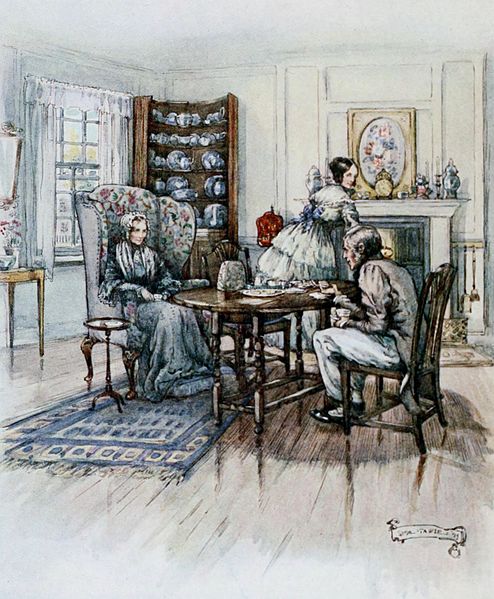
Knutsford, Cheshire, was the pattern for the town of Cranford as well as
Hollingford in Wives and Daughters,
another of her works with which 19 Teen readers might be familiar. I couldn’t
help wondering whether Miss Matty’s brother Peter wasn’t modeled a bit after
Mrs. Gaskell’s brother John, a sailor in the Merchant Marine, who disappeared
during an expedition to India in 1827.

At age 22, Elizabeth married a Unitarian minister like her
father. Two years later, they were blessed with a daughter (Marianne), followed
by Margaret in 1837, Florence in 1842, and Julia in 1846. Between Florence and
Julia, Elizabeth gave birth to a son, William, who died in infancy like her siblings.
It was said she felt his death so keenly that only writing would provide a
solace, and her husband suggested that she try a novel rather than the short
stories she had written up until then.
Her first novel (Mary
Barton) was published anonymously in 1848. Though some protested the story,
which deals with the working class and those who fancy themselves above and
includes some darker themes, the work garnered the attention of the likes of
Charles Dickens. He invited her to submit her work to his Household Words, a popular magazine. She would write Cranford for him in a series of stories,
as Marissa mentioned, beginning in 1851.
But while Cranford is noted for its droll humor and delicate
characterizations, Elizabeth had a strong sense of what today we would call
social justice. Unlike many books published during that time, which featured
the upper classes, her North and South,
like Mary Barton, not only dealt with
the working class but showed a marked affinity for their situations.

While her works were quite popular during her time, her
literary career was not without controversy. In 1853, she dared to write a
novel that openly discussed the plight of women who had been seduced and bore
illegitimate children. Supposedly her readers found it quite shocking. In
addition, she had met and befriended Charlotte Bronte and was asked by
Charlotte’s father to write her biography. The work is heralded by many as a
model for biographies, but Elizabeth was actually threatened with a lawsuit
because of her depiction of some of the people in it.
She was, apparently, a warm, welcoming hostess, who was kind
to the poor and loved to travel with her daughters. Sadly, Elizabeth passed
away in 1865, leaving Wives and Daughters
unfinished, although at enough of a stopping point that it was published
posthumously.
So, what do you think of the delightful Mrs. Gaskell?
Do you see any other influences from her life in Cranford?
Have you read or seen the adaptations for Wives and Daughters or North and South? How did they compare to
Cranford?
Please, chime in!


