Friday, May 16, 2014

Still Here, Part 2

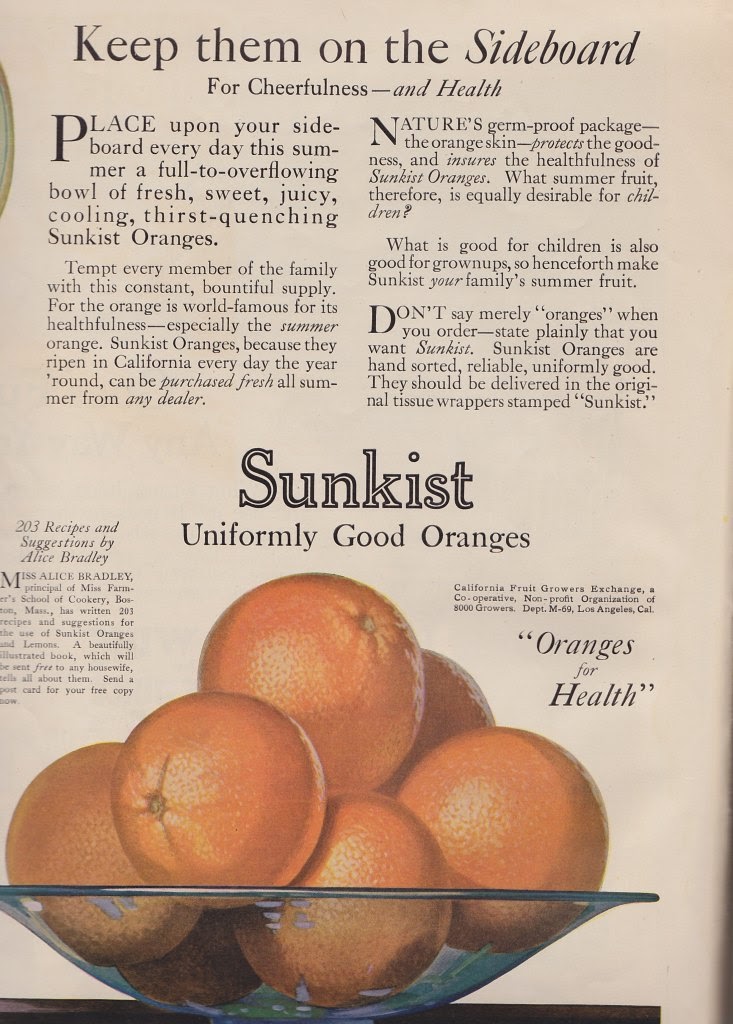
NineteenTeen readers seemed to be amused by the first round of ads for products that are still with us after a hundred or more years that I culled from my research magazines, so here are a few more for your viewing pleasure:

Sunkist Oranges (Ladies’ Home Journal, June 1917):


Waterman’s Pens are now advertised as a luxury item, but in this ad in the June 1917 edition of St. Nicholas, the popular children’s magazine, they’re a tad less upscale:


Mm, mm, good! Campbell’s Soup (The Metropolitan Magazine, June, 1917):


Dental hygiene has come a long way since this post! Pepsodent (The Delineator, May 1917):


This one kind of surprised me. How about you?  Underwood Deviled Ham (Ladies’ Home Journal, June 1917):


For the record--it's pronounced "WUSS-ter-sher." Just in case. Lea and Perrin’s Worcestershire Sauce (The Delineator, May 1917):


It would appear that 'candy is dandy' has been true for quite a long time now! Whitman’s Chocolates (Harper’s Weekly, February 22, 1902):


And this ad takes this week's prize for inventiveness. I thought "Oh, chewing gum saved a pilot's life by helping him stay awake...but no, nothing so prosaic. You can click on the ad to enlarge it...or here's the text: "It Saved His Life!  A British Flyer was up in the air, over the enemy. A piece of shrapnel pierced his petrol tank. He was chewing WRIGLEY'S (Soldiers, sailors, and aviators are strong for it!)  Quick as a flash he plugged the hole with his gum...and got back alive to camp, thanks to it! We'll send you a copy of his letter on request. It just goes to show how, when you're "up in the air" under nervous tension, you'll find WRIGLEY'S a tonic-bracer--a refershing, lasting pick-me-up. It allays thirst, helps appetite and digestion and soothes mouth and throat."  Might this be the origin of the expression, "held together with chewing gum and baling wire!"  Wrigley’s Gum (The Red Cross Magazine, August 1917):


Which is your favorite ad?


Monday, May 12, 2014

What, Why, and How I Write

Surprise!  Regina here, and not even on a Tuesday!  Marissa and I swapped days this week, because awesome YA author Marilee Brothers invited me to be part of the Big Easy Writing Process Blog Tour.  Marilee writes fun fiction with a touch of magic. Her writing has been called “an amazing combination of intelligent and goofy.”  My kind of gal!

She tagged me, and I get to tag three other fabulous authors after answering four questions.

1.  What am I working on?

I am working on the second book in my upcoming Frontier Bachelors series about the East coast ladies who journeyed to Seattle after the Civil War to help civilize the area.  In A Bride for Their Brother, prim and proper nurse Catherine Stanway is kidnapped by the youngest male member of a family of brothers desperate for help to cure their ailing mother.  Catherine agrees to stay and help, and the brothers decide she’d be the perfect match for their leader, Drew Wallin.  Drew feels like he has enough on his hands with raising four brothers and a sister after his father’s death 10 years ago.  He has no interest in taking on a wife, particularly one raised in the city who has no idea how to get on in the wilderness.  But Catherine just might teach him a thing or two about life, and love.

2.  How does my work differ from others of its genre?

That’s like asking a mother why her children are better than anyone else’s!  In my mind, my stories are different because I tend to blend humor, history, romance, mystery, and adventure into one story.  Those are the stories I like read. Those are the stories I like to write.

3.  Why do I write what I do?

Because those stories call to me.  They wake me up in the middle of the night with scenes and characters begging for a full plot.  They pop into my head when I’m at museums or walking past historical houses.  They even introduce themselves at highly inappropriate times, like when I’m being paid to take notes at technical meetings on nuclear waste (that’s where the premise for Perfection arrived).  And they don’t let go until they are written, or rewritten in the case of La Petite Four, now Art and Artifice.

4.  How does my writing process work?

I start with an idea, spend a day or two asking “what if” to see how far I can take it.  I do enough research to make sure the basic idea is historically feasible.  Then I brainstorm the plot and lay out a very rough, high-level outline that ends in “crisis, resolution, denouement” (I kid you not).  Next I write the first draft long-hand in a blank journal, with lots of holes (“Describe hero here.”  “What did they use for lighting in 1866 Seattle?”).  I let the characters and plot go where they will.  When the first draft is done, I go back and research any holes I discovered along the way.  Then I transcribe the journal into the computer, broadening, deepening, filling as I go.  By that time, I have a pretty good idea of what is bothering me about the story, what’s keeping it from being as good as I want.  I print it out and hack it up, then revise it in the computer.  Then it goes to my wonderful critique partner, who tells me what she likes and hates about it, and I revise it once more to deal with any problem areas.  Finally it’s off to my editor for my Love Inspired titles or a copy-editor for my self-published titles.

Curious how other authors write?  So am I.  I’m tagging three other great authors, who will be answering these questions next Monday, May 19:

Cheryl Bolen is the New York Times and USA Today best-selling and award-winning author of more than 20 romance books, both historical and contemporary mystery.  Since she was named Notable New Author in 1999, her books have been translated into eight languages.  In 2006 she won the Holt Medallion (Honoring Outstanding Literary Talent) for Best Historical, and in 2012 she won Best Historical in the International Digital Awards for ebooks published the prior year.  Admitting to a fascination with dead Englishmen and women, she invites readers to her website or her blog or to connect with her on Facebook.

Aileen Fish, author of The Bridgethorpe Brides series and the Small Town Sweethearts series, is an avid quilter and auto racing fan who finds there aren't enough hours in a day/week/lifetime to stay up with her "to do" list. There is always another quilt or story begging to steal away attention from the others. When she has a spare moment she enjoys spending time with her two daughters and their families, and her fairy princess granddaughter.  You can find her online at her blog and website.

Mary Jane Hathaway is the pen name of an award-nominated writer who spends the majority of her literary energy on subjects unrelated to Jane Austen. A homeschooling mother of six young children who rarely wear shoes, she's madly in love with a man who has never read a single Jane Austen novel. She holds degrees in religious studies and theoretical linguistics, and has a Jane Austen quote on the back of her van. She can be reached on Facebook at Pride, Prejudice and Cheese Grits or at her blog. She also writes under Virginia Carmichael, which is another pen name, because she's just that cool.


Friday, May 9, 2014

The Family Nurse

When you were young and had the sniffles, who did you first turn to for help?  Most likely it was a trusted family member and probably your mother.  That hasn’t changed a lot since the early nineteenth century, in England or America.  The heroine in my current work in progress is a nurse, still somewhat a rarity in 1866 New England, so I’ve been researching medical knowledge and how she might have treated various illnesses.  My wonderful critique partner recently took me to the Stabler-Leadbeater Apothecary Museum, where I found a very interesting book.

The Family Nurse by Mrs. Lydia Child is a compendium of advice for mothers who are tending to ill family members.  Originally published in Boston in 1837, it followed Mrs. Child’s very successful publication of The American Frugal Housewife, a tome devoted to helping middle and lower class women manage homes.  I was delighted to learn that Mrs. Child was an advocate for the rights of women and Native Americans, and she was a staunch abolitionist even though it made her a social outcast for a time.  She also wrote the first historical novel with a woman protagonist in New England.  In fact, Mrs. Child is so fascinating, I plan to devote another post soon on her.

Here is some of Mrs. Child’s advice from The Family Nurse:

“Never meddle with medications, unless some disorder of the system renders them really necessary.” 

“The first and most important duty of the nurse is to follow scrupulously and exactly the directions of the physician.”

“Do everything as quietly as possible. Step lightly and gently; avoid creaking shoes, rustling garments, and banging doors.”

The book has a lengthy section on dealing with childhood illnesses as well as a wonderful compendium of various herbs and food stuffs that can be used to soothe.  Some sound a trifle alarming, like Irish moss blanc-mange and calf’s foot jelly.  Others sound like a child’s dream come true, such as using black currant jelly to ease a sore throat or lemonade to comfort a fever.

I remember my mother let us drink 7-Up when we had upset stomachs; it contained bicarbonate of soda so it could actually help.  My husband swears by honey for a sore throat.  Any favorite healing treats in your family? 

Tuesday, May 6, 2014

Fashion Forecast: May 1917


So I got hold of a beautiful copy of the May 1917 edition of The Delineator, a magazine published by Butterick, now best known for their sewing patterns. Well, you know that their magazine would have to have gorgeous fashion pages—over twenty of them!--and you’re right. So I thought it was time to have some slightly more recent Fashion Forecasts, which will continue through the summer months. Enjoy!!

The fashion section begins with a look at the latest Paris fashions, with the headline, “Fleet-Footed are the Fashions that Defy the U-Boats”. Designers mentioned include Georgette, Marthe Wingrove, Magraine-Lacroix, Laferriere, and Parry.


One thing you’ll notice that differs from the 19th century prints that I post is that dresses are usually not labeled “Morning Dress” or “Walking Dress” or what have you. What started with this issue of The Delineator was individual breakdowns of the cost of making each pattern, including estimated cost of fabric, trim, findings and patterns, as a result of expected belt-tightening with the newly entered war. The dres at left has a total cost of $4.94, and the dress at right costs a mere $3.37:


Silhouettes are interesting in this year: though many of the dresses shown still have waists, the general lines are hinting at the coming “vertical”, straight look of the twenties. Busts are still low, an echo of the previous decade:


Parasols and creative millinery were definitely in:


Separates—blouses and skirts, or two piece suits—were also in vogue:


What I found especially interesting is that there was a separate section of clothes intended especially for teens, though that exact term is not used. Still, the pattern descriptions are for 16- and 17- and 18-year-olds--a definite change from 19th century fashion:


The biggest difference I can see between these teen clothes and the more grown-up patterns is that the hemlines seem to be a trifle shorter:


More "teen" fashions:


Children's clothing is also included, both for girls...:


And for boys:


What do you think of May 1917's fashions?


Friday, May 2, 2014

Carlyle House: An American's Dream

Did you notice I appear to be on a house kick recently?  It might be explained by the fact that my husband and I are in the process of downsizing and moving across the state to be near family.  Or it may just be that houses of historical value fascinate me.  When they are arranged as they were in their prime, they offer a window into the past.

I had the pleasure of touring Carlyle House in Alexandria, Virginia, recently.  Carlyle House was the dream of English merchant John Carlyle, who wanted a home in colonial Virginia that would proclaim his status.  Completed in 1753, it is the only stone house dating from that time period in Alexandria and looks very much like you might imagine a wealthy Englishman to build. 

Having studied the English Regency for so long, I found the American version of the same time period interesting.  Here’s some of the things I noted.

A number of the design elements were similar, from the Greek key pattern on the woodwork to the internal shutters rather than draperies on the windows.  Mr. Carlyle apparently wrote at times to his family in England and asked what was fashionable there.  Note, however, that while the chair may look like an original Chippendale, it was made in Boston.

Dresses also mimicked their English counterparts, whether the wide skirts of George Washington’s day or the Empire waists of the Regency.  This display showed how the fabric of one era could be recycled by the next generation. 

There is nothing, however, like American ingenuity.  See the frame above the bed’s hangings in the picture below?  I studied it for the longest time, trying to determine how they would have fit the fabric so precisely to the curve of the wood.  The answer?  It’s not fabric.  The wood has been hand-painted in a perfect match.  This may have been done in England, but I haven’t encountered it yet.


The museum did a good job of showing how Mr. Carlyle started out as a member of the British Empire and ended an American patriot.  I must admit, as much as I love the Regency period, seeing this house and Dumbarton House in Georgetown made me long to write an American Revolutionary War story. 

So, I’m adding it to the long list of books I hope to write someday.  Until then, like John Carlyle, I can dream.

*Top picture by Ser Amantio di Nicolao


Tuesday, April 29, 2014

Girls and World War I, Part 2: Knit Your Bit

When the United States entered the war in April 1917, the government put out the call. Uncle Sam wanted young men to enlist...and he wanted everyone else to knit. The armed forces needed sweaters, vests, mittens, wristlets, caps, helmets, scarves, and above all, socks.

Much of the war was fought from trenches, where conditions were muddy and wet and in winter, muddy and icy. Army boots were made of thick cowhide which was supposed to be water repellent; unfortunately, their uppers had a tendency to come unstitched from the soles. Furthermore, their iron heels and rows of hobnails to provide traction in all that mud conducted cold directly to the feet. To protect their feet, soldiers wore boots two sizes too large and two pairs of thick woolen socks, and changed their socks as frequently as possible in order to avoid "trench foot", a highly unpleasant fungal infection. Take into consideration that the goal was to send at least million Americans across to fight, and you get an idea of the numbers of socks needed.

In the summer of 1917, the government asked America’s knitters for one and a half million pairs of socks for "our boys", as well as an equal number of sweaters, mufflers, and wristlets (rather like mittens that left the fingers free; it's hard to pull a trigger with covered fingers.) America’s knitters heeded the call. The American Red Cross undertook organizing the distribution of yarn and patterns to volunteers and the collection and shipping to Europe of finished items. Women's magazines also published Red Cross-approved patterns, like this helmet from the August 1917 edition of Women's World.

Women (and men) who didn’t know how to knit were taught. It became socially acceptable to knit everywhere: at work, at school, on the bus, at social events, in theatres, and even in church. As college campuses emptied of young men, the young women left behind knit for them; professors were exhorted to allow knitting during lectures. The Junior Red Cross set up knitting programs across America to teach schoolchildren to knit, and those who didn't learn were encouraged to "Do mother's work so she can knit" and "Be careful of  my clothes so that mother will not have to patch, but can knit." Those who, for whatever reason, didn’t take up knitting, were encouraged to buy yarn for those who could but could not afford materials.

That yarn was, of course, gray or khaki colored; it became socially unacceptable to be seen knitting anything in any other color. As an article in the University of Washington Daily stated, “When news comes that American soldiers have died merely from exposure in walking the icy decks on their watches, every stitch on a pink sweater will seem selfish.”

Friday, April 25, 2014

And the Winner Is ... Me and You!

It’s that time of year again.  Hollywood has its Oscars and Golden Globes.  Genre fiction authors have similar events.  For Marissa and me, one of the biggest honors is the RT Book Reviews Reviewer’s Choice Awards. 

The reviewers for RT Book Reviews read hundreds of books a year.  Having them choose your book as a finalist is a huge honor, and winning is, well, marvelous.  Of the many categories, one is for best Love Inspired Historical novel of the approximately 50 books published in that line for the year.  The nominees were

His Mountain Miss by Karen Kirst
The Outlaw’s Redemption by Renee Ryan
Return of the Cowboy Doctor by Lacy Williams
The Courting Campaign by Regina Scott (I've heard she's good)
The Heiress’s Homecoming by Regina Scott

And I am tickled pink to announce that the winner for best Love Inspired Historical novel for 2013 has been selected and it is The Heiress’s Homecoming

Really!  I’m pinching myself. 

But the good news doesn't stop there.  Around Easter I usually hand out a bonus.  This year, I've written a short online story telling how Peter Quimby, that charming valet from The Wife Campaign, met his match.  It’s set just after the close of The Husband Campaign.  I hope you like it.  You can read it free here.   

You might just call it a win-win situation.