Showing posts with label Easter. Show all posts

Friday, April 19, 2019

Queuing for Buns


It is Good Friday, a day for somber reflection, although it’s hard to be sad when we know Easter is coming! Good Friday marked another day in Regency London. It was the day to buy hot cross buns at the Chelsea Bun House (mentioned in a post nearly 10 years ago now!).

The Chelsea Bun House was on Jew’s Row, on the way to Ranelagh Gardens, a popular public garden in the 18th century. Four generations of the Hand family managed the eatery. For most of the year, the house sold Chelsea buns—what appear to be cinnamon rolls with raisins, currants, and white icing. According to The London Encyclopedia, a poem described these delicacies as

“Fragrant as honey and sweeter in taste
As flaky and white as if baked by the light
As the flesh of an infant, doughy and slight.”

(Okay—am I the only one who squirmed a little at the last line?)


While the exterior of the single-story building was fairly standard, the interior was eclectic, with clocks and curiosities from foreign locales sprinkled about. King George II, Queen Caroline, all the princesses, and George the III and Queen Charlotte were said to be customers.


On Good Friday, however, people lined up for cross buns hot from the oven, with sales beginning as early as four in the morning. Numbers vary, but one estimate put the crowds at 50,000. Some years, the ravening customers were so many in number the shop had to close its doors and hand buns out through the shutters. In 1839, the last year of the shop, nearly a quarter million buns were sold!

Sadly, the Hand family died out, and the shop was closed and its contents auctioned. But the name Chelsea bun is still used to this day.

Hungry for more information about the Chelsea Bun House? Try this great post on Jane Austen’s World blog. 

Whether you line up for buns or not, happy Easter!

Friday, April 3, 2015

Happy Easter!

Happy Easter, my dears!  I hope your Sunday is sunny and happy, with friends and family around you, no matter how you celebrate the day.

As I was looking for inspiration for this post, I discovered several lovely Victorian or turn-of-the-century Easter cards. These were given to friends or passed out as promotional material by various companies seeking good will.  Some, like the one at the right, were sentimental over spring. 

Others were playful.


Many followed the traditional story of bunnies and baskets.


And then there were a few that were downright odd.  My sons wanted to know why a bunny brought eggs.  I don’t know what they’d think about a lamb hatching out of one!


May all your animals behave in a suitably proper manner this Easter.

Friday, March 29, 2013

Ride, Cockney, Ride!

When I was researching Easter customs (oh, lovely, lovely research!), I ran across a mention of Cockney riders distinguishing themselves at a hunt in Epping Forest on Easter Monday.  I don’t know about you, but most often I associate the term Cockney with the working-class Londoners who live near the Thames on the East Side.  In the nineteenth century, many of them would not even have owned horses, much less been known as bruising riders.  And hunting, in my mind, was generally reserved to the aristocrats and gentry out in the country.  So, of course, I had to investigate further!

It turns out that for most of the nineteenth century, Epping Forest held 7,000 acres of unenclosed woodland, marshland, and fields as part of a Royal Forest.  It was the haunt of highwaymen and gypsies, a place to bury bodies.  If you wanted to hunt there, you had to have a grant of right by the ruler. 

But over the years, a set of circumstances had led to the belief that the Lord Mayor, Aldermen, and all the citizens of London had the right to hunt a stag in Epping Forest on the Monday after Easter.  And hunt they did.  Until at least 1807, the Mayor and Alderman could be found chasing through the forest after a deer, with the City of London’s own pack of hounds.  But then other Easter civic duties crowded out their schedules, and the costs for keeping a pack of hounds was crowded out by more pressing fiscal responsibilities. 

Still, the citizens of London continued attending the hunt.  And various gentlemen made a sport of it.  For a few years, one fellow encouraged ladies to join the hunt, holding a ball at his nearby country house afterward.  Even when all the deer had left the forest, tame deer were brought in especially for the hunt, their antlers adorned with ribbons and garlands of flowers around their necks. 

Every type of horse and donkey, horseman and horsewoman, of every class, showed up, with dogs of all sorts.  Because of the cost of keeping a large enough pack of hounds, the dogs were cobbled together from several owners and often had trouble staying together as they coursed.  Vendors hawked pies and drinks.  Inns in the area did a brisk business too.  People climbed trees to watch as the deer was let loose and chased over hill and dale.  I was personally enheartened to hear that the deer was caught alive and lived to run again the next year, until I read further that everyone wanted some of its coat to commemorate the affair and in one case nearly plucked it bald! 

I think I’ll stick to colored eggs and Easter services to celebrate the day, thank you very much!  And to help you celebrate, I've written a very short story about how Samantha, Lady Everard, spent her Easter in 1805.  You can find it here.
 
Wishing you a very happy Easter, however you choose to celebrate!

Friday, March 22, 2013

Wonder Weather

I’ll admit it.  I tailor the weather in my stories to suit the situation.  I wanted my heroine’s first sight of the coal mine my hero owns in my August 2013 book, The Courting Campaign, to be bleak, so I set it on a gray, misty day.  I wanted the hero and heroine in my December 2013 book, The Wife Campaign, to search for creative ways to survive an enforced house party, so I made it rain, and rain, and rain. 

But did you ever wonder what the weather was like in certain seasons in the nineteenth century in England?  Several sources on the web offer tidbits.  From them and from historical documentation, we know the following:

  • January 1811, it was cold enough in London, for long enough, that the Thames froze over.
  • May 1811, London saw thunderstorms nine different times in one month.
  • Spring and summer 1812 were unusually cold and wet.
  • The winter of 1813/1814 was extremely cold, and the last of the famous Thames frost fairs was held in February 1814.
  • 1816 was the “Year without a summer,” which has been blamed on a volcanic eruption in 1815 that sent up a cloud of ash into the atmosphere.  London reported snow on Easter Sunday (April 14) and more snow on May 12!
  • Early March 1818 saw strong gales across England that damaged structures and crops.
Makes our late dreary spring look absolutely cheerful!

If you’re stuck indoors today or next week because of inclement weather, and you wonder what to do with yourself, you might wander on over to the blog of Regency authorLesley-Anne McLeod, where yours truly will be sharing information about Easter customs in the early nineteenth century.  You can also join the Love Inspired authors at Goodreads from now through March 28 for an Easter egg hunt with fun prizes.  My day is Wednesday, March 27, but you’re welcome any time.

Regardless of the weather.

Friday, April 6, 2012

Public Spectacles, Amusements, and Objects Deserving Notice, April

April, spring, and Easter all combined to make this month particularly enjoyable for young lads and lasses in nineteenth century London. After all, Easter marked the traditional start of the Season, when anyone who was anyone came to London to take part in Society and its rituals. But it wasn’t just the wealthy that celebrated this time of year. If you were one of the poorer people, for example, you might find it necessary to hang out at Whitehall Chapel on Maunday Thursday, the day before Good Friday. That’s the day His Majesty’s almoner distributes gifts to the poor.

(Now there’s an interesting profession: the Royal Almoner. Appointed by the monarch, the position comes with the title of Lord High Almoner, letters patent, a tidy salary, and the ability to appoint a sub-almoner to help out. He conducted one lecture a year on Maunday Thursday when he made the major distribution of gifts to the poor. But he also distributed gifts to pay for funerals, to compensate for crimes, and to simply hand out kindness from His or Her Majesty.)


The days after Easter are similarly festive. Easter Monday, Sadler’s Wells, Astley’s Ampitheatre, and the Royal Circus open. That same day, the Lord Mayor and Aldermen go in state to Christ-Church, attend service, and then go to feast at the Mansion House. Be sure to attend the ball that evening; tickets are to be had from the Lord Mayor or the sheriffs.

Ah, but if you really wanted a spectacle, Easter Monday and Tuesday you would head out to Greenwich for the Fair. Charles Dickens commented fondly on the practice in his Sketches by Boz, calling Greenwich Easter Fair a "spring rash" and a "three days’ fever." Carriages, wagons, and omnibuses carried merry Londoners out to the event. Stalls of vendors selling things like sweet meats, gingerbread, and toys filled the streets, and there were wild animal shows and theatricals.


Even more boisterous events brought throngs to the park. There were games for the children and young at heart. Retired Naval men set up telescopes and charged a penny for the privilege of explaining what you saw through them. Gypsy fortune tellers worked the crowds. Some adults were content to stroll about and watch the revelry. Others danced and drank and flirted. And some tumbled.

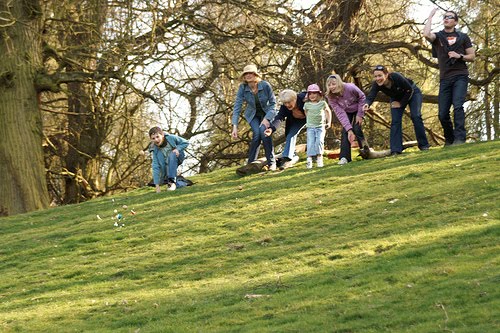
Tumbling seems to have been both a shocking and much beloved event. The idea was to take your sweetie by the hand and climb to the top of Observatory Hill. There you’d link arms with a dozen or more men and women and dash down the slope together. Only some kept their footing. Others fell or rolled to the bottom. Bonnets were squashed; curls were disarrayed; and I imagine more than one gentleman caught a glimpse of shapely ankles and other portions of a lady’s anatomy.

The public frolic and revelry was so great that in 1857 the fair was outlawed as dangerous to order and public morals. And here I thought all those chocolate bunnies were the most dangerous thing about the Easter season!

(Greenwich Fair image from the Bolles Collection at the Digital Collections and Archives, Tufts University)

Friday, April 2, 2010

Interesting Uses for Easter Eggs

This Sunday is Easter, Resurrection Day for those of the Christian persuasion. At our house, this means spending much of the morning celebrating at church. For many households here in the U.S., however, it means baskets of candy and colored hard-boiled eggs. Colored eggs were also popular among young lads and ladies in nineteenth century England, although how they used those eggs might surprise you.

Then as now, the family would boil the eggs and color the shells by dunking them in concoctions. The most commonly used colors were red for the blood of Christ, blue for the water of baptism, and purple for royalty. On Easter Sunday, the eggs might be given as gifts to friends and family.

They might also be used to start a war.

Egg wars were a favorite among the lads (are you surprised?). You picked an Easter egg and your opponent picked an Easter egg and the two of you smacked them together. The least cracked egg was declared the winner, and the owner could receive a forfeit such as a small coin or piece of candy.

You could also roll your eggs. You picked a grassy hill, lined up at the top with each person holding an Easter egg, and pushed them off so that they rolled down to the bottom. You might also push them along with a spoon. Depending on your family tradition, the winner was the owner of the egg that reached the bottom first, lasted the longest among several rolls, or rolled between two goals.


Me? This Easter the only boiled eggs I’m dealing with will be those that are devilled and part of the menu. However, my mother gave me a lovely faux-nineteenth century porcelain egg. Reminds me a bit of Wedgwood, but it’s pink. What do you think?

Happy Easter, all!

Friday, March 26, 2010

One a Penny, Two a Penny

Hot cross buns! Do you remember the old nursery rhyme? Nineteenth century young ladies and lads would have heard versions of it shouted in the streets in the week leading up to Good Friday, the Friday before Easter. Yes, I know, technically that’s NEXT Friday, but I wanted to give you time to plan in case you wanted to cook up a batch.

Cross buns were generally round buns made of sweetened dough, spices like cinnamon and allspice, and currants. The cross on top was to remind people of the crucifixion and resurrection of Jesus. Today the cross is piped on with pastry or icing; then it was more often incised with a knife. Knowing the tradition of eating the little buns on Good Friday, bakers sent out armies of street vendors in the days preceding to hawk their wares, hence the song. You picked up a dozen or two and took them home to eat hot for breakfast. Yum!

Besides street vendors, one of the most popular places to buy hot cross buns until 1839 was the Old Chelsea Bun House outside London. Legend has it that both King George II and King George III patronized the place. Supposedly up to a quarter million buns were sold on Good Friday, with over 50,000 people served!

Of course, you could always make them yourself. Below is a traditional recipe for hot cross buns, simplified for today’s kitchen:

A Dozen Hot Cross Buns
4 cups all purpose flour
1 tsp salt
1 tsp allspice
¼ cup butter (half a stick)
½ cup raisins (or currants if you have them)
1 oz yeast
½ cup sugar
1 cup warm milk

Heat oven to 400 degrees F.

Sift the flour, salt, and allspice into a large bowl. Cut in the butter. Add raisins. In a separate bowl, cream the yeast and sugar together and add warm milk. Leave for 10 minutes until the batter is sponge-like. Add the milk mixture to the flour mixture and combine to form a dough. Leave to rise in a warm place until the dough has doubled. Turn onto a floured surface and knead well then cut into twelve pieces. Flatten each piece into a circle and use a knife to mark each circle deeply with a cross. Allow the lot to rest again for 10 minutes, then bake on a cookie sheet in the hot oven for 20 minutes. Glaze with icing if desired.


And while you’re munching on these, don’t forget that the Young Bluestockings Book Club will be discussing Bloody Jack by L.A. Meyer on April 23 right here on Nineteenteen! Get a copy and be ready to join us.

So, what’s on your menu for Easter?