Showing posts with label Mt. Rainier. Show all posts

Tuesday, October 5, 2021

Taking in the View

Today, Coraline Baxter begins her historic climb! Yes, A View Most Glorious, the third book in my American Wonders Collection, launches in ebook, trade paperback, hardcover, and audiobook, from Revell.

Reluctant socialite Coraline Baxter longs to live a life of significance and leave her mark on the world. When her local suffragette group asks her to climb Mount Rainier to raise awareness of their cause, she jumps at the chance, even though she has absolutely no climbing experience. If she can do it, any woman can do it. And after her mother issues an ultimatum—that Cora marry the man of her mother’s choosing if she is not successful—Cora must do it. But she can’t do it alone.

Noted mountain guide Nathan Hardee initially refuses to help Cora but has a change of heart when he sees what is at stake. He knows enough about the man Cora’s mother has chosen to know that the headstrong young woman should have nothing to do with him, much less marry him.

Climbing Rainier will require all of Cora’s fortitude and will lead her and Nathan to rediscover their faith in God and humanity. These two loners make unlikely partners in righting a wrong and may just discover that only together is the view most glorious.

“Unputdownable! A View Most Glorious is historical romance at its best.” Amanda Cabot, bestselling author 

A View Most Glorious is, indeed, glorious! This adventure-filled tale with its wonderful characters will have you holding your breath as Coraline faces more opposition than what the mountain can throw at her.” Kit Morgan, USA Today bestselling author

You can find the book at fine online retailers and physical bookstores nationwide:

Baker Book House (30% off release and free shipping) 

Baker Publishing Group 

Amazon (affiliate link)

Apple Books 

Barnes and Noble 

Books-A-Million 

Christian Book 

Indie Bound (an independent bookstore near you) 

Kobo 

The Book Depository, free shipping worldwide 

Audio

Kobo 

Audiobooks

iTunes 

Tuesday, August 17, 2021

At the Point of Fisticuffs: Naming Mt. Rainier

I loved getting to write about the history in my own backyard for A View Most Glorious, out in October. But I ran across a few things that surprised me, and none more so than the controversy surrounding the name of one of the highest mountains in the Continental U.S.

Captain George Vancouver claimed the mountain when he sighted it from his ship on his survey of the Pacific Coast of North America in 1792. He named it after his friend, Rear Admiral Peter Rainier. Later settlers to the area called it Tacoma or Tahoma, thinking they were following the tradition of some of the tribes in the area. When the Northern Pacific Railway roared into the city of Tacoma in 1883, the executives were determined to encourage tourism to spur rail travel. All their literature touted trips to Mt. Tacoma.

Suddenly, the name became a household debate. Prominent citizens brought forth pamphlets listing names of tribal members favoring the name Tacoma. Others brought forth scientists and political leaders who favored Rainier. Seattle accused Tacoma of attempting to appropriate the mountain. Tacoma accused Seattle of attempting to steal their history.

In 1890, the nascent U.S. Board of Geographic Names listed the name as Rainier. That only fueled the raging fires. When a map of Washington State was displayed at the World’s Fair of 1893, viewers actually started a fight over which name should be on the map!

A group of Washingtonians petitioned the U.S. Geographic Board to change the name in 1890, 1917, and 1921. All three times they were denied. Finally, the matter reached Congress, resulting in a Joint Resolution to change the name. By that time, those in favor of the name had created a sizeable mythology.

First, they claimed the name Tacoma must be kept to honor Native Americans. The Geographic Board’s research of tribes in the area concluded that Tacoma or Tahoma might be the name of any snow-capped mountain, not Rainier specifically. The name might also have been completely fabricated!

Second, they claimed that Admiral Rainier was unworthy of having anything named after him. He was a pirate who had “raided our shores, captured our citizens, and burned our cities.” The closest Rainier had come to America was the West Indies where, as a young lieutenant, he had helped capture an American privateer during the Revolutionary War and been wounded for his trouble.

Finally, they came out against the Geographic Board itself. They claimed the 1890 pronouncement had been reached after a “midnight orgy” at the capital, in which the attorney for the Rainier Brewing and Malting Company, Senator Watson C. Squire, had delivered a train car full of beer and other intoxicants, to bribe the Geographic Board into keeping the name Rainier. Big problem with that story: Rainier Beer was a brand name, not a company, and Senator Squire had no connection to it. 

In their report to Congress, the Geographic Board stated that to change the name “would be a blow to the stability of geographic and historical nomenclature, and a reflection upon the intelligence of the American people.”

The Seattle Post-Intelligencer, one of the leading newspapers in Washington State, added, “It is of course possible to decree that henceforth the name of the mountain shall be ‘Mount Tacoma’ or ‘Mount Somethingelse.’ But no decree can make people use the name. It will still be ‘Mount Rainier’ in speech and written word.”

Funny thing about that. Rarely does anyone here call it Mount Rainier. To us, it’s just “the mountain.” 😊

Apparently, my own love for that mountain was showing when I wrote A View Most Glorious, as I learned that Booklist, the publication of the American Library Association, has awarded it a coveted starred review!

“As a native to the Mount Rainier region, Scott writes with an exhilarating wealth of sensory detail, bringing the setting to such vivid life the mountain becomes a dynamic character in its own right.”

A rose by any other name…

Tuesday, May 18, 2021

My Father's Mountain

Today would have been my father’s 91st birthday. He died in his early 80s from Alzheimer’s. I think of him often, but never more so then when I see the massive, majestic bulk of Mt. Rainier rising into the heavens. My father loved that mountain.

He was born in the Appalachians, in a sleepy little town now called Whitehall, whose claim to fame is that it was the birthplace of the U.S. Navy in the Revolutionary War. A silk mill employed many in town for some years. The oldest of ten children, he wanted more than anything to get out and see the world. As soon as he could, he enrolled in the Air Force. His dream was to go into radar.

After some training, he ended up at what is now Joint Base Lewis-McChord. He arrived in the winter and endured weeks of unrelenting rain and snow. The first sunny day, he looked out in surprise, then asked his fellow airmen, “Who put that big pile of snow at the end of the runway?”

That big pile of snow was Mt. Rainier. From a certain angle, it does indeed look as if it rises from the end of the main runway.

Even before he married my mother, he was spending his free time up on the slopes, hiking, taking pictures, soaking up the beauty. The tallest mountain he’d seen before then had been less than one-quarter the size. He and Mom went there often. When I was a few months old, he was given the chance to go to Greenland and learn about radar. Instead, he mustered out. His dream was less important than spending time with his family.

I don’t recall a time growing up when we didn’t spend a good chunk of the summer on the mountain. My father liked to brag that I had made the long and steep climb to the Ice Caves (now gone) above Paradise when I was only six. One of the pictures of the climb shows me up on his shoulders, so I’m pretty sure I didn’t walk the entire way!

We hiked, and we camped. He always wanted to summit, but life got in the way. When we moved north for five years, he found other mountains to love in the North Cascades, but Rainier was ever his favorite.

She is mine as well. Happy birthday, Papa. Now, at least, you get to look down at her instead of up. 

Friday, July 31, 2020

Food, Glorious Food, Mount Rainier Edition

I’m working on my third book for Revell, set on and around what would become Mount Rainier National Park. This story has the latest date of the American Wonders Collection so far—1893. I shared how little and how oddly the early explorers of the Grand Canyon ate, as I discovered while researching for A Distance Too Grand (October 2019), which is set in 1871. You would think more than 20 years later, things would be better.

Not so much!

Mount Rainier was a tantalizing figure on the southeast horizon for many in the burgeoning cities of Tacoma and Seattle, not to mention the state capital of Olympia to the west of the mountain. Some of those who decided to venture onto its icy slopes seemed to be a little spare on the food. Jerked venison is frequently mentioned, as is coffee. But some of the men who climbed claimed to have only taken flour and coffee. At least one account describes each man “eating” a half cup of flour as food each day. I searched and searched to find what they added to it and how they cooked it. It appears they didn’t.

Shudders.

At least others came better fortified. Philemon Van Trump, who made the first successful ascent in 1870 and returned several times over the years, brought such staples as flour, bacon, coffee, canned Boston baked beans, jerked venison, oatmeal, potatoes, butter, sugar, condensed milk, and canned apricots, peaches, and pears. He did, however, have a pack horse as far as Paradise, a little more than a third of the way to the top. Little of that made it to the summit.

Some of the items he took surprised and intrigued me:

  • English breakfast tea. I hadn’t known it was named that then, but that was what he wrote in his own report of the climb.
  • Codfish balls. Apparently canned.
  • Potted tongue. Also canned.
  • Liebig’s extract of beef. This was apparently a thick, dark paste. It may have been used like we use bouillon cubes today, as there are records of “beef soup” being served in the crater by those spending the night among the steam vents.

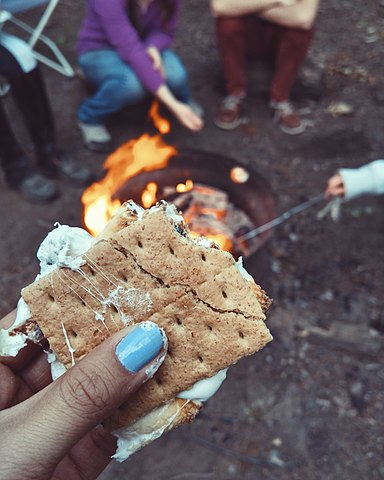
There was one other item that was mentioned on a number of visitors to the mountain, and it’s no stranger to campfire cookery today.

Chocolate.

S’mores, anyone?

Friday, January 11, 2019

Live Like the Mountain's Out


Do you compose New Year’s resolutions or goals for the coming year? I usually do. I enjoyed many lovely things in 2018, including getting to spend time with my dear Marissa, Kristy J. Manhattan (my wonderful critique partner), and other friends. But in many ways, it was a difficult year. Shifting family dynamics and an overly ambitious publishing schedule combined to sap my strength. For only the second time in 45 books, I missed a publication deadline.

I don’t like doing that.

So, in case some of you are coming off a difficult year, I wanted to share a saying we have here in the South Sound and my goal for 2019.

Live like the mountain’s out.

You see, many of us here live in the shadow of Mt. Rainier. She’s a majestic peak, breathtaking actually, at one of the tallest in the U.S. And she dominates the skyline above Puget Sound.

When she’s visible.

You would not think a 14,000-foot mountain could play hide-and-seek, but she does. When it’s raining (and yes, it rains frequently here), storm clouds mask her. Even on bright sunny days, there may be nothing on the southwest horizon. When my father came as a young airman to what is now Joint Base Lewis-McChord in the winter in the late 1950s, he spent weeks without catching a glimpse. Then one day, he went outside and stared.

“Who put that pile of snow at the end of the runway?” he demanded.

Mt. Rainier comes out of hiding on the best of days, when the sun is shining and the air is clear. When birds are singing a welcome, and you can smell the scent of fir and salt water on the breeze. On those days, people leave work early, go outside. We climb hills, skim waves. We gather around fires: in rustic pits in our backyards, in fir-shrouded campgrounds, on rocky beaches. We tell stories about our best memories, make new ones. We smile and laugh and enjoy each other’s company.

Live like the mountain’s out.

This year, I resolve to do that. I want to smile, I want to laugh. I want to enjoy the company of family and friends. I want to write stories that celebrate the best of the past and uplift, encourage, and make you dream of what might be. Dark times come to all. We can be the light.

Live like the mountain’s out.

Friday, April 28, 2017

You Can't Make That Up!

I’m researching my next series, which I hope to propose to my publisher this summer. You know I love the Regency period, but so many places call to me right in my own backyard. The famed Pig War in the San Juan Islands, the orphans who traveled the Oregon Trail alone to be adopted at the Whitman Mission, the soldiers who were dispatched to the forests during WWII when loggers couldn’t chop down trees fast enough for the war effort. You can’t make this stuff up!

Most recently, I’ve been concentrating very close to home. I live in an area south of Tacoma, on the way to Mt. Rainier National Park. Our local library had a number of books you likely won’t find elsewhere. One was a collection of remembrances from those who were children of the first pioneers, along with newspaper clippings and bits of state- or census-compiled data. I found a couple of surprises there. One was that school lasted anywhere from 3 to 6 months, and children as young as 4 and as old as 21 were admitted. I don’t know about you, but my vision of a pioneer schoolhouse featured children from about first through fifth grades. Not here!

Another surprise had to do with immigration routes. As you may know, the famous Oregon Trail led valiant travelers down the Columbia River and into the Willamette Valley of Oregon Territory. Getting from there to the towns along Puget Sound was difficult. For one thing, you have to cross the mighty Columbia, no small feat when there were no bridges or ferries. For another, there were no roads or trails leading north. Most people took a ship up the coast, through the Straits of Juan de Fuca, and down into Puget Sound. However, the Longmire Party blazed a trail over the Cascade Mountains, through what is now Naches Pass, to be among the first to come straight into the south Sound area in 1853, less than 2 years after the Denny party landed on Alki Beach (the start of Seattle). The book gave the location of a marker to commemorate the achievement.

It’s six blocks from my house. (It’s also on private property, so I haven’t found a way to take a picture of it, but I will!)

Another book was a Master’s Thesis by a student at Pacific Lutheran University, just north of me. He chronicled the life of one of the local pioneers, a man named James Sales. Sales had quite an impact on the area, selling his original Donation Land Claim for schools, starting civic and professional organizations, and chartering churches. But what I found most fascinating about him was his beginning.

You see, before James was born, his parents moved to the new city of Tacoma. They lived next to Ed and Martha Croft. The poor Crofts had had a difficult marriage, having lost two babies before the baby they currently had. That boy died shortly after they moved to Tacoma. Mrs. Sales, pregnant with James, was so saddened by the couple’s loss that she offered to give them James when he was born. After all, she reasoned, she already had a healthy son.

Now, I’m struggling with this concept. I cannot imagine the sacrifice of the woman, giving away one of her children to a woman who had none and likely never would. But James was born, and weaned, and given to the Crofts to raise. They moved out my way, a distance of some 15 miles from Tacoma, to the cabin you see above. While James kept his birth name, it appears he never saw his parents again.

You can’t make this stuff up!