Showing posts with label Prince Albert. Show all posts

Tuesday, April 5, 2011

Royal Weddings, Part 1: Victoria and Albert

Feeling bridal? Regina and I thought it would be fun to join in Royal Wedding fever this month and do a series of posts on 19th century royal weddings in the lead-up to the wedding of Prince William of Wales and Miss Kate Middleton on April 29. Are you ready?

Surely one of the most momentous royal weddings of the 19th century was that of Queen Victoria to Prince Albert of Saxe-Coburg and Gotha. Victoria had proposed to her cousin in October—as a reigning monarch, she far outranked him—and the wedding was set for February 10, 1840—a scant three months later. Victoria had hoped for a private wedding, but her prime minister, Lord Melbourne, over-ruled her and so it was the first public royal wedding in decades—since George III’s wedding, back in 1761. The weather was beastly that morning, but it didn’t dampen the enthusiasm of the crowds of people who came out to watch the queen drive from Buckingham Palace to the Chapel Royal at St. James’s Palace. The Chapel was stuffed with as many seats as possible for visiting dignitaries and as much of the whiggish side of the British nobility as possible (of the Tory nobility, only the Duke of Wellington and Lord Liverpool, a former prime minister, were invited).
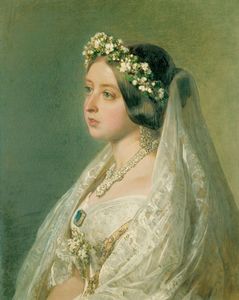
Albert, dressed as a British Field Marshal, entered the chapel first, and awaited Victoria, who walked down the aisle on the arm of her uncle, the Duke of Sussex. Her dress (viewable in the London Museum) was of her own design and fairly simple, of British-made white satin with a trim of orange blossoms. Her veil, worn with a wreath of orange blossoms, was literally one of a kind: it was made by lacemakers in Devon, and the design was destroyed so that the pattern could never be copied. She wore her Turkish diamond necklace and earrings and a sapphire brooch Albert gave her as a wedding present.

There were a multiplicity of clergy on hand, with the Archbishops of Canterbury and York and the Bishop of London all there to officiate. What there hadn’t been was a rehearsal, so that the dowager queen Adelaide was heard whispering to Albert about the proper order of the procession, and Victoria’s twelve bridesmaids (dressed in simple gowns also of Victoria’s design, with wreaths of white roses on their heads) struggled to hold onto the queen’s short train without stumbling over each other. Though Albert often seemed unsure and agitated—his English was not very good at this point, so following the service may have been difficult—Victoria was poised and calm and, as she wrote in her journal, “so very happy!” There were amusing family touches, too: Victoria’s uncle the Duke of Cambridge kept up a very audible, if cheerful, commentary on the proceedings. Her uncle Sussex, who gave her away, still wore his customary black skullcap which he always wore to keep his head warm. And like many mothers of brides, the Duchess of Kent was seen to shed tears.

After the ceremony the married pair returned to Buckingham Palace for a small wedding breakfast (relatively speaking) of family members and their households, the prime minister and a handful of cabinet members, the Royal Household, and the Archbishop of Canterbury and the Bishop of London. Over a hundred wedding cakes were made, to distribute to various family members, Royal Household members, officers of state, and foreign ambassadors. The main cake was nine feet across and sixteen inches high, and decorated with all sorts of allegorical symbols of marriage and of the queen…oh for a photograph! And then it was time to change (Victoria wore a white satin cloak trimmed with swan’s down and a white velvet bonnet with plumes and Brussels lace) and head off to Windsor for their two-day honeymoon. Yes, two days. As Victoria reminded Albert, “You forget, my dearest Love, that I am the Sovereign and that business can stop and wait for nothing.” Not even true love, it seems!

Tuesday, December 21, 2010

Nineteenth Century Christmas Wish List--What Would Queen Victoria Want?

Regina's wonderful Christmas Wish List posts got me thinking about some other 19th century present lists I'd seen before...namely, those listed by Queen Victoria in her diaries. She kept careful note of presents given to and received from family, friends, and servants, especially in her childhood and teens.

So...what was on Queen Victoria's Christmas Wish List?

1. Jewelry Well, of course the future Queen of England had a taste for jewelry, even as a child. She lists gift of an opal brooch and earrings, amethyst earrings, a "massive gold buckle in the shape of two serpents", a gold chain with a turquoise clasp, a turquoise ring...and later, Prince Albert often gave her jewelry made from the teeth of stags he'd killed (ew!) or lockets with strands of their children's hair.

2. Art Several of her diary entries list gifts of prints, drawings, and reproductions of famous works of art from her mother, her governess Baroness Lehzen, and others; she also gave away her watercolors and sketches (and yes, she was a fairly skillful watercolorist). She and Albert also shared a love of art, and often commissioned pictures and scupture from important artists as gifts for each other. This 1843 portrait of her at right is one she commissioned as a birthday present for Albert, for his eyes only, so to speak; it was meant to be a picture of Albert's wife, not of the Queen...isn't that romantic?

3. Handmade items You might have thought that princesses and queens expected slightly fancier gifts, but Victoria loved getting and giving homemade presents from family and friends, including embroidered bags and clothing, fancy aprons ("a very pretty black satin apron trimmed with red velvet"--wow!), handkerchiefs, sachets, fabric covered boxes...the list goes on. And it didn't stop once she became Queen; she sewed quilts and blankets for all her grandchildren at their births and many of her great-grandchildren as well. I wonder if, buried away somewhere like Windsor Castle, are trunks full of items like these? I do know that in a museum in Canada is a scarf crocheted by her; during several of Britain's wars she and her daughters knit and crocheted socks and scarves for the war effort. (And if you'd like to make your own version of this scarf at left, check out this delightful blog!)

I love making presents for family; I've knitted sweaters and mittens, made quilts, and made glass bead bracelets. Are any of you following Her Majesty's example and making homemade gifts?

Monday, December 14, 2009

Christmas in a Nutshell

Before we get started... Remember that invitation to the Regency Tea and Dance party I posted about a few weeks ago? Well, you must check out QNPoohBear's blog--she went, and took lots of pictures! It sounds wonderful...and there are rumors of a spring dance floating about as well. Thanks for the link, QNPoohBear!

* * * * * * * * * * * * * * * * * * * * * * * * * * * * * * * * * * *

Regina and I have been teaching a course on Regency and Early Victorian Christmas customs for the Beau Monde Chapter of the Romance Writers of America, and turning up all sorts of interesting information in the process. Did you know that Christmas as we know it is very much a 19th century invention, courtesy of Queen Victoria and Charles Dickens?

I've mentioned several times how very popular the Queen was when she came to the throne, in a media personality way that really had never happened before. Everyone wanted to know what the queen did, what her favorite perfume was, what kind of biscuits she liked with tea, and so on ad infinitum. When Victoria married her beloved Albert, that attention didn't go away...and when the public learned that Victoria and Albert enjoyed celebrating Christmas in the German way, with things like trees decorated with candles and sweets and lovely ornaments and music and lots of gifts for their children, they thought, "Hmmm...."

At about the same time, Charles Dickens published a short novella he hoped would revive his career which had blossomed with Sketches by Boz and The Pickwick Papers, then tanked with Martin Chuzzlewit. The novella was called "A Christmas Carol", and the first edition of 6000 copies sold out within days. Readers were touched by poverty-stricken Cratchit family and moved by Ebenezer Scrooge's holiday change-of-heart...and the combination of Victoria and Albert and Tiny Tim were enough to send the country Christmas-mad, aided and abetted by such things as increased access to inexpensive manufactured good courtesy of the Industrial Revolution (think TOYS) and improved transportation so that far-flung family members could reunite for the holiday. The Christmas card and Christmas crackers date from this period, and the next twenty years saw the renaissance of the Christmas carol, with most on the ones we sing today dating from the 1850s through 1870s.

Speaking of nutshells...here's a late 19th century Christmas game that I thought was charming...enjoy!

Surprise Nuts Centerpiece
Split some large, well-shaped English walnuts. Remove the meats and in their place put some small toys or trinkets. Glue them back together and then glue an 18” length of colored ribbon to one end of each walnut. Heap them in a bowl with other nuts, ribbons hanging over the side of the bowl; each of your guests can choose one ribbon to pull and claim their prize. Don’t forget to have nutcrackers on hand!

Have fun!

Tuesday, April 28, 2009

Victoria’s Children, Part 1 (sort of): Princess Victoria, the Princess Royal


Some time ago it was suggested that readers might find more information about Queen Victoria’s family of interest, so today I’m launching an occasional series on Her Majesty’s nine children…or at least eight of them. As you may recall, we already considered her eldest son Bertie (later King Edward VII) in a previous post on 19th century bad boys…it seemed like a good time to have look at his somewhat less naughty siblings, so here we go!

Poor Queen Victoria. Imagine her shock at discovering, within weeks of her wedding at age 21 to Prince Albert, that she was going to be a mother! Indeed, she was quite indignant at the prospect, not wanting to have to divert any attention away from her beloved husband. Not that she was going to be busy burping and bathing babies: upper class women of the 19th century did almost no direct child care of that type. But still

She was further disappointed, on November 21, 1840, to find that her first-born was not the hoped-for prince, but a princess. During her pregnancy she wrote to her uncle, King Leopold, that "…if all one’s plagues are rewarded only by a nasty girl, I shall drown it, I think." But once Victoria Adelaide Mary Louisa was actually born, the Queen quickly changed her attitude…and Prince Albert was delighted though he too had hoped for a boy.

The Princess, also known as ‘Pussette’ and ‘Vicky’, was a bright, willful little girl who excelled at the grinding course of study set by her ambitious parents (she was probably the most intellectual of the Queen’s nine children) and as a result became Albert’s favorite child. Her upbringing in the royal palaces of Windsor, Osborne, and Balmoral was idyllic and sheltered to an almost ridiculous degree, the result of her parents’ determination to be moral role models to the country. But sheltered or not, it was still her duty one day to marry for Britain’s benefit, and it was for this reason that she was subtly cued to take an interest in young Prince Friedrich (‘Fritz’) of Prussia…which she did so successfully that she was privately engaged to him at the tender age of 14. It would prove to be a singularly happy marriage…unfortunately, one of the few happy things in Vicky’s later life.

She and her Fritz were married shortly after her 17th birthday, and went to Berlin to live…where Vicky found herself hated and gossiped about by the Prussian Royal Family and populace alike, who distrusted Britain and were sure she was hopelessly devoted to her birth country...mistakenly, as it turned out. Though she worked tirelessly for her new country on charities and in war relief and hospital work, little news of this ever was allowed to become public knowledge.

Vicky and Fritz had eight children, the eldest of whom, Willy, would become best known to the world as Kaiser Wilhelm II, who pushed Europe into the horrors of World War I. She had a rocky relationship with him and her older children, but her younger daughters were devoted to her.

Queen Victoria and her daughter were drawn together by Prince Albert’s untimely death in 1861 and by Fritz’s equally untimely one in 1888 after less than a year on the German throne, and maintained a voluminous correspondence over the next forty years until the Queen’s death in January 1901. Vicky herself was already mortally ill with cancer, and followed her "dearest and best of mamas" to the grave only seven months later.

Tuesday, December 9, 2008

Queen Victoria, Part VIII: Love at Last

Time for a happy ending!

When we last left young Queen Victoria in my June 18 entry (gulp!), it was 1839 and she'd had to deal with the Flora Hastings scandal, brought on by Sir John Conroy's scheming and her own rather immature behavior. But with Sir John gone, life took on a more even keel...

Or did it?

After Sir John's departure in June and Lady Flora's death in July, Victoria was at loose ends. The fun and excitement of being queen and her own mistress had beguin to pale, and she felt trapped in the round of social and public events, bored and tense. A change was needed, and several around her thought they knew what that change should be: it was time for Victoria to marry. But she resisted the idea of marriage, saying she was quite happy as she was. Her Uncle Leopold, King of Belgium, had other plans. He overcame Victoria's nervous ditherings and sent his nephew (and Victoria's first cousin), Albert of Saxe-Coburg-Gotha, to visit England that fall.

Albert was the younger son of the reigning Duke of Saxe-Coburg-Gotha, a small German principality comprising about 18 square miles in central Germany. He was born about three months after Victoria, in August 1819, and almost from his birth it was hoped he'd one day marry Victoria (huge squick factor there for us, but in those days it was considered perfectly all right for first cousins to marry). He was a serious, sober youth, fond of nature and beautiful scenery and not at all fond of society. He and his older brother Ernest visited England in 1836 and Victoria had a delightful time with them...but they had all been children then. Albert's proposed visit in 1839 would determine if he and Victoria would make a match of it...both of them knew it, and both of them were horribly nervous. Victoria worried that Albert would still be the slightly undergrown, sickly boy who couldn't keep his eyes open after nine at night that she'd met before, and Albert had heard dreadful rumors about Victoria's love of empty pomp and ceremony and her tendency to party all night and sleep till noon.

Neither need have worried. When Albert arrived at Windsor on Thursday, October 10, Victoria was waiting to meet him...and fell in love on sight. Her diary for that day states, "It was with some emotion that I beheld Albert, who is beautiful." (That's a sketch she made of him at right.) On Friday she confides that "Albert really is quite charming, and so excessively handsome, such beautiful blue eyes, an exquisite nose, and such a pretty mouth with delicate moustachios and slight but very slight whiskers; a beautiful figure, broad in the shoulders and a fine waist; my heart is quite going...." By Sunday she confided to her Prime Minister, Lord Melbourne, that she had decided to marry Albert, and on Tuesday, she proposed to him. (That's right--she did the proposing. As a queen, it was up to her to do so). Naturally, he said yes.

The wedding was held three months later, in February 1840, and Victoria never looked back. She worshipped her Albert, and there's no doubt that Albert loved her back. He proved to be a steadying influence on her, moderating her sometimes over-enthusiastic likes and dislikes, and becoming her most trusted political advisor as well. It's sad for Victoria that he died only twenty-one years later, leaving her to a long widowhood...and the picture most people have of her today as a sour old lady dressed in black. But I always think of her as she was on the day she became queen, addressing her ministers for the first time--a petite, slender girl who, according the Duke of Wellington "...not merely filled her chair" but "filled the room."