Showing posts with label Queen Victoria. Show all posts

Tuesday, June 6, 2023

The Children of George III: Sophia

Princess Sophia Matilda, the twelfth child and fifth daughter of George III and Queen Charlotte, was born November 3, 1777 at Buckingham House in London, after a mere fifteen minutes of labor—after twelve children, the queen was clearly well-versed in childbirth! She entered the family at a fraught time; Britain was at war with its American colonies, and walking on eggshells waiting for word on whether the French were about to join the war on the American side (which they did a few months later, in March 1778.)

Flora Fraser, author of Princesses, the excellent group biography of the daughters of George III, (Amazon affiliate  link), posits that the three elder daughters (the Princess Royal, Augusta, and Elizabeth) and the three younger (Mary, Sophia, and Amelia) were almost more cousinly than sisterly. They generally lived in separate houses in Windsor, and the elder group received much more attention from the queen, who by the time of Sophia’s birth was simply overwhelmed by the demands of her large family. As a result the younger girls, mostly left to nurses and governesses to raise, received a much more haphazard and superficial education.

Sophia received even less attention from her parents when, around her eleventh birthday, the king suffered his first period of madness. But aside from that frightening time, she seems to have had a quiet, pleasant childhood. She was delicate and blonde, with her father’s somewhat protruding eyes (she remained child-like in appearance all her life) and despite her extreme nearsightedness was an avid reader and accomplished needlewoman, even if her handwriting was terrible.

In her teens, a bad case of chicken pox led to month of ill health, with frequent “fits”, difficulty swallowing, and low spirits. She was sent to the spa at Tunbridge Wells and seemed to eventually recover, but this would be only the first episode of poor health she would suffer, necessitating frequent visits to various spas and seaside towns for sea-bathing.

Like all of her sisters, Sophia suffered from her parents’ unwillingness to allow them to marry—a problem exacerbated by the Napoleonic Wars, which made finding appropriately royal husbands almost impossible, much to the princesses’ dismay. She did find a new friend, at age twenty, in the form of Miss Frances Garth, a sub-governess to Princess Charlotte and niece of the king’s favorite equerry, Colonel Thomas Garth…with whom Sophia had fallen in love. It was hardly surprising, considering the circumstances; nor was she the only one of the sisters to do so. What set Sophia’s experience apart was the fact that Colonel (his knighthood came later) was more than thirty years her senior…and that in late July or early August 1800 she bore him a son.

Colonel Garth eventually “adopted” the boy and was a fond parent—perhaps a little too fond, as Thomas Garth turned out to be a bit of a rotter, later on trying to blackmail the royal family and running away with a married woman. But the Colonel continued as the king’s favorite equerry, while for all intents, Sophia’s life was over. While her three of her sisters would eventually marry, she would remain a spinster all her life, condemned by her youthful mistake to live more or less retired (though she hints in her correspondence to having tender feelings for an unnamed man at court.) General Garth’s very public embrace of his child eventually drove them apart, and Sophia dedicated herself to being a companion to her father before his final descent into illness…when she herself was not ill. By 1812 she had become a semi-invalid, “nervous and weak”—the victim of psychosomatic illness, perhaps?

The king’s permanent illness left her to devote herself to other members of her family. She was a favorite of Princess Charlotte, and was devastated by her death in 1817; the death of the queen the following year was a further blow, though their relationship had generally been a chilly one. But it was the king’s death in 1820 that was the hardest…yet it also set her free. She moved to London, taking a house near Kensington Palace (and eventually moving into the palace itself), and actually began to venture out for walks and rides and invite a few friends to visit in the evenings. And she became the friend of her brother Edward’s widow, the Duchess of Kent, along with her tiny niece, Victoria…and of the Duchess’s comptroller, Sir John Conroy.

For several years, the extended family lived a mostly peaceful life at Kensington; Sophia doted upon her niece, who returned her affection. We’ve seen the extraordinary influence Sir John exerted over the Duchess; he exerted the same over Sophia, who was ever susceptible to a strong man—especially one who kept Thomas Garth, her now-grown illegitimate son, from importuning her for money. But Sir John’s machinations set Victoria against not only him and her mother, but Sophia as well. On becoming queen Victoria paid dutiful visits to her aunt, but the old affection was gone.

Almost totally blind by 1837 and forced to leave the dilapidated Kensington, Sophia still had two sisters left. After Augusta’s death in 1840, Mary devoted her still considerable energies to Sophia, and the children of her youngest brother, the Duke of Cambridge, also visited frequently. But the last years of her life were twilight ones, in all sense of the word: blind, mostly deaf, and crippled, she could do little but wind yarn and write illegible letters to her remaining family members. She passed away in May 1848.

Tuesday, March 7, 2023

Retro Blast: Queen Victoria Goes to Kokomo


I wish I were going somewhere warm where one can unironically drink things with slices of pineapple and little umbrellas stuck on top! It's the time of year when spring seems so close, but still so far...an opinion shared by Queen Victoria. Enjoy!

* * * * *

Well, not quite. But sort of. :)

I’m lucky enough to be looking forward to a visit to warmer climes in the near future—when you live in the chilly north, a few days spent in a place where it’s not necessary to wear heavy down coats is a Very Good Thing.

I’m not the only one to think so. Queen Victoria started taking an annual holiday somewhere in sunny southern Europe, usually for six or seven weeks from the beginning of March to mid-to-late April. Her first trip, in 1879, was shortly after the death of her daughter, Princess Alice; the Queen felt that she needed a complete change of scene, and decided it was high time she visited Italy, which she had never seen. She was lent a villa, Villa Clara, at Baveno, on Lake Maggiore, which though close to the Alps has a mild, Mediterranean climate year round.

The Queen was delighted with her decision. The scenery was gorgeous (though she invariably compared it to Scotland), so she spent a lot of time sketching and painting watercolors, went boating on the lake all the way up to its end in Switzerland, visited Milan to see the artwork (not a success as she was mobbed while visiting the cathedral). It whetted her appetite for more travels, and three years later, she went to the French Riviera, a trip that eventually became an annual event.

Her first visit there was to Menton, where she saw the Mediterranean for the first time. Once again she compared the scenery to Scotland, but as anything that reminded her of Scotland was definitely a good thing, it was high praise indeed. She was an indefatigable sightseer, taking little trips to Monte Carlo (though not to gamble) and other places, with her English coachman and Scottish servant, John Brown, in full Highland regalia (how the sight must have bemused the French!)…perhaps to visit a quaint nunnery, or a pottery factory, or to have a picnic in a secluded spot by the side of the road. In future years she stayed at Hyères, Grasse, and Cannes before finally settling on the Hotel Excelsior Regina (it added the “Regina” to its name with the Queen’s permission), in Cimiez, Nice. She always travelled “incognito” as the Countess of Balmoral, which of course fooled nobody but permitted her to avoid making visits of state—this was, after all, supposed to be a vacation. Family members descended on her for visits while on their own winter vacations, so that at times the poor Queen was quite exhausted from entertaining.

Her last visit was in 1899; the Boer War kept her home the following spring, which was her last before her death in January 1901. I’m sorry she had to miss that last year; she took great delight in her annual visits south, away from “the sunless north”. I know I’ll enjoy mine!

Tuesday, March 8, 2022

The Soup That Never Was

This post was inspired by a social media post I recently ran across that I found fascinating, and had to share with you. It’s about a soup that never was.

Yes, that’s right: a historical soup that never seems to have existed in real life.

Brown Windsor Soup appears in all sorts of modern cookbooks as an historical recipe, a Victorian staple, and even as Queen Victoria’s favorite soup. In my copy of Jane Garmey’s Great British Cooking*, it’s called a “hearty beef soup, once extremely fashionable…. For many years, a particularly unappetizing version was continually served by British Railways in their dining cars, which may explain its present demise.” It appears in the Unofficial Downton Abbey Cookbook and several other modern volumes of Victorian cookery.

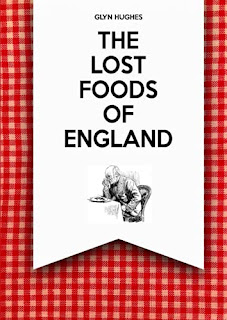
There’s only one problem: were you to go back in time to the Victorian era and, say, try to order it in a restaurant, they wouldn’t know what you’re talking about. Brown Windsor Soup didn’t actually exist, according to food scholar Glyn Hughes, author of The Lost Foods of England (which is totally on my to-buy list!)

When Hughes was beginning research on his book documenting English gastronomy, Brown Windsor Soup seemed like an easy topic to start with; everyone knew what it was, and even had memories of the dreadful version served on trains (see Jane Garmey’s comment above.) But when he started consulting Victorian cookbooks, he could find no mention of it—anywhere. Intrigued, he pored through the British Newspaper Archive and even paid researchers to comb through the records of the National Railway Museum. There was nary a single mention of it in Victoria’s reign. Certainly recipes for hearty beef soups existed, but not under this name. Not until the 1920s did it begin to appear in cafeterias and cafes (and likely railway stations dining rooms) as a filling, if dubious and dreary, menu item.

So where did the legend of Brown Windsor Soup as a Victorian staple come from?

Hughes points to a few things, among them toiletries and radio.

It seems that there was a Windsor Soup, or potage à la Windsor, on her majesty’s menus. It was the creation of Charles Francatelli, one of the queen’s chefs whom we’ve met before. But Francatelli’s Windsor Soup was a creamy white soup made with rice, not brown and beefy...and while it’s not known to have been a particular favorite of her majesty, Francatelli’s cookbook was a staple in Victorian households for decades. Other Victorian cooks created their own Windsor soups, but again, most borrowed heavily from Francatelli’s recipe, and were decidedly white.


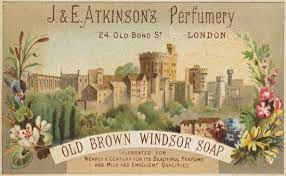
But there was Brown Windsor Soap—a toiletry that was well known as a favorite of Queen Victoria (and Napoleon!), complete with a picture of Windsor Castle on its packaging (and still available today.)

And then there was The Goon Show. This popular (and very goofy) radio show of the 1950s (featuring Peter Sellars in his pre-Inspector Clouseau/Pink Panther days—if you ever have a chance to hear them, do!) latched onto “Brown Windsor Soup” as a recurring comedic gag, a stand-in for all stodgy English cuisine (and, by extension, stodgy Britishness.)

Might all of these—a real Windsor soup, a very popular product with a similar name, and the hilarity of radio—have mixed themselves up with a twentieth century invention into a sort of cultural pseudo-memory? Hughes thinks so—and is astonished by the resistance to his research by people who are convinced to this day that they used to eat Brown Windsor soup on trains.

* * * * *


Not imaginary or Victorian is that there is currently a giveaway for The Forgery Furore, the first installment in my new Regency fantasy series The Ladies of Almack’s, on Goodreads. You can enter it here; entries are open till March 20. Good luck!


*Amazon affiliate links are used in this post.

Tuesday, December 22, 2020

We Wish You a Merry (Victorian) Christmas!

What is it that makes me get sort of goofy and sentimental about the Victorians and how they elevated the celebration of Christmas to a fine (if florid) art? The candles, the decorations, the food—the sheer coziness—and the emphasis on home and family…it paints a very beguiling mental picture, doesn’t it?

But it certainly isn’t just me (and feel free to comment and make me feel less sheepish. 😉) I’ve found some splendid bits around the interwebs by other just as beguiled and fascinated by Victorian Christmases as I am, such as this video about Victoria’s Christmas dinners by history blogger/filmmaker Lindsay Holiday:

Now, you probably know by now that I’m all about the 19th century clothes... While I’m usually more excited by clothes from the earlier part of the century, I couldn’t help being delighted by a video by CrowsEye Productions about Queen Victoria being dressed for an evening Christmas party, as depicted in this popular engraving from 1848 as seen above right at the beginning of the post. The dress isn’t exact, but close enough:

And just because it’s really neat, here’s Prince Albert getting ready for the same party:

While I expect that I’ll be dressed in a considerably more casual fashion on the 25th (because of course I’ve given my lady’s maid the day off), I’ll be enjoying the holiday...and Regina and I hope that you will be doing the same. A very happy Christmas to you, dear NineteenTeen readers, and we’ll see you in the new year. 😘


Tuesday, May 14, 2019

She Doesn’t Look a Day Over 180, Does She?


Cake? Check.
Party hats? Of course.
Two hundred candles? Umm...maybe we ought to call the fire department, just in case... ☺

This coming Saturday is the 200th birthday of my favorite British monarch, one who should bewell known by now to NineteenTeen readers.


We’ve learned about theextraordinary circumstances surrounding her birth, her rather lonely upbringing, the challenges she faced as she grew ever closer to the throne during her uncle’s(King William IV) decline, and her triumphal ascension as Queen Regnant shortlyafter her eighteenth birthday...as well as some of her early missteps. Sometimes controversial, often admirable, always fascinating (how often has a woman come to embody a historical era?)...let’s wish Queen Victoria a very happy 200th birthday!

And in case you want your piece of birthday cake home-baked...try this recipe for a Victoria Sponge, which was evidently one of her favorites for afternoon tea, courtesy of the New York Times:


Enjoy! And eat a slice for Her Majesty!

Tuesday, March 12, 2019

The Children of George III: Ernest


It’s been a while since we’ve met another one of George III’s numerous brood. As it happens, we’ve already met this particular son. But I’m getting ahead of myself...

The king’s fifth son and eighth child, Ernest Augustus, was born on June 5, 1771 at Buckingham House. His childhood seems to have been uneventful; it was spent growing up at Kew with his numerous siblings and sharing a household with his two younger brothers, Augustus and Adolphus. Ernest was a handsome, boisterous boy; unlike most of his brothers, he would never become corpulent, but remained lean his whole life.

At fifteen and still with his two younger brothers in tow, Ernest was sent to study at the University of Göttingen in Hanover, and received his earliest military training there as well. By 1792 he was commissioned as a cavalry colonel, being an excellent horseman and shot, and went on to fight against the French in several battles over the next few years, receiving a saber wound to his head (that would eventually result in a loss of vision in one eye) and other wounds. Though he would continue to serve in the military for another twenty years, returning to the continent and eventually attaining the rank of field marshal, his battle days were past.

However, his interest in politics was just beginning. When his father awarded him the title of Duke of Cumberland and Teviotdale in 1799, he took his seat in the House of Lords and actually got involved. A dedicated Tory unlike his brothers Prinny and the Duke of York, he voted against bills for Catholic Emancipation and other liberal legislation and became a leader of the conservative end of his party. Also unlike his brothers, he was circumspect in his personal habits, which may have backfired on him as he acquired a reputation as a sinister figure who preferred to enjoy his vices privately. Rumors likely circulated by political opponents whirled around him, reaching their apex in the scandal around the death of his valet, Joseph Sellis.

The army and politics kept him sufficiently busy until 1813, when he became smitten by a cousin, Princess Frederica of Meckenburg-Strelitz. Though she was already married, the marriage was not a success and discussion of a divorce was underway when the princess’s husband died unexpectedly—a fact which became more grist for the rumor mill after Ernest and she married in 1815. Since Queen Charlotte did not approve of the marriage and would not receive her daughter-in-law, the couple eventually moved to Germany and had a son.

Over the next decade and a half, lurid rumors of murder and assault continued to circulate around Ernest, many of them probably politically motivated as he continued to involve himself in politics, being especially active in questions involving Ireland during the 1820s. The issue of the line of succession to the throne was an especially fraught one; after Prinny’s death in 1830, Ernest was next in line for the throne after young princess Victoria, and rumors that her life was in danger from her wicked uncle were rife even after she came to throne; only the births of her first children put those rumors to rest.

On the death of his older brother William IV Ernest became the king of Hanover, since Victoria as a female could not inherit the Hanoverian throne. He left England within the month to take up residence in his new kingdom, where he ruled according to his highly conservative bent (though he did eventually approve a more liberal constitution for Hanover.) He wasn’t very popular, but wasn’t unpopular either, and was appreciated for the fact that he kept Hanover out of the reaching grasp of Prussian expansionism. He died in 1851, at the age of 80.

Tuesday, December 18, 2018

Popping in for Popovers

I’m drawing up my grocery shopping list for my family’s Christmas dinner (it’s just a week away—eek!) We always have a roast beef at Christmas, served with the traditional horseradish sauce. Queen Victoria evidently enjoyed a good piece of roast beef herself on December 25. But because I live in New England, not the old one, our roast beef is eaten with those lovely bubbles of bready goodness, popovers.

For those who haven’t had the good fortune to be acquainted with popovers, they are muffin-shaped, mostly hollow rolls made from a thin, eggy batter; they are baked in either muffin cups or in special high-sided popover pans. Cooked in a very hot oven, the thin, liquid batter releases lots of steam, which creates the hollow effect, rather like a soufflé. When done, you slather popovers with butter and enjoy...honestly, given the choice I’d rather skip dessert on Christmas and just eat more popovers.

The origin of the popover is in Yorkshire pudding, the traditional accompaniment to a beef roast, which follows a similar recipe but is cooked in a pan (originally set under the spit on which a roast was cooking, so that the dripping juices from the roast fell into the pan of batter, enriching it.) For some reason, cooks in the new world came up with the idea of cooking the batter in individual, small servings and using butter rather than meat drippings...and the rest is delicious culinary history.

Being huge popover fans in my family, we have the special popover pans, but 5 oz. Pyrex custard cups will work as well.

POPOVERS 😍

Set your oven rack to the middle of the oven, because these babies rise.

Ingredients:

1 ½ cups all-purpose flour
1 ½ cups milk
½ teaspoon salt
3 eggs
2 tablespoons melted butter

Generously butter a dozen or so small Pyrex custard cups; set them in a baking pan, which makes the whole thing easier to handle. Whisk together all the above ingredients, preferably in a mixing bowl with a spout. The batter should be thin—rather the consistency of heavy cream—and don’t worry if it’s a bit lumpy. Pour the batter into the prepared cups till they’re about half to two-thirds full—don’t fill them completely or they won’t puff. Put them in a cold oven and turn it on, setting the temperature to 425°. Set the timer for 45 minutes, and go do something else to take your mind off them, because you can’t peek—if you open the door, kittens will sob, puppies will turn their backs on you, flowers will fail to bloom...and your lovely popovers might collapse. Only after 45 minutes can you check on them, to make sure they’re deliciously golden brown; depending on your oven, a few more minutes might be necessary. When done, remove them immediately from their cups, and serve at once with butter.

If you feel like gilding the lily, finely grated Parmesan cheese and/or herbs can be added to the batter. Or you can serve them with herbed garlic butter—but I digress... 😋

Enjoy...and I hope your year-end celebrations are warm and wonderful. See you next year!

Tuesday, June 27, 2017

Retro Blast: A Royal Wedding


Today’s post is a re-run of a post from April 2011—a re-run because I’m busy today celebrating my 30th wedding anniversary with my dear husband. Though my wedding was nothing like Queen Victoria’s (I emphatically did not have a wedding cake nine feet in diameter!), I, like the little queen, was—and still am— “so very happy!”

Enjoy!


Surely one of the most momentous royal weddings of the 19th century was that of Queen Victoria to Prince Albert of Saxe-Coburg and Gotha. Victoria had proposed to her cousin in October—as a reigning monarch, she far outranked him—and the wedding was set for February 10, 1840—a scant three months later. Victoria had hoped for a private wedding, but her prime minister, Lord Melbourne, over-ruled her and so it was the first public royal wedding in decades—since George III’s wedding, back in 1761. The weather was beastly that morning, but it didn’t dampen the enthusiasm of the crowds of people who came out to watch the queen drive from Buckingham Palace to the Chapel Royal at St. James’s Palace. The Chapel was stuffed with as many seats as possible for visiting dignitaries and as much of the whiggish side of the British nobility as possible (of the Tory nobility, only the Duke of Wellington and Lord Liverpool, a former prime minister, were invited).

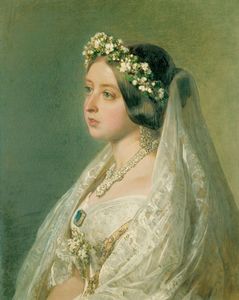
Albert, dressed as a British Field Marshal, entered the chapel first, and awaited Victoria, who walked down the aisle on the arm of her uncle, the Duke of Sussex. Her dress (viewable in the London Museum) was of her own design and fairly simple, of British-made white satin with a trim of orange blossoms. Her veil, worn with a wreath of orange blossoms, was literally one of a kind: it was made by lacemakers in Devon, and the design was destroyed so that the pattern could never be copied. She wore her Turkish diamond necklace and earrings and a sapphire brooch Albert gave her as a wedding present.

There were a multiplicity of clergy on hand, with the Archbishops of Canterbury and York and the Bishop of London all there to officiate. What there hadn’t been was a rehearsal, so that the dowager queen Adelaide was heard whispering to Albert about the proper order of the procession, and Victoria’s twelve bridesmaids (dressed in simple gowns also of Victoria’s design, with wreaths of white roses on their heads) struggled to hold onto the queen’s short train without stumbling over each other. Though Albert often seemed unsure and agitated—his English was not very good at this point, so following the service may have been difficult—Victoria was poised and calm and, as she wrote in her journal, “so very happy!” There were amusing family touches, too: Victoria’s uncle the Duke of Cambridge kept up a very audible, if cheerful, commentary on the proceedings. Her uncle Sussex, who gave her away, still wore his customary black skullcap which he always wore to keep his head warm. And like many mothers of brides, the Duchess of Kent was seen to shed tears.

After the ceremony the married pair returned to Buckingham Palace for a small wedding breakfast (relatively speaking) of family members and their households, the prime minister and a handful of cabinet members, the Royal Household, and the Archbishop of Canterbury and the Bishop of London. Over a hundred wedding cakes were made, to distribute to various family members, Royal Household members, officers of state, and foreign ambassadors. The main cake was nine feet across and sixteen inches high, and decorated with all sorts of allegorical symbols of marriage and of the queen…oh for a photograph! And then it was time to change (Victoria wore a white satin cloak trimmed with swan’s down and a white velvet bonnet with plumes and Brussels lace) and head off to Windsor for their two-day honeymoon. Yes, two days. As Victoria reminded Albert, “You forget, my dearest Love, that I am the Sovereign and that business can stop and wait for nothing.” Not even true love, it seems!

Tuesday, January 17, 2017

So What Did You Think?: Victoria


I think it’s probably safe to assume that a number of NineteenTeen readers watched the new offering on PBS’s Masterpiece, Victoria, this past Sunday evening (or, as I did, streamed on-line at pbs.org). And c’mon, you knew I’d be watching it.

The seven-part series is a dramatization of the first three-ish years (1837-1840) of Queen Victoria’s reign. It opens with her reception of the news that her uncle, King William IV, had died and that she, at just over eighteen years of age, is queen.

I’ve more or less come to the conclusion that I should probably not watch television or movie dramatizations of historical events, because, inevitably, the “dramatization” part wins out over the “history.”  History simply doesn’t make very good television: it’s too slow, too messy, too often lacking in the cohesion that makes for good storytelling.

And that was decidedly the case with Victoria. While there was oodles of conflict in the events around Victoria’s coming to the throne—the years between 1835 and 1837 were drama-filled indeed—Victoria chooses to make stuff up (I’m sorry—dramatize) and moves it to the years after 1837. So we basically ended up with a first episode here in which there wasn’t a lot of history.

  • Unlike what is shown in Victoria, Sir John Conroy was more or less out of Victoria’s life the minute she became queen: she barely saw him again, and after a matter of months Lord Melbourne managed to negotiate him out of Victoria’s mother’s household and into retirement (it took a little longer to repair the relationship between Victoria and her mother, but it did mend.) And while Conroy spent considerable time and effort before her ascension to try to force a regency on her, there was no question of it once she became queen.

  • The Duke of Cumberland became King of Hanover the minute Victoria became queen, and was in Hanover by the end of the month, taking up his royal duties...not conniving against her back in London.

  •  Lord Melbourne had certainly been popular with the ladies in his earlier years...but by the time Victoria came to the throne, he was fifty-eight years old and looked it every bit of it. Though he undoubtedly adored his little queen and treated her gallantly, it was very much a paternal sort of affection...and hers for him was that of a girl who’d never had a father figure in her life (don’t forget, her father died while she was still an infant), not to mention a male friend.

  •  Sir Robert Peel wasn’t “common,” as he’s played here—he was the son of a wealthy mill owner and politician and attended Harrow and Oxford. Victoria didn’t much care for him at first, but eventually came to both admire and respect him.

However, they did at least a semi- creditable job with the Lady Flora Hastings scandal and with the Bedchamber Crisis, when Victoria’s stubbornness about losing her ladies because they were married to Whig ministers brought down Peel’s fledgling government. Within a decade, court appointments became more disassociated from party politics.

Overall verdict? I was...underwhelmed. The settings weren’t bad but the costumes were disappointing (The Young Victoria movie was much yummier in that regard). I found a lot of the acting stiff, and while Jenna Coleman as Victoria was very striking, there was simply far too much time spent with the camera lingering on her face while she emoted...stiffly.

But that’s just me...did you watch it? What did you think? Tell us!

Tuesday, July 26, 2016

Blast from the Past: Nineteenth Century Bad Boys, Part I: The Disreputable Duke


July is a busy month in the Doyle household, so I'll be taking a break this week...in the meanwhile, have fun with this post from 2008. I should see about a few new Bad Boy posts...hmm.... 

First, I feel like I should make a disclaimer here…unlike a lot of females, I have zero interest in what we today call “bad boys” and what our counterparts in the 19th century called rogues or rakes. I just don’t get the attraction…but I know a lot of women do…and did.

Princess Victoria definitely appreciated a good bad boy. In 1837 the seventeen-year-old began to take notice of a second cousin of hers who had come to London and could be seen at fashionable balls and the opera and out with his friends in Kensington Gardens. His name was Charles, Duke of Brunswick and he was a nephew of the late Queen Caroline, wife to George IV…and what made him a bad boy was that he’d been booted out of his duchy of Brunswick as being “unfit to rule” and his younger brother installed as reigning duke. It seems his seven-year rule was marked by corruption and poor judgement, and when he reacted to political unrest in France by clamping down on reform in his own country, he was not-very-politely shown the door. Though he tried many times to interest other European governments in helping him retake his country, no one ever did.

So he spent most of his time in London and Paris, being attractive. He wore his dark hair long and shaggy, had dark, fierce eyebrows, and a romantically military moustache. Vic was fascinated, and sketched him from memory (yes, she drew the above picture!) as well as recording sightings of him in her diary:

[at a ball] “He was in a black and dark blue uniform with silver; his hair hanging wildly about his face, his countenance pale and haggard; I was very sorry I could not see him de pres for once, that I may really see if he is so ferocious looking.”

[out walking in Kensington Gardens] “He is, I think, very good looking, for we passed him close, though I was told by a lady who had seen him at Almacks, that he was not so, but I don’t think she saw him very close, and perhaps he looks handsomer by daylight and with his hat on. He was very elegantly dressed.”

Of course, nothing ever came of Victoria’s interest in her exiled cousin, and he slouched about Europe for most of his life, collecting diamonds as a hobby and dying in Geneva in 1873.

Tuesday, May 24, 2016

Move Over, Dowager Countess—the Queen Is Coming!


So I may have mentioned this before (and please don’t hit me): I was not a fan of Downton Abbey, as you might have guessed from the dearth of mentions of the show on this blog (though I did like the Evil Butlerfilms...)  Truth be told, I don’t watch any television at all apart from DVDs because there’s just too much else to do (like read! and write!)

However, I may have to cave in and get a decoder box (yeah, I told you I don’t watch TV) because of what’s coming to Downtown Abbey’s time slot on PBS’s Masterpiece Theatre next year: Victoria, an eight-part miniseries that details the young queen’s life from her accession in June 1837 at age 18 to her courtship and marriage to Prince Albert of Saxe-Coburg in 1841.


Cue Marissa hyperventilating.

My hopes are pretty high that this series might be reasonably historically accurate (and not throw in silly assassination attempts like that one added into 2009’s The Young Victoria.) Since they list the role of Lady Flora Hastings, I expect they’ll cover that whole episode (during which the young queen did not show to her best advantage), and we can hope that the actor who plays Sir John Conroy, Paul Rhys, will be suitably dastardly (‘coz honestly, the guy pretty much was almost a classic storybook villain.) It looks like the actress who will play Victoria, Jenna Coleman, does a pretty good job of trying to look like Victoria, particularly her habit of keeping her mouth slightly open that can be seen in many of her portraits. We can hope she gets the fascinating mixture of childish enthusiasm and royal gravity that was the young queen. And hey, we’ll almost definitely get beautiful sets and costumes to look at (just like Downton Abbey, I’ll concede), so it sounds like a win to me.

Do you plan to watch it? We may have to have more posts on this topic when it airs...

Oh, and happy birthday to my favorite monarch: Queen Victoria is 197 today!!

Tuesday, February 16, 2016

1810, What a Year It Was, Part 2: The Lady of the Lake and the Hughland Revival


Just in case you think that media having a profound effect on popular culture is a modern phenomenon, I have five words for you: The Lady of the Lake.

In 1810 a Scottish lawyer named Walter Scott who had been slowly building a name for himself as a poet writing about Scottish history and lore published his third narrative poem, called The Lady of the Lake. His previous efforts, The Lay of the Last Minstrel (1805) and Marmion (1808) had seen moderate popular success. But for some reason, the May release of The Lady of the Lake turned Scott into a household name, selling 25,000 copies that year alone.

The poem’s story is a dramatic one, with three suitors vying for the hand of the fair Ellen Douglas, a disguised king reconciling with an estranged old friend and supporter (who happens to be the father of the aforementioned Ellen), and war between the king and his Lowland Scots versus the Highland Clans led by one of the (also) aforementioned suitors. There are bards and druidic prophets and old feuds affecting the present and one-on-one combat and lots and lots and lots of description of the wild beauties of Scotland...and the origins of the song we now know as “Hail to the Chief”!

So, popular book, sold lots of copies, blah blah blah. But The Lady of the Lake also sparked something known as the Highland Revival, a sort of craze for Scottish history and culture (or at least what people thought was Scottish culture). Don't forget that Scotland had been in eclipse through most of the 18th century, ever since the last Stuart uprising in 1745 had led to the horrible slaughter of the Battle of Culloden, decades of sanctions against the Scots, and widespread emigration to America. Scotland as a topic was ripe for romanticization and exploitation; it had already begun with the publication in 1760 of what purported to be epic poems by an ancient Scottish bard, Ossian, by one James Mcpherson. They were an international sensation: people from Thomas Jefferson to Napoleon counted them as favorites. Alas, it turned out that they were not ancient, but Macpherson's own work. Still, the seed had been planted, fertilized by the passion of the late 18th and early 19th centuries for the wild and picturesque. 

Scott knew a good thing when he saw it; he followed up the success of  with a series of historical novels set in Scotland, and the craze only grew. The Prince Regent was an enthusiastic subscriber; he invited Scott to dinner in 1815 after reading his novel Waverley, published the previous year, and ended up visiting Scotland in 1822, the first reigning monarch to do so since 1650. He also had his portrait painted wearing a kilt to commemorate the visit.  The Highland Revival would eventually find its apotheosis in Queen Victoria’s buying a house in the Scottish Highlands, decorating it from cellar to attic in tartans and deer antlers, and trying to spend as much time there as possible, much to the dismay of her ministers.  And long-time NineteenTeen readers may recall my poking gentle fun at the Scottish craze in an April Fool’s Day  post a while back.
And it all more or less started in 1810. ☺

Tuesday, July 22, 2014

The Queen's Indian Servants, Part 2

As we discussed here in Part 1, Queen Victoria decided to employ some Indian servants in her household, and Mohammed Buksh and Mohammed Abdul Karim duly joined the Royal Household in Windsor in June 1887, their first duty being to serve Her Majesty’s breakfast. The Queen enjoyed their presence, and noted in her diary in early August that she had learned a few words of Hindustani in order to converse with them in their own language. By the end of that month, she had asked Karim to give her lessons in Urdu, the variety of Hindustani used by Muslims, and had arranged for extra tutoring for him in English to facilitate their communication. She had taken a definite liking to him above and beyond his being a window into an exotic world she knew little about; she liked this cheerful, good-looking young man (he was twenty-four at the time he came to England), who though not particularly well-educated and certainly unsophisticated, seems to have been genuinely fond of his mistress. The Queen returned his fondness, signing herself “your affectionate mother” in notes to him and giving him permission to bring his young wife and mother-in-law to England, whom she visited frequently.

When Karim told her that waiting at table was beneath his social station because he had been a clerk in India, the Queen named him her “Munshi”, or teacher. Gradually, he took on more secretarial duties for her...and this was where he ran into trouble.

While the Queen herself was amazingly free of racial prejudice, her Household was not. The Queen’s Household was its own little world; the people who served in the various secretarial and “waiting” positions were often the children and grandchildren of people who had served the Queen in the past, and outsiders found it difficult to be accepted into what had almost become a hereditary “caste.” When those outsiders had skin of a different color and spoke accented English... Resentment quickly arose when the Queen made it clear that she expected the rest of the Household to accept Karim as one of themselves.

It is difficult now to know whether complaints of high-handed and arrogant behavior on his part are true, or simply the outrage of those of the Queen’s Household who could not imagine treating an Indian native as an equal; he left no memoirs, while they left several. Add in the different cultural expectations for behavior, and it made for a tense atmosphere, especially after Karim was given John Brown’s old room at Balmoral—a sign of the Queen’s definite favor. Accusations that Karim was leaking state secrets to Muslim agitators and others, though they persisted for years, were never proven; there is no evidence he engaged in any political behavior of the sort. Karim was also excoriated for asking the Queen for a grant of land in India for his family (which he received after a great deal of hemming and hawing from the Viceroy), and for asking to be made a nawab (peer). He was instead made a Commander of the Order of the Indian Empire and the Royal Victorian Order, honors which acknowledged his personal importance to the Queen but lacked political overtones.

Perhaps the most telling detail of the relationship between the Queen and her Munshi came after her death in 1901. The new King Edward dismissed Karim and arranged to send him and his family back to India after the Queen’s funeral, but first he was commanded to hand over all his correspondence with his late mistress...which he did, without complaint, even handing over signed photographs the Queen had given him. He lived quietly at his home outside Agra until his death in 1909.

Tuesday, June 10, 2014

The Queen’s Indian Servants, Part 1


First, a little background.

When you think about it, being Queen Victoria was probably a rather lonely prospect. She had been raised to be very aware of who she was—basically, the very top of a large pyramid. No one was her equal, especially after Prince Albert died (“There is no one to call me Victoria now,” she said on his death.) She just didn’t have any BFFs, especially as she grew older, because how can you be BFF with someone who rules substantial portions of the planet? Her children were afraid of her even though they loved her; her half-sister, though also dearly loved, was scarcely in a position to be her chum. She was almost never alone, surrounded by ladies-in-waiting and equerries and other courtiers almost constantly...but while their relationships with her could be affectionate, there was always that certain something that kept them at arms’ length—not only on the Queen’s part, but on theirs.

One exception to this was the Queen’s “Highland Servant”, John Brown. He somehow managed to remain unimpressed by her position, called her “woman” to her face, and seems to have cared deeply for her in his peculiar, brusque way. Interestingly, all those ladies-in-waiting and equerries and her family all seem to have loathed John Brown, just because of the special place he held as her favorite servant and friend. When Brown died in 1883, the Queen was nearly as devastated as she had been after Albert’s death: she had lost her only friend. The fact that she was buried with mementoes not only of Albert, but also of John Brown, says a great deal about the depth of her feelings.

In 1877, Queen Victoria adopted the title “Empress of India.” She was fascinated by India, and in 1886, after attending the Colonial and Indian Exhibition, decided that she wanted to employ some Indian servants in her household in time for her Golden Jubilee coming up the following year. She asked the man in charge of one of the exhibits, a John Tyler, superintendant of the Central Jail in Agra, to recruit her two servants. As a result, in June 1887, Mohammed Abdul Karim and Mohammed Buksh, the former employed by Tyler as a clerk at the jail and the latter a servant of Major-General Thomas Dennehy who was joining the royal household, came into the Queen’s Service. Though she didn’t yet know it, the Queen had found a new friend...and her family and household found someone to hate as much as they had John Brown.

To be continued...

Tuesday, May 20, 2014

Happy 195th Birthday to You!


This coming Saturday marks the 195th birthday of one of my favorite historical persons: I refer, of course, to HM Queen Victoria.

Since I’ve—ahem!—written about her frequently enough here over the years, I thought it might be fun to give a little quiz to make sure you’ve all been paying attention. Answers can be found in past NineteenTeen posts...or you can wing it and see just how much of a QV enthusiast you are. Are you game? Here we go! Answers (with links) will be posted at the end, so no peeking!

1. True or False: Victoria’s father died before she was a year old, leaving her to be brought up by her mother, a German princess.

2. True or False: The Queen was briefly engaged to Prince William of Orange (The Netherlands) but changed her mind and called off the marriage because she did not wish to have to spend time away from England as queen.

3. True or False: Victoria designed her own wedding dress, which can still be viewed in the London Museum.

4. True or False: Her Majesty was briefly addicted to the chewing of betel-nuts, a temporary fad at court in 1838, and could out-spit her prime minister, Lord Melbourne.

5. True or False: The Queen was one of the first women to use chloroform to help get through childbirth, much to the dismay of certain conservative groups in the medical community of the time who felt that women should not be permitted any abatement of labor pain.

6. True or False: Victoria was passionately fond of parrots as pets, and had several throughout her lifetime who were said to amuse her very much with their comments about Mr. Gladstone.

7. True or False: In her old age, The Queen had several servants from India, of whom she was immensely fond and who taught her the rudiments of Hindi.


*******Answers*******

1. True. Victoria’s father, the Duke of Kent, died of pneumonia when she was only eight months old.

2. False. That was her cousin, Princess Charlotte, who died in 1817.


4. False. That was my tricksy April Fool’s Day post from 2008. :)

5. True. She used chloroform for her last two pregnancies, and was roundly abused by the medical journal The Lancet for doing so.

6. False. Actually, Victoria was a dog lover, and the first thing she did on arriving home after her coronation was to give her spaniel, Dash, a bath.

7. True. Unlike other members of her family and household, Victoria was remarkably color-blind for her time...and my goodness, I haven't written about her Indian servants yet, have I? Look for that in an upcoming post. :)

Okay...so how did you do?

Tuesday, August 13, 2013

Victoria’s Grandchildren: Empress Alexandra of Russia

Along with Kaiser Wilhelm, Empress Alexandra of Russia is probably the most famous of Queen Victoria’s grandchildren...as well as one of the most tragic.

She was born in Darmstadt on June 6, 1872, the sixth child of Princess Alice and Grand Duke Louis of Hesse, and christened Victoria Alix Helena Louisa Beatrice (though her family nicknames were Alicky or Sunny, because of her cheerful disposition). The Hesse household was a close one; Princess Alice was a loving, involved mother who paid close attention to her children’s upbringing...until tragedy struck in 1878, when diphtheria raged through the ducal house, killing Alicky’s younger sister Marie...and her mother as well. Six year old Sunny underwent a radical personality change as a result, becoming withdrawn and brooding and able to relax only with her closest family members.

Louis loved his children, but he was a soldier and could not replicate his late wife’s care. So the Hesse children began to spend a great deal of time in England at their grandmother’s or various aunts and uncles’ houses. The Queen took a deep interest in their lives, minutely directing their education and upbringing. The Hesse girls grew to be attractive young woman, especially Alix, who drew the matrimonial attention of not only her cousin, the Duke of Clarence (and son of Bertie, Prince of Wales) but also of Ferdinand of Roumania. Both were refused, for Alix was in love with yet another cousin, Nicholas, Tsarevitch of Russia.

But when Nicky proposed, Alix refused, for marrying him would mean converting to the Russian Orthodox church and giving up her Lutheran faith. She suffered agonies of conscience, madly in love yet unable to say yes, until at her brother’s wedding in 1894, with most of the crowned heads of Europe gathered for the event, she relented. Alix and Nicky married just months later, following the death of Nicky’s father, Tsar Alexander III. The orphaned princess from a tiny German principality became Empress of Russia at the age of 22...and took the first steps on the road that would lead to tragedy 23 years later.

Life was difficult for Alix; she remained painfully shy and withdrawn in a country that admired showmanship and appearance. She kept as isolated as she could from the free-wheeling, licentious court and encouraged Nicky to withdraw too, absorbing herself in her children and a small number of trusted friends and, increasingly (and ironically in light of her initial reluctance) in religion. Nicky, kindly but almost painfully weak-willed, followed her lead. Multiple pregnancies (not only the birth of her four daughters and son, but miscarriages as well) undermined her health, and in time she became a semi-invalid, shutting herself away from public view (much as Queen Victoria had after Prince Albert’s death. Coincidence?) Her melancholy nature led her to the mystical end of the Orthodox church; the hemophilia of her long-awaited son pushed her further into withdrawal and religion, including her reliance on an uncouth peasant priest named Grigori Rasputin, who had an uncanny ability to ease her hemophiliac son’s suffering.

Unfortunately, the deteriorating political situation in Russia inspired her to encourage her husband to take a stand and oppose those of his ministers who wanted to curtail imperial powers and introduce some degree of democracy into government. The outbreak of World War I rang the death peal of many monarchies in Europe, Russia’s included. Nicholas abdicated in March 1917, making his younger brother Michael the actual last Tsar. The royal family were placed under house arrest; a plan to send them to a life of exile in England was discussed, nothing came of it. They were shuffled from one place to another as differing faction battled for control of Russia; in the fall the Bolsheviks gained the upper hand. Nicky and Alix were temporarily separated from their family, but reunited with them several weeks later near the city of Ekaterinburg. Their living conditions grew grimmer with each move; by the time of their stay in Ekaterinburg, they had little left and only a servant or two willing to stay with them.

In July 1918, with different factions still struggling for power in Russia, the Bolsheviks who held Nicky and Alix and their family decided that they were too dangerous to be left alive. The entire family—22 year old Olga, 20 year old Tatiana, 19 year old Marie, 17 year old Anastasia, and 14 year old Alexei—were horribly executed in the cellar of their house...on the site of which today stands a cathedral. The devout Alix and Nicky, as well as their children, were made saints in the Orthodox Church.

Tuesday, April 16, 2013

It’s Time to Play Name that Novella

All right, Nineteenteen readers. It’s time to help an Authoress in distress.

This summer, I plan to self-publish a novella for all the readers of Bewitching Season who’ve asked for a story for Charles, a.k.a. Chuckles, Persy and Pen’s younger brother. I am delighted to finally oblige you, and am working on having the story edited and proof-read and a cover designed and all the things that must be done to ensure a quality product. But one thing is holding me back, and that’s where you come in.

I need a title.

I’ll confess here and now that I’m terrible at book titles—simply terrible. And you have been so good at coming up with wonderful ones when Regina and I have asked for your help…so I’m here today to ask you to help find a name for Charles’s story.

Here’s a blurb:

Sixteen-year-old Charles Leland is not looking forward to his summer holidays from Eton—not when he has to spend them studying history to make up for a less-than-stellar grade last term. Not even the thought of spending them with Persy and Lochinvar while his parents are in Ireland visiting Pen can cheer him up.

But as it turns out, cramming history takes a back seat to finding out what has happened to Persy, who disappears from home the day he arrives. All signs indicate that she’s been abducted by gypsies…but a gypsy boy named Nando convinces Charles that her disappearance has a much more otherworldly explanation.

Now Charles must brave the perils and sheer strangeness of the fairy lands to try to rescue his sister from being forcibly married to a powerful fairy lord, with the help of the fairy lord’s own younger and very insistent sister, a copy of History and Policy of the Norman and Angevin Kings that he must read before September, and Queen Victoria. But will he also be able to rescue himself?

There you have it, dear Nineteenteen readers. Can you help me come up with a title for Charles’s story? You’ve done it before…can you do it again?