
Showing posts with label weddings. Show all posts

Tuesday, June 27, 2017

Retro Blast: A Royal Wedding


Today’s post is a re-run of a post from April 2011—a re-run because I’m busy today celebrating my 30th wedding anniversary with my dear husband. Though my wedding was nothing like Queen Victoria’s (I emphatically did not have a wedding cake nine feet in diameter!), I, like the little queen, was—and still am “so very happy!”

Enjoy!


Surely one of the most momentous royal weddings of the 19th century was that of Queen Victoria to Prince Albert of Saxe-Coburg and Gotha. Victoria had proposed to her cousin in October—as a reigning monarch, she far outranked him—and the wedding was set for February 10, 1840—a scant three months later. Victoria had hoped for a private wedding, but her prime minister, Lord Melbourne, over-ruled her and so it was the first public royal wedding in decades—since George III’s wedding, back in 1761. The weather was beastly that morning, but it didn’t dampen the enthusiasm of the crowds of people who came out to watch the queen drive from Buckingham Palace to the Chapel Royal at St. James’s Palace. The Chapel was stuffed with as many seats as possible for visiting dignitaries and as much of the whiggish side of the British nobility as possible (of the Tory nobility, only the Duke of Wellington and Lord Liverpool, a former prime minister, were invited).

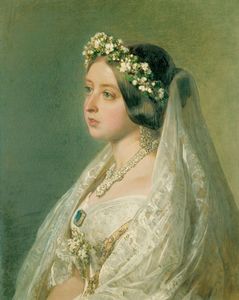
Albert, dressed as a British Field Marshal, entered the chapel first, and awaited Victoria, who walked down the aisle on the arm of her uncle, the Duke of Sussex. Her dress (viewable in the London Museum) was of her own design and fairly simple, of British-made white satin with a trim of orange blossoms. Her veil, worn with a wreath of orange blossoms, was literally one of a kind: it was made by lacemakers in Devon, and the design was destroyed so that the pattern could never be copied. She wore her Turkish diamond necklace and earrings and a sapphire brooch Albert gave her as a wedding present.

There were a multiplicity of clergy on hand, with the Archbishops of Canterbury and York and the Bishop of London all there to officiate. What there hadn’t been was a rehearsal, so that the dowager queen Adelaide was heard whispering to Albert about the proper order of the procession, and Victoria’s twelve bridesmaids (dressed in simple gowns also of Victoria’s design, with wreaths of white roses on their heads) struggled to hold onto the queen’s short train without stumbling over each other. Though Albert often seemed unsure and agitated—his English was not very good at this point, so following the service may have been difficult—Victoria was poised and calm and, as she wrote in her journal, “so very happy!” There were amusing family touches, too: Victoria’s uncle the Duke of Cambridge kept up a very audible, if cheerful, commentary on the proceedings. Her uncle Sussex, who gave her away, still wore his customary black skullcap which he always wore to keep his head warm. And like many mothers of brides, the Duchess of Kent was seen to shed tears.

After the ceremony the married pair returned to Buckingham Palace for a small wedding breakfast (relatively speaking) of family members and their households, the prime minister and a handful of cabinet members, the Royal Household, and the Archbishop of Canterbury and the Bishop of London. Over a hundred wedding cakes were made, to distribute to various family members, Royal Household members, officers of state, and foreign ambassadors. The main cake was nine feet across and sixteen inches high, and decorated with all sorts of allegorical symbols of marriage and of the queen…oh for a photograph! And then it was time to change (Victoria wore a white satin cloak trimmed with swan’s down and a white velvet bonnet with plumes and Brussels lace) and head off to Windsor for their two-day honeymoon. Yes, two days. As Victoria reminded Albert, “You forget, my dearest Love, that I am the Sovereign and that business can stop and wait for nothing.” Not even true love, it seems!

Friday, June 6, 2014

How Did 19th Century Pioneer Ladies Say "I Do"?

What is it about June and weddings? Once held to be the luckiest month in which to marry, it’s still one of the most popular times here in the U.S., with the best venues, caterers, and photographers booked more than a year in advance.  And of course weddings are so romantic, the joy of a couple pledging their lives to each other.  Sigh.

I’ve written about more than one wedding in my twenty-seven published stories set in early nineteenth century England, from grander affairs in a church to eloping to Gretna Green and being married by a so-called “anvil priest,” otherwise known as a blacksmith. The service in the Book of Common Prayer, the manual for the Church of England, is relatively easy to find online for the time period. Very helpful authors and researchers can provide detail on the wedding breakfast or the wedding gown, as in the lovely post this week by author Katherine Givens.   

But now I’m writing about a wedding ceremony in pioneer Seattle, 1866 to be exact.  And the details are sketchy to say the least.

Certainly the East Coast magazines were full of advice to new brides.  I can find pictures from Godey’s Lady’s Book and Magazine that look not too different from what we’d expect--yards of white satin with lace trimmings, embroidered bodices, long sheer lace veils that flow from the head to past the hips, orange blossoms in the hair.  Godey’s even advises what to include in the trousseau:  six trimmed cambric petticoats, four morning wrappers (two cambric, two of wool in a neutral color), plain handkerchiefs embroidered with your initials, a neutral-colored traveling dress finished with heavy silk cord with matching cloak and bonnet, and three silk dresses for morning calls. I can hear my brave pioneer ladies laughing now.

So, how did a lady say “I do” in the early days of Washington Territory?  There were two churches in 1866 Seattle, called the brown church and the white church because of the colors they were painted rather than using grander names that signified their denominations. They each had an officiating minister, but the ministers were known for traveling other places to marry folks. There’s an account of the Reverend Daniel Bagley marrying one young couple in his study. At least one pioneer lady recalled marrying in the Occidental Hotel. Vows appear to be a mere “I do” responding to the minister’s list of duties for husband and wife. 
 Of course, even that can be quite romantic, with the right gentleman at your side!

Tuesday, April 26, 2011

Royal Weddings Part 6: George, Duke of York and Princess Mary of Teck

I’m starting our final week of Royal Wedding month with the 19th century royal wedding that most resembles this current week’s event: the 1893 wedding of Prince George, Duke of York (and grandson of the reigning monarch) and his bride Princess Mary of Teck.

What’s interesting about this wedding is the fact that George was not the first person Mary was engaged to marry. In December 1891 George’s older brother Eddy, Duke of Clarence, had proposed to Mary, who’d more or less been chosen for him by the Queen. Eddy was not known to be terribly stable or intelligent, while Mary was both—it was thought that she might improve him as he was, after all, in line for the throne after his grandmother and father. But only weeks after their engagement, Eddy was dead of pneumonia following an attack of the flu.

Queen Victoria, however, had decided that her great-niece Mary (a descendent of her father's younger brother, the Duke of Cambridge) was too good to be allowed to slip away, and encouraged a match between her and Eddy’s younger brother George, now second heir to the throne. Her wish was eventually granted, and a little more than a year after Eddy’s death (and after a lot of public speculation as to whether they would or not and doubts on both their part), George and Mary were engaged. Happily, their doubts proved groundless, and they became a devoted if not very demonstrative couple, Mary indeed proving to be a source of strength for her husband, just as the Queen had foreseen.


Their wedding, in the Chapel Royal at St. James's Palace, was attended by a large crowd of royalty, among them the recently engaged Alix of Hesse and her fiancé, Tsarevitch Nicholas of Russia. The weather was perfect, hot and sunny but with a breeze, and Londoners turned out in droves to watch the spectacle. Mary's ten bridesmaids (including two of George's sisters and several cousins) rode to St. James's in open carriages to the delight of spectators. The Queen was a spectator, and wrote in her journal about the wedding "Dear May looked so pretty & quiet and dignified. She was vy. simply and prettily dressed--& wore her mother's lace veil. The bridesmaids looked vy. sweet in white satin, with a little pink & red rose on the shoulder & some small bows of the same on the shoes.... Georgie gave his answers distinctly...while May, though quite self-possessed, spoke vy. low."

After the service, which was performed by the Archbishop of Canterbury, the Bishop of London, and a handful of other bishops, a luncheon was served back at Buckingham Palace, and at 5 pm the couple left Buckingham Palace for Sandringham, the country estate of the Prince of Wales, for their honeymoon--an odd choice, as it had been the place of Prince Eddy's death just the previous year. They would eventually settle in York Cottage on the grounds of Sandringham, and not quite a year later, the couple's first child would be born--a son who would grow up to be King Edward VIII and give up his throne in order to marry Wallis Simpson.

Tuesday, April 19, 2011

Royal Weddings, Part 4: Albert Edward, Prince of Wales, and Princess Alexandra of Denmark

Our latest royal wedding wasn’t precisely a love match like Vicky and Fritz’s, but as royal marriages go managed, after a few rocky years, to be a successful one, based on mutual respect and affection. I’m talking about the match between “bad boy” Bertie, eldest son of Queen Victoria and Princess “Alix” Alexandra of Denmark.

Finding a bride for Bertie, the twenty-year-old future king of England, was of course a very important issue. Victoria was in the depths of mourning first for her mother, then for her beloved Albert who’d died in December 1861 (and whose death she partly blamed on poor Bertie's misbehavior with an Irish "actress"), so Bertie’s elder sister Vicky, now Crown Princess of Prussia, stepped in to find a suitable bride for her brother.
She found the young and beautiful Alexandra of Denmark, known as Alix to her family. Although their first meeting didn’t precisely result in sparks, neither outright refused to consider marriage, and a year later, on their second meeting (and after much behind-the-scenes discussion and negotiation), Bertie proposed in September 1862, with the wedding to take place on March 10, 1863. Though traditionally the marriage should have taken place in the bride’s home, Victoria would not hear of her heir being married anywhere but London, and so in London it was.

Because the Queen was still in the deepest mourning, the wedding was held at St. George’s Chapel at Windsor. The small venue meant that only Alix’s closest family members were invited, and Bertie was limited to inviting six friends. Holding the wedding at Windsor also denied Londoners the spectacle of the wedding of the heir to the throne, but the Queen would not hear of a more public wedding. Court mourning also decreed that female guests could wear only secondary mourning colors like mauve or grey, which must have been a bit of a disappointment.

Alix’s dress was of white and silver satin, decorated with garlands of greenery; Bertie wore a general’s uniform under his Garter robes. But most of the eyes were on the Queen in a balcony overlooking the altar; she seems to have played somewhat shamelessly to the crowds, making it clear that witnessing what was supposed to be a joyous event was terribly painful to her (“I dread the whole thing awfully, & wonder even how you can rejoice so much at witnessing what must I should think be to you, who loved Papa so dearly, so terribly sad a wedding,” she wrote to her eldest daughter Vicky a few weeks before the happy event.) The Archbishop of Canterbury officiated, operatic star Jenny Lind sang, and Bertie’s nephew, Vicky’s eldest son, four-year-old Willy (later Kaiser Wilhelm II), behaved very badly, crawling about and biting people.

A wedding breakfast for five hundred was held under a tent (fortunately the weather was sunny at this point) with another enormous cake, and then the bride and groom went away to dress for their wedding journey to Osborne House on the Isle of Wight. “Ah, dear brother, what a sad and dismal ceremony it was!” the Queen wrote later to the King of Prussia.

Tuesday, April 12, 2011

Royal Weddings, Part 3: Princess Victoria and Prince Friedrich of Prussia

Our next royal wedding is that of Princess Victoria the Princess Royal, eldest daughter of Queen Victoria, and Prince Friedrich Wilhelm of Prussia, the future Emperor and Empress of Germany…and known within their families as Vicky and Fritz. As we have seen, the match between these two was truly a love match, and they remained devoted all their lives. In fact, they became semi-secretly engaged—family were informed, but it wasn’t widely announced—when Vicky was not quite 15. As Fritz was nine years her senior, she must have been quite a young lady to enchant a more-or-less grown man, and a very eligible one to boot.

Since her parents decreed that she should not marry before she was seventeen, Queen Victoria had plenty of time to gather Vicky’s trousseau…which she did with a vengeance. In the end, 100 hundred packing cases of everything from clothing (dozens of dresses and fabric for dozens more) to housewares (from carpets to wallpaper to furniture) to dainties from Fortnum and Mason and saddles. Parliament granted her a dowry of £40,000, which would generate her an income of £8,000 per year. Although the Prussians wanted their future king to be married in Prussia, the Queen would not hear of it, and the wedding was set for January 25, 1858, in London.

According to her former governess, Vicky was wonderfully calm and composed all through the fuss of dressing and preparing. Her dress was of white silk moire over a flounced lace petticoat, decorated with sprays of orange blossom and myrtle. Her veil was held on with a matching wreath, and she wore diamonds. The Queen wore lilac, while the mother of the groom, Princess Augusta, wore white with a blue velvet train, and Fritz himself wore the dark blue tunic and white trousers of the Prussian Guards.

Unlike her mother’s wedding day, the weather was clear and sunny for Vicky, and the roads between Buckingham Palace and St. James’s Chapel were thronged with onlookers. The wedding itself seems to have run smoothly: Vicky’s train was long enough that her eight bridesmaids didn’t have to worry about tripping over each other, and while according to the Queen the Archbishop of Canterbury was “very nervous”, the bride and groom themselves were poised and spoke “very plainly”. And when the vows were said, the young couple set a tradition, walking out of the chapel to the strains of Mendelssohn’s Wedding March. They also set a precedent by stepping out onto the balcony at Buckingham Palace to wave to the cheering Londoners.

If Victoria and Albert’s cake was enormous, their daughter’s was no smaller: it stood over six feet tall, and quite hid them from view at the wedding breakfast! Also like her mother, Vicky’s honeymoon at Windsor was a short two days, after which her parents and dozens of other wedding guests arrived. And by February 1, Vicky was sailing away with her new husband for her new life as a Prussian Crown Princess—a life which would often be difficult for the warm-hearted young girl.

Friday, January 15, 2010

May I Have the Honor of Hopping the Broom--Part II

Thanks for all your interest in eloping to Scotland! Just as people run away to Vegas to marry in a hurry these days, Scotland was the place to go in the nineteenth century if you wanted to be married quickly, no questions asked.

In Scotland, you didn’t have to be a minister to perform a legal wedding ceremony; in fact, you could be married by anyone, as long as you had two witnesses. In some areas, merely tying hands together (handfasting) or jumping over a decorated broom (the besom) was enough to declare you husband and wife. When a toll booth was built on the border late in the nineteenth century, people just stopped there and asked the booth guard to marry them!

Most of them, however, ventured into one of the border towns. One of the first towns over the border on the main road from London was Gretna Green, and the closest and most prominent landmark was the blacksmith’s shop where five major coaching roads met. The blacksmith, along with a number of other fellows in town, were willing and able, for a fee, to perform a marriage, so they all became known as anvil priests.

None was more famous than Joseph Paisley. He was the original blacksmith who set up the marriage market in Gretna Green in the late 1700s. A large, coarse fellow, he conducted his ceremonies with the least amount of effort. Legend has it he once married two couples at the same time, but inadvertently paired the wrong bride and groom. When they protested, he waved his beefy hand and told them to “Sort it out among yourselves.”

His nephew David Lang also married couples, but he opted for a more official air and went around dressed somberly like a minister, though he had no claim to the title. His son Simon took over the trade when his father passed away in 1827 and continued practicing until 1872. The Lang family recorded over 10,000 marriages from 1795 to 1895.

Would you do it? Would you risk scandal, run away, and have a fat sooty fellow clang his hammer on the anvil and proclaim you married? Would a Gretna Green marriage or hopping the broom in Scotland be enough romance for your wedding day?

Friday, June 27, 2008

Dearly Beloved

“Oh they say when you marry in June
You’re a bride, all your life.
And the bridegroom who marries in June
Gets a sweetheart for a wife.”
Johnny Mercer and Gene de Paul, Seven Brides for Seven Brothers

The song isn’t exactly nineteenth century, though the setting was 1850 Oregon, but the sentiment still rings true. June is the time for weddings!

A young lady in nineteenth century England could be married as early as twelve and a young man as young as fifteen, with parental permission. Thankfully, usually only royalty married that young and then only to cement friendships between countries or ensure royal bloodlines would be kept intact. The age of consent, when you could marry without parental permission, was twenty-one for women and twenty-five for men.

Most girls married somewhere between sixteen and twenty-five. How they married differed greatly from the beginning of the century to the end. Before Marissa’s beloved Queen Vic, weddings were in the morning (before noon), and more often in the home or garden of the bride, groom, or a relative than in a church. Wedding dresses weren’t necessarily white or very fancy; they were simply stylish day dresses. And the only attendants needed to be two people in good standing in the Church of England to witness the exchange of vows.

During Queen Victoria’s reign, weddings became more elaborate affairs, with bridesmaids, groomsmen, flower girls, ring bearers, and the like parading down the aisle. The gorgeous white dresses came into fashion and never left. They too grew more bejeweled, reribboned, and bedecked with the passing years, as you can see by our progression of pictures.

And speaking of weddings, today happens to be Marissa’s wedding anniversary! Join me in wishing her and her dear one a very happy day! Blessings on you, my dears! Here’s to many, many more!

P.S. Stop by the Class of 2K8 blog where we've been interviewing YA and MG book reviewers, with an opportunity to win a book on each post (We're giving away 11 book in all!). Leave comments before June 29th to be entered.

P.S.S. If you find yourself misty eyed at the thought of June brides, check out my June release from Regency Reads, Be My Bride, a collection of three stories in which three dashing gentlemen find that it takes a small black kitten, three incorrigible boys, and a master French spy to win their lady loves.