Showing posts with label travel. Show all posts

Tuesday, March 7, 2023

Retro Blast: Queen Victoria Goes to Kokomo


I wish I were going somewhere warm where one can unironically drink things with slices of pineapple and little umbrellas stuck on top! It's the time of year when spring seems so close, but still so far...an opinion shared by Queen Victoria. Enjoy!

* * * * *

Well, not quite. But sort of. :)

I’m lucky enough to be looking forward to a visit to warmer climes in the near future—when you live in the chilly north, a few days spent in a place where it’s not necessary to wear heavy down coats is a Very Good Thing.

I’m not the only one to think so. Queen Victoria started taking an annual holiday somewhere in sunny southern Europe, usually for six or seven weeks from the beginning of March to mid-to-late April. Her first trip, in 1879, was shortly after the death of her daughter, Princess Alice; the Queen felt that she needed a complete change of scene, and decided it was high time she visited Italy, which she had never seen. She was lent a villa, Villa Clara, at Baveno, on Lake Maggiore, which though close to the Alps has a mild, Mediterranean climate year round.

The Queen was delighted with her decision. The scenery was gorgeous (though she invariably compared it to Scotland), so she spent a lot of time sketching and painting watercolors, went boating on the lake all the way up to its end in Switzerland, visited Milan to see the artwork (not a success as she was mobbed while visiting the cathedral). It whetted her appetite for more travels, and three years later, she went to the French Riviera, a trip that eventually became an annual event.

Her first visit there was to Menton, where she saw the Mediterranean for the first time. Once again she compared the scenery to Scotland, but as anything that reminded her of Scotland was definitely a good thing, it was high praise indeed. She was an indefatigable sightseer, taking little trips to Monte Carlo (though not to gamble) and other places, with her English coachman and Scottish servant, John Brown, in full Highland regalia (how the sight must have bemused the French!)…perhaps to visit a quaint nunnery, or a pottery factory, or to have a picnic in a secluded spot by the side of the road. In future years she stayed at Hyères, Grasse, and Cannes before finally settling on the Hotel Excelsior Regina (it added the “Regina” to its name with the Queen’s permission), in Cimiez, Nice. She always travelled “incognito” as the Countess of Balmoral, which of course fooled nobody but permitted her to avoid making visits of state—this was, after all, supposed to be a vacation. Family members descended on her for visits while on their own winter vacations, so that at times the poor Queen was quite exhausted from entertaining.

Her last visit was in 1899; the Boer War kept her home the following spring, which was her last before her death in January 1901. I’m sorry she had to miss that last year; she took great delight in her annual visits south, away from “the sunless north”. I know I’ll enjoy mine!

Friday, October 11, 2019

Glamping in the Trees: Storybook Perfect!


I recently had a birthday, turning over another decade. And I wanted to do something special. Some poking around for opportunities led me and my husband into the woods to the north of us, to Treehouse Place at Deer Ridge, near Lake Stevens, Washington. I thought you might get as big a kick out of visiting as I did.

To start out, the approach to the house begins on Sasquatch Lane. (Big fan of Sasquatch, the Ape Man of the Northwest—have been since I was a kid.)

You climb up through the trees on a lighted path.

Until you see the house.


Now, it’s not completely up in the trees, but it’s on the edge of a hill, so the view out truly makes you feel as if you were singing with the birds.


Inside, it’s a darling cabin. Here's the main floor. Yes, that’s a soaker tub.


Bedroom.


An Alexa is available to dim the lights for you. My husband and I got a big kick out of telling her what to do and asking questions. She answered my husband back more than she did me. Hmmm. 

If you need more to stimulate you, nearby Lake Stevens is gorgeous too!


Treehouse Place at Deer Ridge is on Airbnb and was mentioned in USA Today. If you’re in the area, I highly recommend. For this writer, it was storybook perfect. 😊

Tuesday, August 7, 2018

Quiz: Where is Marissa Going?


Today’s post is an abbreviated one, because I’m presently scurrying around folding and packing and otherwise getting ready to get on a airplane later on this evening. I’ll be gone ten days, so next week’s post will be a “blast from the past” while I’m off gallivanting with my DH. This trip is our belated 30th anniversary celebration (because we’ve now been married 31+ years!) but well worth the wait.

Where are we going? We’re going to—

Hmm. Nope. Not gonna make it easy. You’re going to have to take a quiz to figure out where we’re headed, partly because it's a fascinating place and partly because I'm a tease. 😉 

Are you ready? Here it goes...
  • This place is one of the breeding grounds of a well-known type of bird sometimes called the ‘sea parrot.’
  • The name of a certain location in this place, Geysir, has become the word for all other places of a similar type.
  • The language spoken here still bears a strong resemblance to its early medieval form.
  • One of the world’s oldest Parliaments, the Althing, dating to the tenth century AD, meets here.
  • This place is one of the two locations on earth where you can see the meeting of two tectonic plates above the surface of the earth.
  • There are no mosquitoes here!
Any guesses?

I'll be back the week after next with lots of pictures of my mystery location...see you then!  😘

Tuesday, August 23, 2016

Blast from the Past: Mr. Pocock Rides Again (Sort of) (Again)

I still need to figure out a way to incorporate the Charvolant into a story...

It’s amazing what you can find when you clean out a bookcase.

Recently my mother was doing just that, and found an old issue of Heritage, the British history magazine, from February/March 1990. Naturally she saved it for me so that I could put it in my overburdened bookshelves...and while flipping through it, I ran across an article entitled “Pocock’s Flying Carriage”. The story was wonderful, and the name was familiar. Hmm, yes, we have met a Mr. Pocock before, haven't we...however, it seems to have been a different Mr. P.

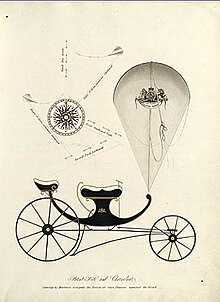
That Mr. Pocock (William) was, it seems, a London furniture-maker and known for his interest in patent furniture—designs that involved clever, ingenious mechanizations as we saw with his Reclining Patent Chair. Perhaps there’s something to the name that dooms its bearers to be inveterate tinkerers, because another Mr. Pocock, this time a George, was inventing at the same time...and went far beyond furniture. You see, that Mr. Pocock was the proud inventor, in the 1820s, of the Charvolant, or Flying Car.


George P. (1774-1843) was a schoolmaster in Bristol who liked to invent things on the side. One of his inventions, a spanking machine (the “Royal Patent Self-acting Ferule”) which could punish several misbehaving schoolboys at once, had something to do with his teaching vocation (I wish I could find a picture of it!)...but evidently, Mr. Pocock was also fascinated by kites. He spent his youth experimenting with the power of kites, and induced a trusting friend to squat on a makeshift sled attached to kites. The friend ended up dragged away faster than George could follow on foot and was eventually tumbled into a quarry (uninjured, fortunately) but young George was even more hooked by kite power.

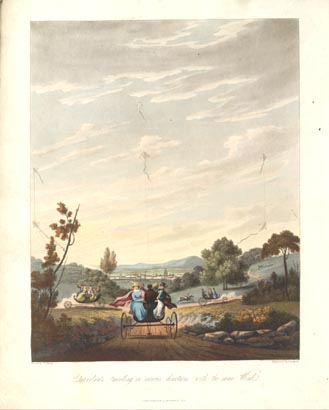
More experimentation followed, fortunately with no fatalities—that included launching his own daughter 300 feet into the air in a kite-drawn chair. Of course, you knew what would come next: kite-powered carriages. He spent several years working on his Charvolants, and finally in 1826 registered a patent. In 1828 he demonstrated a Charvolant at Ascot to King George IV, and was soon running demonstration races, beating the London coach in a race from Bristol to Marlborough by twenty-five minutes (after giving the coach a 15 minute head-start.) His Charvolant could travel as fast as twenty miles per hour, and the ride was much smoother and quieter than a horse-drawn vehicle—in fact, a Charvolant driver blew a bugle to warn vehicles it was overtaking, because of its quietness.

Charvolant travel was also much cheaper than travel utilizing horses: wind was free, after all, while horses were expensive to maintain and had to be changed on journeys of more than fifteen to twenty miles. And, amusingly, Charvolants could travel the turnpikes free. Tolls were charged at toll-gates based on the number of animals drawing any given vehicle...and Charvolants were notably draft-animal free. Though critics scoffed that a Charvolant would be grounded on a windless day, Mr. Pocock remained unruffled and replied, “Ships might be objected to on this principle—that there were sometimes calms, or contrary winds.”

Alas for Mr. Pocock, though, his timing was bad. Despite the interest his Charvolants generated, another new mode of transportation generated even more interest and would soon doom the Charvolant to a sidenote in transportation history: the railway.

Tuesday, October 20, 2015

Green and Pleasant Land, Part 7: Last Stop, Hampton Court—and Where I’m Going Next Time

Our final stop on the Doyle Family Tour of Southern England meant leaving Brighton (sigh!) after breakfast and heading for our last stop: we had plans to spend the day at Hampton Court Palace before heading to Heathrow Airport (a short drive away) and back home to Massachusetts.


I had visited Hampton Court on my last visit to England, but had only had time to see a small portion of it. Today we had a good five hours, and we still didn’t see all of it—much less the gardens, which would take a full day just on their own.

Hampton Court has seen centuries of use, from the early sixteenth century through the present day. It was built as a country retreat by Cardinal Wolsey, advisor to King Henry VIII—to whom he gave the palace as a gift when Henry’s favor had turned to Anne Boleyn and her political faction. Henry expanded the palace and did a lot of redecorating for Anne, including putting their entwined initials everywhere...which he had to hastily redo a few years later on divorcing (and beheading) Anne and marry Jane Seymour instead. The area where Henry’s kitchens were located have been restored to their former culinary use, which was pretty awesome to see.

After viewing all the Tudor areas (including his private Chapel and ) we visited the Jacobean and Hanoverian bits as well, viewing portraits and furniture and generally being staggered at the sheer size of this place. George II was really the last English monarch to used Hampton Court as a royal house; George III disliked it intensely, and instead rebuilt Windsor and Buckingham House for his family, and Hampton languished for a while until someone hit on the bright idea of using it as a sort of retirement village for old royal retainers and others who had done some service to the crown or country. It housed hundreds of people through the nineteenth and all the way up to the late twentieth centuries; though apartments stopped being given out in the late 1980s, a few residents linger on.

We had a delightful tea in one of the courtyards before departing for the airport and home...but I’m already plotting my next trip to England. Where will I go?
  • London, to visit the places I didn’t get to this time: Sir John Soane’s House, the Burlington Arcade, and Kensington Palace.
  • Absolutely back to Dartmoor. This time I might want to stay at Lewtrenchard House, former home of a well-loved clergyman and specialist on Dartmoor history and folklore (and author of the hymn, “Onward Christian Soldiers”) Sabine Baring-Gould.
  • Back to the Jurassic Coast...to Lyme Regis, but also to Sidmouth, which is rife with some awesome Regency architecture.
  • The Isle of Wight (and this time we’ll make ferry reservations!) to see Osborne House as well as the well-preserved Roman ruins there.
  • And then, north! A brief stop in Cambridge, to revisit where I spent one summer at Christ’s College, and York, which is one of the most delightful cities in England, and finally on to the Lake District to stay on Ullswater and do some more tramping about the countryside.
Thank you for following along on my trip...now, where in England would you like to go?

Tuesday, September 15, 2015

Green and Pleasant Land, Part 5: Lyme Regis

We hated to leave Dartmoor. We really did. But I’d promised Daughter #2 some fossil-hunting on the beach in Lyme Regis. Those of you who are Jane Austen fans will recognize that name, I’m sure...so we once again set forth, this time for the shore.

Best pub name spotted en route: The Salty Monk. ☺

Lyme Regis itself is a charming little town, clinging closely to the shore. And I don’t use the term “clinging” lightly—there’s a heck of a drop from the main road through town to the beach itself. Blessedly, there’s plenty of visitor parking, though it did involve a very steep walk down to the shore—not bad on the way down, but uphill was definitely a challenge. Thank goodness for all those hours I’ve spent on the elliptical!

The climate of the immediate south coast of England is amazingly mild. We hardy New Englanders were astonished to see fuchsia grown as a hedge, rather than a summer-time potted plant doomed to death in the first good October frost!

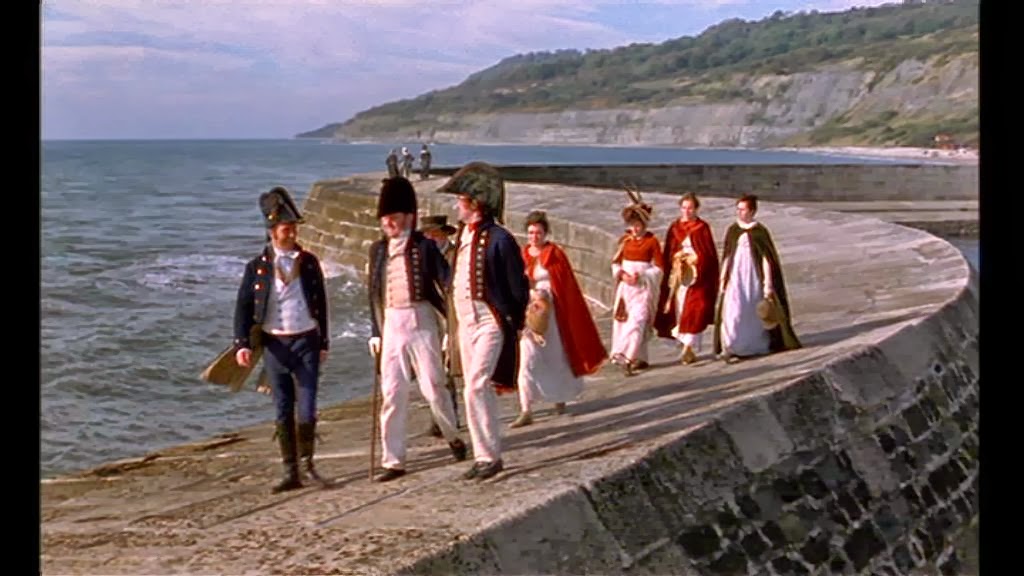
As we trundled down the hill, we were delighted with this view of the famous Cobb... famous, of course, as the location of an important scene in Persuasion—where Louisa Musgrove imprudently jumps the stairs leading down from its top. The Cobb is a partial breakwater, creating a small, protected harbor for the local fishing fleet—though now, the main denizens appear to be pleasure craft.

What I found interesting about the Cobb was the angle at which it was built: good for allowing breaking waves to run off, but a little unnerving to walk on, especially in a brisk breeze (that's Daughter #1, walking at an angle!) But even more interesting was the thought that Jane Austen knew this town and this very place—a bit of a shiver down the spine moment!

Being good Jane Austen fans, my son and husband and I spent a good long time debating which of the stairs leading down from the Cobb were the ones that Louisa jumped from. In the end, we decided it must be these (also known by the name "Granny's Teeth"!), as they were the most suitably archaic and untrustworthy looking (honestly, if I’d been Louisa, I might have preferred jumping rather than trying to negotiate them in a stiff breeze in a long skirt!

Next, it was time to go fossil hunting. This whole 95-mile section of the south coast is called England’s “Jurassic Coast”. Going east from Orcombe Point to Old Harry Rocks is like traveling in time, from the early Triassic period onward. Lyme Regis is located in the oldest part of the coast, its formations dating to 200 to 195 million years ago. Down the beach from the Cobb a great cliff face looms up, made of very crumbly black shale, the remains of an ancient ocean bed (you can see it in the pictures above of the Cobb.) And as gravity and the weather erode it, the fossils of creatures that died and left their remains in the oozy black mud of that old ocean end up on the beach, where they can be picked up from amongst the clitter of rocks and flints by geeky American tourists like us.

Here's part of our haul.
What you see here are ammonite fossils, distant and extinct relatives of today’s squid and nautiluses; the little star-shaped one is possibly an echinoid, a relative of today’s starfish and sea urchins. It was a lot of fun, actually, and reminded me of my long-ago days as an archaeology student doing field surface surveys. We had a lovely if late lunch at a pub close to the Cobb, then dragged ourselves back up the hill to our car, to go to our next destination. But I’ll be back to the Jurassic Coast some day.

Next installment: Not the Isle of Wight, sadly, but a few other sites of interest.

Tuesday, September 8, 2015

Mr. Pocock Rides Again (Sort of)

It’s amazing what you can find when you clean out a bookcase.

Recently my mother was doing just that, and found an old issue of Heritage, the British history magazine, from February/March 1990. Naturally she saved it for me so that I could put it in my overburdened bookshelves...and while flipping through it, I ran across an article entitled “Pocock’s Flying Carriage”. The story was wonderful, and the name was familiar. Hmm, yes, we have met a Mr. Pocock before, haven't we...however, it seems to have been a different Mr. P.

That Mr. Pocock (William) was, it seems, a London furniture-maker and known for his interest in patent furniture—designs that involved clever, ingenious mechanizations, as we saw with his Reclining Patent Chair. Perhaps there’s something to the name that dooms its bearers to be inveterate tinkerers, because another Mr. Pocock, this time a George, was inventing at the same time...and went far beyond furniture. You see, that Mr. Pocock was the proud inventor, in the 1820s, of the Charvolant, or Flying Car.


George P. (1774-1843) was a schoolmaster in Bristol who liked to invent things on the side. One of his inventions, a spanking machine (the “Royal Patent Self-acting Ferule”) which could punish several misbehaving schoolboys at once, had something to do with his teaching vocation (I wish I could find a picture of it!)...but evidently, Mr. Pocock was also fascinated by kites. He spent his youth experimenting with the power of kites, and induced a trusting friend to squat on a makeshift sled attached to kites. The friend ended up dragged away faster than George could follow on foot and was eventually tumbled into a quarry (uninjured, fortunately) but young George was even more hooked by kite power.

More experimentation followed, fortunately with no fatalities—that included launching his own daughter 300 feet into the air in a kite-drawn chair. Of course, you knew what would come next: kite-powered carriages. He spent several years working on his Charvolants, and finally in 1826 registered a patent. In 1828 he demonstrated a Charvolant at Ascot to King George IV, and was soon running demonstration races, beating the London coach in a race from Bristol to Marlborough by twenty-five minutes (after giving the coach a 15 minute head-start.) His Charvolant could travel as fast as twenty miles per hour, and the ride was much smoother and quieter than a horse-drawn vehicle—in fact, a Charvolant driver blew a bugle to warn vehicles it was overtaking, because of its quietness.

Charvolant travel was also much cheaper than travel utilizing horses: wind was free, after all, while horses were expensive to maintain and had to be changed on journeys of more than fifteen to twenty miles. And, amusingly, Charvolants could travel the turnpikes free. Tolls were charged at toll-gates based on the number of animals drawing any given vehicle...and Charvolants were notably draft animal-free. Though critics scoffed that a Charvolant would be grounded on a windless day, Mr. Pocock remained unruffled and replied, “Ships might be objected to on this principle—that there were sometimes calms, or contrary winds.”

Alas for Mr. Pocock, though, his timing was bad. Despite the interest his Charvolants generated, another new mode of transportation generated even more interest and would soon doom the Charvolant to a sidenote in transportation history: the railway.

Tuesday, May 19, 2015

Where's Marissa?

Just so you know, I’m not really here.

Okay, that’s rather a cryptic statement. But as you’re reading this, I am happily traipsing around England with my family. We’re doing a whirlwind tour of southern England, starting in London and progressing through Oxford, Bath, Dartmoor, then along the south coast from Lyme Regis to the Isle of Wight and Brighton, then back to London and home. Believe me, you’ll hear all about it here on NineteenTeen in the coming weeks--I can’t wait to get back to Bath...and go fossil hunting in Lyme Regis...and I’m dying to see the Royal Pavilion (that's it above)! As you might guess, there's just a bit of a Regency slant to the places we're visiting.

Something else I’ve been anticipating for a long time is also happening right now. One of my favorite books (definitely in my all-time top five), Susanna Clarke's Jonathan Strange and Mr. Norrell, has been made into a television mini-series by the BBC.

Now, ordinarily, I would cringe—I don’t watch any TV apart from an occasional movie on DVD (hey, watching TV wastes valuable writing time!) But it actually looks like they managed to nail this 800-page glorious behemoth of a novel. It’s about an alternate Regency-era England in which magic exists, though fallen from use...until a pair of magicians arise and try to resurrect English Magic...and nearly destroy each other in the process. It’s full of a delightfully dry humor (like when Jonathan Strange temporarily moves Brussels across the Atlantic on the eve of the Battle of Waterloo to keep it safe from Napoleon), features marvelous world-building and the occasional 3-page footnote, and is just a giant confection of a book for lovers of historical fantasy. And it’s airing in Britain right now (coming to the US in July) so I’ll have a chance to catch the first two episodes while I’m here! In the meanwhile, check out the trailer:


See you soon!

Tuesday, February 5, 2013

Queen Victoria Goes to Kokomo

Well, not quite. But sort of. :)

I’m lucky enough to be looking forward to a visit to warmer climes in the near future—when you live in the chilly north, a few days spent in a place where it’s not necessary to wear heavy down coats is a Very Good Thing.

I’m not the only one to think so. Queen Victoria started taking an annual holiday somewhere in sunny southern Europe, usually for six or seven weeks from the beginning of March to mid-to-late April. Her first trip, in 1879, was shortly after the death of her daughter, Princess Alice; the Queen felt that she needed a complete change of scene, and decided it was high time she visited Italy, which she had never seen. She was lent a villa, Villa Clara, at Baveno, on Lake Maggiore, which though close to the Alps has a mild, Mediterranean climate year round.

The Queen was delighted with her decision. The scenery was gorgeous (though she invariably compared it to Scotland), so she spent a lot of time sketching and painting watercolors, went boating on the lake all the way up to its end in Switzerland, visited Milan to see the artwork (not a success as she was mobbed while visiting the cathedral). It whetted her appetite for more travels, and three years later, she went to the French Riviera, a trip that eventually became an annual event.

Her first visit there was to Menton, where she saw the Mediterranean for the first time. Once again she compared the scenery to Scotland, but as anything that reminded her of Scotland was definitely a good thing, it was high praise indeed. She was an indefatigable sightseer, taking little trips to Monte Carlo (though not to gamble) and other places, with her English coachman and Scottish servant, John Brown, in full Highland regalia (how the sight must have bemused the French!)…perhaps to visit a quaint nunnery, or a pottery factory, or to have a picnic in a secluded spot by the side of the road. In future years she stayed at Hyères, Grasse, and Cannes before finally settling on the Hotel Excelsior Regina (it added the “Regina” to its name with the Queen’s permission), in Cimiez, Nice. She always travelled “incognito” as the Countess of Balmoral, which of course fooled nobody but permitted her to avoid making visits of state—this was, after all, supposed to be a vacation. Family members descended on her for visits while on their own winter vacations, so that at times the poor Queen was quite exhausted from entertaining.

Her last visit was in 1899; the Boer War kept her home the following spring, which was her last before her death in January 1901. I’m sorry she had to miss that last year; she took great delight in her annual visits south, away from “the sunless north”. I know I’ll enjoy mine!

Friday, November 18, 2011

The Grand Tour, Part 1: Planning


First, I’m very pleased to announce that Beebs won my second chance copy of An Honorable Gentleman. The Random Number Generator does not lie, even though its choice was oddly fitting since she also guessed right but lost out in the first chance! Beebs, contact me at reginascott@owt.com with your mailing address, and I’ll send it right out to you.

During our birthday house party, Lo suggested that we talk about activities on the Continent, such as the Grand Tour. As the Grand Tour was rather, well, grand, I’m planning for the topic to take a few posts to relay, and I’ll be sprinkling them in between now and spring.

To start out with, the Grand Tour came to be the term used for a trip a young man took to complete his education in the nineteenth century, sort of the senior road trip some take today. Only this trip took considerably more than roads to accomplish!

The general purpose of the Grand Tour was exposure. By traveling to foreign climes, the young man would see art, architecture, manners, customs, and cultures different from his own and come back better informed and better able to take part in his own society. The young men were generally gentry or aristocrats, and most often British, although youths from Northern European countries sometimes traveled as well, and there are accounts of Americans and South Americans joining the party.
On your trip, you were expected to view the other cultures, partake only to a certain extent that was proper, and somehow memorialize your impressions, whether through painting, writing a journal, or carting home representative books, artwork, or tokens that would then be displayed with pride the resulting years of your life.

So how did one go about preparing for a Grand Tour? I imagine there was a lot of dreaming involved, discussions with fathers, uncles, and older friends who had gone. Then, as you were finishing Oxford, say, and were between 17 and 20 years of ago, your family would look for a suitable guide to escort you. This guide would be a gentleman of some learning or pretension to the arts who could serve as companion, chaperone, and bodyguard. This paragon came to be called a bear-leader. Your parents paid the bear-leader to take you on your tour and ensure you had an educational, enjoyable, and not too enthusiastic time and that you came home safely, mind expanded, all limbs still intact. If you were wealthy enough, you had your own guide; otherwise you might share with one or two other young men.

The Grand Tour could take several months, or several years, depending on the itinerary and your family’s wealth and willingness to have you away from home. The most common itinerary included time in France (when Britain was not at war with it), Switzerland, and Italy (Rome, Venice, Naples), but might extend to the German States, Spain (when it was not at war), and Greece (if you weren’t afraid to brave the Ottoman Empire). As the nineteenth century wore on, and train travel became more available, more people began to take their own Grand Tours, whether young men from mercantile families or even well-chaperoned young ladies.

So, your families had the good sense to hire you two ladies with reasonable credentials and some experience with literature (cough, cough, Regina and Marissa). Think about where you’d like to go on your Grand Tour, ladies, and perhaps we can plot out an itinerary for the next few months.

Friday, January 14, 2011

It's in the Bag

I nearly hit a wall with my work in progress this week. My hero (you remember the baronet of Blackcliff?) has traveled on horseback in September of 1811 up to an estate he has recently been awarded in the Lakes District. He didn’t intend to stay more than a few days, but circumstances conspire to keep him there a few weeks. During that time, he climbs a mountain, attends services at the local church, and even sweeps the heroine off to the local assembly for dancing. The problem? His suitcase.

When you don’t have a large traveling carriage, your options for packing are limited. English saddles don’t have horns like Western saddles. Saddle bags were more often put on pack horses (which my hero does not own) than riding horses. But the cavalry had some sort of cases that connected to saddles (the picture is of an American one).

Kind of puny, isn’t it?

His problem would be the problem of any young man or lady traveling by horseback or even on the mail coach, where you could only bring so much luggage. And this was still a time when most clothing and footwear were custom-made; not so easy to borrow or buy when you get to your destination, at least immediately. I’m pretty good at packing light, but there’s no way I could fit enough clothes, even with today’s modern packable fabrics, for a variety of activities spanning two or more weeks into a case that size.

So, what did he bring with him?

He’s wearing stockings and boots, trousers, a greatcoat, jacket, waistcoat, shirt, cravat, and hat. He needs a shaving kit. Though it’s a little outside our period (early 1900s), I liked this one made from elephant hide. And he’d have to bring some traveling money with him, which means piles of gold coin (bank drafts aren’t going to work in the wilds of Cumberland). Doesn’t leave a whole lot of room for much else, does it?

The necessities, as I see them, are a nightshirt and a spare shirt, pair of trousers, and a couple cravats so the maid can wash the ones he’s wearing. A spare jacket and waistcoat so he can change up his look a bit would be nice, but that may be straining credibility. But dancing shoes? Not making the cut. Nicer outfit for church? Not going to happen. Spare boots to climb that mountain? Nah.

If you had two small bags for a young nineteenth century gentleman, what would you put in them?

Tuesday, November 10, 2009

If it's November, this must be Balmoral

Queen Victoria, footloose and fancy-free?

Well, yes. As Queen of the United Kingdom, Victoria either had use of or personally owned dozens of houses and palaces. While the official home of the kings and queens of the UK is Windsor Castle, Victoria spent her childhood at the royal palace of Kensington and the early years of her reign at Buckingham Palace, both in London. Wanting a summer getaway home for her growing family, she purchased an 1100-acre estate on the Isle of Wight, where she and Prince Albert built Osborne House (that's it at above right). But Osborne wasn’t the real getaway she’d hoped it would be, so she later purchased a large estate in the Scottish Highlands named Balmoral.

So what did QV do with all these houses?

Amazingly, she lived in them, traveling from house to house several times over the course of the year, much to the dismay of her servants and staff.

Here's how it generally went: Christmas and New Year’s were spent at Osborne; some time in January she would usually return to Windsor (shown at left) and remain there for February. March and April could be spent at Windsor or abroad, in Italy, Switzerland, Germany, or the south of France (the Queen liked to travel “incognito”, calling herself the Countess of Balmoral). Mid May generally saw a quick month-long jaunt to Balmoral, then back down to Windsor or Buckingham Palace if necessary for receiving debutantes at Drawing Rooms during the Season. Mid July saw her back to Osborne for the yachting season at Cowes, then late August sent her to Balmoral till mid-November for the shooting season. Mid-November meant a return to Windsor, then back to Osborne for Christmas and the start of the cycle once more.

Phew! If I’m exhausted just writing this, just imagine how her children, household and servants felt! The queen did not travel lightly; entire trains were required to ferry her and her household and luggage about the countryside. And even up in the remote Scottish Highlands at Balmoral (shown at right), she was still queen: a member of the cabinet always had to accompany her as a representative of the government (they squabbled endlessly about whose turn it was, as few enjoyed the Queen's frigid Scottish home); in addition, the prime minister in office frequently journeyed the roughly 500 miles to consult with her as well. In addition, the special red dispatch boxes containing reports and documents requiring her consideration were sent up daily from London.