Showing posts with label Jane Austen. Show all posts

Tuesday, November 28, 2023

Nineteenth Century Christmas Wish List, 2023 Edition

I hope those of you in the states had a lovely Thanksgiving. The day after, my thoughts always turn to Christmas. So, as I have in years past, I thought I’d share some goodies you might want to put on the gift list for yourself or anyone else who loves the nineteenth century!

An Etsy shop with the intriguing name of Neurons Not Included has a delightful beveled glass ornament showing the spines of Jane Austen’s beloved books.

And if you want to be certain your books are returned to you, you might turn to Pickled Stamps on Etsy for embosser stamps declaring the book’s ownership.

Perhaps you intend to do some entertaining over the holidays. Café Press has some lovely notecards designed to look like an invitation to the Pemberly ball. Who wouldn’t want to attend that! 

And if you need coffee while penning those invites, you might find this mug just the thing to keep you warm. As the temperature of the mug changes with its contents, so does the finery of the ladies on it. 


Then again, what lady would despise reproduction jewelry pieces? Lady Detalle on Etsy has a number of Victorian and Regency reproduction jewelry pieces.  As does Dames Alamode on eBay, although those tend more to the Georgian. 

And I simply have to mention our own Marissa’s Ladies of Almacks magnets and 2024 calendar. I ordered several sets of the magnets this year, as I keep thinking of friends who would love her unique blend of history, fashion sense, and snark.

Remember, if you want to keep up with what Marissa and I are doing, be sure to sign up for our newsletters, which give you access to all kinds of lovely free stories. You can find mine here and hers here.

May all your shopping be hassle-free, and your thoughtful gifts greatly appreciated!

Tuesday, October 17, 2023

Not a Slippery Slope


Here’s a bit of a riddle to introduce today’s topic: can you guess what it is?

  • Jane Austen wrote her books on one.
  • The daughters of George III had them for their voluminous correspondence and artwork.
  • You can order one on-line right this minute, from a multitude of places.

What is it?

It is one of these: writing slopes!


Writing slopes are elegant little boxes (generally twelve to fourteen inches wide and ten to twelve inches deep.) They’re called slopes because they open like so, providing an angled surface (generally around twenty-five or thirty degrees), usually covered with fabric (blue velvet is a favorite) that provides an absorbent surface on which to write—in short, a portable desk.

The interiors are divided into small compart- ments in which one could keep writing paper, pens, ink, penknives, sealing wax, and all the other appurtenances of writing. The tiny ink bottles just slay me!


They could be relatively plain, like this one:


Or elaborately inlaid with decorative woods, bone, mother of pearl, and metal. They often had locks, so that one could store private correspondence in them; some even had secret compartments.

The world is fortunate that Jane Austen's writing slope, a gift from her father in the 1790s, has been preserved—along with are purported to be some of her spectacles! It is in the collections of the British Library; go here to see a couple of really cool 3-D manipulative images of it.

And as for writing slopes today, physical therapists, teachers, and orthopedists have found that using a slanted surface to write, read, or draw at, which is why slanted surfaces are readily available today. However, I’ve yet to see one as pretty as those from the 19th century!

* * * * *

Speaking of slopes…slide your mind back to March 2022, when NineteenTeen welcomed guest blogger Katie Kennedy to talk about which president she would most prefer to go bathing suit shopping with (among other things!) I’m happy to report that Katie’s The Presidents Decoded: A Guide to the Leaders Who Shaped Our Nation is out today!  You can find it at Amazon, Barnes and Noble, or your favorite independent bookstore.


Tuesday, October 18, 2022

Blast from the Past: When Jane Austen Went Bump in the Night


I am fond of the topic of this post, because I've always thought the Gothic novel craze was both fascinating and fun--enough so that I played with the genre in The Vanishing Volume, the second installment in The Ladies of Almack's series. Enjoy!

* * *

Jane Austen must have enjoyed a good laugh. How else could she have created Mr. and Mrs. Bennett, Lady Catherine de Bourgh, Marianne from Sense and Sensibility, and today's topic, Northanger Abbey?

Much of the divine Jane's early work was outright comedic, written to amuse her family; she especially seemed to have enjoyed parody, gently making fun of existing works and genres (her A History of England, a parody of Oliver Goldsmith's book of the same name and dedicated to her sister Cassandra, is pure silliness.) We've discussed the Gothic novel craze as a brief thing of the past, a temporary blip on the history of the English novel...but Jane experienced it in real time. And just as there are people who find today's vampire craze amusing, it's pretty clear that Jane got a chuckle from Gothic novels.

Northanger Abbey, though not published till after her death in 1818, is one of Jane's earliest major works: a first draft, entitled Susan, was probably written in 1798 or 1799. It's also the most explicitly literary of her major novels in that it's very much a book about books. The story begins with the introduction of the heroine: "No one who had seen Catherine Morland in her infancy would have supposed her born to be a heroine. Her situation in life, the character of her father and mother, her own person and disposition, were all equally against her. Her father was a clergyman...and he was not in the least addicted to locking up his daughters. Her mother was a woman of useful plain sense...and instead of dying in bringing [her] into the world, as anyone might expect, she still lived on...."

Jane is poking fun here at the convention in Gothic novels that the heroine be perfect and either orphaned or subject to the whims of a parent who has suffered a clouded past which will of course rebound upon his or her hapless child. The book continues in this vein with frequent authorial intrusions to point out how boring and normal Catherine and her life are...much to Catherine's dismay, for she is a devotee of books "provided they were all story and no reflection." Poor Catherine, with a head full of stories and a life full of commonplaces, for "There was not one lord in their neighbourhood; not even a baronet. There was not one family among their acquaintances who had reared and supported a boy accidentally found at their door; not one young man whose origin was unknown....But when a young lady is to be a heroine, the perverseness of forty surrounding families cannot prevent her. Something must and will happen to throw a hero in her way."

Of course Catherine does find a hero while visiting Bath. Handsome Henry Tilney and his sister invite her to visit their country home, Northanger Abbey, and Catherine is in raptures at the thought: will it be infested with the ghosts of murdered monks and inhabited by ancient retainers who know all the awful secrets of the family they serve? Jane has a field day with Catherine's visit: the Abbey is no crumbling, battlemented ruin but a comfortable, modern house; a dusty scroll hidden in a strange Japanese cabinet turns out to be an old laundry list. But then poor Catherine does indeed get a fright when the Tilneys' father, hitherto almost fawningly nice to her, suddenly turns cold and declares her visit at an end. Catherine learns that being the heroine in a dramatic story isn't as much fun as she thought it would be, but all ends happily: Henry Tilney follows her home and proposes, explaining that his rather money-grubbing father had thought her an heiress, but is told (falsely) that she was a penniless adventuress. Papa is brought round when he learns that Catherine has a respectable dowry, and all live happily ever after.

Northanger Abbey is probably the most light-hearted of Jane's books, with even its central love story being something of a joke (Henry Tilney takes no real notice of Catherine until he realizes she admires him enormously: "in finding him irresistable, becoming so herself." Read it, and laugh along with its author across the centuries.


P.S. Amusingly, it was thought that Jane Austen had made up many of the titles of Gothic novels mentioned in Northanger Abbey, until some scholarly detective work in the 1920s revealed that they had all, indeed, been realio, trulio published works.


Tuesday, December 1, 2020

19th Century Christmas Wish List, 2020

Have you been shopping earlier than usual this year? I have, partly because whatever I buy will have to be shipped to me before I ship to those I love. Yes, I could ship direct, but I want to see the items, and I like wrapping things. But if you’re still looking for the reader, or writer, in your life, or you’re interested in things that make a nineteenth century aficionado’s heart go pitter-pat, then allow me to direct your attention to some of the lovelies for this year. 

To start, there’s a nice overview of the Regency period, well-told, that I somehow missed last year: Robert Morrison’s The Regency Years: During Which Jane Austen Writers, Napoleon Fights, Byron Makes Love, and Britain Becomes Modern.  

For some calming thoughts and a pretty craft, try Regency Dress Fashion Coloring Book: A Fashion Adult Coloring Book in Grayscale for Fans of Jane Austen, by Caroline James. 

More interested in making a statement, Jane Austen style? Try a t-shirt proclaiming your membership in the Society of Obstinate, Headstrong Girls. (Wish I could have been a charter member!) 

And if you’d like some wonderful vintage posters and maps, look into Cartolina of Canada.  

Then there’s the “just cuz” category: 
What nineteenth-century-like goodies are on your list this year?

Friday, February 21, 2020

A Tale of Writing Spaces

I love that laptops and tablets have made it easy to write anywhere. That wasn’t always the case. Jane Austen may have written some of her novels at a little table. Gentlemen might have a lap desk to carry with them when travelling and much larger desks at their homes. This lady philosopher is said to have gone into raptures after solving a knotty problem at her desk. 

Mine is a different tale. I didn’t have a desk at home growing up. We did our homework and wrote our papers on the kitchen table. I scribbled in notebooks and journals. Sometime in high school, I figured out how to take two particle-board bookcases, turn them side by side, put a plank across one end, and make my own desk. Surrounded by books, I typed stories on an ancient Remington that had belonged to my grandmother. My parents were convinced to purchase me an electric typewriter when I started college.

That funky little make-shift desk followed me from home to my first apartment to a better apartment in another part of the state. A slightly bigger version held the massive electronic typewriter that showed a full sentence at a time—imagine!—and then an actual word processor.

It wasn’t until my sons were in elementary school that my wonderful husband insisted on a real desk for me, oak, with a hutch over the top to store books and room for a printer as well as a computer. And we added three floor-to-ceiling oak bookcases to match. Oh, the luxury. My office grew from a corner of the bedroom to a bedroom of its own—first the smallest, then the mid-size as one son went off to college and finally the largest room when they both left home.

Five and a half years ago, we moved across the state to a smaller house and a fixer-upper at that. I took the smallest room for my office, but it is a very nice size with plenty of room for desk and bookcases. But immediately we ran into problems. My lovely bookcases wouldn’t fit through the door upright, and the turning radius was too narrow to allow them to be angled in, from any angle. We ended up bringing them in through the window, with a burly mover inside and out. They will not be moving until other burly movers appear.

Next, my floor plan was stymied by a defunct baseboard heater. It sticks out six inches from the wall under the window. We should have removed it before bringing in the furnishings, but there were those handy burly movers about. So, a second desk now presses up against it, and the floor plan mostly works.

The third problem we have yet to master. You see, the room used to belong to a teenager with a vivid imagination and an indulgent father. She painted two of the walls teal, two turquoise, and added random hot pink circles of various sizes wherever she fancied. And she painted all the wood trim and the defunct heater purple. (I did mention the house was a fixer-upper.) I fully intended to paint it (a nice Wedgwood blue, perhaps?), but I realized I would have to empty and re-position those bookcases again.

The décor is growing on me.

Tuesday, December 17, 2019

History Geek Christmas Wishlist, 2019


My goodness. By some fortuitous stroke, the publishing world has released a slew of books this fall that are setting the heart of this history geek to going pitter-pat. If you too happen to proudly claim the history geek moniker, it might not be too late to ask Santa to make some of these appear under your tree.

Dress in the Age of Jane Austen by Hilary Davidson

Just released in November from Yale University Press, this is a look at the clothes worn by all classes, male and female, during the “long Regency”, 1795-1825. It’s lavishly illustrated with formal portraits, fashion plates, amateur sketches and drawings of the era, and photos of extant examples. Awesome book; I already got a copy (yay for Barnes and Noble coupons!) and I’m making myself wait till the day after Christmas to dive in, because I know I will be totally engrossed.

The Regency Years: During Which Jane Austen Writes, Napoleon Fights, Byron Makes Love, and Britain Becomes Modern by Robert Morrison

Published in April, here’s another broad overview of the history and culture of the Regency in England (covering the actual Regency years, 1811-1820). There have been a few of these published in the last five years or so; reviews are generally good, but I haven’t yet had a look at it. Anyone?

Gentlemen of Uncertain Fortune: How Younger Sons Made Their Way in Jane Austen’s England by Rory Muir

I’m very much looking forward to reading this one. Fiction is full of dashing young noblemen who will one day (or already have) inherited their family titles, wealth, and properties...but what happened to their younger brothers who might receive a small inheritance (perhaps from their mothers) but who, overall, usually had to make their own ways in the world? From the book’s description: “If they were to remain ‘gentlemen’, only a few options, such as joining the Church or the army, were available to them. Each of these careers had its own attractions, drawbacks and peculiarities, and Gentlemen of Uncertain Fortune is the first exploration of the lifestyle and prospects afforded by these different professions.”

Bloodlust and Bonnets by Emily McGovern


I love me a good graphic novel...and even more, I love me a good, funny, Regency-set graphic novel featuring a vampire-hunting Lord Byron and a motley fellowship including an adventure-hungry young debutante and a mysterious bounty hunter and their increasingly outlandish escapades. This one I may crack on Christmas night, after the dishes are in the dishwasher and the leftovers tucked away in the fridge.

How about you? Any good history geekish books you’ve got on your wishlist?

Have the happiest of holidays, dear readers!

Friday, December 7, 2018

Nineteenth Century Christmas Wish List, 2018 Edition


Almost done with my Christmas shopping (don’t hate me, and don’t tell me you finished in October). 😊 As we have in past years, I thought I’d alert you to presents that any aficionado of the nineteenth century and avid bookworm might enjoy.

Let’s start with books. Fabric a la Romantic Regency appears to be a lovely glossary of fabric terms from the early nineteenth century. Ever want to know the difference between sarsnet and lustring? This ought to tell you.  

There’s also an interesting tome, Jane Austen’s England, that promises to look closer at the places and situations depicted in Jane Austen’s novels.

And this one tickled my fancy: How Jane Austen Kept Cool, all about Georgian ice cream!

Perhaps your more in the mood to make sure your favorite books remain in the family. Check out this embosser, which will tastefully mark the books with your name.

Mugs always seem a popular gift. This one has a unique slant. 


Need something to put that new mug on? Try these coasters of Jane Austen books.


Or perhaps you’d like to step up your organization approach. Love these file folders from the Victorian Trading Company.

Finally, you can be reminded of all your favorite British authors, from Shakespeare to Tolkien, with this decorative plate. There’s only one, I’m afraid. 


Good luck, and Merry Christmas!

Tuesday, December 12, 2017

It’s Jane Austen’s Birthday, But You Get the Presents


Authors of past centuries may continue to be read, revered, studied and debated long after their deaths, but I don’t think there’s one who has such a passionate popular following as a genteel but wickedly humorous spinster from a quiet corner of Great Britain who wrote only six completed novels and a handful of lesser and unfinished works.

Yes, you all know who I’m talking about. ☺

Can't you just picture them all huddled over their phones?
This coming Saturday (that's December 16) will be the inimitable Jane Austen’s 242nd birthday. Well into her third century, she continues to delight readers with her characters’ matrimonial adventures and misadventures...and inspires the question, “How would things have been different for the Bennett sisters if they’d had a good dating app?" The BBC thinks they might have an answer...
   
On a slightly more serious note, research into The Divine Jane’s work and life continue—not only on the content of her work, but how she put it together. There’s a saying among writers that writing is revising, and it’s very true: the books you see on bookstore shelves have been written, re-written, revised, polished, edited, and possibly re-written and revised and polished again. For us spoiled writers of the 21st century, our trusty computers make it a relatively easy process (well, except for getting the actual words right!) But for authors in the benighted pre-computer era, revising their work was a chore: what did you do when, say, you decided that a paragraph had to be inserted into an existing manuscript page?  Well, if you were Jane (and others on her era, I presume), you wrote it down on a separate piece of paper and pinned it to the original manuscript in the spot where it was to be inserted. Between crossing out words and sentences and writing in new ones and pinning in longer additions, it’s easy to understand why an important part of preparing a manuscript was sitting down with a large stack of paper and copying the whole thing—making a “fair copy”—before sending it off to the publisher.

I’ll bet Jane would have loved Post-it notes...

Tuesday, September 15, 2015

Green and Pleasant Land, Part 5: Lyme Regis

We hated to leave Dartmoor. We really did. But I’d promised Daughter #2 some fossil-hunting on the beach in Lyme Regis. Those of you who are Jane Austen fans will recognize that name, I’m sure...so we once again set forth, this time for the shore.

Best pub name spotted en route: The Salty Monk. ☺

Lyme Regis itself is a charming little town, clinging closely to the shore. And I don’t use the term “clinging” lightly—there’s a heck of a drop from the main road through town to the beach itself. Blessedly, there’s plenty of visitor parking, though it did involve a very steep walk down to the shore—not bad on the way down, but uphill was definitely a challenge. Thank goodness for all those hours I’ve spent on the elliptical!

The climate of the immediate south coast of England is amazingly mild. We hardy New Englanders were astonished to see fuchsia grown as a hedge, rather than a summer-time potted plant doomed to death in the first good October frost!

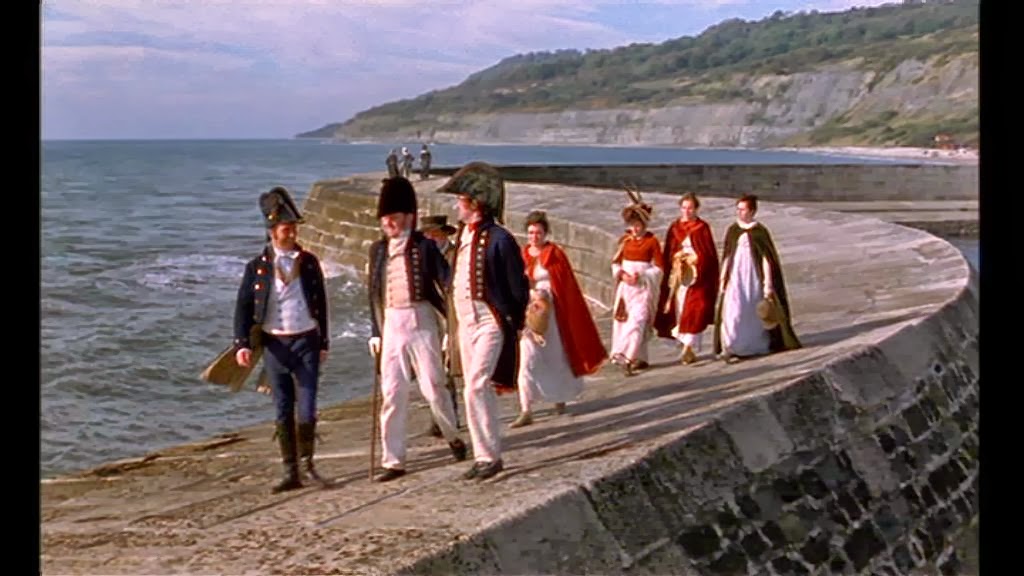
As we trundled down the hill, we were delighted with this view of the famous Cobb... famous, of course, as the location of an important scene in Persuasion—where Louisa Musgrove imprudently jumps the stairs leading down from its top. The Cobb is a partial breakwater, creating a small, protected harbor for the local fishing fleet—though now, the main denizens appear to be pleasure craft.

What I found interesting about the Cobb was the angle at which it was built: good for allowing breaking waves to run off, but a little unnerving to walk on, especially in a brisk breeze (that's Daughter #1, walking at an angle!) But even more interesting was the thought that Jane Austen knew this town and this very place—a bit of a shiver down the spine moment!

Being good Jane Austen fans, my son and husband and I spent a good long time debating which of the stairs leading down from the Cobb were the ones that Louisa jumped from. In the end, we decided it must be these (also known by the name "Granny's Teeth"!), as they were the most suitably archaic and untrustworthy looking (honestly, if I’d been Louisa, I might have preferred jumping rather than trying to negotiate them in a stiff breeze in a long skirt!

Next, it was time to go fossil hunting. This whole 95-mile section of the south coast is called England’s “Jurassic Coast”. Going east from Orcombe Point to Old Harry Rocks is like traveling in time, from the early Triassic period onward. Lyme Regis is located in the oldest part of the coast, its formations dating to 200 to 195 million years ago. Down the beach from the Cobb a great cliff face looms up, made of very crumbly black shale, the remains of an ancient ocean bed (you can see it in the pictures above of the Cobb.) And as gravity and the weather erode it, the fossils of creatures that died and left their remains in the oozy black mud of that old ocean end up on the beach, where they can be picked up from amongst the clitter of rocks and flints by geeky American tourists like us.

Here's part of our haul.
What you see here are ammonite fossils, distant and extinct relatives of today’s squid and nautiluses; the little star-shaped one is possibly an echinoid, a relative of today’s starfish and sea urchins. It was a lot of fun, actually, and reminded me of my long-ago days as an archaeology student doing field surface surveys. We had a lovely if late lunch at a pub close to the Cobb, then dragged ourselves back up the hill to our car, to go to our next destination. But I’ll be back to the Jurassic Coast some day.

Next installment: Not the Isle of Wight, sadly, but a few other sites of interest.

Friday, January 30, 2015

Nineteenteen Welcomes Award-Winning Author Julie Klassen!

In the inspirational romance genre, there are few awards more prestigious than the Christy. When an author has won it three times in a few years, you know she's good. That's only one of the reasons we're delighted to welcome historical romance author Julie Klassen to our blog to tell us a little about herself and her recent book, The Secret of Pembrooke Park.

Nineteenteen:  Like us, you are fascinated with all things Jane, from Jane Austen to Jane Eyre.  What drew you to early 19th century England and romance in particular?

Julie:  Reading books like The Secret Garden and Jane Eyre at a young age certainly made quite an impression on me and cemented my love of “all things England.” But why the early 19th century in particular? It’s all Colin Firth’s fault. Like many women, I was smitten by him as Mr. Darcy in the 1995 BBC/A&E adaptation of Pride & Prejudice. Seeing it led me to re-read Jane Austen’s novels and in turn, to set my novels in the Regency period. 

Nineteenteen:  Ah, Colin.  Yes, he is known for leading many of us a merry dance.  You, however, are known for your impeccable research, which really came through in The Secret of Pembrooke Park. Did you turn up anything unexpected or especially exciting as you researched the book?

Julie:  Thank you. I try! Most of the research for this novel revolved around the life of clergymen and Anglican services in the 19th century, but I’m not sure I’d call that exciting. One fun new topic I researched was hidden rooms. Secret rooms, passages, and hiding places were not all that uncommon in ancient manor houses. They came in handy over the centuries when you found yourself on the wrong side of a monarch and wished to keep your head. Or if you, say, needed to hide a priest during the reign of Elizabeth I. One of the places I visited while in England in 2014 was Chastleton House to see its historic secret room. It saved at least one life, we know, when a quick-thinking wife hid her husband there, then offered the search party a lovely meal laced with drugs. While the soldiers slept if off, she sneaked her husband safely past them. I loved seeing a real secret room in person, and it helped me better imagine the one in The Secret of Pembrooke Park.

Nineteenteen:  Regina loved the treasure hunting aspect of the story. What inspired you to include that in the book?

Julie:  I was first inspired to write about an abandoned manor, and decided to give it a secret room because I had come across them in my research, plus I had a “secret room” behind my closet as a girl growing up (where I kept my Trixie Belden books and posters of teen heartthrobs Parker Stevenson and Shaun Cassidy). But what fun is a secret room, I thought, without the hope of something tantalizing hidden inside? So the idea of rumored treasure was born.

Nineteenteen:  And now the really important question: if you were making your first appearance in Regency society, what would you wear?

Julie:  Goodness. Since I currently own only one Regency era dress—a pink ball gown with lace at neckline and puffed sleeves—I suppose I would wear that. Though at my age, I would likely be accused of being “mutton dressed as lamb.”

[Editorial note:  as you can see from this photo, Julie actually looks rather dreamy in her pink gown.]

Nineteenteen:  We know you just turned in a manuscript to your publisher. What's it about, and what's next for you?  A little bird told us you might be having more books out, with a second publisher.

Julie:  Yes, in 2015 I will have two books coming out. Lady Maybe in July with Berkley/Penguin, which is about a woman whose startling secrets lead her into unexpected danger and romance in Regency England. And The Painter’s Daughter in December with Bethany House, which is my first novel with the often-requested marriage of convenience premise. 

Nineteenteen:  They both sound great!  Thank you so much for joining us.

Julie:  Thanks for asking and thanks for having me here!


If you'd like more information about Julie and her award-winning books, you can find her online at her website http://www.julieklassen.com/ or on Facebook.

Purchase The Secret of Pembrooke Park from these fine retailers:

Amazon
Barnes and Noble
iTunes
Kobo
A bookseller near you
The Book Depository (free shipping worldwide)

Friday, December 19, 2014

Happy Christmas! We Come Bearing Gifts!

Happy Christmas, my dears!  Marissa and I will be taking the next two weeks off to spend time with family and friends, but before we go we wanted to wish you a very merry Christmas and a wonderful, productive, prosperous New Year! 

And bring you presents.  J

The first is my usual Christmas bonus, but this year with a twist.  While I contributed to the bonus, it was actually conceived and created by the talented authors at the Historical Romance Network, of which I am a member.  For your perusing pleasure, we have an annotated list of more than 60 historical romance novels set around the winter holidays.  The list is organized by era, title, and heat level, so you can find just the right book for you!  

The second is a must-see online exhibit called Beauty, Virtue, and Vice from the American Antiquarian Society library describing how women and beauty were perceived based on prints from the nineteenth century.  Fascinating!

Finally, we offer this short video showing the places key to Jane Austen’s life.  I do love the narrator’s dry voice, particularly where he talks about the “gloriously overgrown” kitchen pump at Steventon.


Enjoy your holidays, my dears!  We remain, as always, your humble servants.  See you on January 6th.

Tuesday, November 19, 2013

Young Bluestockings Attend the Cinema: PERSUASION (1995)


Welcome to "Young Bluestockings Attend the Cinema" at NineteenTeen! Today we're discussing the 1995 Jane Austen adaptation Persuasion, starring Amanda Root and Ciaran Hinds!

(As an aside, can I mention how magical the mid-1990s was for Jane Austen fans? We had one fabulous adaptation after another...delightful!)

Ah yes, Persuasion! Lost love, pride and class, vanity, and lots of dashing naval men.


So, whether you watched this movie recently or long ago, please tell us what you thought of it!

Did you like the cast? Did you root for Root, or sigh for Wentworth?

Did you like how the director gave us the silences and low-indoors-lighting of the period, to really put us in that world? Or were you frustrated by that, finding the movie slow, or low-energy, or even at times hard to follow?


If you've read Austen's novel, what did you think of this interpretation of it? Did you think it captured the soul of the original? Did you mind any changes?

And if you have any other comments or insights, please share!!! We bluestockings love to discuss things while sipping our tea (and perhaps enjoying some caraway cakes and ratafia biscuits...)

And to aid the discussion, here are the major actors and creators:

CAST AND CREW:

Director: Roger Michell

Screenwriter: Nick Dear

CAST:

Anne Elliot: Amanda Root

Wentworth: Ciaran Hinds


Lady Russell: Susan Fleetwood

Sir Walter Elliot: Corin Redgrave

Elizabeth Elliot: Phoebe Nicholls

Mrs. Clay: Felicity Dean

Mary Musgrove: Sophie Thompson

(Interesting fact: Sophie Thompson had a role in another Jane Austen movie--she played Miss Bates in the Gwyneth Paltrow version of Emma! She is also the sister of Emma Thompson, who played Elinor (and wrote the screenplay) for the 1995 Sense and Sensibility. Austen royalty!)

Charles Musgrove: Simon Russell Beale

Louisa Musgrove: Emma Roberts

Henrietta Musgrove: Victoria Hamilton

Captain Benwick: Richard McCabe


Admiral Croft: John Woodvine

Mrs. Croft: Fiona Shaw

Mr. Elliot: Samuel West


So....what did you think? All opinions welcome!

Tuesday, October 22, 2013

Young Bluestockings will discuss Persuasion!


When other young ladies and gentlemen doze on the sofa or stare admiringly at their reflections in the looking-glass, young bluestockings gather together with like-minded souls and have merry debates about novels, ideas, and that delightful (yet futuristic) invention, the cinema.

So please join us here next month (November 19) for our next "Young Bluestockings Attend the Cinema" virtual outing, which will be...

(drumroll...)

The 1995 film of PERSUASION, starring Amanda Root and Ciaran Hinds!


Ah, yes.  Jane Austen!

Young bluestockings do love Jane Austen, with her wit, her wisdom, and her romances.

This version of Persuasion is a gorgeous, atmospheric movie, and if you haven't ever seen it, you're in for a treat!

But don't let me influence you -- what we're asking for are your honest opinions on the movie.  (What did you like, or dislike?  What would you have done differently?  Which home would you most like to live in?  Which actors or actresses are the most swoon-worthy?  Did you spot the person who later played a relative of Harry Potter?)

So please stop by here on Tuesday, November 19, and join our lively discussion!  We promise to brew you a fresh pot of virtual tea when you arrive...

Please join us!


The 1995 PERSUASION is available through Netflix, iTunes, Amazon (DVD or digital), and quite possibly at your local library.


Tuesday, July 23, 2013

Young Bluestockings Attend the Cinema: EMMA (1996/Paltrow)


Welcome to "Young Bluestockings Attend the Cinema" at NineteenTeen!  Today we're discussing the 1996 feature film "Emma," starring Gwyneth Paltrow, Jeremy Northam, and Obi Wan Kenobi himself, Ewan McGregor!

(Interesting fact:  there were two adaptations of Jane Austen's "Emma" in 1996!  One was made for TV, and starred Kate Beckinsale;  the other was this, a little independent film with Hollywood star Gwyneth Paltrow.)

So: have you seen this "Emma"?

What did you think?

Did you like the costumes?

The casting?

The script?

If you've read the book, did you like the adaptation?

And perhaps most important of all, did you like the character Emma?


To aid the discussion, here's the cast list!


CAST:
Gwyneth Paltrow … Emma Woodhouse
Denys Hawthorne … Mr. Woodhouse
Jeremy Northam … Mr. Knightley
Toni Collette … Harriet Smith
James Cosmo … Mr. Weston
Greta Scacchi … Mrs. Weston
Alan Cumming … Mr. Elton
Sophie Thompson … Miss Bates
Phyllida Law … Mrs. Bates
Polly Walker … Jane Fairfax
Ewan McGregor … Frank Churchill
Juliet Stevenson… Mrs. Elton

Please share your thoughts!  All opinions welcome!

Tuesday, June 25, 2013

Young Bluestockings Attend the Cinema: Emma in July!


Ah, July...when a young lady's thoughts turn to parasols and lace fans, gardens in bloom and dancing until dawn.

So what better month for us all to watch and discuss the 1996 movie of Jane Austen's beloved novel Emma?  It has all of the above, plus:


The younger Obi Wan Kenobi -- that is, Ewan McGregor, in a top hat!   

(These are not the cravats you are looking for....)


Oscar-winner Gwyneth Paltrow, and Golden-Globe winner Toni Collette, before they were quite so famous or award-winning!  Oh, and they have the loveliest gowns and hair.


Jeremy Northam -- he may not be immensely famous, but once you see Emma, you'll remember his name.

So do what you can to get your hands on the 1996 movie version (the one starring Paltrow -- be careful, because there was a television version the same year, starring brunette Kate Beckinsale!  We're doing the blonde version.)  It's available through Netflix (DVD or Blu-ray, not streaming), Amazon DVD or instant video, and quite possibly at your local library.

Then watch it, store up all your opinions, and stop back in here on Tuesday, July 23, when we'll put on our own lace gloves, sip our tea, and share what we all thought of this Emma!

Please join us!