Showing posts with label Windsor. Show all posts

Tuesday, June 23, 2015

Green and Pleasant Land, Part 2: Oxford and Windsor

The next part of the Marissa Doyle tour of southern England involved a whirlwind tour of two quintessentially English places: the city of Oxford, and Windsor Castle. While we only spent a few hours in each place, it was well worth the effort...and helped break in my family to the sheer amount of walking we’d be doing for the rest of the trip!

After a quick peek at the Ashmolean Museum, we set out for a stroll up Cornmarket Street...


to the Carfax Tower--more properly, the 12th century tower of St. Martin’s church (the clock with the little mechanical guys who ring the hour are a 19th century addition)...


up High Street to get a peek at the Radcliffe Camera (alas, closed for the day)...


and the Church of St. Mary...
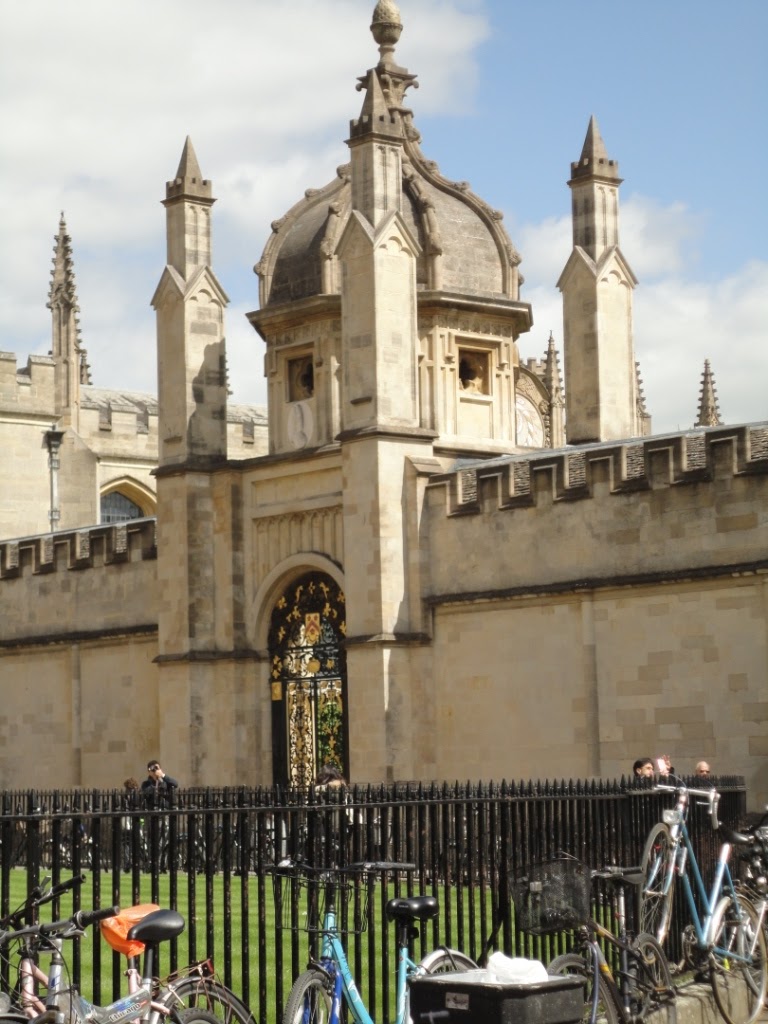

up to the Botanical Gardens, then down the Broad Walk past Christ Church Meadow (which was lovely and wild but surprisingly sheep-free)...


and Merton College, one of the oldest in the university and the college of J.R.R. Tolkien...


then on for a pleasant lunch (notice the delightfully sunny and warm weather--a feature of most of the trip) at The Head of the River Pub, on the Thames...or is it the Isis? For some reason, the Thames is called the Isis where it flows through the city. From what I’ve been able to discover, this seems mostly to have been a Victorian thing, involving some romantic but erroneous mythological and linguistic shenanigans; the old Celtic name of the river was the Tamesis, so you can see where the borrowing might have come from.

Whizzing down the M40 and M25, we arrived in Windsor and made it up to the Castle just before ticket sales closed...and I’m so glad we did. It’s a very interesting place, so old in places and yet immaculately maintained and manicured. Security was fairly tight as the Queen was in residence (her standard was flying over the Castle, which was pretty cool), so we had to go through the equivalent of airport security after purchasing our tickets.


We wandered around the grounds for a bit and got a look at this charming garden...


then made our way to view the bits open to the public: the State Rooms and...the Queen’s Dolls’ House, which I blogged about a few years ago and which was beyond amazing to see in person (alas, no photographs permitted.) The State Rooms were gorgeous, especially the Waterloo Chamber with Sir Thomas Lawrence’s portraits of the leaders of the Allies. It’s kind of amazing to see the originals of artwork you’ve only seen reproduced in books.

But probably the coolest thing we saw at Windsor was a special exhibit entitled “Waterloo at Windsor”, commemorating the 200th anniversary of the battle. Again, no photos permitted (sigh!), but here's a link to the exhibit's website. On display were portraits and Rowlandson cartoons and drawings...and then there were the letters: Napoleon’s formal letter of surrender to the Prince Regent, Wellington’s dispatch to the Prince after the battle, and more. My kids were mightily amused at their mother’s hyperventilating as she scurried from display case to display case, but honestly—what amazing things to see! I was a very happy history geek that afternoon.

Next stop on our tour: Bath!

Tuesday, May 8, 2012

Celebrity Chefs of the Nineteenth Century, Part 3: Francatelli

Our next super-chef of the 19th century is a bit of a mystery man…but ending up as chef to Queen Victoria definitely puts him in the top league, don’t you think?

Charles Elmé Francatelli was born in London in 1805, presumably of Italian extraction—we know nothing of his family history. According to his own account, he trained in France and indeed was a pupil of Antonin Carême, whom we have already met—although when and where the two worked together is not clear. But by his twenties, Francatelli was already working for some fairly important people: his first post was as chef to the Earl of Chesterfield, for whom he worked for several years, and he went on to become head chef at Crockford’s, a notable men’s club in St James’s Street famous for its excellent food, luxurious appointments, and outrageous gambling. It was probably while he worked at Crockford’s that he made the acquaintance of the Earl of Errol, who was the new Queen Victoria’s Household Steward. When Victoria needed a new chef, Lord Errol pinched Crockford’s chef…and Francatelli came to be the Queen’s Chief Cook and Maître d’Hôtel, either in late 1840 or early 1841; alas, many of the Queen’s household records were destroyed at the end of her reign, and we simply don’t know his exact dates of employment.

Francatelli brought his French training to the Queen’s table (by the way, the print at left is of the kitchen at Windsor Castle), walking a fine balance between the new haute cuisine and traditional English tastes: though his menus for the Queen introduced the lighter, more delicate cooking he learned in France, there was always a roast beef or a roast saddle of mutton or haunch of venison prepared and waiting on the sideboard for any who wanted it. Unfortunately, his employment with the Queen only lasted two years; some have speculated that the young Queen’s new husband, Prince Albert, did not care for his wife’s chef (pointing out that in Francatelli’s books there are numerous recipes called after the Queen, but only one after Prince Albert—for a highly pungent sauce containing a great deal of horseradish!)

Francatelli’s career, however, flourished after his time with the Queen: he worked for more notable noble employers, was the head chef at the Coventry House Club and then at the Reform Club, the bastion of Liberal politicians for much of the middle and later 19th century (that's their kitchen at right). He also wrote several books. One of the most interesting was his 1846 The Modern Cook, which includes several full menus for dinners served to the Queen and which is available in a modern reprint edition—very interesting for those interested in the history of cookery. Later, he changed his focus somewhat and produced a book aimed at England’s growing middle classes, A Plain Cookery Book for the Working Classes (1852). The Cook's Guide and Housekeeper's & Butler's Assistant and The Royal English and Foreign Confectionery Book followed in 1861 and 1862 respectively. He went on to manage the St. James Hotel in Berkeley Street and the Free Mason’s Tavern in Lincoln’s Inn Fields, but again, there are few records of his life at this time. He died in 1876.

Tuesday, November 10, 2009

If it's November, this must be Balmoral

Queen Victoria, footloose and fancy-free?

Well, yes. As Queen of the United Kingdom, Victoria either had use of or personally owned dozens of houses and palaces. While the official home of the kings and queens of the UK is Windsor Castle, Victoria spent her childhood at the royal palace of Kensington and the early years of her reign at Buckingham Palace, both in London. Wanting a summer getaway home for her growing family, she purchased an 1100-acre estate on the Isle of Wight, where she and Prince Albert built Osborne House (that's it at above right). But Osborne wasn’t the real getaway she’d hoped it would be, so she later purchased a large estate in the Scottish Highlands named Balmoral.

So what did QV do with all these houses?

Amazingly, she lived in them, traveling from house to house several times over the course of the year, much to the dismay of her servants and staff.

Here's how it generally went: Christmas and New Year’s were spent at Osborne; some time in January she would usually return to Windsor (shown at left) and remain there for February. March and April could be spent at Windsor or abroad, in Italy, Switzerland, Germany, or the south of France (the Queen liked to travel “incognito”, calling herself the Countess of Balmoral). Mid May generally saw a quick month-long jaunt to Balmoral, then back down to Windsor or Buckingham Palace if necessary for receiving debutantes at Drawing Rooms during the Season. Mid July saw her back to Osborne for the yachting season at Cowes, then late August sent her to Balmoral till mid-November for the shooting season. Mid-November meant a return to Windsor, then back to Osborne for Christmas and the start of the cycle once more.

Phew! If I’m exhausted just writing this, just imagine how her children, household and servants felt! The queen did not travel lightly; entire trains were required to ferry her and her household and luggage about the countryside. And even up in the remote Scottish Highlands at Balmoral (shown at right), she was still queen: a member of the cabinet always had to accompany her as a representative of the government (they squabbled endlessly about whose turn it was, as few enjoyed the Queen's frigid Scottish home); in addition, the prime minister in office frequently journeyed the roughly 500 miles to consult with her as well. In addition, the special red dispatch boxes containing reports and documents requiring her consideration were sent up daily from London.