
Showing posts with label Thames River. Show all posts

Tuesday, July 18, 2023

Retro Blast: The Royal Waterloo Bath


As much of the US is gasping through a heat wave, I hope those affected have access to somewhere cooling, though not perhaps this particular one, which originally appeared here in December 2009.

* * * * *
 
From the June 1819 edition of Ackermann's Repository, may I present to you, with mingled delight and horror...


THE ROYAL WATERLOO BATH


"This very elegant floating bath is stationed near the north end of the Waterloo-bridge, and has recently been built and completed with entirely new and substantial materials, in a style of superior accommodation, at a very considerable expense: it contains a plunging bath, 24 feet long by 8 feet wide, and two private baths, 10 feet long by 8 feet wide. The depth may be regulated at pleasure by machinery, which raises or depresses the bottom as required, secured by cross timbers, and bound with iron. To each of the baths are attached small dressing rooms, commodiously fitted up, with proper persons to attend upon visitors. These baths are so constructed, that the water, being a running stream, is changed every two minutes. The advantage of bathing in a flowing stream is obvious, and gives a decided preference over a cold still bath, which is frequently dangerous from the violence of the shock. The terms of bathing, as our readers will see, are extremely moderate:--they are--
 
In the plunging-bath. . £0 1s. 0d.
For the season. . . £1 11s. 6p.
In the private baths . £0 1s. 6p.
For the season. . . £2 2s. 0p.
 
Constant attendance at Waterloo-bridge to convey visitors to and from the bath.
 
Bathing is so essentially connected with health, that we cannot but congratulate the public on this new establishment. It is singular that so few of the kind should be known in London, while there is scarcely a street in the French metropolis that has not its cold, warm, vapour, Chinese, and Tuscan baths, with a variety of others, suiting the capricious tastes of the inhabitants. Yet how deficient they are in the most important article connected with bathing every body knows, while we have a noble river filled with the purest and most wholesome waters in the world. The want of baths in London has led to the incommodious and indecorous practice of public exposure in the Thames.
 
All I can say is, eek! Or maybe just ick. Though the waters of the Thames might indeed have been pure and wholesome upriver, at this point it served as drainage for all the city...gulp! I applaud the recognition that bathing was associated with good health and understand the desire for cleanliness (and for getting the nudists off the banks of the river!) but do have to wonder if the writer of this article visited the baths in person. Unfortunately, no interior views were provided--it would have been interesting to see how the water depth controls worked.
 
I don't think any young ladies of fashion would come here; I expect it was for the working class population of London who didn't have hip baths before the fireplaces in their bedrooms and legions of servants to carry up cans of hot water to fill them.

Tuesday, May 19, 2020

Mudlarking!


I love to walk on the beach. Even more, I love to look for treasures as I walk.

Living my entire life on or near the coast of Massa-chusetts, I’ve kind of taken it for granted that any walk on a beach of my home state might turn up treasures beyond a pretty scallop shell or a tumbled piece of rose quartz. This part of the US has been settled since the early 1600s, and over years of beach strolling, I’ve found my share of prizes: clay pipe stems, shards of pottery and glass (and a few intact pieces!), interesting bits of metal from fishing weights to the working mechanism of an oil lamp. My favorite finds include a tiny plate from a doll’s tea set, several ink bottles, and a large piece of early seventeenth century redware pottery.

So it was with great delight and fellow-feeling that I recently devoured Lara Maiklem’s Mudlarking: Lost and Found on the River Thames. Mudlarking is the term (dating back to the 18th century) for rummaging around on the shore of a river or harbor, looking for lost and cast-off items that might be of use; in the last several years, it has more or less become the act of wandering the edges of the Thames at low tide (the Thames below Richmond—where Hampton Court Palace is—is subject to the tide) looking for…well, treasure. Of course, “treasure” is a relative term, so while some do their mudlarking with metal detectors, looking for money or jewelry, others (like Ms. Maiklem) mudlark for the sheer love of history, of connecting to the past through the bits and bobs she finds on her mudlarking trips.

And what bits and bobs she finds! The Thames has hosted human settlements back to the Neolithic, so her collection spans everything from stone tools to Bronze and Iron Age finds, through Roman coins and mosaic tiles to medieval potsherds, Tudor jewelry, eighteenth century Chinese porcelain, and so on up to the present era.  

The book is divided into sections about each stretch of the Thames. In each, Ms. Maiklem entwines the history of that part of the river with accounts of some of her visits and what she has found, juxtaposed with snippets of autobiographical and family history that lend a personal and often moving edge to the narrative. It’s a lovely, absorbing read, and I know that when I finally get back to visit London, I’m going to find a mudlarking trip to join. In the meanwhile, however, there’s always the beach right here…

Have you ever been mudlarking? Where did you go, and what did you find?

Friday, March 30, 2018

Happy Easter!

I’m a bit early, but I wanted to wish you a happy Easter. And just like the Easter bunny brings eggs, I’m bringing a few presents.

  1. Panorama of the Thames. This wonderful project compares stretches of the river in picture and illustration as it was in 1829 and in 2014. Look at the comparisons tab if you do nothing else. Fascinating!
  2. Romancing Yesteryear Giveaway. More than 40 historical romance authors bring you a chance to win more than 50 full-length novels and a Kindle Fire in the Romancing Yesteryear May Day giveaway. Fabulous! 
  3. 19th Century Fashion: How to Tell the Decades Apart—This fun video provides a high-level overview of how ladies’ hair and fashion changed from the 1800s to the 1900s. She has other great videos available as well. Clever, and nicely done. 


May you have a lovely weekend, however you celebrate!

Friday, October 20, 2017

Put a Lock on It

File:Locks on the thames Teddington London.jpgI’m researching a new book (lovely, lovely research), and I found myself looking more deeply at navigation on the Thames during the nineteenth century. The River Thames was the lifeblood of London and every town upstream and down, carrying goods and people where they were needed. I spent nearly 30 years living on another great river, the Columbia, so I had some idea of how important a waterway could be. What surprised me were the number of locks, and how they were used.

The Columbia River is confined by hydroelectric dams that also serve as flood control mechanisms. These dams have locks to allow ship traffic passage. When I sailed on the Lady Washington, our state’s tall ship, we passed through the lock at McNary Dam, and the massive gates reminded me of the mythical Mordor of Tolkien fame. But the locks on the Thames weren’t designed for electric power or flood control. They were originally created for navigation purposes.

The Thames is an aged river. As such, its braided, curving channels make for a leisurely passage at best. So, in 1751, George II chartered the Thames Navigation Commission to ensure safe and efficient travel along the river. Through the Regency period, they oversaw the building of 25 locks to even out rough patches and speed transit. The City of London had jurisdiction of the river through its environs and built an additional set of locks.

File:Strensham Lock - 2 - geograph.org.uk - 1167190.jpg
Locks came in several designs, but the basic purpose was the same, to store up water that could be flooded downstream to make passage easier or faster. Some of the locks had sloping earthen sides, but most were lined with brick or stone. Gates of massive timbers marked either end and had to be cranked open and shut, often by hand. To facilitate the process, most locks were staffed by lock keepers, with a cottage to live in nearby. (Photo by Trevor Rickard)

The Thames Navigation Commission sounds like an interesting group. At the time of the Regency, it included as many as 600 people. Yes, you read that right—600. Care to envision that committee meeting? Every person with more than one hundred pounds to his name who owned land along the river was a member. So too was Oxford University and each mayor with a town along the river.

But with all these possibly competing interests, a quorum was only 11 commissioners. And if those 11 commissioners decided your land would be a good spot for a lock and cottage, you had no choice by law but to sell. They could also select land to be used for tow paths for barges and canal boats, so long as they didn’t take someone’s house, garden, or orchard.

Some interesting plot ideas there, eh? I think that’s a lock.

Tuesday, July 19, 2016

Have You Upped a Swan Today?


Well, have you? This is the official week for it, after all. Get out there and up those swans!

All right, I’ll settle down now. Swan Upping is the traditional census-taking of Mute Swans on the River Thames, wherein swans are rounded up, checked for bands or banded, and released. The king or queen of England, by ancient law and custom dating back to the middle ages, owns all unmarked swans in England. And since the twelfth century or so, the swans who live on the Thames have been counted and marked by the Royal Swan Upper to enforce that ownership (though two ancient groups, the Worshipful Company of Vintners and the equally Worshipful Company of Dyers also have some swan related rights and participate as well.) Swans were once reckoned something of a delicacy, after all, and having one on your banquet table was something of a status symbol that the Crown thought ought to mostly belong to it.

Of course, no one today, even the Queen, eats swans. Even so, the annual Swan Upping is still carried out, though today it’s more a matter of monitoring the mute swan population’s health than making sure the peasants aren’t eating above themselves. While there’s still some ceremonial involved in the form of natty uniforms and rowing skiffs, the actual handling of the swans is managed by the Royal Swan Warden, a professor of ornithology from Oxford University. And yes, it's not completely an odd holdover from the past: Swan Uppings in the 1980s revealed a drop in population that was found to be caused by swans swallowing lead fishing weights. The weights were banned in the Thames, and the population happily rebounded.

So...happy Swan Upping week!

Tuesday, June 23, 2015

Green and Pleasant Land, Part 2: Oxford and Windsor

The next part of the Marissa Doyle tour of southern England involved a whirlwind tour of two quintessentially English places: the city of Oxford, and Windsor Castle. While we only spent a few hours in each place, it was well worth the effort...and helped break in my family to the sheer amount of walking we’d be doing for the rest of the trip!

After a quick peek at the Ashmolean Museum, we set out for a stroll up Cornmarket Street...


to the Carfax Tower--more properly, the 12th century tower of St. Martin’s church (the clock with the little mechanical guys who ring the hour are a 19th century addition)...


up High Street to get a peek at the Radcliffe Camera (alas, closed for the day)...


and the Church of St. Mary...


up to the Botanical Gardens, then down the Broad Walk past Christ Church Meadow (which was lovely and wild but surprisingly sheep-free)...


and Merton College, one of the oldest in the university and the college of J.R.R. Tolkien...


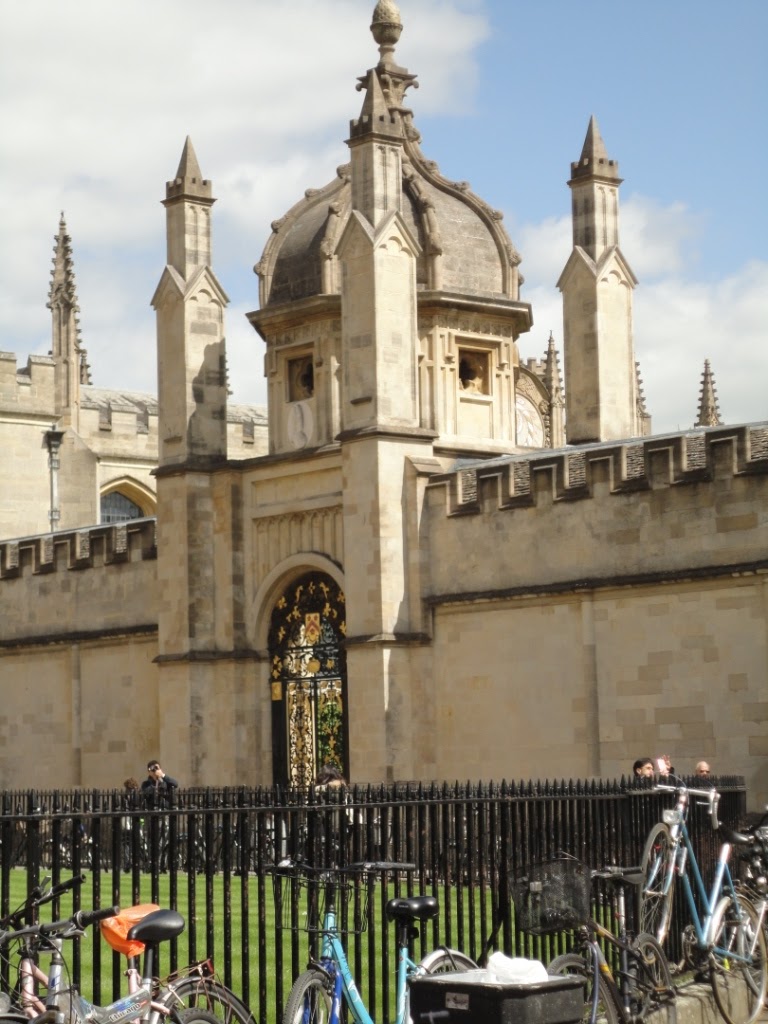
then on for a pleasant lunch (notice the delightfully sunny and warm weather--a feature of most of the trip) at The Head of the River Pub, on the Thames...or is it the Isis? For some reason, the Thames is called the Isis where it flows through the city. From what I’ve been able to discover, this seems mostly to have been a Victorian thing, involving some romantic but erroneous mythological and linguistic shenanigans; the old Celtic name of the river was the Tamesis, so you can see where the borrowing might have come from.

Whizzing down the M40 and M25, we arrived in Windsor and made it up to the Castle just before ticket sales closed...and I’m so glad we did. It’s a very interesting place, so old in places and yet immaculately maintained and manicured. Security was fairly tight as the Queen was in residence (her standard was flying over the Castle, which was pretty cool), so we had to go through the equivalent of airport security after purchasing our tickets.


We wandered around the grounds for a bit and got a look at this charming garden...


then made our way to view the bits open to the public: the State Rooms and...the Queen’s Dolls’ House, which I blogged about a few years ago and which was beyond amazing to see in person (alas, no photographs permitted.) The State Rooms were gorgeous, especially the Waterloo Chamber with Sir Thomas Lawrence’s portraits of the leaders of the Allies. It’s kind of amazing to see the originals of artwork you’ve only seen reproduced in books.

But probably the coolest thing we saw at Windsor was a special exhibit entitled “Waterloo at Windsor”, commemorating the 200th anniversary of the battle. Again, no photos permitted (sigh!), but here's a link to the exhibit's website. On display were portraits and Rowlandson cartoons and drawings...and then there were the letters: Napoleon’s formal letter of surrender to the Prince Regent, Wellington’s dispatch to the Prince after the battle, and more. My kids were mightily amused at their mother’s hyperventilating as she scurried from display case to display case, but honestly—what amazing things to see! I was a very happy history geek that afternoon.

Next stop on our tour: Bath!

Friday, May 23, 2014

Four Things on a Friday

Sometimes so many things catch your eye in a week that you just have to share them all!  So, I give you four things on a Friday:

1.  Some of the foodstuffs mentioned in nineteenth century literature are certainly interesting!  Ever wonder what calf’s foot jelly looks like?  Check out this blog post by Regency author Susan Karsten.  The picture alone has me shivering!  

2.  Mark your calendars for October 26, when PBS stations will be begin broadcasting Death Comes to Pemberley, based on the book by P.D. James and Jane Austen’s Pride and Prejudice.  Reviews are mixed for both the book and the miniseries, but the acting, costuming, and sets should be amazing! 

3.  Can’t get enough of 19th century art?  Now you can see it (and use it) for free!  This week the Metropolitan Museum announced that it is releasing 400,000 images of itsworks, all free for noncommercial use.  Not all of them are paintings.  Check out these beautiful evening shoes dating from 1875. 

4.  Did you know that over the last hundred years, thousands of people have drowned in the River Thames?  Their grieving families have nowhere to go to remember them.  Now the former curator of the Thames Police Museum and a local artist are teaming to create a memorial to those lost.  You can learn more about it and perhaps donate here. 

For those of you in the states, may you have a lovely and thoughtful Memorial Day weekend!  Everyone else, carry on!

Friday, August 3, 2012

Public Spectacles, Amusements, and Objects Deserving Notice, August: Doggett's Coat and Badge

August could be a sweltering time in London in the nineteenth century.  Anyone who could got out of town, to their country estates, to the seashore, to the Lake District.  The Picture of London, which for many years was an annual volume of places to see and things to do in the capital, called the month a “dull season for amusement.”  So what was a young lady or gentleman to do if the family chose not to rusticate?

On August 1, one might head to the Thames for the annual race called Doggett’s Coat and Badge.  It had been instituted in the 1700s by Thomas Dogget, an Irish comedian who also jointly managed the Drury Lane Theatre.  In keeping with the times, he endowed a wager:  a crimson coat and a silver badge to the winner of a rowing race up the Thames, from The Swan at London Bridge to The Swan at Chelsea, a distance of 4 miles and 7 furlongs that could take anywhere from 30 minutes to 2 hours to row, depending on the tide and the weight of the boat. 

Only six men could compete, and only if they were watermen within the first year of finishing their apprenticeships. You could put in your name and the Fishmongers Company, who had agreed to administrate the race, would draw the name of the six lucky rowers.

And not just any rowers.  Watermen were like taxi drivers.  Their job was the row people from one side of the river to the other in boats that ranged from sculls to heavy-bottomed wherries.  Many had set routes or locations from which they rowed: Wapping Old Stairs, Westminster, and Putney, for example.  One of the winners was from Pickle Herring.  I want to find that spot. 


The Thames is a tidal river, meaning that the current and depth changes constantly over the day.  Rowing upriver could be extremely challenging.  People crowded the bridges, flocked to spots that overlooked the river, even thronged on larger boats and barges just to watch the prodigious feat.

The winner got his own parade and a banquet at the Fishmongers Hall.  And the badge?  It was a huge piece of silver, about the size of a dinner plate, that you wore on your upper right arm.  It was engraved with symbols representing the House of Hanover, as Doggett had been a big supporter of King George.  The race is still run today, although generally in late July.  Below is the picture of the winner from 2010, Daniel Arnold, along with previous winners, courtesy of the Fishmongers Company's press release.


As you can probably tell, then as now, winning was considered quite the honor. 

Especially if you were from Pickle Herring.

Tuesday, December 8, 2009

The Royal Waterloo Bath

From the June 1819 edition of Ackermann's Repository, may I present to you with mingled delight and horror...

THE ROYAL WATERLOO BATH

"This very elegant floating bath is stationed near the north end of the Waterloo-bridge, and has recently been built and completed with entirely new and substantial materials, in a style of superior accommodation, at a very considerable expense: it contains a plunging bath, 24 feet long by 8 feet wide, and two private baths, 10 feet long by 8 feet wide. The depth may be regulated at pleasure by machinery, which raises or depresses the bottom as required, secured by cross timbers, and bound with iron. To each of the baths are attached small dressing rooms, commodiously fitted up, with proper persons to attend upon visitors. These baths are so constructed, that the water, being a running stream, is changed every two minutes. The advantage of bathing in a flowing stream is obvious, and gives a decided preference over a cold still bath, which is frequently dangerous from the violence of the shock. The terms of bathing, as our readers will see, are extremely moderate:--they are--
In the plunging-bath. . £0 1s. 0d.
For the season. . . £1 11s. 6p.
In the private baths . £0 1s. 6p.
For the season. . . £2 2s. 0p.
Constant attendance at Waterloo-bridge to convey visitors to and from the bath.

Bathing is so essentially connected with health, that we cannot but congratulate the public on this new establishment. It is sigular that so few of the kind should be known in London, while there is scarcely a street in the French metropolis that has not its cold, warm, vapour, Chinese, and Tuscan baths, with a variety of others, suiting the capricious tastes of the inhabitants. Yet how deficient they are in the most important article connected with bathing every body knows, while we have a noble river filled with the purest and most wholesome waters in the world. The want of baths in London has led to the incommodious and indecorous practice of public exposure in the Thames.


All I can say is, eek! Or maybe just ick. Though the waters of the Thames might indeed have been pure and wholesome upriver, at this point it served as drainage for all the city...gulp! I applaud the recognition that bathing was associated with good health and understand the desire for cleanliness (and for getting the nudists off the banks of the river!) but do have to wonder if the writer of this article visited the baths in person. Unfortunately, no interior views were provided--it would have been interesting to see how the water depth controls worked.

I don't think any young ladies of fashion would come here; I expect it was for the working class population of London who didn't have hip baths before the fireplaces in their bedrooms and legions of servants to carry up cans of hot water to fill them.

Tuesday, January 6, 2009

Winter Fun, 1814 Style

Once upon a time (well, before 1831), two interesting facts were true: London Bridge was located somewhat further downstream on the Thames than it is now, and a climatic bump in the road called the Little Ice Age (ca. 1300-1900 AD) held most of Europe in its chilly grip.

So what do these facts have to do with each other?

Plenty, as it turns out! These two circumstances resulted in rare but wonderful phenomena known to Londoners as Frost Fairs. Especially hard winters would freeze the Thames hard enough so that it would support foot traffic…and of course, London’s citizens rushed to enjoy the novelty of strolling across the river wherever they chose to, rather than being forced to use bridges or boats…and where curious and excited Londoners thronged, other Londoners determined to make a fast shilling or two followed. Enterprising tradesmen opened stalls on the ice selling everything from warming (or intoxicating!) beverages to food to books and toys, while others opened games stalls, rather like a country fair.

Frost Fairs were recorded in 1564, 1608, 1634, 1715, 1739, and 1789. The last and probably best known Frost Fair happened in February of 1814. A cold and very snowy January gradually closed the Thames’ flow, and by February 1st hardy souls were venturing out onto it. The inevitable crowds followed and within a few days drinks stalls, printing presses selling souvenirs cards with “Printed on the Thames” on them, and stalls selling any other item that could be similarly labeled (and sold for inflated prices!) were doing a brisk business. One stall built a roaring fire and roasted a sheep on it (spectators were charged admission just to watch it cook!) then sold it by the slice as “Lapland mutton”. Swings (see them in the middle right of the picture above?), skittles, merry-go-rounds, donkey rides, and even an elephant added to the festival air.

Of course, a thaw was inevitable. By February 7 the river was once again flowing and the Fair a thing of the past. In 1823 London Bridge was re-built further upstream and in 1831 the old London Bridge torn down, causing the Thames to flow more swiftly, so that it never froze over again.