Showing posts with label Queen's Dolls' House. Show all posts

Tuesday, June 23, 2015

Green and Pleasant Land, Part 2: Oxford and Windsor

The next part of the Marissa Doyle tour of southern England involved a whirlwind tour of two quintessentially English places: the city of Oxford, and Windsor Castle. While we only spent a few hours in each place, it was well worth the effort...and helped break in my family to the sheer amount of walking we’d be doing for the rest of the trip!

After a quick peek at the Ashmolean Museum, we set out for a stroll up Cornmarket Street...


to the Carfax Tower--more properly, the 12th century tower of St. Martin’s church (the clock with the little mechanical guys who ring the hour are a 19th century addition)...


up High Street to get a peek at the Radcliffe Camera (alas, closed for the day)...


and the Church of St. Mary...
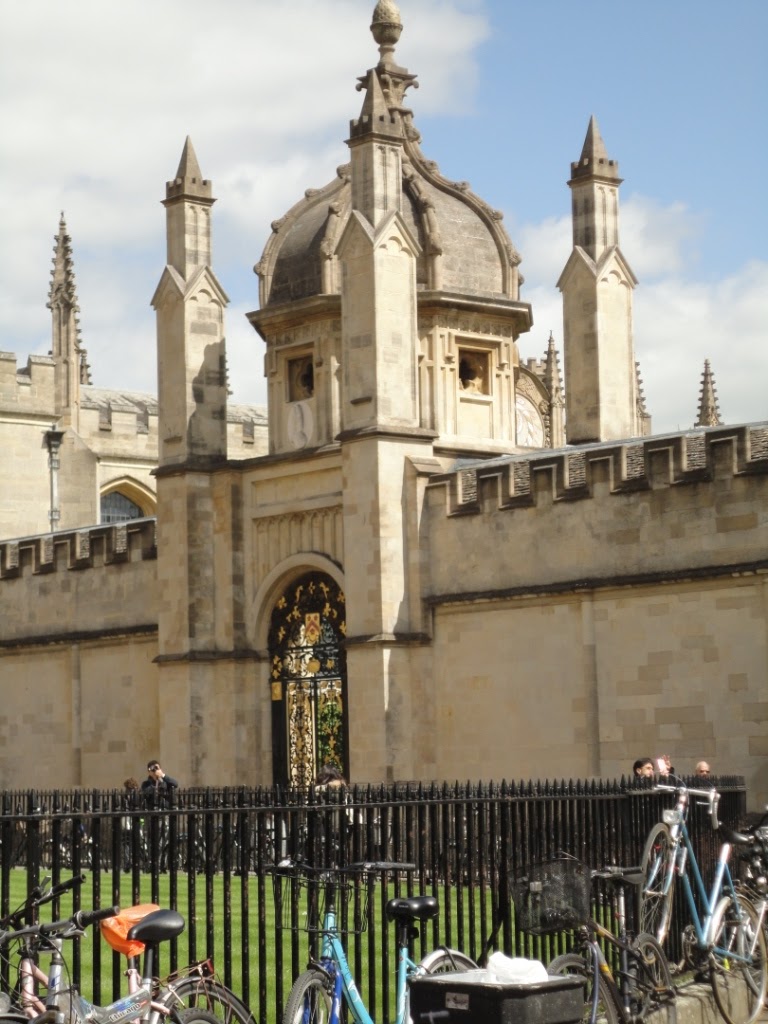

up to the Botanical Gardens, then down the Broad Walk past Christ Church Meadow (which was lovely and wild but surprisingly sheep-free)...


and Merton College, one of the oldest in the university and the college of J.R.R. Tolkien...


then on for a pleasant lunch (notice the delightfully sunny and warm weather--a feature of most of the trip) at The Head of the River Pub, on the Thames...or is it the Isis? For some reason, the Thames is called the Isis where it flows through the city. From what I’ve been able to discover, this seems mostly to have been a Victorian thing, involving some romantic but erroneous mythological and linguistic shenanigans; the old Celtic name of the river was the Tamesis, so you can see where the borrowing might have come from.

Whizzing down the M40 and M25, we arrived in Windsor and made it up to the Castle just before ticket sales closed...and I’m so glad we did. It’s a very interesting place, so old in places and yet immaculately maintained and manicured. Security was fairly tight as the Queen was in residence (her standard was flying over the Castle, which was pretty cool), so we had to go through the equivalent of airport security after purchasing our tickets.


We wandered around the grounds for a bit and got a look at this charming garden...


then made our way to view the bits open to the public: the State Rooms and...the Queen’s Dolls’ House, which I blogged about a few years ago and which was beyond amazing to see in person (alas, no photographs permitted.) The State Rooms were gorgeous, especially the Waterloo Chamber with Sir Thomas Lawrence’s portraits of the leaders of the Allies. It’s kind of amazing to see the originals of artwork you’ve only seen reproduced in books.

But probably the coolest thing we saw at Windsor was a special exhibit entitled “Waterloo at Windsor”, commemorating the 200th anniversary of the battle. Again, no photos permitted (sigh!), but here's a link to the exhibit's website. On display were portraits and Rowlandson cartoons and drawings...and then there were the letters: Napoleon’s formal letter of surrender to the Prince Regent, Wellington’s dispatch to the Prince after the battle, and more. My kids were mightily amused at their mother’s hyperventilating as she scurried from display case to display case, but honestly—what amazing things to see! I was a very happy history geek that afternoon.

Next stop on our tour: Bath!

Tuesday, April 30, 2013

Victoria’s Grandchildren: Marie Louise of Schleswig-Holstein

So far, the grandchildren of Queen Victoria that we’ve met have lived fairly dramatic lives as heads of state or embroiled in tumultuous times. But some of them lived much quieter, though in their own way, equally dramatic existences. One of those was Princess Marie Louise of Schleswig-Holstein.

Despite her Germanic sounding title, Marie Louise (christened Franziska Josepha Louise Augusta Marie Christina Helena) was born and raised in England, the fourth and last surviving child of Princess Helena and her husband, Prince Christian of Schleswig-Holstein, who (as you may recall) had consented to stay in England so that the Queen would not lose the services of Helena as a sort of glorified secretary. And so Marie Louise (born August 12, 1872) and her two older brothers and older sister Helena Victoria (called Thora--that's the two of them at right) grew up at Cumberland Lodge near Windsor, with the typical privileged upbringing of the time and an education focusing on speaking French and German nicely and a smattering of history and literature, with more focus on dancing, sketching, and deportment. There were visits to country houses, to Balmoral and Osborne to stay with Grandmama the Queen and to various relations in royal families around Europe—Marie Louise was especially close to her cousin Alix of Hesse, who would one day become the last Tsarina of Russia.

And then in 1889 when she was eighteen, Marie Louise went to Berlin for yet another cousin’s wedding and met a tall, handsome young cavalry officer, Prince Aribert of Anhalt. To the bedazzled girl’s delight he paid her a great deal of flattering attention, and she fell head over heels in love. Though her cousin Emperor Wilhelm tried to fix her up with another royal suitor, Ferdinand of Roumania (who would go on to marry another English Marie), Marie Louise had made up her mind, and Wilhelm good-naturedly arranged matters so that Aribert proposed the following year. They were married in July 1891.

Anhalt was a not-terribly important duchy in east-central Germany, and was delighted to get a grand-daughter of Queen Victoria (and cousin of Emperor William) as its future duchess. Marie Louise loved her new mother-in-law and was fond of her father-in-law the Duke, though she regarded him as not very bright. Etiquette was very strict in her new home and throughout Germany, which rather chafed the lively young woman, accustomed to a more relaxed family life at home in Cumberland Lodge. She took refuge in travel, sometimes with Aribert and sometimes without, and took extended visits to Italy, Tunis, and Algiers. That she traveled without Aribert became more and more common: almost from their wedding day, Aribert always seemed busy elsewhere, and weeks might pass without their seeing each other. It’s hardly surprising that the couple had no children, which might have reconciled Marie Louise to her loneliness—instead, she continued to travel and busy herself with her network of friends (and no, that did not include any romantic entanglements. Marie Louise remained a faithful wife.) So when on her doctor’s orders she took a long sea voyage to visit the United States and Canada, she went only with her lady-in-waiting…and was surprised to receive a curt telegram in Ottawa from her father-in-law, ordering her home at once. It was rapidly followed by one from Queen Victoria reading, “Tell my granddaughter to come home to me. VR.”

Marie Louise went home to Grandmama—and found out to her shock that in her absence, her father-in-law had declared her marriage to Aribert annulled, because Aribert felt he could no longer live with her. There has been speculation that he was perhaps gay, but no one will ever know…and now, for all intents, poor Marie Louise was once again single. Though legally her marriage had been dissolved, Marie Louise still regarded herself as a married woman in the eyes of the church, and never remarried—nor did Aribert.

And that was that. She moved home again, continued to travel extensively (that's her at right on a trip to the Gold Coast in the 1920s), took up enameling and jewelry making as a hobby, and gave generously of her time to various charitable endeavors, including nursing and hospital work, a home for lepers, a Girls’ Club in a poor section of London, and other poor relief projects. She also headed up the doll house project for her childhood friend, Queen Mary. After her parents’ deaths, she and Thora (who never married) lived together, busy with their friends and family and charitable activities. Marie Louise lived long enough to see the present queen, Elizabeth, crowned in 1953, published a charming memoir called My Memories of Six Reigns, and died in 1956.

Tuesday, July 12, 2011

What I Did on My Summer Vacation, Part 2: The Queen’s Doll House

Today’s Summer Vacation activity is about twenty years after the 19th century…but it’s just so amazing and fascinating that I’m going to talk about it anyway…and the neat thing is that if you happen to be in the vicinity of Windsor Castle, you too can see it.

What “it” is is Queen Mary’s Dolls’ House. Queen Mary (born 1867, married Prince George of York 1893, became queen 1910, died 1953) was a noted collector of art and trinkets—objets d’art—with an especial fondness for miniatures. In fact, hostesses often put away their trinkets when the queen was coming for a visit because of her well known habit of staring longingly at an object and commenting on its beauty until its owner felt compelled to give it to her.

Her friend and cousin, Princess Marie Louise (one of the daughters of Princess Helena) was inspired in 1921 to create a dolls’ house for her as a gift, both personal and public. The Queen had been a tower of strength during the hard years of World War I, and such a gift seemed the perfect thank you. The princess enlisted the help of well-known architect Sir Edwin Lutyens to help organize…and the project snowballed, with Marie Louise calling on her extensive circle of friends and acquaintances in the arts (and on their friends and acquaintances) to help create a perfect miniature palace featuring three years of work and the labor of thousands...and the results are amazing:

Hundreds of well-known artists contributed, painting amazing tiny murals in the house or creating miniscule watercolors for the royal portfolio. Writers like Rudyard Kipling, Edith Wharton, Aldous Huxley, Arthur Conan Doyle, and hundreds of others donated work for the library, some of it unpublished elsewhere, and often handwriting it themselves in tiny 1” by 1 ½” blank volumes provided to them which were later bound in elegant gold-tooled leather (Ernest Shepard, the illustrator of Winnie the Pooh, designed the bookplates). Composers like Delius, Holst, and Bax contributed musical scores. The wine cellar contains hundreds of tiny bottles of actual vintage wines, from champagne (Veuve Cliquot 1906) to fine Madeira from 1820. The linens are all monogrammed. The tiny gramophone in the nursery actually works, and there’s electricity and hot and cold running water. There are working motor-cars and motorcycles in the Royal Garage, and the gardens were designed by famed designer Gertrude Jekyll.

The Queen was, of course, delighted. The house was exhibited to the public at the British Empire Exhibition in 1924-25 and later to raise funds for charities; now it’s on permanent display at Windsor. Want to see more? Check out this interactive website, which includes information on a new book just published about the Dolls' House, The Queen's Dolls' House by Lucinda Lambton (don't worry, it's available in the US as well). Fancy a visit? Go here for more information. I know that the next time I go to England, this will definitely be one of my stops!