
Showing posts with label Duke of Wellington. Show all posts

Tuesday, January 5, 2021

Nineteenth Century Today: In My Own Backyard

As you can imagine, I spend a lot of time envisioning life in England in the early nineteenth century. So, finding touches of nineteenth century England in the Pacific Northwest is quite exciting! And to find them in my own backyard, here south of Tacoma, Washington, is priceless.

My search took me to the north end of Tacoma today, to Wright Park. In 1886, Charles Wright, through his company, donated approximately 20 acres of land in what was then the center of town for a public park. The idea was to mimic Central Park in New York. He even stipulated that at least 300 ornamental shade trees were to be planted in the first four years. The city hired a landscape architect to design the park and set about clearing stumps and bush. At first, the “park” looked like nothing so much as bare ground, but the second landscape architect on the project saw to the planting, beginning in 1890, of more than 350 varieties of trees from all over the United States and eventually the world. Many of the trees in Wright Park today are more than 100 years old.

But trees weren’t the only things to spring up in Wright Park. Tacoma businessman Colonel Clinton P. Ferry encouraged the city to include classical art in the park as well. In 1891, he brought back from Europe nine statues patterned after those sculpted by Italian masters and cast in a sandstone/concrete composite. Five still survive today.

Here’s where the early nineteenth century and England come into the picture. Two of the statues are of “dancing girls.” The originals were sculpted by Antonio Canova between 1806 and 1810. He is the highly celebrated artist who sculpted Napoleon as Mars the Peacemaker, which was given to the Duke of Wellington after his victory at Waterloo; the statue currently resides in the museum that was once Wellington’s home in London. I’ve had the honor of viewing it there. Canova himself visited England in 1815 to view the Elgin Marbles and was instrumental in the British Museum's purchase of them.

One of the two statues in Wright Park is a copy of “Dancing Girl with Hand on Chin.” You might notice in the picture above that her hand is most definitely not on her chin. Apparently, it was when she arrived and was installed in 1892. Since then, she was broken (haven’t found anyone willing to fess up to how and by whom). Whoever fixed her (also unknown), put her hand across her waist instead.

There’s a historical reason behind their nicknames as well, for they were quickly called Annie and Fannie. Annie Wright was the daughter of Charles Wright. Her name also graced a girls’ seminary nearby. The heroine of my October 2021 book, A View Most Glorious, was graduated from that school. Fannie Paddock donated land for a hospital that would bear her name until it was transferred to Tacoma General Hospital.

Of course, once I learned this history, I had to go visit them. When the nineteenth century comes this close, you embrace it. Or at least marvel.

Tuesday, April 14, 2020

Snippets: The Lady’s Magazine, January 1811

I do enjoy reading periodicals from the nineteenth and early twentieth centuries—the articles, the stories, the illustrations, and even the ads. They don’t necessarily offer a completely accurate picture of their eras: overall, most general-consumption magazines present an aspirational picture of their worlds —how its readers would like their lives to be. After all, does any magazine you read truly reflect the reality of your everyday life?

Still, they do provide a window into the past that is often useful and informative. To this history geek, they can be at times surprising, eye-opening, and—sometimes—utterly delightful.

I have before me the January 1811 edition of The Lady’s Magazine, or, Entertaining Companion for the Fair Sex; Appropri-ated Solely to Their Use and Amusement (gotta love the snappy title.) The “top story” is the beginning of a biography of the then-General Viscount Wellington (on the first step up the ladder leading to his eventual dukedom) who was busily engaged in the Peninsula. Like most of the pieces in this magazine, it is one installment of a longer piece; aside from letters to the editor and a few shorter extracts from essays and books, most of the articles here are continuations from issue to issue. The accompanying portrait engraving, purporting to be “an accurate likeness”, makes him look considerably younger (and plumper) than most of the portraits I’ve seen!

Of universal interest, I’m sure, is a brief but alarming piece titled “Ladies’ Clothes on Fire”, advocating for heavy woolen “fire cloaks” to become an accepted part of the décor of “every parlour and ’drawing-room in the kingdom, and deemed as necessary an article of its furniture, as the hearth-rug, the fire-screen, or the fender.”

Then there’s a touching story of “The Remarkable Docility of a Sow”, detailing the story of pigs who have been raised alongside hunting dogs and trained to point as well as their canine step-siblings.

Of course, there’s a fashion plate, showing “London Morning and Evening Dress” in shades of black and gray as mourning for Princess Amelia was still in effect. The black velvet evening dress, trimmed “with velvet and gold cord twisted together would pass muster today at an evening event, I think.

But the piece that surprised me the most was a brief item in the Births, Marriages, and Deaths section: on January 9 was listed the death “At Gretna Green, aged 79, the celebrated Joseph Pasley, first (it is said) a tobacconist, afterward a fisherman, and finally, without ordination or commission, a volunteer, self-constituted priest of Hymen, better known by the appellation of the Gretna-Green Parson*” The asterisk indicates a note reading, “On a trial respecting the validity of one of his marriages—on which occasion, he appeared in court as a witness—we recollect the judge characterizing him as a blacksmith.” This is, of course, the famous performer of clandestine marriages for eloping couples from England who fled just over the Scottish border—and out of the reach of English church law...and evidently a news-maker even then!

Tuesday, June 23, 2015

Green and Pleasant Land, Part 2: Oxford and Windsor

The next part of the Marissa Doyle tour of southern England involved a whirlwind tour of two quintessentially English places: the city of Oxford, and Windsor Castle. While we only spent a few hours in each place, it was well worth the effort...and helped break in my family to the sheer amount of walking we’d be doing for the rest of the trip!

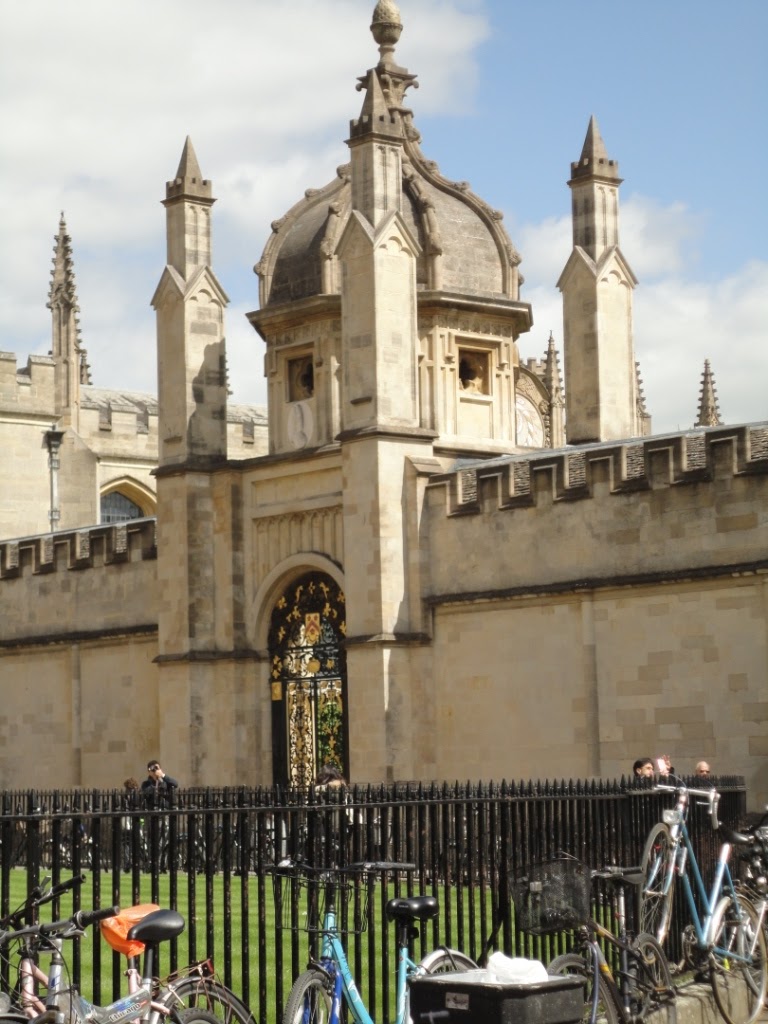
After a quick peek at the Ashmolean Museum, we set out for a stroll up Cornmarket Street...


to the Carfax Tower--more properly, the 12th century tower of St. Martin’s church (the clock with the little mechanical guys who ring the hour are a 19th century addition)...


up High Street to get a peek at the Radcliffe Camera (alas, closed for the day)...


and the Church of St. Mary...


up to the Botanical Gardens, then down the Broad Walk past Christ Church Meadow (which was lovely and wild but surprisingly sheep-free)...


and Merton College, one of the oldest in the university and the college of J.R.R. Tolkien...


then on for a pleasant lunch (notice the delightfully sunny and warm weather--a feature of most of the trip) at The Head of the River Pub, on the Thames...or is it the Isis? For some reason, the Thames is called the Isis where it flows through the city. From what I’ve been able to discover, this seems mostly to have been a Victorian thing, involving some romantic but erroneous mythological and linguistic shenanigans; the old Celtic name of the river was the Tamesis, so you can see where the borrowing might have come from.

Whizzing down the M40 and M25, we arrived in Windsor and made it up to the Castle just before ticket sales closed...and I’m so glad we did. It’s a very interesting place, so old in places and yet immaculately maintained and manicured. Security was fairly tight as the Queen was in residence (her standard was flying over the Castle, which was pretty cool), so we had to go through the equivalent of airport security after purchasing our tickets.


We wandered around the grounds for a bit and got a look at this charming garden...


then made our way to view the bits open to the public: the State Rooms and...the Queen’s Dolls’ House, which I blogged about a few years ago and which was beyond amazing to see in person (alas, no photographs permitted.) The State Rooms were gorgeous, especially the Waterloo Chamber with Sir Thomas Lawrence’s portraits of the leaders of the Allies. It’s kind of amazing to see the originals of artwork you’ve only seen reproduced in books.

But probably the coolest thing we saw at Windsor was a special exhibit entitled “Waterloo at Windsor”, commemorating the 200th anniversary of the battle. Again, no photos permitted (sigh!), but here's a link to the exhibit's website. On display were portraits and Rowlandson cartoons and drawings...and then there were the letters: Napoleon’s formal letter of surrender to the Prince Regent, Wellington’s dispatch to the Prince after the battle, and more. My kids were mightily amused at their mother’s hyperventilating as she scurried from display case to display case, but honestly—what amazing things to see! I was a very happy history geek that afternoon.

Next stop on our tour: Bath!

Tuesday, June 2, 2015

Green and Pleasant Land, Part 1: London

London is an amazing city. Of course the history aspect is amazing...but it’s also a remarkably livable city, at least for me who gets antsy when there aren’t trees nearby. There’s little of the canyon-like effect you get in Manhattan...and the parks are truly lovely. And did I mention the history? ☺

So the five of us arrived at our hotel in Westminster in what is probably an ideal place for sightseeing: we were at the St. James Courtyard hotel, a five-minute walk from Buckingham Palace (and on the same street as the Bluecoat School, about which Regina blogged). The hotel itself dates to the Edwardian era, and is built around a courtyard with all sorts of delightful architectural bits. London abounds in delightful architectural bits, by the way—no walk is ever dull there.


I’m happy to report that the statue of Queen Victoria at her memorial in front of the Palace still looks like a lifeguard (which I’d noticed on my first visit to London about thirty years ago)—for some reason Her Majesty’s nose is lighter than the rest of her, as if smeared with zinc oxide. And Canada Gate at the entrance to Green Park off Constitution Hill is as shiny as ever:


However, I was very sad to see that cows are no longer kept in Green Park as they were during the Regency, despite this reminder of their presence:


I found it a little surprising to see how small St. James’s Palace was, and how “right there” as well—the streets run right alongside it—considering it’s actually the official home of the sovereign (ambassadors are still accredited to the Court of St. James.) It was built by Henry VIII and added onto over the centuries, but still has that sixteenth century feel:


And then we were in St. James’s Street, Masculinity Central of Regency London, home of such places as Brooks’s and White’s Club (and yes, there’s the famous Bow Window at White’s)


What I found interesting (beside all the famous historical landmarks and stores) was the topography. St. James’s Street trends uphill, which I did not know—it’s one of those things that somehow doesn’t get mentioned very often, and which I’m glad I now know. But even more exciting to me was catching sight of King Street off St. James’s. The King Street, home of Almack’s Assembly Rooms? You bet—only, Almack’s is long gone, replaced by (sob!) an office building. But at least I can now say I was there as I scribble away at my Almack’s stories. That's me with Child #1. Yes, he's pretty tall.


What else? We dined at Wilton’s on Jermyn Street, established 1742, and had a wonderful dinner...and a delightful tea at Duke’s Hotel. We carried out a quick raid on Harrod’s and came away with tea and chocolates (alas, the presence of a husband and son necessitated the visit being brief). And we visited the Victoria and Albert Museum (glorious sensory overload—it’s the world’s largest museum of art and design) and Apsley House, the Duke of Wellington’s house at Hyde Park Corner, which was amazing.


No interior photographs permitted, alas, as my little history-geek heart was a-galloping at the eleven-foot tall statue of Napoleon at the base of the Principal Staircase on which it is rumored Wellington used to hang his hat as he went up the stairs (and the painting of Wellington in old age presenting a gift to his godson, Queen Victoria’s son Arthur)...at the astonishing Waterloo Shield, which really has to be seen to be appreciated (Google it!) Wellington came away from the wars with a ton of goodies from grateful European heads of state. And most of all at the Waterloo Gallery, the room where Wellington held his annual dinners to commemorate the battle and which held his collection of Spanish masters. Curiously, among the amazing art collection amassed here are multiple portraits of Napoleon and members of his family. After Waterloo, Wellington would be linked for the rest of his life to the former French emperor—without Napoleon, Wellington would not have been Wellington. That must have been a strange thing to have to live with for the rest of his life—so closely linked to someone he actually never met face-to-face—and he lived nearly forty more years after the battle.

And right around the corner from Apsley House in Hyde Park? Rotten Row, of course!


Next time: visiting Oxford and Windsor

Friday, June 20, 2014

From the Women of England to Wellington

This week marks the 199th anniversary of the Duke of Wellington’s victory over Napoleon at Waterloo.  As we've mentioned in previous posts, Wellington ended up a much celebrated gentleman, with nations and royalty showering him with gifts and mementos.  One of my favorites, however, is said to have come from a very different set of people, the women of England.

The Wellington Monument in Hyde Park, also known as Achilles, was paid for by a ladies subscription amounting to 10,000 pounds sterling and cast from cannons captured at the battles of Salamanca, Vitoria, Toulouse, and Waterloo. Created by popular sculptor Sir Richard Westmacott, the 18-foot bronze statue sits on a plinth of Dartmoor granite to rise a total of 36 feet above the pebbled path near Hyde Park Corner.  Even before it was erected in 1822 it was surrounded by controversy.

For one thing, Westmacott must have focused more on his art than the dimensions of its intended location, for when the statue was moved from his studio in Pimlico, Achilles was found to be too big to fit through the gates of Hyde Park! Not to be deterred, the movers merely knocked a hole in the wall to move it through.

For another, critics could not decide whether it was great art or a cheap knockoff.  Newspapers and books of the time either praise the fact that the statue resembled one in Rome, where Westmacott had spent some time on his Grand Tour, or scolded the artist for failing to live up to his Roman pretensions.  Some deemed the body magnificent; others complained that it didn’t look enough like Achilles (and you would know how?).  One critic even lambasted Westmacott for including visible straps holding the shield in place on the statue’s arm.

And then there was the matter of Achilles’ lack of clothing.  The statue is said to be the first nude male figure on public view in London.  The ladies who had helped raise the subscription had not seen the design and were rather shocked by the anatomically correct statue.  Some seemed to feel their reputations damaged by association.  A fig leaf was hurriedly placed over the offending section.  It remains there to this day, even though it has been chipped off twice.

And if you’re a lady enamored of Greek or Roman statuary, or anything Greek or Roman, I urge you to return next week, when Marissa will be launching her first book for adults, by Jove.

Er, yes. By Jove.  No need to raise a subscription.  Fig leafs not required.


Friday, March 7, 2014

Number One London

Doesn’t that sound like a cool address?  It ought to be where the king lives, or perhaps the prime minister.  But it just so happens to be the former home of the Duke of Wellington, and a fete there was one of the most sought after invitations in nineteenth century England.


Originally built by the famous architect Robert Adam for the first Baron Apsley Henry Bathurst, Apsley House sits at the north side of Hyde Park Corner, with a commanding view over some of London’s busiest streets.  Lord Apsley sold it to Wellington’s older brother, who in turn sold it to Wellington.  The duke had it enlarged and remodeled to suit his needs.

Part of that remodeling involved moving the entrance hall to one side.  Then as now, portions of the house were open to visitors, so a room just off the entrance was made into a museum showcasing some of Wellington’s trophies and mementoes.  Of course, even at the time, his friends remarked that the entire house felt like a museum because so many pieces of furniture, paintings, and plate were in fact gifts for Wellington’s services in putting down Napoleon. 


Napoleon is a large part of the house, beginning with a larger-than-life marble statue of him as Mars, which takes up much of the main stairwell.  Then again, one of the most beautiful rooms at Apsley House is the Waterloo Gallery, named after the battle where Wellington finally triumphed.  Over 90 feet long and two stories tall, the room boasts walls covered in silk damask, gilded doors and ceiling, and mirrored shutters for the windows.  As the story goes, Wellington and his designer argued over how the room would look.  In the end, Wellington insisted on yellow damask for the walls, although today it can be seen in scarlet.  The grand gallery was the scene of many an entertainment, including an annual banquet to celebrate the victory at Waterloo.

Because something that big needs to be celebrated annually in a room that gorgeous in London’s first residence.

And speaking of celebrations, I’m delighted to report that next Friday will see the beginning of a special two-part guest post by Jo AnnBrown, author of this month’s A Bride for the Baron, who promises to tell all about smuggling in early nineteenth century England and the secrets of Robin Hood’s Bay! Join us!

Tuesday, July 19, 2011

Victoria’s Children, Part 7: Arthur

It’s often said that the middle children in families tend to get lost in…well, the middle. But Prince Arthur, seventh of Victoria’s nine children, somehow managed to avoid that fate. In fact, the Queen frequently called him her favorite child (that's her with baby Arthur at right.)

So what earned Arthur his Most Favored Child status?

Prince Arthur William Patrick Albert was born on May 1, 1850, at Buckingham Palace. As he shared his birthday with Arthur Wellesley, Duke of Wellington, who by now had reached mythic status as the victor of the Battle of Waterloo, the Duke was asked to be one of his godfathers and lent the new royal baby his name (that's the old Iron Duke giving his namesake a first birthday present below). The Queen seemed to dote on this well-behaved, easy-going child from the start. She “adored little Arthur from the day of his birth”--unusual, for she was not fond of infants; he was her “precious love” who “has never given us a day’s sorrow or trouble” and was “dearer than any of the others put together” (phew!) Young Arthur seems to have shown up well compared to his two older brothers, Bertie and Alfred, which might be the source of his mother’s doting upon him: raised as an only child (her half-brother was much older) she’d had no experience with the occasional boisterousness of some boys…and Bertie and Affie could be boisterous!

Arthur was tutored at home—no school for Victoria’s children, thank you very much—and seemed to have borne well his mother’s restrictions and demands (no fraternizing with Eton boys while at Windsor, rooms must be kept no warmer than 60°). He was delighted to take up the career in the Army that had been chosen for him from early childhood (another tie to his godfatherly namesake) and entered the Royal Military Academy at Woolwich in 1866, at age 16. He acquitted himself creditably during his training and eventually settled into the famous Rifle Brigade, of which the Duke of Wellington and then his father, Prince Albert, was Commander-in-Chief. In the early years of his career he saw service in South Africa, Canada (where he was made a Chief of the Six Nations by the Iroquois), and Ireland.

The Queen made him Duke of Connaught and Strathern in 1874, and was delighted when he married Princess Louise of Prussia in 1879. Their marriage was a happy one, and produced three children: Margaret (later Crown Princess of Sweden), Arthur, and Patricia. In his later years, and especially after his wife’s death in 1917, he was close to Leonie Leslie, aunt of Winston Churchill.

Arthur continued to perform both his army and royal duties, was made a Field Marshal (though he was disappointed never to become Commander-in-Chief of the Army as his mother hoped he would) and in 1911 became Viceroy of Canada, the only member of the royal family to have served thus. After his return from Canada (where he was quite popular and well-liked) he didn’t hold any further official positions but continued his ceremonial and advisory duties right up to World War II, dying in 1942 at age 91. Not a bad life, when you consider it.

Friday, June 25, 2010

Dueling Dukes and Other Eligibles

You see them in movies; you read about them in books: the hero and generally the villain square off in a duel with swords or pistols. We’ve talked about how many young men were taught early to shoot and to fence. They were also cautioned against hot-headed displays. But dueling was viewed as an honorable alternative to settling a dispute. Even though it was frowned upon by the magistrates, even the most senior and respected of peers sometimes demanded satisfaction on the field of honor!

Some duels were over gambling debts. In September 1810 in Surrey, Captain Hants was mortally wounded when he met a Mr. Coleshall at Monsley Hurst over a “trivial bet at Egham races.” This after Mr. Coleshall’s brother tattled on them the previous week when they were trying to set up to duel in Middlesex. So strong was the feeling about dueling, however, that when the Coroner’s Inquest was called, no witness mentioned Mr. Coleshall’s involvement. (So even the gossip columnist who reported about the event knew who had shot the gallant captain, but no one was willing to tell the jury the information.) The jury returned a verdict of “Willful Murder by person or persons unknown.” Hmm.

Sometimes duels were fought over a lady’s honor. A wealthy married gentleman by the name of Payne made advances toward a Miss Clark, who was a friend of his wife. Even his own brother tried to talk him out of it, but he refused to stop his attentions. Miss Clark must have poured her concerns out to her brother, who was a captain in the army, because he took umbrage and met Payne on Wimbledon Common (yes, that Wimbledon). Mr. Payne must have been feeling some remorse, for he told a friend that he would not return fire. The captain’s first shot killed him, leaving his widow to raise their four children. Once again, the jury returned a verdict of “Willful Murder by some person or persons unknown.”


Sometimes, however, duels were fought for political reasons. In 1798, the Prime Minister of England, William Pitt, accused George Tierney, an opposition politician, of desiring to obstruct the defense of England. Tierney demanded that Pitt withdraw the accusation; Pitt refused. Tierney challenged him to a duel, and the two met near London. The first set of shots went wild, and Pitt fired his second shot into the air, thereby vindicating honor. Even the Duke of Wellington, that victor of Waterloo, fought a duel when he was Prime Minister. He was accused of attempting to introduce “Popery” into British government by favoring laws giving Catholics more freedom in England. Wellington missed, and his opponent, the Earl of Winchilsea, fired into the air.

By the way, you may see the word delope or delopement used to describe the business of firing into the air. Georgette Heyer used the word in one of her books. So far, the term hasn’t been located in any document from the nineteenth century, to my knowledge.

So does that mean the pen really is mightier than the sword?

Wednesday, June 23, 2010

"The Nearest Run Thing You Ever Saw in Your Life"

Last Friday marked the 195th anniversary of an event that was...well, not to sound too dramatic, but an event that marked the beginning of modern Europe. I'm talking about the Battle of Waterloo.

It was June 1815. Napoleon Bonaparte, Emperor of the French, had been defeated in 1814 after running roughshod over most of Europe and sent into exile on the island of Elba...and had come back eight months later, determined to return to his former position. Everyone who was anyone in Europe was at the Congress of Vienna, where they were busy carving up the former French empire into bits based on who owed whom favors when Napoleon sailed from Elba on February 26 and landed in the south of France. By March 20 he was back in Paris, having retaken the country without firing a single shot. King Louis XVIII (brother of Louis XVI who had been guillotined in the Revolution) who had been restored to the throne after Napoleon's ouster, fled to Belgium (at this time still part of the Netherlands).

However, the crowned heads of Europe were not about to let Napoleon stay where he was and risk his reconquering Europe once again. The man who'd been most responsible for Napoleon's recent downfall, Arthur Wellesley, Duke of Wellington, left Vienna, where he'd been head of the English delegation, and headed to Brussels, Belgium. It had been decided that the armies of Europe would hastily re-gather themselves and march on France on three fronts; English and Dutch and Prussian troops would take the northeast frontier in Belgium. It was thought that Napoleon might begin his defense of France there, and the guess proved correct: on June 15, while at a ball in Brussels given by the English Duchess of Richmond, the Duke of Wellington received word that Napoleon had crossed the border with his army and was marching toward the city.

The indecisive Battle of Quatre Bras, fought on June 16, ended in more or less a draw, and ensured that further battle would follow...which it did, two days later, near the small village of Waterloo south of Brussels. Noteworthy for readers of Nineteenteen is the age of many of the soldiers who fought in this battle: there wasn't time to gather the seasoned troops who'd fought with Wellington in Spain and Portugal (many of them had been deployed to fight in America in what we know as the War of 1812) and so thousands of youths enlisted to fill the void. Though legally 18 was the enlisting age, enlistees as young as fifteen were permitted, with a nod and a wink, to join up. Many of them never returned home; of the Allied (Dutch/Belgian, German, and British) troops, 23,000 of them British, one in four did not survive.

The battle itself was hell. It had poured the previous night and everyone was wet and miserable; indeed, Napoleon did not attack until nearly noon, waiting for the ground to dry so that his artillery pieces could be better manoeuvered. This delay favored the Allies; they were awaiting the arrival of reinforcements in the form of the Prussian army under General Blucher. Wellington's strategy was to simply stand in the way and not let Napoleon progress along the road to Brussels. This he did; General Blucher's arrival with the mass of his army early that evening enabled the combined Allied/Prussian army to go on the offensive, and by half-past eight, the French began to flee. Napoleon abdicated a second time on June 24, and the years of war were finally over.

This is, of course, the briefest outline of the Battle and the circumstances around it. If you're interested in getting deeper into it, I recommend two books: the first is An Infamous Army by (yes, really) Georgette Heyer. Don't laugh; it was used as a text at Sandhurst (Britain's West Point) to teach about the battle, so well-regarded was her account. The second is Dancing into Battle: A Social History of the Battle of Waterloo by Nick Foulkes--non-fiction, but as readable and lively as fiction.

Oh, and today's title? It's a quote from the Duke himself, who is supposed to have said it to describe the day's events.