
Showing posts with label 1811. Show all posts

Tuesday, April 14, 2020

Snippets: The Lady’s Magazine, January 1811

I do enjoy reading periodicals from the nineteenth and early twentieth centuries—the articles, the stories, the illustrations, and even the ads. They don’t necessarily offer a completely accurate picture of their eras: overall, most general-consumption magazines present an aspirational picture of their worlds —how its readers would like their lives to be. After all, does any magazine you read truly reflect the reality of your everyday life?

Still, they do provide a window into the past that is often useful and informative. To this history geek, they can be at times surprising, eye-opening, and—sometimes—utterly delightful.

I have before me the January 1811 edition of The Lady’s Magazine, or, Entertaining Companion for the Fair Sex; Appropri-ated Solely to Their Use and Amusement (gotta love the snappy title.) The “top story” is the beginning of a biography of the then-General Viscount Wellington (on the first step up the ladder leading to his eventual dukedom) who was busily engaged in the Peninsula. Like most of the pieces in this magazine, it is one installment of a longer piece; aside from letters to the editor and a few shorter extracts from essays and books, most of the articles here are continuations from issue to issue. The accompanying portrait engraving, purporting to be “an accurate likeness”, makes him look considerably younger (and plumper) than most of the portraits I’ve seen!

Of universal interest, I’m sure, is a brief but alarming piece titled “Ladies’ Clothes on Fire”, advocating for heavy woolen “fire cloaks” to become an accepted part of the dĂ©cor of “every parlour and ’drawing-room in the kingdom, and deemed as necessary an article of its furniture, as the hearth-rug, the fire-screen, or the fender.”

Then there’s a touching story of “The Remarkable Docility of a Sow”, detailing the story of pigs who have been raised alongside hunting dogs and trained to point as well as their canine step-siblings.

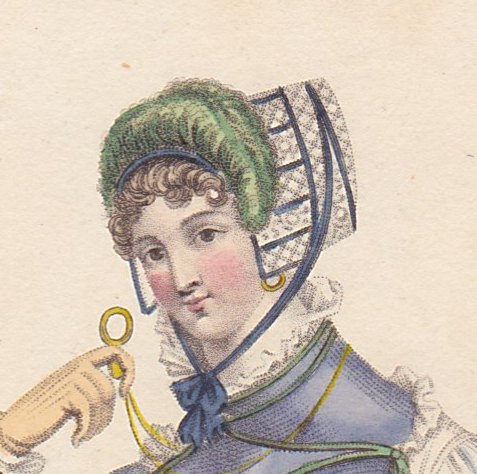
Of course, there’s a fashion plate, showing “London Morning and Evening Dress” in shades of black and gray as mourning for Princess Amelia was still in effect. The black velvet evening dress, trimmed “with velvet and gold cord twisted together would pass muster today at an evening event, I think.

But the piece that surprised me the most was a brief item in the Births, Marriages, and Deaths section: on January 9 was listed the death “At Gretna Green, aged 79, the celebrated Joseph Pasley, first (it is said) a tobacconist, afterward a fisherman, and finally, without ordination or commission, a volunteer, self-constituted priest of Hymen, better known by the appellation of the Gretna-Green Parson*” The asterisk indicates a note reading, “On a trial respecting the validity of one of his marriages—on which occasion, he appeared in court as a witness—we recollect the judge characterizing him as a blacksmith.” This is, of course, the famous performer of clandestine marriages for eloping couples from England who fled just over the Scottish border—and out of the reach of English church law...and evidently a news-maker even then!

Tuesday, March 3, 2020

Regency Fabrics, Part 28

Here’s another post in our ongoing series on Regency fabrics.

As I have in previous posts, I’ll be examining actual fabric samples glued into several earlier editions of Ackermann’s Repository, samples supplied by the manufacturers and published by Ackermann in order to boost the British cloth-making industry at a time when exporting British goods to Europe was almost impossible because of the Napoleonic war. I'll give you a close-up scan of each sample, the published description if available, and my own observations of the color, weight, condition, and similarity to present-day materials, to give you as close a picture as possible of what these fabrics are like.

Today’s three samples are from the September 1811 issue of Ackermann’s Repository. The overall condition of my copy is excellent; the page itself is free of foxing and is only slightly toned. One of the samples shows some foxing, but overall they’re in very good condition.


Here we go!

No. 1 and 2. A striped Persian dove-coloured chintz for window-curtains and bed furniture. The colour of this article is so chaste, and at the same time so perfectly neutral, that fringed trimming of any hue will suit it; a rich gold yellow, however, is particularly adapted to shew it to the greatest advantage. This pattern is supplied by Mr. Allen, 61, Pall-Mall, whose taste as a designer and printer of furniture is so conspicuously displayed in the elegance of all his productions, as to have procured him the most flattering patronage of His Royal Highness the Prince Regent.


My comments: Hmm. I’d always thought “dove-coloured” to be a grayish color, but this sample is decidedly brown; either it has changed over the years, or the definition has. It’s a nicely evenly-woven, not-too-heavily glazed chintz, which would drape well but would likely need lining to give it sufficient body for curtains.

No. 2. is a celestial blue waved gauze for evening dress. This article, equally novel and graceful, should be worn over white satin or sarsnet, and may be had of Messrs. Cooper and Co. silk-mercers, 28, Pall-Mall.


My comments:  Oops—some mis-numbering here. This is an airy net-like fabric, beautifully silky, with a pattern of zig-zags to give it visual interest. The pale sky blue would be lovely over white satin as suggested in the text.

No. 3. A sprigged chintz, designed for morning dresses. It combines a high degree of elegance with a pleasing simplicity; and is sold by Cooper and Co. 113, New-Bond-street.


My comments: Ah, another morning dress print fabric, perhaps for a Morning Dress like this one at left from Ackermann in February 1810. This chintz is woven of very fine thread which makes it sturdy yet supple, and the printing is neatly and accurately done.

What do you think of this month’s fabrics?

Tuesday, January 21, 2020

Such Language! Part 25


More lexigraphic levity and laughter, courtesy of the 1811 Dictionary of the Vulgar Tongue. Enjoy!

Bottle-headed: Void of wit. (I was so tongue-tied when introduced to that handsome young earl at Almack’s last night that I could scarce utter a word, and I’m sure he thinks me completely bottle-witted.)

Trap sticks: Thin legs, gambs: from the sticks with which boys play at trap-ball. (Uncle Simon’s tailor is so skilled at making trousers that he can even make uncle’s trap sticks look shapely and muscular.)

Clunch: An awkward clownish fellow. (My new horse is such a clunch that I don’t dare ride him in Rotten Row, lest my friends all mistake him for a circus pony.)

Scaly: Mean, sordid. (Great-aunt Agatha’s tips are so scaly that there’s not a single crossing-sweeper in London who’ll sweep a way for her.)

Long Meg: A jeering name for a very tall woman: from one famous in story, called Long Meg of Westminster. (My statuesque friend Alice complains that the worst part of being such a Long Meg is that her dresses need an extra half-yard of fabric and therefore cost more than everyone else’s.)

Gilly Gaupus:  A Scotch term for a tall, awkward fellow. (Fortunately, Alice’s betrothed, Lord Maclathy, is not only himself a Gilly Gaupus, but also a very wealthy man.)

Laid up in lavender: Pawned. (This is the seventeenth time my brother’s watch-chain and fobs have been laid up in lavender; I think he’s run out of friends to help him retrieve them.)

Tuesday, June 11, 2019

Ooh La La, La Belle Assemblée!


Now this is quite the light summer frock! May I present to you the Kensington Garden Fashionable Promenade Dress, courtesy of the July 1, 1811 edition of La Belle Assemblée?


There’s a great deal going on here, so let’s see what the description says...

“A round robe of white jaconot muslin, with a bodice of violet sarsnet, trimmed with rich silk Brandenburgs of Austrian green, a half pelisse of fine transparent muslin, with Bishop’s sleeves, fancifully tied with a green ribband. A Hymen hat of purple brocaded ribband and lace, ornamented with a green military plume; a Chinese parasol of purple sarsnet, shot with green; gloves and shoes of York tan.”

Well. The first thing that I noticed about this dress is the waistline: it falls more or less at the natural waist, which is unusual...but one thing I love about the clothes from these years is that they weren’t as strict as, say, the 1820s would be in terms of line and structure—so there was some room for creativity. The dark violet bodice contrasting with the soft white muslin of the skirt and half pelisse makes a striking statement; I wish it was possible to see how long the sleeves were under that pelisse. The frogging and tassels crisscrossing the bodice are striking as well, and rather emphasize the bust.

I don’t think I’ve run across a half pelisse before: it’s almost like an open cardigan, and seems to end in fanciful points. The sleeves tied with ribbon down the length of the arm is a style that will persist on and off now through the 1820s, until the enormous sleeves of the 1830s will make such a look impossible.

The hat is curious, I thought. The drawing is a little awkwardly done so it’s difficult to see exactly what is going on here; it looks rather like a box perched on the back of her head, but the green plume over the top of the forehead is quite dashing. And since this is a promenade costume, note the quizzing glass: one must see as well as being seen!

What do you think? Would you wear this on your next jaunt to Kensington Gardens?

Tuesday, May 21, 2019

On Fire!


Oh my goodness, what a cloak! It looks more like a prop from Game of Thrones than a Walking Dress from the April 1811 fashions in La Belle Assemblée...but a Regency miss and not a mother of dragons got to wear this beauty.


Let’s have a closer look: the text reads Round dress of cambric muslin, with a ruff collar, trimmed round the bottom with narrow purple ribband; cassimere crimson mantle, confined close to the back, lined with purple silk, embroidered round the neck, cape, and sides with purple fancy border; a deep cape falling from the shoulders, sloping to a narrow point, with tassels. A crimson velvet bonnet, turban front, and trimmed with purple to correspond. York tan gloves. Yellow kid boots.

Wow. It’s quite a garment, isn’t it? It reminds me a little of the Jubilee cloak we saw from 1810 with the purple-lined red, but this takes things a step further: the deep V detail on the back, the tassels, the purple embroidery—very striking! The fabric is cassimere, or kerseymere, a very fine, soft fabric woven of merino wool.

The accompanying hat is also striking: part turban, part Phrygian cap, and of crimson velvet to match the cloak. It rather reminds me of a very gorgeous seashell!

I do confess to being a tad disappointed that the boots are not also scarlet, but one can’t have everything. ☺

What do you think? Would you like a cloak like this?

Tuesday, March 19, 2019

Regency Fabrics, Part 23

Here’s another post in our ongoing series on Regency fabrics.

As I have in previous posts, I’ll be examining actual fabric samples glued into several earlier editions of Ackermann’s Repository, samples supplied by the manufacturers and published by Ackermann in order to boost the British cloth-making industry at a time when exporting British goods to Europe was almost impossible because of the Napoleonic war. I'll give you a close-up scan of each sample, the published description if available, and my own observations of the color, weight, condition, and similarity to present-day materials, to give you as close a picture as possible of what these fabrics are like.

Today’s four samples are from the  November 1811 issue of Ackermann’s Repository. The overall condition of my copy is excellent; the page itself is free of foxing and is only slightly toned, and the fabrics themselves seem to be in excellent condition as well.

Here we go!
No. 1.  A fawn-coloured lustre for evening or half-dress. This appropriate article has not before been introduced of this becoming and delicate shade. It is usually trimmed with swansdown, or other light skin, or with falls of thread lace; and is sold by Mr. George, No. 19, Holywell-street, Strand. 

My comments: Oh, lovely! This appears to be a woven silk of a slightly uneven but still beautifully smooth hand, and the color is indeed becoming. I’m sure it drapes very well, and while fairly opaque, would do best over an underskirt.

No. 2. A new sea-weed printed cambric, whose warmth of colouring renders it particularly adapted for the approaching winter season.  It is calculated more immediately for the domestic or morning robe, and is worn with lace cuffs and frill. Sold by Waithman and Son, corner of Fleet-street, Blackfriars.


My comments: Heh—another vintage quilting fabric look-alike, looking very American Civil War era to my eyes. The weave is smooth and even and the printing very sharp and precise.

No. 3. A checked ladies’ Merino cloth for habits, German coats, pelisses, &c. It is similar to that represented in the walking figure of the present Number of this work. The trimmings most fashionable and consistent for coats of this article are, Spanish silk braid and frogs, with divers kinds of fur, happily contrasted with the colour of the cloth.


My comments: A cozy, lightly flocked woolen, not so heavy that it wouldn’t fall nicely. Very curiously, while the check pattern isn't visible to the naked eye, it can been seen when scanned. I cannot tell if the square pattern was woven in or printed as it just doesn't show up in person; also, the scan makes it look like the contrasting check is a sort of faded acid yellow, which is not apparent in regular light--the fabric appears a uniform vanilla color.


No. 4. A Persian kerseymere, worked in tambour, first introduced in this country by the late Persian ambassador, and is much in vogue with our male fashionables. Some gentlemen trim the waistcoat, formed of this unique article, at the collar and breast with a border or edging of sable; it has a most comfortable and becoming effect during the winter months. This article, together with No. 3, is furnished by Messrs. Maunde and Co. wholesale and retail drapers and mercers, in Cornhill.

My comments: Similar in texture but slightly lighter in weight that the woolen in No. 3...but that yellow...and the black, white, and orange pattern...! The yellow is brighter in natural light than it appears to be under the scan. I’m trying to picture a gentleman’s waistcoat made of this and trimmed with fur, and expect that Beau Brummel would have had to have a brief lie-down in a darkened room with a cold compress on his forehead had he spotted one of his friends wearing it.

And an interesting side note on this month’s samples: in the next month’s issue is a note that reads We forgot to mention in our number for November that the Persian Kerseymere, No. 4,  furnished us by Messrs. Maunde and Co., is worked in tambour by a society of unfortunate, but industrious French immigrants, residing in the west of England. An interesting footnote on many levels...do I feel a story coming on about an impoverished but nobly-born French emigrĂ© and the foppish earl who falls in love with the fabric of his new waistcoat and moves heaven and earth to find out whose dainty hands stitched it? Stay tuned...

Any thoughts on this month’s fabrics?

Tuesday, January 15, 2019

Such Language! Part 22


Oh, the Rabelaisian buffet that is the 1811 Dictionary of the Vulgar Tongue! What’s your favorite word or phrase this time? Muckworm is soooo very evocative, as is old toast--can't you just picture a spry, dapper old gentleman? What do you think?

Arch Duke: A comical or eccentric fellow. (I see no reason why my younger brother should be called an arch duke just because he prefers gravy to whipped cream on his strawberries.)

Caudge-pawed: Left-handed (Being caudge-pawed made remembering which hand to use when being presented to the queen something of a nightmare for Lucinda.)

Gabey:  A foolish fellow. (Sir Arnold is enough of a gabey to think that his purple and gold waistcoat is the height of fashion.)

Slamkin:  A female sloven, one whose clothes seem hung on with a pitchfork. (To see her now fluttering her fan and swishing her skirts, you’d never suspect my sister Ermentrude was an utter slamkin before her come-out.)

Peccavi: To cry peccavi; to acknowledge one’s self in an error, to own a fault: from the Latin peccavi, I have sinned. (Ermentrude won’t cry peccavi, but I know she’s the one who borrowed my new parasol and left it at Gunter’s.)

Muckworm: A miser (That old muckworm Mr. Pauncefort must be rolling in his grave to see how open-handed and generous his young nephew and heir has been toward his tenants.)

Old Toast:  A brisk old fellow. (Great-Uncle Gilbert walks three times up and down Rotten Row each day, just to hear the ladies whisper about what a lively old toast he is.)


Tuesday, September 18, 2018

Regency Fabrics, Part 21


Here’s another post in our ongoing series on Regency fabrics.

As I have in previous posts, I’ll be examining actual fabric samples glued into several earlier editions of Ackermann’s Repository, samples supplied by the manufacturers and published by Ackermann in order to boost the British cloth-making industry at a time when exporting British goods to Europe was almost impossible because of the Napoleonic war. I'll give you a close-up scan of each sample, the published description if available, and my own observations of the color, weight, condition, and similarity to present-day materials, to give you as close a picture as possible of what these fabrics are like.


Today’s four samples are from the October 1811 issue of Ackermann’s Repository. The overall condition of my copy is very good, at least as far as the paper goes; while the physical integrity of the fabrics is good, the two lower ones seem to be a bit faded or have offset from the facing page.

Here we go!

No. 1. A lilac and white Moscow checked sarsnet, for dinner or evening dresses: trimmings of Chinese fringe, thread-lace, or white beads, are appropriate for dresses of this light article, with jewellery ornaments to correspond. They are (like most of the evening robes) made with demi-trains, and many ladies adopt the short full sleeve. It is furnished by D. and P. Cooper, Pall-Mall.


My comments: Very pretty! Today we might call this a window-pane plaid, and it is lovely stuff, a lightweight silk plain weave with the twill stripes in off-white running through it and a soft sheen overall. It's fairly opaque, but would benefit from a lining in both bodice and skirt.

No. 2. A purple striped Iris net, calculated for the above order of costume. This article is usually worn over a white sarsnet or satin slip, and trimmed with white lace, or silk fringe. It is sold by Mr. George, No. 19, Holywell-street, Strand.


My comments: Funny how tastes change; I would not have pegged this fabric as appropriate for dresses intended for formal occasions. It's a net-type fabric so the thread count is lower (and yes, it would absolutely have to be worn over a slip) but the weave is even and the fabric itself fairly stiff and sturdy.

No. 3. A jonquil shawl-pattern cambric, belonging to the domestic or intermediate order of dress. Robes of this article are usually made plain, sitting close to the form, in wraps, or high gowns, with long sleeves, rather large, and trimmed around the throat and at the wrists with lace. It is sold by Mr. Smith, Tavistock-street, Covent-Garden.


My comments: What a cheerful fabric! Though the yellow is fading it's plain to see how bright this originally was. The fabric itself is of a nice weight and would drape nicely, with twilled diagonal stripes woven in.

No. 4 is also an article for morning or domestic decoration, and is called the palm-leaf imperial-striped cambric. It is formed in plain robes as above; and furnished also by Mr. Smith, Tavistock-street, Covent-Garden.


My comments: A twill weave, with the pink stripes woven in and the leaves printed over. A bit lighter weight than No. 3, but certainly appropriate for a cheerful morning dress to wear at home while answering letters or planning the social domination of London. ☺

Any thoughts on this month’s fabrics?

Tuesday, June 26, 2018

Regency Fabrics, Part 20

Regency Fabrics, Part 20

Here’s another post in our ongoing series on Regency fabrics.

As I have in previous posts, I’ll be examining actual fabric samples glued into several earlier editions of Ackermann’s Repository, samples supplied by the manufacturers and published by Ackermann in order to boost the British cloth-making industry at a time when exporting British goods to Europe was almost impossible because of the Napoleonic war. I'll give you a close-up scan of each sample, the published description if available, and my own observations of the color, weight, condition, and similarity to present-day materials, to give you as close a picture as possible of what these fabrics are like.


Today’s four samples are from the August 1811 issue of Ackermann’s Repository. The overall condition of my copy is good: the page itself is most free of foxing and toning, though one of the samples is a little worse for the two hundred plus years since it was woven, and two have lost their color to a greater or lesser degree.

Here we go!

No. 1. A royal regency leno, for evening or full dress, calculated for the Turkish robes and Roman tunics now so fashionable in elegant circles. It should be worn over white satin, or sarsnet; and embellished with ornaments of pearl, diamonds, white cornelian, or the satin bead. This elegant article is furnished by Harris, Moody, and Co. Pall-Mall.


My comments: This is an attractively airy net style of fabric, elaborately woven of lovely silky thread in dark green, yellow, and dusty pink. While it’s mostly made of air, the style of weaving and heft to the threads gives it some weight. I do wish more Ackermann prints showed dresses made from the fabrics they advertised; it would be most instructive to see just what was done with a fabric like this, worn over white satin. I think I would have been terrified of catching it on jewelry or on something else and tearing the you-know-what out of it.

No. 2. A dove-coloured imperial gauze, adapted for the same order of costume, and to which the same jewellery ornaments are appropriate. Trimmings of fine lace, with decorations of wreaths and bouquets for the hair and bosom, are also becoming appendages to this neat and elegant article, which is furnished by Messrs. Coopers, Pall-Mall.


My comments: Another woven net, this time of all one color. This one feels a little less substantial than the first, despite its greater opacity. It would be charming as an overdress; I wonder if it was made up with the stripes oriented in the vertical or horizontal?

No. 3. A celestial blue penciled muslin, adapted for the intermediate order of dress. It is either made high, with a trimming of narrow lace round the throat, or formed in a low square bosom, finished with white embossed satin ribbon. With each the long sleeve is to be preferred, in this as in most other muslin articles.


My comments: Um...celestial blue? This sample has clearly suffered; the dye is gone, though the feathery little random pattern printed on has survived...and after a quick look around on the interwebz, mine is not the only one to have suffered. It’s not easy to say much about it as it seems to have been glued entirely down on the page, but it is a very loosely (if evenly) woven fabric.

No. 4. A pink muslin, with embossed green spot. This animated article is confined to the more youthful females, to whom it is most becomingly adapted. It should invariably be worn over white sarsnet, fine glazed cambric, or satin; and should be formed in the most plain and simple manner. No jewellery ornaments but white can be admitted to blend with this material, nor any but white flowers to be worn in the hair.

The last two articles are furnished by Messrs. T. and J. Smith, 43, Tavistock-street, Covent Garden.


My comments: Oh my goodness, more polka dots! Interesting that this fabric is only recommended for young women... The dots have faded to a not-very-attractive khaki brown, and look almost applied—as if someone plopped little blobs of paint onto the fabric at regular intervals. Like number three, this is a very open-weave muslin, but the threads are of fine, uniform gauge. I suspect the pink may have once been more intense, not the pale dusty pink of today.  This must have once been a very cheerful sort of “article.”

Any thoughts on this month’s fabrics?