

Showing posts with label promenade dress. Show all posts

Tuesday, January 11, 2022

Baby, It's Cold Outside


After a very mild autumn, my neck of the woods is finally getting a sharp dose of winter today, with temperatures hovering in single digits (which is why I did anything that needed doing outdoors yesterday.) Of course, in today’s world we have central heating and insulated homes and amazing fabrics that keep us warm…and while winter temperatures in England aren’t generally as severe as those in the more northerly parts of North America, the world was still in the grip of the Little Ice Age and the Thames still occasionally froze over. So what did a Regency miss do when winter dogged her heels and nipped at her nose?

I’ve one word in answer to that question: fur.

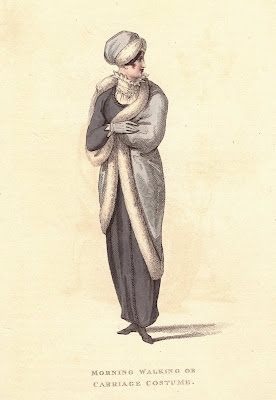
Since down jackets and Gore-tex had yet to be invented, the warmest thing in outerwear that one could wear was fur…and our hypothetical Regency lady took full advantage of it. She might wear fur-lined pelisses and cloaks like some of these:

Carriage or Promenade Dress, Ackermann’s Repository, January 1810. Incidentally, this print and the next are among the only illustrations I’ve seen of fur used in millinery in Ackermann’s Repository; the other is a print from La Belle Assemblee that we looked at in detail a few years ago.
Morning Walking or Carriage Costume, Ackermann
’s Repository, December 1810


Carriage Dress, Ackermann’s Repository, February 1820


Or maybe just settle for fur trim, as in this Walking Dress from the March 1822 Ackermann’s Repository.


She might cuddle up in a fur tippet (or what we call a boa) to keep her neck warm. (A Walking Dress, or Carriage Costume, Ackermann’s Repository, February 1811.)


And of course, there were those enormous, eye-catching muffs that were popular for decades...and no wonder: gloves were worn year round, but when glovemakers boasted of the fineness of the kidskin they used, something more would definitely be wanted in winter to keep the hands and forearms warm. (Promenade Dress, Ackermann’s Repository, January 1814)


Promenade Dress, Ackermann’s Repository, December 1822.


So what kind of fur was worn?

Looking over years of Ackermann’s Repository images gives the impression that a lot of ermine (white fur decorated with the tufts of black tail fur) was worn. But actually reading the text accompanying the images tells a different tale (ahem): for example, the fur-lined mantle above from January 1810 is made with (are you ready?) “spotted American squirrel skin”! A coat from January 1811 (not shown here) was trimmed with blue fox fur. The February 1811 Walking Dress with the tippet and fur trim uses “astracan” (more commonly spelled astrakhan), or lamb. Other plates mention red fox, mole, leopard, sable, and chinchilla in addition to ermine.

While these prints are fascinating to look at, I have to say that I’m very grateful that we don’t have to follow their example any more. Now if you’ll excuse me, I think I’ll go have some quality time with my Primaloft quilt...


Tuesday, June 11, 2019

Ooh La La, La Belle Assemblée!


Now this is quite the light summer frock! May I present to you the Kensington Garden Fashionable Promenade Dress, courtesy of the July 1, 1811 edition of La Belle Assemblée?


There’s a great deal going on here, so let’s see what the description says...

“A round robe of white jaconot muslin, with a bodice of violet sarsnet, trimmed with rich silk Brandenburgs of Austrian green, a half pelisse of fine transparent muslin, with Bishop’s sleeves, fancifully tied with a green ribband. A Hymen hat of purple brocaded ribband and lace, ornamented with a green military plume; a Chinese parasol of purple sarsnet, shot with green; gloves and shoes of York tan.”

Well. The first thing that I noticed about this dress is the waistline: it falls more or less at the natural waist, which is unusual...but one thing I love about the clothes from these years is that they weren’t as strict as, say, the 1820s would be in terms of line and structure—so there was some room for creativity. The dark violet bodice contrasting with the soft white muslin of the skirt and half pelisse makes a striking statement; I wish it was possible to see how long the sleeves were under that pelisse. The frogging and tassels crisscrossing the bodice are striking as well, and rather emphasize the bust.

I don’t think I’ve run across a half pelisse before: it’s almost like an open cardigan, and seems to end in fanciful points. The sleeves tied with ribbon down the length of the arm is a style that will persist on and off now through the 1820s, until the enormous sleeves of the 1830s will make such a look impossible.

The hat is curious, I thought. The drawing is a little awkwardly done so it’s difficult to see exactly what is going on here; it looks rather like a box perched on the back of her head, but the green plume over the top of the forehead is quite dashing. And since this is a promenade costume, note the quizzing glass: one must see as well as being seen!

What do you think? Would you wear this on your next jaunt to Kensington Gardens?