

Showing posts with label Lady's Magazine. Show all posts

Tuesday, April 14, 2020

Snippets: The Lady’s Magazine, January 1811

I do enjoy reading periodicals from the nineteenth and early twentieth centuries—the articles, the stories, the illustrations, and even the ads. They don’t necessarily offer a completely accurate picture of their eras: overall, most general-consumption magazines present an aspirational picture of their worlds —how its readers would like their lives to be. After all, does any magazine you read truly reflect the reality of your everyday life?

Still, they do provide a window into the past that is often useful and informative. To this history geek, they can be at times surprising, eye-opening, and—sometimes—utterly delightful.

I have before me the January 1811 edition of The Lady’s Magazine, or, Entertaining Companion for the Fair Sex; Appropri-ated Solely to Their Use and Amusement (gotta love the snappy title.) The “top story” is the beginning of a biography of the then-General Viscount Wellington (on the first step up the ladder leading to his eventual dukedom) who was busily engaged in the Peninsula. Like most of the pieces in this magazine, it is one installment of a longer piece; aside from letters to the editor and a few shorter extracts from essays and books, most of the articles here are continuations from issue to issue. The accompanying portrait engraving, purporting to be “an accurate likeness”, makes him look considerably younger (and plumper) than most of the portraits I’ve seen!

Of universal interest, I’m sure, is a brief but alarming piece titled “Ladies’ Clothes on Fire”, advocating for heavy woolen “fire cloaks” to become an accepted part of the décor of “every parlour and ’drawing-room in the kingdom, and deemed as necessary an article of its furniture, as the hearth-rug, the fire-screen, or the fender.”

Then there’s a touching story of “The Remarkable Docility of a Sow”, detailing the story of pigs who have been raised alongside hunting dogs and trained to point as well as their canine step-siblings.

Of course, there’s a fashion plate, showing “London Morning and Evening Dress” in shades of black and gray as mourning for Princess Amelia was still in effect. The black velvet evening dress, trimmed “with velvet and gold cord twisted together would pass muster today at an evening event, I think.

But the piece that surprised me the most was a brief item in the Births, Marriages, and Deaths section: on January 9 was listed the death “At Gretna Green, aged 79, the celebrated Joseph Pasley, first (it is said) a tobacconist, afterward a fisherman, and finally, without ordination or commission, a volunteer, self-constituted priest of Hymen, better known by the appellation of the Gretna-Green Parson*” The asterisk indicates a note reading, “On a trial respecting the validity of one of his marriages—on which occasion, he appeared in court as a witness—we recollect the judge characterizing him as a blacksmith.” This is, of course, the famous performer of clandestine marriages for eloping couples from England who fled just over the Scottish border—and out of the reach of English church law...and evidently a news-maker even then!

Tuesday, March 21, 2017

Accessories, Part 8: More Parasols

We’re back for another installment in our fashion series on NineteenTeen focusing not on dresses and gowns (gorgeous as they are) but on the little things that complete a fashionable ensemble—hats, shoes, gloves, purses, and other accessories

Back in February we looked at parasols from the first two decades of the 19th century; here are examples from the next fifteen years. Look for lots of images rather than commentary, though I’ll try to supply original text if I have it—the point is to be able to examine multiple examples of each item. Images are drawn from my collection of prints from British publications including Ackermann’s Repository, La Belle Assemblée, Lady's Magazine, and the Court Magazine. However, Ackermann’s had the most detailed plates, so the majority of images you’ll see will be from that publication.  These date from 1819-1834.

Walking Dress, Ackermann's Repository, May 1819.  Notice that this parasol has a full handle grip and a band of fabric to keep it furled when not in use.


Walking Dress, Ackermann's Repository, September 1821.  Note the tiny hooked end of the handle.


Walking Dress, Ackermann's Repository, April 1822. Here you can clearly see a ring on a ribbon to help keep the parasol furled when not in use.


Public Promenade Dress, La Belle Assemblee, October 1824.  An elaborately turned shaft, hooked handle, and ring furler.
 

Promenade Dress, Ackermann's Repository, July 1825. A finely machine-turned shaft--and two colors!


Morning Promenade Dress, Lady's Magazine, July 1825. "Chinese parasol of grass-green edged with white." 


Sea Side Dress, Lady's Magazine, August 1825. Either the artist lost track of his scale, or that is one large parasol!


Garden Costume, Ackermann's Repository, November 1825. "...rose-colour parasol, lined with white, and an antique wreath round the edge."


Walking Dress, Ackermann's Repository, July 1826. The finial looks lethal!


Sea-Side Costume, Ackermann's Repository, September 1827. The shaft appears to be of bamboo.


Walking Dress, La Belle Assemblee, June 1832.


Morning Dress, The Court Magazine, September 1832.
 

Public Promenade Dress, The Court Magazine, October 1833. What a pretty one! Note the ring up near the finial to keep it furled.


Walking Dress, The Court Magazine, October 1834. Printed fabric for parasols seems to be a trend.


So are you with me? Bring Back the Parasol!

Tuesday, March 17, 2015

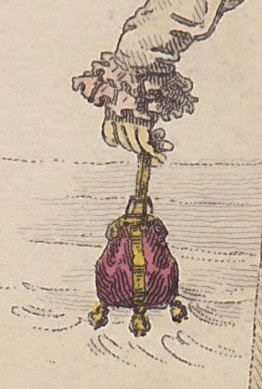
Accessories, Part 2: More Reticules

Are you writing a Regency-set story or a reenactor thinking about whipping up the perfect costume for an 1815-set ball? Following up on the first post in our new series on women’s fashion accessories in the Regency era, here are more reticules for your viewing pleasure.

Once again, all images are from my Ackermann’s Repository collection, with a few contributions from the Lady’s Magazine, noted below. Lots more cute little drawstring closure-type bags, but some surprisingly modern looking ones as well. Happy accessorizing!

Walking Dress, March 1815:


Carriage Dress, December 1816:


Carriage Dress, January 1818 (from a mourning dress, incidentally--the full image is here:


Walking Dress, November 1819:


Walking Dress November 1820:


Evening Dress, February 1821:


Walking Dress, December 1821:


Walking Dress, March 1822:


Promenade Dress, January 1824--I love the shell shape!:


Evening Dress, March 1824 (Lady’s Magazine):


Promenade Dress, July 1824:


Morning Dress, May 1826:


Carriage Costume, September 1826--though I think this is more a change purse than a reticule, don't you think?


Walking Dress, December 1827 (Lady’s Magazine):


Dinner Dress, March 1828:


Carriage Costume, April 1828:

Tuesday, March 11, 2014

More on Needlework...

Back at the end of February, Regina posted about the genteel pastime of fine needlework for ladies. This week, I’m following up with some of the sources young ladies might have consulted for their fancywork: magazines!

La Belle Assemblee, The Lady’s Magazine, and of course Ackermann’s Repository all published needlework patterns in every monthly issue. Many were for specific items, as you can see below in this pattern for a collar from La Belle Assemblee:


Others were just nice patterns that could be used anywhere. Here are several for your viewing pleasure. I've supplied dates where I have them…enjoy!

Muslin Patterns from Ackermann's Repository, 1813:


Needlework patterns, Ackermann's Repository:

Muslin Patterns, Ackermann's Repository, 1818:


La Belle Assemblee, 1815:


La Belle Assemblee, 1812:

Tuesday, February 19, 2013

Fashion Forecast: 1827, Part 2

What was the well-dressed young woman wearing in the second half of 1827?

If she were on holiday after the season (don’t forget, no one who was anyone lingered in London much past mid-July) she might wear this very pretty apricot-colored Promenade Dress, with its leg o’mutton sleeves, lace van dyke falling collar, and tiers of ruffles around the hem…and a truly striking bonnet lined with what looks like a tattersall pattern and adorned with artificial flowers and ribbon ruchings (Ackermann’s Repository, August):


Pink seems to be popular this season, as it appears again in this Evening Dress from August’s Ackermann. Here it’s in the form of puffed appliques on a white gauze overskirt, edged at the hem with a double row of dagged trim. The appliques repeat on the bodice, and there is a neat pink belt or sash to finish it off. The headdress features loops of ribbon and a dyed heron’s plume as well as a lace veil. I must say that I definitely fancy this dress!


Ruffles make an appearance again in this Evening Dress from the September issue of the Lady’s Magazine, both around the hem and on the long-tailed scarf-like thing called a fichu-pelerine. Notice the width of the shoulders in this dress, a tendency that will only increase over the next few years until, in the 1830s, women will be forced to go through doors sideways:


More pink…and another striking Evening Dress, from the September edition of Ackermann’s Repository. This one features a deep, scalloped band of pink around the hem, pink scalloped cuffs, and a pointed bodice also of pink. Her hat seems large for an indoor event, but headgear gets quite daring over the next few years…and I love her feather fan!:


Speaking of daring headgear…this Promenade Dress is almost overshadowed by and astonishing hat with a tall crown, broad brim, ostrich plumes, and a veil! The dress itself is handsomely restrained, though, with triangular decorations around the hem, puffy leg o’mutton sleeves, and another fichu-pelerine collar. (Ackermann’s Repository, October):


Here’s a sweet Ball Dress, also from October’s Ackermann’s, dainty in yellow and white with festoons and bows of ribbon decorating the skirt, a yellow ribbon sash, large bows on the sleeves, and what looks like a flounce of eyelet around the neckline. Ruffled gloves finish the look…but a heavy armlet on her left upper arm that looks like it was borrowed from Cleopatra makes a daring statement:


And now an equally dainty Dinner Dress, with a lace and embroidery gauze overskirt on top of a blue underdress, a ribbon sash with what looks like gold embroidery on it, a lace van dyke falling collar, and gauze oversleeves atop small puffed sleeves of blue. Her headdress is a more restrained turban, and her shawl looks almost like a guazy plaid—not very good for keeping the chill off, but very pretty (Ackermann’s Repository, November):


Here’s an outfit that would do a much better job of keeping its wearer toasty warm! This Carriage Dress from December’s Ackermann’s includes what looks like a velvet cloak, lined with ermine and topped with a capelet of darker velvet, worn over a green dress trimmed with bands of embroidery. An ermine muff contribute to the general warmth, and the whole is topped off with a white wide-brimmed hat trimmed with plumes and loops of pink ribbon. Very cozy!:


Equally cozy is this Walking Dress from the December edition of the Lady’s Magazine. I have the original description for this one: A PELISSE, of dark-grey satin, with a broad border and facing of black velvet, is fastened down the front with gilt oblong buckles. The body is made quite plain, and the sleeves, which are en gigot, terminate at the wrists with very broad black velvet bracelets, confined by a gold buckle. A pelerine cape of black velvet is worn with a white blond colerette, falling over, of a rich Vandyck pattern. The hat is of black velvet, lined with Canary-yellow, and large bows of black velvet and stain are placed over the crown, each bound with yellow satin, as is the edge of the bonnet, round which is a black blond. The bonnet is tied down close on the right side, with yellow strings in a bow. A reticule of Indian painted taffeta accompanies this dress:


One more pink-and-white confection, this time a Ball Dress in white decorated with long loops and knots of pink ribbon and a wreath of tiny roses and leaves, which also appear around the short puffed sleeves. The bodice is pink, with a sort of Van Dyke effect at the waist and lacing across the front. Note her hair, which is dressed in curls and loops of hair standing up…I wonder how they managed without hair-spray? (Ackermann’s Repository, December):


What do you think of 1827’s fashions?