Showing posts with label Almack's. Show all posts

Tuesday, March 22, 2022

The Forgery Furore is Here!

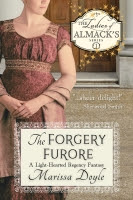
The Forgery Furore, first book in The Ladies of Almack’s series, is out today!

Young widow Annabel Chalfont, Countess of Fellbridge, has two small sons to raise, a mountain of her late husband's debts to pay off, and a secret: she's a shadow-shaper, able to manipulate shadow as anyone else might clay. She and six other high-born ladies with equally extraordinary abilities defend England against supernatural crime--but the world knows them only as the Lady Patronesses of Almack's, Regency London's most exclusive social venue.

The social season of 1810 starts out like any other year, but a sudden influx of strangers to Almack's exclusive balls means only one thing: someone is forging vouchers, and the evidence points to Annabel. And if finding the forger and clearing her name aren't challenging enough, there's dealing with her husband's old crony, the Marquess of Quinceton, and his hungry wolf stare...

The idea for a series of Regency-set stories featuring the Lady Patronesses of Almack’s as supernatural crime fighters came to me years ago. I’ve worked on it on and off for a long time, but it was only in the last couple of years that all of my ideas around it coalesced into an actual coherent series rather than a set of vaguely linked stories.


The Ladies of Almack’s mixes actual figures and events with my own characters and “speculation” on what might have happened behind the history we know about. Annabel and her fellow Lady Patronesses will go through many adventures together, eventually saving England from a dastardly Napoleonic plot…but of course, there’s a slow-burn romance wrapped up in it as well, along with (I hope) some light-hearted fun.

You can read the first chapter of The Forgery Furore on my website…and if you’d like a further taste of the Ladies of Almack’s, my short story “Just Another Quiet Evening at Almack’s” can be downloaded from BookFunnel by my newsletter subscribers.

Look for the second Ladies of Almack’s adventure, The Vanishing Volume, on April 5…and for their further adventures at the beginning of each month. All are available direct from the publisher, Book View Cafe, as well as from Amazon (affiliate link), Barnes and Noble, Kobo, Apple, and Smashwords, and in print from Amazon and Barnes and Noble.

Friday, June 12, 2015

The Shocking Truth About Almack's

We’ve talked before about the magical Season in London, when a young lady made her debut in polite society for the first time. Once you were “out,” you could attend balls, hold parties at your own house, and, if you were lucky, visit Almack’s. I recently had cause to dig a little deeper into the workings of the mighty club, and I was a little surprised at what I found.

Almack’s, as we’ve also discussed, was that bastion of society often referred to as the Marriage Mart. A club dictated by women was a novelty in a society that still largely catered to the gentleman. The lady patronesses of Almack’s determined who was allowed to attend each ball held on Wednesday nights during the Season.

What surprised me was the entire process. As gleaned from various sources, some of which are not first-hand, it seems that when a mama knew she was bringing her daughter to London for the Season, she might write to a patroness and request vouchers in advance. The patronesses thus had a pretty good idea of who was going to be out and about that year. But no patroness would issue vouchers unless she visited the prospective attendee or otherwise knew that young lady personally. Then the patronesses met together and discussed potential candidates.

Wouldn’t you have liked to be a fly on the wall at one of those meetings.

“I met with Miss Charming this week. She is utterly delightful. We must have her.”

“Tsk—not a bit of it! Her mother is a harridan, and I cannot like her wardrobe.”

“Oh. Pity. What about Miss Newvoriche? She is polite above all things.”

Shudder. “No. Her grandfather was a coal merchant.”

Gasp! 

And it wasn’t just the ladies who waited with great trepidation to hear whether they had been chosen. Men too had to be issued vouchers to attend. And attendance could still be denied even after you’d received vouchers if your behavior was found lacking for any reason.

There also appears to have been some sort of rule on the number of people in a single family who could be granted vouchers. Some sources say two; others three. Vouchers were non-transferrable, meaning that if you couldn’t go one week you couldn’t just hand your ticket to another person.

I couldn’t help wondering what would happen in a family with two daughters on the ton in one year and a socially astute mother. Which daughter would be denied tickets? How would that make her feel? What might she do to convince the patronesses to change their minds?

Particularly when attending Almack’s meant everything, even catching a French spy.

Dropping hints? Guilty. Stay tuned, because later this month, I’ll tell you more about what Ariadne Courdebas did to earn tickets to Almack’s after Eloquence and Espionage, Book 4 in my Lady Emily Capers, debuts on June 22.


Tuesday, June 2, 2015

Green and Pleasant Land, Part 1: London

London is an amazing city. Of course the history aspect is amazing...but it’s also a remarkably livable city, at least for me who gets antsy when there aren’t trees nearby. There’s little of the canyon-like effect you get in Manhattan...and the parks are truly lovely. And did I mention the history? ☺

So the five of us arrived at our hotel in Westminster in what is probably an ideal place for sightseeing: we were at the St. James Courtyard hotel, a five-minute walk from Buckingham Palace (and on the same street as the Bluecoat School, about which Regina blogged). The hotel itself dates to the Edwardian era, and is built around a courtyard with all sorts of delightful architectural bits. London abounds in delightful architectural bits, by the way—no walk is ever dull there.


I’m happy to report that the statue of Queen Victoria at her memorial in front of the Palace still looks like a lifeguard (which I’d noticed on my first visit to London about thirty years ago)—for some reason Her Majesty’s nose is lighter than the rest of her, as if smeared with zinc oxide. And Canada Gate at the entrance to Green Park off Constitution Hill is as shiny as ever:


However, I was very sad to see that cows are no longer kept in Green Park as they were during the Regency, despite this reminder of their presence:


I found it a little surprising to see how small St. James’s Palace was, and how “right there” as well—the streets run right alongside it—considering it’s actually the official home of the sovereign (ambassadors are still accredited to the Court of St. James.) It was built by Henry VIII and added onto over the centuries, but still has that sixteenth century feel:


And then we were in St. James’s Street, Masculinity Central of Regency London, home of such places as Brooks’s and White’s Club (and yes, there’s the famous Bow Window at White’s)


What I found interesting (beside all the famous historical landmarks and stores) was the topography. St. James’s Street trends uphill, which I did not know—it’s one of those things that somehow doesn’t get mentioned very often, and which I’m glad I now know. But even more exciting to me was catching sight of King Street off St. James’s. The King Street, home of Almack’s Assembly Rooms? You bet—only, Almack’s is long gone, replaced by (sob!) an office building. But at least I can now say I was there as I scribble away at my Almack’s stories. That's me with Child #1. Yes, he's pretty tall.


What else? We dined at Wilton’s on Jermyn Street, established 1742, and had a wonderful dinner...and a delightful tea at Duke’s Hotel. We carried out a quick raid on Harrod’s and came away with tea and chocolates (alas, the presence of a husband and son necessitated the visit being brief). And we visited the Victoria and Albert Museum (glorious sensory overload—it’s the world’s largest museum of art and design) and Apsley House, the Duke of Wellington’s house at Hyde Park Corner, which was amazing.


No interior photographs permitted, alas, as my little history-geek heart was a-galloping at the eleven-foot tall statue of Napoleon at the base of the Principal Staircase on which it is rumored Wellington used to hang his hat as he went up the stairs (and the painting of Wellington in old age presenting a gift to his godson, Queen Victoria’s son Arthur)...at the astonishing Waterloo Shield, which really has to be seen to be appreciated (Google it!) Wellington came away from the wars with a ton of goodies from grateful European heads of state. And most of all at the Waterloo Gallery, the room where Wellington held his annual dinners to commemorate the battle and which held his collection of Spanish masters. Curiously, among the amazing art collection amassed here are multiple portraits of Napoleon and members of his family. After Waterloo, Wellington would be linked for the rest of his life to the former French emperor—without Napoleon, Wellington would not have been Wellington. That must have been a strange thing to have to live with for the rest of his life—so closely linked to someone he actually never met face-to-face—and he lived nearly forty more years after the battle.

And right around the corner from Apsley House in Hyde Park? Rotten Row, of course!


Next time: visiting Oxford and Windsor

Tuesday, February 3, 2015

Almack’s Again: The Marriage Mart

Somewhat to my be- musement, I’ve found myself writing a series of novellas set around that Regency institution, Almack’s Assembly Rooms. Modern readers can certainly understand how Almack’s was the place to be, the most exclusive of exclusive social venues, because that concept is timeless...but there’s one aspect of Almack’s we haven’t discussed before, and I thought it might be interesting to do so.

Almack’s was nicknamed ‘the Marriage Mart’ because it was the place for aristocratic young women and young men (or not so young ones) to go to look over the season’s marital prospects. It was Almack’s very exclusiveness that made it attractive for spouse-shopping: if only persons of a certain social class were allowed within its precincts, then by definition anyone there could be considered “safe” as a potential marriage partner. Watchful parents could relax, knowng that their romantically–minded daughters would not be solicited for the next dance by a shop-clerk or a nouveau-riche City merchant; men would not find their eyes and their fancies caught by an attractive but unsuitable young woman who dropped her aitches and didn’t know how to properly address a duchess or arrange seating at a dinner party.

Sounds kind of...well, cold, doesn’t it? Yes, absolutely, by modern standards of courtship and marriage. But the early 19th century was in flux as far as what marriage was all about.

Up until the rise of Romanticism in the 18th century, marriage was as much a financial transaction as it was about finding a husband or wife...and the wealthier the families, the truer this was. Families considered what other families they wanted to ally themselves with through the marriages of their sons and daughters for reasons of outright monetary gain as well as for less tangible but still enormously important assets like social, economic or political influence. You might decide that you wanted your son to marry the daughter of a family whose political support you sought for your career, or who might bring as part of her dowry land or other assets you coveted. And while you made some attempt to make sure the new couple would be compatible...well, that wasn’t necessarily the first consideration. But as the concept of marrying for companionship and love took hold, it fought for a while with the older view of marriage...and Almack’s was a prime example of that uneasy compromise.

It’s also hard sometimes for Americans to wrap their heads around just how class conscious England was (and still is, to a degree.) We’ve discussed that fact before—just how separately the different social classes lived their lives and the difficulty of moving from one class to another when it dictated everything about you, from how you moved and spoke to your education and expectations in life. Now, think of how that might come into play when looking for a husband or wife...and once again, Almack’s begins to be much more understandable, if not, by our standards, admirable. It’s not so surprising that Almack’s importance faded as class barriers became more fluid with the rise of the middle classes, and by the late 1830s, it had lost almost all its old cachet—not forgotten, but also, for many reasons, not mourned.

Friday, September 26, 2014

The Longitude and Latitude of St. Petersburgh

Political cartoons have been around a long time.  One of the most famous caricaturists of nineteenth century England was George Cruikshank.  Below is one of my favorites of his, dubbed the Longitude and Latitude of St. Petersburgh.


Why, you might ask?

The scene is Almack’s, that exclusive ladies' club of London.  The gentlemen all sport the requisite knee breeches and white stockings.  The ladies are in their finery, ostrich plumes waving.  And every eye is turned to the couple dancing to the music of the orchestra in the box at the upper left.  That couple, it is said, is Prince Pyotr Borisovich Kozlovsky of Russia and the Countess Lieven (later Princess). As you can see, they make quite a pair. 

It wasn't only their looks that contrasted.  The prince was from one of Europe’s oldest royal families, but wasn't particular bright or ambitious.  He was a bit of a womanizer and somewhat associated with literary circles, mostly through connections, not achievements.  He entered the diplomatic corps, served for a time in Sardinia, and was a part of the Congress of Vienna.  As wide as he was tall, he visited England with the Russian delegation in 1812 and seems to have paid court to many a lady, married or not.  The novelist Maria Edgeworth is credited as saying of him, “If he throws himself at my feet, he will never be able to get up again.” 

Dorothea von Lieven, on the other hand, also came from a Russian royal family and was wife to the Russian ambassador in London in 1812.  She was everything the prince was not--tall, slender, intelligent, and ambitious.  Her social skills made her invitations among the most sought after in the land, giving her husband’s career a major boost.  She was the first foreigner to be made a patroness of Almack’s and is said to have introduced the waltz to England.  Somehow, I doubt she saw herself dancing it with Kozlovsky and certainly not to be ridiculed in cartoon afterward.

The prince, however, thought the whole thing hilarious.  He would.

Tuesday, February 10, 2009

Heaven, Regency Style

It was "the seventh heaven of the fashionable world", the "exclusive temple of the beau monde", the "marriage mart" of exclusive London society. Regency wit Henry Luttell said of it:

"If once to Almack’s you belong,
Like Monarchs you can do no wrong;
But banished thence on Wednesday night,
By Jove, you can do nothing right."

On the other hand, it served "wretched refreshments", had a "bad floor", and was viewed as shockingly dull by most young men.

So just what was Almack’s, that place that has appeared in almost every Regency-set novel since Georgette Heyer?

Originally, it was an assembly room (remember that we discussed those last week?) built on King Street (behind St. James’s Square) in 1764 by a Yorkshireman of Scottish ancestry named William Almack who began life as a gentleman's valet but soon moved up in the world. Mr. Almack opened his assembly rooms in 1765, charging 10 guineas for a series of twelve weekly balls and suppers over the course of the season. Anxious to make his assemblies appear exclusive and select, Almack enlisted the aid of a group of blue-blooded society ladies to help decide who merited admission and who did not, and thus was the famous voucher system born. If the lady patronesses did not approve of you, no matter how large your estate or noble your birth, you didn’t get in to Almack’s.

Almack’s system worked. By the Regency era, Almack’s was THE place to be if one had any pretensions to being a member of the haute ton. And as a result, the lady patronesses wielded an almost ridiculous amount of power over society; the cartoon above comments on just how sought-after those vouchers to purchase tickets were. According to one story, a man challenged the husband of one of these august ladies to a duel because his wife had been refused a voucher. Others worked out elaborate schemes to sneak in. No one who had any connection to trade was admitted, and even otherwise socially acceptable army officers and members of the aristocracy might find themselves refused admission.

Within the hallowed halls, the rules were just as rigid. There was a strict dress code for men, and even those who had proper tickets might be turned away if not properly attired (even, it was rumored, the Duke of Wellington on one occasion!) Until around 1814, dances like the quadrille and the waltz were not permitted. Even after they were, young ladies had to demonstrate that they were of modest demeanor and attitude before they could get the permission of one of the lady patronesses to engage in waltzing (which was still considered a rather improper dance). And no one was permitted to enter the rooms after 11 pm, even those with tickets. Liquid refreshment was limited to lemonade, tea, orgeat (a non-alcoholic drink flavored with almonds and orange-flower water) and ratafia (a light liqueur, also fruit and nut based); bread and butter and cake were the only munchies served.

So with all these rules and the less-than-exciting atmosphere, why was it so sought-after?

Because admission to Almack’s meant that you counted. It meant that you were the crème de la crème of English society…one of the 19th century version of the beautiful people. If you were on the prowl for a "good" marriage, it was the prime hunting ground. It meant that, as Henry Luttrell said, "you can do no wrong."