Showing posts with label balls. Show all posts

Tuesday, March 9, 2021

Show and Tell!

I’ve written before about my delight in dance cards, those useful little notebooks that enabled fashionable young ladies to keep track of all the young men clamoring for the honor of a dance (that would so not have been me, by the way--just call me Miss Wallflower!), and have a new and exquisite one to share with you.

First, this one is in its original leather box (measuring 6 3/8 inches by 1 3/4 inches), which is just a dozen flavors of wow. See the teeny tiny hooks and loops that keep it closed?

On opening the velvet lined box, we find a fan-shaped carnet measuring 3 1/4 inches long (6 inches overall, including the chain and ring) made of what appears to be gold and silver vermeil over brass in an elegant, etched Rococo pattern. It is complete with double chain fastening it to a ring so that it could dangle from a young woman’s hand as she danced (because not all ball gowns have pockets!) Notice that the ring is a little outsized, to fit over a gloved finger.

When the “fan” is opened, there are five leaves of bone or ivory on which to write the names of dance partners…and the dainty pencil (all of 1 3/4 inches long!) with which to write them is still secure in its little loops.

I wonder what sparkling events this delightful little dance card was carried at, or what joys or heartaches it might have played a role in? There are plenty of signs that it was written on and erased…and then perhaps tucked away in a bureau drawer, based on the faint sachet scent still clinging to it. I do hope that whoever owned it kept it so well because of happy memories attached to it.

Thursday, September 13, 2012

Nineteenteen's Fifth Birthday Ball: Wear out your Dancing Slippers!

Have we found our partners? The musicians (did you know Regina hired an orchestra that plays regularly at Carlton House? Shocking expense, but oh so worth it!) are ready to open with a delightful cotillion waltz that offers multiple opportunities for some genteel flirtation...and aren't all the dancers most elegantly attired?:


Now, perhaps a sprightly country dance?


Or another cotillion?


And do check out this last set of dances--held in the Music Room at the Prince Regent's Pavilion in Brighton!


But after a few hours of dancing, it's time to go in for supper. A dance supper is meant to refresh and sustain after all that dancing and impress the guests...oh yes, and be easily served and eaten in a crowded, busy setting. Rather analogous to what we call heavy hors d'oeuvres at an evening event--so, think small cakes, both savory and sweet, thinly sliced meats, individual servings of ices or syllabub like our young lady at right is enjoying, and beverages, from champagne and punches to lemonade. I'm not a big sweets eater, so we have an assortment of cold sliced ham and beef, lobster patties, savory cheese biscuits, jellied sliced chicken, fruit trays, and both whipped syllabub and cherry and pineapple ices. And of course, champagne! This is a birthday ball, after all!

There! Are we ready for more dancing?

*************

Having too much fun? For your further viewing pleasure, I highly recommend a visit here: http://www.youtube.com/user/fainmusicuk?feature=results_main where there are videos of period dances as well as several demo clips of several figures used in Regency period dancing--an excellent primer! And for general Regency-era listening try this channel on Pandora--the Regency Era Reading Channel!

Wednesday, September 12, 2012

Our Fifth Birthday Ball: May I Introduce the Gentlemen?

Welcome, welcome! Oh, but you look delightful in your beautiful gowns. Marissa and I are so glad you could join us for our ball celebrating our fifth birthday here at Nineteenteen. We’re honored by your company today, and every time we blog. Please feel free to introduce yourself, say hello, comment, and generally have fun.

We’ve been preparing for our ball for weeks, cleaning house, ordering food and extra staff to see to your every need. We even brought in a dance master so we could practice.


Now our guests are here, friends and family alike. Do be kind to Uncle and Aunt Troglington. They are terribly old fashioned, but such dears. How thoughtful of them to warm up the dance floor for us as we promenade about, greeting old friends, making new ones.

I am quite pleased to be able to introduce to you an excellent selection of dancing partners this evening. Take the Earl of Winterhoven—mature, bruising rider, avid gamester. But there’s something wistful about his face, as if he were looking for just the right lady to make his life complete.


And then there’s our cousin Dashiell, Dash for short. Fresh from Oxford, ready to start his career as a barrister, studious, serious, never met a book he didn’t like. I do think a waltz would prove the mettle of the man.


But if you like more adventuresome types, I did convince Marissa to invite Geoffrey Lewellen. Yes, I know, shocking that we allow such a renowned rake into our company. He looks so young and innocent! Personally, I think all he needs is a lady of uncommon sense and uncompromising intelligence to set him on the path to redemption.


Perhaps you like the more artistic type. Maximus Decampter paints the most glorious sunsets. Can’t you just see the sensitivity pouring from his eyes? He’ll lay his heart at your feet given the least provocation. Mind where you step!


But for me, there’s nothing like a strapping military man, broad shoulders, commanding attitude. Major Lord Michaelson is already taken for the first dance, but I will share. After all, it wouldn’t do to dance more than twice with anyone gentleman. And we have so many to choose from!


So, who’s your favorite hero? Find a partner quickly! I hear the musicians tuning up!

Tuesday, September 11, 2012

Celebrating Nineteenteen’s Fifth Birthday: Let’s Have a Ball!

It’s hard for Regina and me to believe that we’re celebrating Nineteenteen’s fifth birthday this week. That’s over 500 posts, averaging between 5500 and 7500 pageviews per month, on hundreds of topics (I tried to count our post tags, and was over a hundred by the time I hit the Bs). So you know what? We're in a party mood…and what better way for us to party than with a birthday ball?

First things first—we must decide what we’re going to wear! I've combed through my fashion print collection to find a selection of the prettiest dresses.

Feeling early 19th century? There's this slinky number from 1809:
Or this one from 1810:There's this very girly dress from 1816: Or this very demure one from 1817: From the next decade, there's this pretty number from 1823: And this one from 1825: In the 1830s, we get into some extreme ballgowns, like this (or perhaps it's just the hair that's extreme): But also some charmingly frou-frou ones, like these (the one on the left is for a costume ball): Or this:
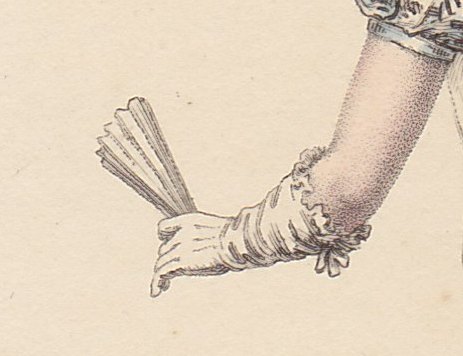
We'll need dancing slipper, often made with ribbons to lace about the ankles, rather like today's ballet slippers: And a fan, to cool down after a lively set (and, of course, flirt with!):
Gloves are a must--perhaps with ruffles at the edge: As is a quizzing glass, to check out what everone else is wearing and speculate on which mantua-maker created it: And if we're going in an 1830s dress, a dance card is definitely in order now that most dances are done in pairs...like, of course, the waltz: There! Are we ready to go? Then let the ball begin!


Friday, September 16, 2011

Shall We Dance?

What a delightful group you’ve been at our birthday house party! Good conversation, excellent suggestions, charming comments. The gentlemen have told me they are completely entranced. So, this sounds like a great time for a ball to me! Before we get started, let me also mention that the lovely El has won Lit Wit: 100 Trivia Cards to Boost Your Book Smarts by Richard Lederer. Please contact Marissa via her website and let her know where she should send it. And anyone who comments today will be entered to win a miniature reproduction of the 1817 Glengarry bonnet (by Pipkin and Bonnet) along with hat box and stand.

Now, our ball! Of course, one cannot spontaneously host a ball. We actually sent invitations to all our genteel neighbors in the area weeks ago, letting them know you’d be here with us and encouraging them to join us this evening. We hired musicians to play and brought in additional staff from the village to help with the cooking and cleaning and see to the needs of our guests. As I write, a footman is lowering the chandeliers in the ballroom to put in fresh candles, and our houskeeper is inspecting the dance floor to make sure it’s gleaming in expectation.


The gentlemen have already retired to their rooms to change into their evening clothes and freshen up. Perhaps you’d like to glance over the positions of dance so you’re ready for your partner.


And I can’t wait to see what you brought to wear to the ball! I’ve had a lovely gown made up in red, a bit daring, I know, but the off-white of so many of the gowns just doesn’t do my complexion any favors.


Ah, do you hear the musicians tuning up? Already the air is scented with perfume. Marissa and I welcome you to the ballroom and suggest a partner. We’re pairing up (I will of course partner Leopold on this first dance, but I’m sure he’d be happy to offer you his hand later). Goodness, but the set is crowded! Everyone looks so lovely! I can see you smiling from here. And away we go!


Do tell me your favorite dance so I can be sure to have the musicians play it. And please catch me between sets to suggest other ways we can make Nineteenteen the best it can be.

Friday, June 19, 2009

Dancing Queen's Waterloo

Yesterday marked the 194th anniversary of the Battle of Waterloo. Over 22,000 Englishmen and their allies and 40,000 Frenchmen died in that epic battle outside Brussels, Belgium. But almost as famous is a ball that was given just a few days earlier in Brussels by the Duchess of Richmond.

Why is it famous? Well, for one thing, the very fact that it happened seems amazing to many of us today. Only 100 days before, the worst threat to English sovereignty and European peace, Napoleon Bonaparte, had been imprisoned on the island of Elba, and representatives from the countries who had beaten him were meeting in Vienna to carve up all the land he had conquered. What does he do but escape, rally the French, and start a march across Europe once more! The best in British military leadership rushed to meet him.

And their friends rushed to watch.

Yes, watch. British nobility and gentry were so certain of a quick, decisive win by their hero Wellington that they actually traveled to the battlefields to watch the action. By day, the British officers planned their campaigns, by night they joined their friends and campaigned for the right to dance with the prettiest girl at the ball.

On the night of June 15, the Duchess of Richmond held such a ball (shown in the painting) and invited only the very best of the families present. The guest list reads like the Who’s Who of the early nineteenth century, with royal princes, aristocracy, and military leadership in attendance. But the ball had barely begun when Wellington received news: Napoleon had moved faster than anyone expected and would likely arrive to meet them by morning!

You would think that such news would have put a swift end to the Duchess’ grand ball. But that’s another reason this ball is famous. Most people just kept partying! Some of the officers went off to prepare, but many danced the night away and went to meet Napoleon in their evening clothes instead of their uniforms. The Duchess’ daughter, Lady Georgiana, was 19 at the time, and had this to say about the event:
“I went with my eldest brother (Aide de Camp to the Prince of Orange) to his house, which stood in our garden, to help him to pack up, after which we returned to the ballroom, where we found some energetic and heartless young ladies still dancing . . . It was a dreadful evening, taking leave of friends and acquaintances, many never to be seen again. The Duke of Brunswick, as he took leave of me in the ante-room adjoining the ballroom, made me a civil speech as to the Brunswickers being sure to distinguish themselves after "the honor" done them by my having accompanied the Duke of Wellington to their review! I remember being quite provoked with poor Lord Hay, a dashing merry youth, full of military ardor, whom I knew very well, for his delight at the idea of going into action, and of all the honors he was to gain; and the first news we had on the 16th was that he and the Duke of Brunswick were killed.”

During the battles that followed, the British visitors stayed in Brussels, listening to shots fired in the distance, wondering who would be next trundled through town on litters either dead or wounded. Napoleon met his Waterloo on the 18th, but the Duchess met hers shortly thereafter, when the society newspapers of the time sneered at her efforts to be a good hostess and claimed that she had not done the ball well at all.

Well, there was a war going on, ya know? I’m just saying.

Tuesday, February 10, 2009

Heaven, Regency Style

It was "the seventh heaven of the fashionable world", the "exclusive temple of the beau monde", the "marriage mart" of exclusive London society. Regency wit Henry Luttell said of it:

"If once to Almack’s you belong,
Like Monarchs you can do no wrong;
But banished thence on Wednesday night,
By Jove, you can do nothing right."

On the other hand, it served "wretched refreshments", had a "bad floor", and was viewed as shockingly dull by most young men.

So just what was Almack’s, that place that has appeared in almost every Regency-set novel since Georgette Heyer?

Originally, it was an assembly room (remember that we discussed those last week?) built on King Street (behind St. James’s Square) in 1764 by a Yorkshireman of Scottish ancestry named William Almack who began life as a gentleman's valet but soon moved up in the world. Mr. Almack opened his assembly rooms in 1765, charging 10 guineas for a series of twelve weekly balls and suppers over the course of the season. Anxious to make his assemblies appear exclusive and select, Almack enlisted the aid of a group of blue-blooded society ladies to help decide who merited admission and who did not, and thus was the famous voucher system born. If the lady patronesses did not approve of you, no matter how large your estate or noble your birth, you didn’t get in to Almack’s.

Almack’s system worked. By the Regency era, Almack’s was THE place to be if one had any pretensions to being a member of the haute ton. And as a result, the lady patronesses wielded an almost ridiculous amount of power over society; the cartoon above comments on just how sought-after those vouchers to purchase tickets were. According to one story, a man challenged the husband of one of these august ladies to a duel because his wife had been refused a voucher. Others worked out elaborate schemes to sneak in. No one who had any connection to trade was admitted, and even otherwise socially acceptable army officers and members of the aristocracy might find themselves refused admission.

Within the hallowed halls, the rules were just as rigid. There was a strict dress code for men, and even those who had proper tickets might be turned away if not properly attired (even, it was rumored, the Duke of Wellington on one occasion!) Until around 1814, dances like the quadrille and the waltz were not permitted. Even after they were, young ladies had to demonstrate that they were of modest demeanor and attitude before they could get the permission of one of the lady patronesses to engage in waltzing (which was still considered a rather improper dance). And no one was permitted to enter the rooms after 11 pm, even those with tickets. Liquid refreshment was limited to lemonade, tea, orgeat (a non-alcoholic drink flavored with almonds and orange-flower water) and ratafia (a light liqueur, also fruit and nut based); bread and butter and cake were the only munchies served.

So with all these rules and the less-than-exciting atmosphere, why was it so sought-after?

Because admission to Almack’s meant that you counted. It meant that you were the crème de la crème of English society…one of the 19th century version of the beautiful people. If you were on the prowl for a "good" marriage, it was the prime hunting ground. It meant that, as Henry Luttrell said, "you can do no wrong."

Tuesday, February 3, 2009

The Ball: A Primer

A ball is a ball is a ball. Right?

Well, not quite. There were actually a few different types of balls that we ought to go over...so here we go!

Public Balls: Also known as "assemblies." Most towns of any size from the 1770s onward had "assembly rooms", often located at an inn in smaller towns or in their own building in larger, where local society met for lectures, concerts, and other cultural events (some even included lending libraries)... and of course, dancing! (That's the Bath Assembly room at left). The wealthier local families would often pay a subscription fee to defray maintenance costs and pay for the services of a master of ceremonies, who ran all events (hiring an orchestra, arranging refreshments, etc.) Tickets were required for admission, with cost varying. Jane Austen was an avid assembly-goer, as can be seen from her letters...as were her beloved creations, the Bennett sisters. Attendance at these assemblies was generally self-limited to the gentry--that class of smaller landed families and professionals who could be considered "gentlemen" (the clergy, military officers, physicians, barristers), though assemblies for other classes might also be held. This may sound strange to modern American ears, but don't forget that in the 19th century, class distinctions were very real and accepted, and members of different social classes did not, on the whole, like to mingle socially.

In London, public balls were also held at places like Vauxhall (the orchestra stand is seen here at right) and Ranelagh, a cross between a public garden and a circus/carnival fairway. Most notorious were the masked balls held here, where all wore dominoes (voluminous hooded cloaks with masks) that concealed identity and promoted flirtation and secret assignations in the shrubbery for clandestine lovers. Again, anyone who could pay the admission fee could come.

That certainly wasn't the case with private balls, which were, of course, by invitation only (though gate-crashing was certainly a common phenomenon!) The season was prime ball-giving time, and a ball given by her family was often part of a debutante's presentation to society. Of course those were the most elaborate: the flowers and other decorations, the food and drink, the musicians must be the best. But elaborate balls were also part of entertaining in the country, either for the neighboring "families" or during the house parties that were common during the times when Parliament was not in session and the ton vacated London for their country estates.

Next week I'll be chatting about that early 19th century institution, Almack's-- a peculiar cross between a public and private ball...but in the meanwhile, stay tuned for Friday's dance lesson from Regina. White gloves prefered but not required.

Wednesday, January 28, 2009

Having A Ball

Please excuse my tardiness in posting—due to the weather in the northeast, we’re having anything but a ball. I hope everyone who’s been affected by this latest ice storm is safe and warm, or will be very soon.

What is the first image that comes to your mind when you think of the 19th century? I wouldn’t be surprised if it were a young lady dressed to the nines, ready to go to a ball, like this one at right.

Balls were probably THE most talked-about and enthusiastically attended social events…which hardly seems surprising. Wearing beautiful dresses that in some decades showed off a nicely-turned pair of ankles (as does our young lady from 1811 at left), having the opportunity to spend focused yet limited amounts of time with multiple gentleman over the course of an evening and thereby getting to check them out in a slightly more up close and personal manner, and of course, dancing! I personally can’t help wondering if nineteenth century teen girls loved balls so much because they provided one of the few chances they had, while in London for the social season, to move freely and actively. No gyms or Jazzercize classes were available, don’t forget!

I’ve talked in general about what happened at balls; over the next week or two Regina and I will get a little more specific describing actual dances and other bits of ballroom lore, and I’ll discuss and post some pictures of dance cards from my collection.

Stay tuned!

Wednesday, May 28, 2008

Partying Hearty: The Ball

The quintessential 19th century party, the one most celebrated in thousands of Regency and Victorian novels, is the ball. And what’s not to love? Dresses and jewelry to die for, handsome young men in evening clothes, and license to flirt (discreetly, of course) with several of them over the course of an evening…it just didn’t get better for a nineteenth century girl.

Early on in the century, balls could be public--held in a town’s Assembly Rooms (a sort of public gathering place) and attended by anyone who paid the subscription fee--or they could be private parties, by invitation only. Assembly balls fell out of fashion by the 1830s, and thereafter most balls were private parties thrown by an individual or by a private organization (for example, charity balls for fundraising purposes).

So what happened at a ball?

Well, dancing, of course. But it was also customary to provide a room for elderly or less spry guests to play cards for the evening while the younger and more active folks danced. There was also generally food--ices and cool drinks in a room near the ballroom for a quick pick-me-up between sets, and a supper buffet served sometime in the wee hours of the morning.

So say you’re the Honorable Miss Petunia High-Instep, dressed to the nines like the young ladies in the prints I’ve posted here (note that the dresses worn to balls are a little shorter, presumably to avoid anything so catastrophic as tripping on one’s hem). What happens when you go to a ball?

You’ll arrive with your parents or other relatives…certainly not alone and without a chaperone! You leave your cloak or other wrap in the ladies’ cloakroom (staffed by a maid who was available to repair wardrobe or hairdressing mishaps). You might be greeted by the host and hostess if it’s still early in the evening (sometimes you might attend two or even three balls in one evening!) and then your mother or aunt or married sister or whoever has accompanied you will set up camp on the chairs lining the ballroom, preferably near friends to chat with…and you seat yourself with your gown becomingly arranged and wait for an invitation to dance.

When a gentleman approaches, he'll ask you to dance…meanwhile, Mama has a few seconds to check him out and nod approval. If you (or she) don’t like his looks, you can refuse…but that means you're doomed to sit that dance out, as it was not done to refuse one man and accept another after that. More than likely you say yes, both because it's dreadfully boring to sit there and watch other people dance, and so that you won’t appear to be a wallflower whom nobody wants to dance with.

You make some amount of polite conversation during your dance, and then the gentleman escorts you back to Mama and either leaves you there or asks permission to take you to the refreshment room for a quick glass of lemonade (if he's cute and you want to prolong the encounter, you can encourage this by fanning yourself and dramatically proclaiming how parched you are as he walks you back to your chair). If you're lucky, someone you like asks you for the “supper dance”, the last dance before the musicians take a break and everyone troops down for the buffet supper.

As you go to more balls, you get to know the usual crowd and learn whom you like and whom you don’t, which men are definitely worth encouraging (wealthy, titled or heir to a title, well-behaved and interesting) and which aren’t (younger sons who wouldn’t inherit much, utter boors/bores, rakes who are only looking for a good time).

Balls could be great fun if the music was good, if there were more men than women (which would help cut down on the percentage of wallflowers), if the guests were amiable…or they could be dreadful if the reverse were true. But everyone went to them.

There’s a lot more to talk about--the types of dances, for one thing--but we’ll cover that in a future post.