Showing posts with label Prinny the Prince of Wales. Show all posts

Friday, August 7, 2020

Royal Toxophilites

When I was researching for the post on Regent’s Park a couple of weeks ago, I ran across a mention that had me drooling to do discover more (lovely, lovely research!). The tantalizing tidbit?

Prinny was a member of the Toxophilite Society.

I had known the Prince Regent practiced the manly arts when he was a young man and lent his patronage to a few, but I hadn’t realized he was such an archery enthusiast. It wasn’t news to the incomparable Emily Hendrickson, one of the beloved authors of early Regency romance and an avid historian. She references the matter in her Lord Nick’s Folly.

Now, Marissa told you about toxophilia or the love of archery a while ago. The Toxophilite Society was formed by Sir Ashton Lever in 1781. When the man who would become George IV added his patronage in 1787, it became the Royal Toxophilite Society. The prince also lent his patronage to the Royal British Bowmen and the Royal Kentish Bowmen. He not only shot in competition from time to time, but he also awarded the prizes at various competitions. In one case, he had a portrait painted of himself by John Russel with an English longbow in the colors of the Royal Kentish Bowmen and gave away the portrait as a prize. It is now hung in Buckingham Palace. The picture is apparently copyrighted, but you can see aversion here

Other local archery societies sprang up around the country with general meetings beginning in 1789, but each set up its own rules. Prinny is credited with standardizing the lengths of the various shooting competitions: 100 yards, 80 yards, and 60 yards. At least one Victorian-era source claims only a handful of archers ever hit the innermost ring of the target (called the bullseye later in the century) at 100 yards.

Prinny is also said to have laid out the rules for the rings and colors painted on targets. The middle circle was painted with real gold and was worth 9 points if your arrow hit it, followed by red (7 points), white (5), black (3), and then white again (1).

Today, membership in the Royal Toxophilite Society is by invitation only. If you’d like to learn more, I recommend this piece by a lady historian and archer. 

And you don’t need an invitation or Prinny’s patronage to read it. 😊

Friday, July 24, 2020

A Park for the Regent

I love parks—the greenspace, the sound of children playing, birds singing. It always seems like I can breathe a little easier out among the flowers and trees.

I’m not sure that was the Prince Regent’s reason for deciding to create another park in London. I’m not even certain it was Prinny’s idea, though many sources mention “the Crown” as the instigator. Whatever the genesis, 487 acres of land in what was then northern London belonged to the king and was being leased as farmland, and in the early 1800s, the Commissioner of Woods requested proposals from architects as to how it could be better used.

The proposal of John Nash, often called Prinny’s architect, won the competition. He envisioned a round park, with an Inner Circle and Outer Circle, both ringed by elegant homes. In the center would be a new summer palace for the Prince, with a grand avenue leading from it down St. James’s Palace. The Regent’s Park would include an ornamental lake and a canal as well.

Work started in 1811. Nash first excavated the lake, which was fairly deep and intended to allow boating. After an accident in 1867, in which dozens of people died by drowning after falling through the ice on top, the lake was filled in to a 4-foot uniform depth. Nash also believed in ground contouring and planting early, before construction.
Next came the villas of the Inner Circle and the townhouse terraces of the Outer Circle. The architecture is generally credited to John Nash but at least some evidence suggests that Decimus Burton, then getting started on his career, was involved, with financial support from Burton’s father, James Burton, a wealthy real estate developer. The Holme in the Inner Circle was James Burton’s home.

It was also one of the few to be constructed. Prinny ultimately decided against having his summer palace built in the park. Of the 56 villas planned, only 8 were ever built. The grand avenue to St. James’s Palace, completed in 1819, became today’s Regent Street. The Regent’s Canal that was to run through the park was moved to its northern edge and became the Grand Union Canal.

Instead of Prinny’s set, wealthy merchants and professionals leased the townhouses of the Outer Circle. At first, they and those who lived in the mansions on the inner circle were the only ones allowed to use the park, although it may have been open once a week for carriage rides. In 1828, the recently formed Royal Zoological Society leased some of the land and started the London Zoo. In 1832, the Toxophilite Society built a hall and grounds for archery. In 1838, the Royal Botanic Society moved in and continued to populate the landscape.

It wasn’t until 1835 that the park opened to the public, and then only two days a week, with access to the east side. Today, Regent’s Park welcomes visitors from all over the world and is a much beloved London park.

All that lovely green.

Friday, June 12, 2020

Cattle Call, Updated


I originally published this post in October 2009, but a couple of interesting tidbits came my way this week, which warranted an update.

Tattersall’s Repository was in the nineteenth century and still is Britain’s foremost auction house for horses (called cattle in that day). And not just any cattle. The description of the drawing from the early nineteenth century states, “Cart and agricultural horses are seldom offered for sale at this place, as the purchasers who attend here are devoted rather to the pursuit of pleasure than of business.”  

Founded in 1766 by Richard Tattersall, formerly a groom of the Duke of Kingston, and operated in the nineteenth century by his son, apparently also Richard, Tattersall’s was the place you went to purchase a saddle horse, carriage horse, hunters (horses you rode while hunting), and racehorses. They also auctioned carriages and coach-harness and hounds. It was located on the south side of Hyde Park Corner until 1865, when it relocated to even bigger digs near Knightsbridge Green. It is still in business in Newmarket. While many a Regency romance has called it Tattersall’s, the group itself has stopped using the possessive. https://www.tattersalls.com/

The space included stables and a central circle for checking out the horses and giving them a try. See the folly in the center? The bust on top is of Prinny, the Prince of Wales.

But the idea wasn’t just to buy a horse back then. A young gentleman might go to Tattersall’s even when it wasn’t a sale day on Monday or Thursday, just to be seen around “sporting” types. Tattersall’s was the home of the Jockey Club, the body that makes the rules for England’s races, so you were sure to run into people famous in the racing world. Then too, for about a pound a year, you could buy a subscription to a private room at Tattersall’s, where you could settle your bets. You see, true gentlemen didn’t carry sums of cash to the track. They met at Tattersall’s a few days later and settled their debts. So you could look like you were wealthy and privileged just by hanging around. 

Approximately 100 horses a week passed “under the hammer” of the auctioneer. Saddle horses cost 40 to 200 pounds, a pair of coach horses from 150 to 420 pounds, outstanding hunters around 350 pounds, and racehorses 1,500 pounds.

Think you’d like to purchase one? Think again. Women were not welcome at Tatt’s. You’d have to send a male agent if you wanted to purchase one of the prime bits of blood there. Or even a horse.

Tuesday, March 12, 2019

The Children of George III: Ernest


It’s been a while since we’ve met another one of George III’s numerous brood. As it happens, we’ve already met this particular son. But I’m getting ahead of myself...

The king’s fifth son and eighth child, Ernest Augustus, was born on June 5, 1771 at Buckingham House. His childhood seems to have been uneventful; it was spent growing up at Kew with his numerous siblings and sharing a household with his two younger brothers, Augustus and Adolphus. Ernest was a handsome, boisterous boy; unlike most of his brothers, he would never become corpulent, but remained lean his whole life.

At fifteen and still with his two younger brothers in tow, Ernest was sent to study at the University of Göttingen in Hanover, and received his earliest military training there as well. By 1792 he was commissioned as a cavalry colonel, being an excellent horseman and shot, and went on to fight against the French in several battles over the next few years, receiving a saber wound to his head (that would eventually result in a loss of vision in one eye) and other wounds. Though he would continue to serve in the military for another twenty years, returning to the continent and eventually attaining the rank of field marshal, his battle days were past.

However, his interest in politics was just beginning. When his father awarded him the title of Duke of Cumberland and Teviotdale in 1799, he took his seat in the House of Lords and actually got involved. A dedicated Tory unlike his brothers Prinny and the Duke of York, he voted against bills for Catholic Emancipation and other liberal legislation and became a leader of the conservative end of his party. Also unlike his brothers, he was circumspect in his personal habits, which may have backfired on him as he acquired a reputation as a sinister figure who preferred to enjoy his vices privately. Rumors likely circulated by political opponents whirled around him, reaching their apex in the scandal around the death of his valet, Joseph Sellis.

The army and politics kept him sufficiently busy until 1813, when he became smitten by a cousin, Princess Frederica of Meckenburg-Strelitz. Though she was already married, the marriage was not a success and discussion of a divorce was underway when the princess’s husband died unexpectedly—a fact which became more grist for the rumor mill after Ernest and she married in 1815. Since Queen Charlotte did not approve of the marriage and would not receive her daughter-in-law, the couple eventually moved to Germany and had a son.

Over the next decade and a half, lurid rumors of murder and assault continued to circulate around Ernest, many of them probably politically motivated as he continued to involve himself in politics, being especially active in questions involving Ireland during the 1820s. The issue of the line of succession to the throne was an especially fraught one; after Prinny’s death in 1830, Ernest was next in line for the throne after young princess Victoria, and rumors that her life was in danger from her wicked uncle were rife even after she came to throne; only the births of her first children put those rumors to rest.

On the death of his older brother William IV Ernest became the king of Hanover, since Victoria as a female could not inherit the Hanoverian throne. He left England within the month to take up residence in his new kingdom, where he ruled according to his highly conservative bent (though he did eventually approve a more liberal constitution for Hanover.) He wasn’t very popular, but wasn’t unpopular either, and was appreciated for the fact that he kept Hanover out of the reaching grasp of Prussian expansionism. He died in 1851, at the age of 80.

Friday, November 30, 2018

A Peek into London Life: the London Gazette Online

I was recently made aware of a treasure trove of information original to the nineteenth century we love so much and available for searching online: The London Gazette. Oh, the joys of research, lovely, lovely research! (Must. Force. Self. Back. To book in progress!)

But you can play. You see, the Gazette started during the Great Plague of 1665, when, according to that news source’s website, couriers fleeing from a grisly death in London refused as to so much as touch a London newspaper for fear of contracting the disease. The Gazette began publishing information that had arrived as dispatches at the royal court—reports of ships captured or sank, battles won and lost, military valor, and ambassadorial splendor. Indeed, a gentleman did not count his deeds complete until they had been “gazetted.” And, wonder on wonders, every issue dating back to its origin is available online!

Published every few days, the Gazette carries intriguing insights into life in the court of His Royal Highness, the Prince of Wales and Regent of the United Kingdom of Great Britain and Ireland. For example, in the issue covering Saturday, September 19, to Tuesday, September 22, 1812, we learn that the “Envoy Extraordinary and Minister Plenipotentiary” from Sweden had his first private meeting with the Prince Regent (wouldn’t you love to know how that conversation went?). We also learn that the ships of no less than 24 American privateers were captured by the British navy in the last few months (I never realized we had so many privateers during the War of 1812!). You can learn their names, the names of the captain, the name of the captain and ship who captured them, and what sort of ship (brig, sloop, etc.). Talk about scope for fiction!

But juicy tidbits abound.

File:Sir Ralph James Woodford.jpgHave you heard? Sir Ralph Woodford, Baronet, has been appointed governor of Trinidad.

And the poor Mayor of Plymouth! He’s been receiving death threats from an anonymous source (and the Gazette reprints a few). The Prince is offering 500 pounds, a princely (cough, cough) sum, for information leading to the villain’s capture. He will also graciously pardon you if you happen to be an accomplice squealing on a friend.

And, oh my! Two Frenchmen escaped England after giving their parole as prisoners of war. His Royal Highness is offering 200 pounds for information on which British subjects aided the enemy. Someone has already determined the Frenchmen were ferried away by a smuggler, whose ship was seized as it returned from France loaded with contraband.

The paper also includes notices of impending bills in Parliament, with most penned by solicitors. The bills deal with building and expanding roads, enclosing commons, and changing rules for companies (guilds). Then there are lists of prize payments to be made for various ships captured and notices to sailors when to report to pick up their share.

Toward the back are sadder notices of estates being sold for debt and estates going bankrupt. Pages are devoted to insolvent debtors owing less than 2,000 pounds and more than 2,000 pounds, which prisons they resided in, and how creditors can come make claims.

See what you can find.

Tuesday, April 24, 2018

1810, What a Year It Was: the (Final) Madness of King George


We’ve talked about the some of the most noteworthy public events of 1810, from literary to sporting to true crime...but perhaps the most momentous was what happened in its final months: the descent of George III into permanent debilitation.

Everyone’s heard of “mad King George”, and doctors and medical historians have derived endless hours of diversion from trying to figure out just what it was that the poor man suffered from. The most recent thinking seems to be that he was indeed suffering from some form of mental illness, perhaps aggravated by arsenic poisoning (arsenic was commonly used in medical treatments of the day) and not porphyria, a metabolic disease. No matter the cause, the last months of 1810 would also be his last months as reigning monarch.

First, a little history: the king’s first confirmed demonstration of mental illness began in the fall of 1788, when various physical symptoms (rash, rheumatic pains, gastric distress, and fever) manifested, quickly followed by delirium, hysteria, and mania. He talked for hours on end, making grandiose, delusional plans and pronouncements until he was out of breath and foaming at the mouth. Though his physical symptoms eased, his behavioral ones did not (on November 17 he talked for nineteen straight hours), and between his ministers and his family, plans were made for a regency to rule in his stead...a plan that fell through when, early in the new year, he began to recover and was able by March to call himself mostly recovered.  He seems to have suffered a brief relapse in 1794 (though not as severe as the 1788 illness) and again in 1801. After that point, his condition seems to have remained highly fragile, with more relapses and recoveries occurring over the next few years.

By October 1810, George III was 72 years old and suffering from cataracts and painful rheumatism. He’d been devastated by the deaths of two of his children in the 1780s, while they were quite young. But now it appeared that he would be facing the death of an adult child—one whose very existence had helped him over those earlier losses.  Princess Amelia, his youngest daughter, had been a semi-invalid for years, probably suffering from tuberculosis, and by this time, was on death’s doorstep. The king’s poor eyesight had perhaps cushioned him somewhat from the truth—he could hardly see how ill she was—but toward the end even that could not shield him from the reality of his daughter’s condition. As her life ebbed, his old, familiar symptoms began to reappear: nervousness and excitability, over-talkativeness, sleeplessness. In her last week of life, he too slipped away into a twilight world, and was too ill to comprehend that Amelia was dead.

The king had realized, early on, that he was in for another period of illness, and instructed his physicians that he was not to be entrusted to any “medical man specially engaged in the department of insanity,” but the doctor who had looked after him in earlier periods, Robert Willis, was brought in to consult. Poor George had days when he seemed almost normal over the course of November and December, but enough bad days encouraged the revival of the Regency bill that had first been drafted (and nearly passed by Parliament) back in 1789.  Everyone—his family, servants, and ministers—waited with bated breath to see what would happen. More lucid days in January occurred, but while there were hopes that he would once again recover, the Regency bill was voted on and passed Parliament, with George’s knowledge, at the end of the month, and Prince George became Regent with limited powers, to be reviewed in one year’s time (presumably in case the king recovered.)

However, it became clear through the spring that recovery was unlikely: while he still had periods of lucidity, the king slipped inexorably into his delusional world, talking and giving commands to people who weren’t there, and seemed to forget his affection for his family. The lucid periods became fewer, and in the fall it was expected that at the one-year anniversary of the Regency Act in January 1812, the regency would be made permanent. Poor King George would hang on for another eight years, growing blinder and sicker, until his death in 1820.

Tuesday, May 30, 2017

1810, What a Year It Was: The Derby


One of the big events of the London social season didn’t actually take place in London at all, but twenty-ish miles south of the metropolis, in the small town of Epsom located on the rolling, grass-covered terrain of the North Downs. I am speaking, of course, of the Epsom Derby, the undisputed Queen of horse races.

Epsom was known first as a spa town—the source of the purgative Epsom Salts—beginning early in the 17th century, and the infirm (and not-so-infirm) of London and beyond tottered there throughout the next decades to drink the water from one particular spring. Horse-racing was first mentioned as taking place there early in the century—perhaps as a pastime for the healthy young members of families who accompanied older relatives visiting the spring. I can totally understand the attraction of galloping across the miles of open, green grassland! During Cromwell’s time racing was forbidden, but was back in force when King Charles II regained his throne; Samuel Pepys noted a visit there during which he saw Nell Gwyn, the king’s cockney mistress, having a merry time, and the King himself often attended races. By the 1680s there was an official course clerk, and fifty years later, twice-yearly race meetings were taking place.

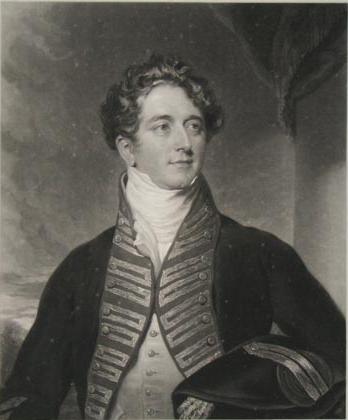
Then, in 1778, the Earl of Derby (that's him at left) and a group of friends including Sir Charles Bunbury, the playwright Richard Sheridan, and politician Charles James Fox, hatched the idea of a new race for three-year-old fillies, over one and a half miles (most races at Epsom were in the two-to-four mile range), naming it The Oaks, after Lord Derby’s nearby house. In 1780 they added a second race, for both colts and fillies, over one mile (soon expanded to one and a half); Lord Derby and Sir Charles flipped a coin for the honor of naming this new race, and Derby won the toss—and so The Derby was born. Sir Charles probably wasn't too upset—his colt Diomed became the Derby's first winner.

The races soon became popular; several shorter races over the course of the meet made for more excitement among the viewers (and thus more bets placed!), which of course had the effect of drawing more than just the racing crowd, so that eventually a sort of country fair atmosphere took over, which in turn drew more crowds (helped by the location’s proximity to London.) A verse declaims,

On Epson Downs, when racing does begin
Large companies from every part come in.
Tag-rag and Bob-tail, Lords and Ladies meet,
And Squires without Estates, each other greet.
Bets upon bets; this man says, ‘Ten to one.’
Another pointing cries, ‘Good sir, tis done.’

Our friend Prinny, the Prince Regent, was one of those spectators; in the 1790s he built the first permanent structure at Epsom, the Prince’s Stand (a larger grandstand would finally be built in the 1830s). By the Regency, the Derby was an established “event” of the season, and an audience of thirty to forty thousand was the norm.

1810’s Derby, run on June 7, was no exception, drawing the usual hordes of racing enthusiasts from the lowest to the highest. What set it apart was the horse who would win that day, a three-year-old colt with “the lowest and longest, and most-double jointed horse, with the best legs...and worst feet I ever saw in my life," according to his groom.

Whalebone, owned by the Duke of Grafton, was running only his second formal race ever; he’d won the Newmarket Stakes just the month before. But despite his unprepossessing looks, he was a grandson (grandcolt?) of the mighty sire Eclipse, and went out favored to win...and win he did, leading the field throughout the race. Though his subsequent career was a checkered one, with a pattern of grand wins followed by disappointing losses then back to wins, his greatest victories came after he retired to stud: he was the progenitor of champions straight through into the 20th century and beyond—not bad for a horse described by a contemporary as “shabby”!

Tuesday, October 4, 2016

Nineteenth Century Bad Boys, Part 4: the Count d’Orsay


It’s been a while since we met a bad boy, isn’t it? I have to admit that I clapped my hand to my forehead when I realized that there was a perfectly splendid one that we’d missed—and yet, from all accounts, he was probably the nicest bad boy one could ever hope to meet. He’s also someone whose image you might well have seen before, without realizing his identity. And so, may I present to you Alfred Guillaume Gabriel Grimod d’Orsay, more commonly known as the Count d’Orsay.

Alfred was born in Paris in 1801, the son of a Bonapartist general and an illegitimate daughter of the Duke of Württemberg. As such, he had a comfortable, privileged childhood, and as a youth was known for his charm and beauty—just about everyone who met him, including the other boys at his school, compared him to a Greek god.

The young d’Orsay followed in his papa’s footsteps and joined the army under the restored King Louis XVIII (though he remained a lifelong Bonapartist at heart). His looks and charm only improved with age, it seems, and to them he added being a faultless horseman and a ready (if sometimes impudent) conversationalist. So it was no surprise when he was asked to accompany the Duc de Guiche, his brother-in-law, as part of the official French delegation to London for Prinny’s coronation as King George IV. By all accounts, he took London by storm...and most especially, the Anglo-Irish Earl and Countess of Blessington.

Lord Blessington was a very wealthy, very enthusiastic collector of art and, it seems, people...and he was determined to collect d’Orsay. He and Lady B. left to travel on the continent the next year, and made a bee-line for Paris...and more or less acquired Alfred, who resigned from the army and joined their household as it traveled around the continent, including Italy (where they hung out with, among others, Lord Byron, who was much struck by d’Orsay and consented to be sketched by him—for as it turns out, Alfred was also a very talented artist and sculptor. The relationship among the Blessingtons and d’Orsay remains murky, though it is widely assumed that Lady Blessington and d’Orsay fell thoroughly in love. Which makes d’Orsay’s marriage in 1827 to Lord Blessington’s daughter by his first marriage kinda creepy...nor did the marriage last, as they legally separated in 1838.

Lord Blessington died in 1829, and Lady Blessington and d’Orsay returned to England and became host and hostess of one of the most brilliant literary and artistic salons of London: Charles Dickens, Edward Bulwer-Lytton, Benjamin Disraeli, and William Thackeray were all habitués (though not many women came, it should be noted, for Lady Blessington’s past was, shall we say, a shadowy one-- honestly, she deserves a biography of her own.) d’Orsay was as admired as he had been on his 1821sojourn: again, he was admired for his beauty, his talents, and his inherent kindness.

Through the 1830s and 1840s Lady B. and d’Orsay reigned over their literary, if raffish, salon...but neither were precisely known for their frugality, and the party came to an end in 1849 when d’Orsay went bankrupt. He moved to France, as all good bankrupt English nobility do, while Lady Blessington sold off her belongings in preparation to join him...but died shortly after arriving in Paris. Devastated, d’Orsay scraped along for a few years painting portraits and probably through the handouts of his enormous circle of friends, until one old friend in particular, now Emperor Napoleon III, offered him a job as the director of the Académie des Beaux-Arts in 1852. Unfortunately, he became ill just days after the appointment was announced, and died...and was sincerely mourned.

Now, I mentioned that you’ve probably seen a picture of d’Orsay without knowing it.  Are there any readers of The New Yorker out there? If so, you’ll recognize this fine fellow...but did you know he was based on an 1834 sketch of d’Orsay by Daniel Maclise?

I've had to leave out all sorts of fascinating detail...but if you'd like to know more about d'Orsay and his life and times (as well as the equally fascinating Lady Blessington), I highly recommend Nick Foulkes's marvelous biography Last of the Dandies: The Scandalous life and Escapades of Count d"Orsay.

Friday, September 23, 2016

Recounting a Great Recounting

Imagine this: prices are skyrocketing, in part because of import/export laws. People are finding it hard to afford bread. The country is deep in debt. What do you as a member of government do?

Have everyone bring in their coins and give them new ones.

Really, that’s what happened in 1816 and 1817 in England. The so-called Corn Laws were keeping the cost of grain artificially high and preventing other countries from bringing in grain at lesser prices. Things were looking wobbly economically. Parliament in its wisdom decided the best way to stabilize the economy was to standardize the coinage, and to do that they needed new coins.

The Coin Act of 1816 ordered the Royal Mint to put forth new silver coins to replace the old ones. Master of the Mint, William Wellesley-Pole, older brother of the Duke of Wellington, came up with a daring plan. (He added the Pole part of his name as a requirement to receive his inheritance from a distant relative). He had to create new coins, get everyone in the entire country to trade out their old ones, and bring the old ones back for destruction.

Not easy by any imagining. Right away, he ran into trouble. To begin with, the Royal Mint had no record of the coins it had previously cast, so he had no examples on which to build. Joseph Banks, head of the Royal Society, gave him some old coins, and Wellesley-Pole started the Royal Mint Museum, which is still in operation today.

For another, the old coinage had been cast in such a way that the designs and denominations were rubbed off over time, until no one was sure what was worth what (one of the reasons Parliament wanted to have new money minted). Wellesley-Pole used the latest engraving and printing processes.

Then there was the fact that Parliament wanted him to keep this whole endeavor strictly secret until it was time to redistribute the coins. (You can imagine how robbers eyes would gleam if it were known new coins were being transported around the country.)

Finally, there was the matter of the Prince Regent. He had to approve the design of each type of coin. To ensure success, Wellesley-Pole contracted with the great Italian engraver, Benedetto Pistrucci to design the faces of the coins. And they were literally faces—then as now, English coins carried a bust of the reigning monarch. Normally, Pistrucci would have had his subject sit for him to create the bust, but King George wasn’t in any shape to comply. (He was quite mad at this point.) So, Pistrucci set up the coin based on other portraits. Shall we say, they were not his finest work? His initial design has been dubbed the “bull head George” (the coin at the top of the post). I’m sure you can see why. It was roundly criticized, and another design prevailed. This St. George and the Dragon was used then and in 1915, as shown on the coin.

Wellesley-Pole also prevailed. He managed to have cast new silver coins and a new gold coin, the sovereign, which was worth 20 shillings as opposed to the new defunct guinea, which was worth 21 shillings. He also had cast crowns and half crowns. All coins were cast to specific standards, bagged and crated, and distributed by 1,000 agents through banks all over Britain.

The effort at last met with high success. Approximately 57 million coins were exchanged, with no robberies and no riots, over the course of two weeks. And the coins remained in circulation until 1971.

Well done, Wellesley-Pole, well done. I’m happy to recount your triumph.


Tuesday, August 16, 2016

Blast from the Past: Toxophilia

In honor of the amazing women from all countries competing at the 2016 Summer Olympics in Rio...a reminder that women in sports is not necessarily a completely modern phenomenon...

In these days of Title IX when young women can participate in pretty much any sport they choose, it’s easy to forget that just a hundred years ago, anything much more strenuous than a decorous horseback ride in Rotten Row, a gentle game of tennis or maybe—maybe—a few holes of golf was frowned upon by the medical profession and society alike. Girls, move freely and break a sweat? How un-lady-like!

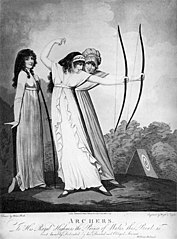
But there have always been a handful of sports to which young women have been given grudging access…and one of them was archery. Here was a sport at which it was unlikely you might become overheated or over-excited. It was a sport you could do while wearing a corset (in fact, wearing a corset might even help!) And it gave you a chance to order adorable new clothes, like the archery suit from 1829 worn by this young lady at the right.

Archery was a reasonably popular sport in 19th century England, due in no small part to the important role it played in English history. In the middle ages, English bowmen were famed (and feared!) in warfare. English longbows could launch an arrow capable of piercing plate armor, which of course did not make French knights very happy during the Hundred Years' War. Several kings passed laws requiring all able-bodied men over the age of 17 to own a bow and arrows and establishing mandatory weekly shooting practice. This fell by the wayside once firearms became widespread, but interest in archery never died…and indeed, recreational archery enjoyed a resurgence with the foundation of the Royal Toxophilite Society in 1781. Toxophilia (isn’t that a dreadful sounding word?) means “love of archery”, and several prominent members of the nobility became members of the society, most notably the Prince of Wales (who later became Prince Regent and King George IV). They established a permanent clubhouse and shooting range in 1833 in Regent’s Park in London where practices and in-club competitions were held weekly in season…and, unusually for this time, they held an annual Ladies’ Day invitational competition every July with prizes given by the society. Go girls!

Tuesday, August 9, 2016

The Children of George III: The noble Duke of York


Do you remember that rhyme about the noble Duke of York and his ten thousand men, marching up to the top of a hill and marching down again? More about that shortly. ☺


Image result for frederick duke of yorkThe second child and second son of George and Charlotte was born a year and a day after his elder brother George, on August 16, 1763, and unusually for royalty was given just one name—Frederick. The brothers were to remain fast friends their entire lives, and were raised almost as twins and educated by the same tutors; but from an early age young Fred manifested an interest in all things military which would lead his father in 1780 to send the boy off to Germany, to receive a military education from his uncle the Duke of Brunswick, regarded as the finest soldier in Europe. He didn’t return to England until almost seven years had passed, and amazingly, much of the correspondence between him and his family has been reserved, giving us a picture of a young man whose passion for the military was probably somewhat greater than his ability...but who retained a fundamental kindness and sweetness of character despite years of living amongst the less-than-kind-and-sweet royal military caste of the continent.

After a few years of riotous living in England (following in his elder brother’s footsteps once again, much to their father’s dismay) Frederick proposed to a girl he’d met during his years on the continent, Frederica of Prussia, great-niece of Frederick the Great. It wasn't a love match, and the fact that they had no children allowed them to drift apart, but they always remained good and loyal friends and Frederick visited her frequently at the country estate she preferred to live at, Oatlands, where she was able to indulge her extreme fondness for dogs and other animals. Her husband, in the meanwhile, continued his military career; though Frederick tried, he ended up doing poorly not through incompetence but through bad luck and unreliable allies (the “noble Duke of York” rhyme might have come about from his participation in the disastrous Flanders Campaign against France in 1793-94.) A further campaign in 1799, a joint invasion of Holland with the Russians, also ended badly.

Image result for frederick duke of yorkAfter that, Frederick retired to England to take a desk job back home as Commander-in-Chief...and finally came into his own. His bad experiences as a field commander with the woefully undersupplied and inadequately trained British army led him to a program of military infrastructure building: among other things he strongly supported the establishment of the military college at Sandhurst to train officers and encouraged promotion by merit, not birth or wealth. This work made possible the success of the Peninsular Campaign, driving Napoleon out of the Iberian peninsula, and laid the foundation for the future British Empire’s military might.

A scandal in 1809 involving the sale of officers’ commissions by the Duke's mistress Mary Ann Clark, supposedly with his tacit permission—a scandal that seems to have been constructed by poor Fred’s political opponents—led to his resignation as C-in-C, though the uncovering of the plot came to light soon after, and he was reinstated by his brother, now the Prince Regent, in 1811. Fortunately, the rest of his life went on quietly—he did his job, continued to amiably carouse and gamble away vast amounts of money, and remained a fundamentally nice guy. To Prinny’s enormous sadness his favorite brother died in 1827.


Tuesday, June 28, 2016

Announcing a New NineteenTeen Series: the Children of George III

Some years back I did a series of biographical posts on the nine children of Queen Victoria. I enjoyed writing it and NineteenTeen readers seemed to enjoy reading it; I mean, imagine growing up with the most influential woman on earth as your mom. Not all of her children were as influential on world events, of course, but it was interesting to learn about them.

So I thought you might find a series on the children of another British monarch interesting as well—and more of those offspring were important on a world level. I’m talking about the fifteen children of King George III and his wife Queen Charlotte. Unlike Victoria’s brood, not all lived to adulthood (in the 18th century, even the King’s children could escape the era’s higher infant mortality rate.) Not all married and had children (unlike all of Victoria’s children, even the sickly Leopold.) But I find them on the whole a more sympathetic and vital group of individuals, with more interesting lives, and I hope you will too.

Before we dive into the life of George’s second child, Frederick, (the eldest of course being our old friend Prinny, perhaps better know as King George IV, has already been a topic of discussion here and here and here) I thought a little background information might be in order.

George III came to the throne in 1760 at age 22—an earnest, somewhat plodding but basically good-hearted young man—and one of his first concerns was finding a wife in order to beget an heir and secure the succession. He’d been briefly enamored with Lady Sarah Lennox, daughter of the Duke of Richmond (and one of the Lennox sisters in author Stella Tilyard’s excellent book Aristocrats) but both his mother and his mentor Lord Bute, who held a great deal of influence over George, felt that an English bride would not be advisable. And so, not quite a year later, he married a foreign bride, one his mother felt she could comfortably bully—a Princess Sophia Charlotte of the tiny German principality of Mecklenburg-Strelitz.

Charlotte was just 18, and had never left her country before (nor would she see it again.) Though her education had been mediocre she was a bright young woman, fond of reading and eager to expand her intellectual horizons. She spoke no English on her arrival...and in fact, within six hours of arriving in London (after a difficult and stormy passage across the North Sea), she met her husband-to-be for the first time, was hastily dressed in her wedding finery, and married to him.

George and Charlotte seemed to have become genuinely fond of each other; they shared an interest in learning and music, and while George made it clear that he expected his wife to keep strictly to home and hearth (so to speak--we're talking 18th century court life here!) and not meddle in government, she was a quiet influence on him. She also admirably fulfilled her duty to her husband and presented him with a son just eleven months later...and fourteen more children over the next twenty-one years. 

Tuesday, February 16, 2016

1810, What a Year It Was, Part 2: The Lady of the Lake and the Hughland Revival


Just in case you think that media having a profound effect on popular culture is a modern phenomenon, I have five words for you: The Lady of the Lake.

In 1810 a Scottish lawyer named Walter Scott who had been slowly building a name for himself as a poet writing about Scottish history and lore published his third narrative poem, called The Lady of the Lake. His previous efforts, The Lay of the Last Minstrel (1805) and Marmion (1808) had seen moderate popular success. But for some reason, the May release of The Lady of the Lake turned Scott into a household name, selling 25,000 copies that year alone.

The poem’s story is a dramatic one, with three suitors vying for the hand of the fair Ellen Douglas, a disguised king reconciling with an estranged old friend and supporter (who happens to be the father of the aforementioned Ellen), and war between the king and his Lowland Scots versus the Highland Clans led by one of the (also) aforementioned suitors. There are bards and druidic prophets and old feuds affecting the present and one-on-one combat and lots and lots and lots of description of the wild beauties of Scotland...and the origins of the song we now know as “Hail to the Chief”!

So, popular book, sold lots of copies, blah blah blah. But The Lady of the Lake also sparked something known as the Highland Revival, a sort of craze for Scottish history and culture (or at least what people thought was Scottish culture). Don't forget that Scotland had been in eclipse through most of the 18th century, ever since the last Stuart uprising in 1745 had led to the horrible slaughter of the Battle of Culloden, decades of sanctions against the Scots, and widespread emigration to America. Scotland as a topic was ripe for romanticization and exploitation; it had already begun with the publication in 1760 of what purported to be epic poems by an ancient Scottish bard, Ossian, by one James Mcpherson. They were an international sensation: people from Thomas Jefferson to Napoleon counted them as favorites. Alas, it turned out that they were not ancient, but Macpherson's own work. Still, the seed had been planted, fertilized by the passion of the late 18th and early 19th centuries for the wild and picturesque. 

Scott knew a good thing when he saw it; he followed up the success of  with a series of historical novels set in Scotland, and the craze only grew. The Prince Regent was an enthusiastic subscriber; he invited Scott to dinner in 1815 after reading his novel Waverley, published the previous year, and ended up visiting Scotland in 1822, the first reigning monarch to do so since 1650. He also had his portrait painted wearing a kilt to commemorate the visit.  The Highland Revival would eventually find its apotheosis in Queen Victoria’s buying a house in the Scottish Highlands, decorating it from cellar to attic in tartans and deer antlers, and trying to spend as much time there as possible, much to the dismay of her ministers.  And long-time NineteenTeen readers may recall my poking gentle fun at the Scottish craze in an April Fool’s Day  post a while back.
And it all more or less started in 1810. ☺

Tuesday, September 29, 2015

Green and Pleasant Land, Part 6: New Forest and Brighton

Our next destination on the Doyle family tour of southern England was the seaside town of Lymington, from which we planned to spend the next day visiting the Isle of Wight. “Ferry reservations?” we cluelessly trilled. “Who’ll be going to the Isle of Wight on a Thursday morning?”

Um...well, as it turned out, a lot of people. The ferry was book solid until 4 pm, which meant our plans to see Cowes and Queen Victoria’s Osborne House were shot. It was time for Plan B. And you know what? As much as I was bummed to miss Osborne House, Plan B wasn’t so bad...not when it included a visit to a handsome stately home, Beaulieu (that’s pronounced “Bew-lee”, just so you know).

In addition to the current house, Beaulieu includes the remains of a large medieval monastery (here's a section of garden with bits of original stonework that have been found) and some lovely plantings (I especially loved this laburnum tunnel...as did hundreds of bees!)

We also did a lot of driving around the New Forest, another royal hunting preserve (this time dating to the time of William the Conqueror). Though much smaller and tamer than Dartmoor, there were small moors, also inhabited by lots of sheep and ponies. And while wandering around a section of forest, I heard my first cuckoo call.

The next day we were off to another long-awaited destination: Brighton, home of the Prince Regent's beloved Pavilion, where he would spend the summer enjoying the breezes off the English Channel. He first discovered Brighton (or Brighthelmstone, its original name as noted in the Domesday Book) in the early 1780s, when sea-bathing had become the latest health fad. Prinny was charmed and bought a modest farmhouse, which he commissioned architect Henry Holland to turn into a home worthy of the Prince of Wales. Holland built him one...but evidently it wasn't grand enough, for in 1815 Prinny hired architect John Nash for an upgrade. And what an upgrade he got!

The exterior of the Pavilion is made of chastely cream colored stone, in a fantastical dreamlike Mughal style with onion domes, pierced screens, and minarets--rather a contrast to the Georgian classicalism that had been the prevailing building style in the town for the last fifty years. And while it's beautiful in a fanciful way, it's only the beginning.

The interior is, quite simply, jaw-dropping. Where Indo-Islamic style prevails on the outside, within the decor is fantasy Chinese. There are dragons everywhere (include one of silver gilt clinging to the chandelier in the Banqyueting Room that must be at least ten feet long). In the Music Room, the central done is covered with hundreds of thousands of gilt cockles shells, which look like dragon scales. The colors are rich and saturated, and every surface is decorated; even the kitchens, which were state of the art in 1820, are beautiful.

What's even cooler about the Pavilion, though, is its history. After Prinny's (now King George IV) death in 1830, his brother King William used the Pavilion. But when Victoria came to the throne, she was not amused by the Pavilion and by Brighton in general, finding it far too crowded and the palace itself too small and lacking in privacy. She bought land on the Isle of Wight for her summer retreat of Osborne House, and the Pavilion was sold to the city of Brighton (after Victoria carried off anything that wasn't nailed down.) Decades of decline followed; Nash's creation was not built to last. But after World War I, partly spurred by the interest of Queen Mary (who began to donate back to the Pavilion things that Victoria had carried off) and a full-scale restoration of the Regency era palace was begun, hugely helped by the fact that all of Nash's original plans and detailed paintings of the rooms were available. Since then, despite fires and other calamities, work has been ongoing, and the result is just breathtaking. We sure as heck enjoyed it! If you ever, ever have a chance to see it--go!

Our hotel was also worth mentioning; Brighton remained a popular watering hole long after Prinny went to the great Assembly Room in the sky, and a series of elegant hotels were built right along the shore, rather like a Victorian Miami Beach. The grand Brighton was indeed a grand old place, a little shabby in spots but oh so atmospheric.  We ate dinner at the Old Ship Hotel, mentioned in at least one Georgette Heyer novel that I remember, and then after dark looked out at the Brighton Pier, which is basically a small amusement park built over the water (it dates to 1899) before going to sleep for the last night of our trip.

The last installment: Hampton Court Palace, and where I'm going next time!