
Showing posts with label Lord Byron. Show all posts

Tuesday, January 10, 2017

Happy New Year, Dear Readers!


First of all, Happy 2017 to you, our dear readers! Regina and I hope you’ll continue to read along as we squee over 200-year-old fashions, tell weird history stories, talk about our books, and generally have fun.

And speaking of reading along...believe it or not (yeah, I’m kinda struggling with believing it myself) the fact that it’s 2017 means we’ll have been writing NineteenTeen posts for ten years come September. I expect we’ll be posting our one thousandth post some time toward the end of the year, which is kind of mind-boggling...but you know, we wouldn’t do this if we didn’t want to. We hope you’re still enjoying reading as much as we enjoy posting.

Since this is a New Year’s celebration post, there are a couple of things I wanted to do...and one of them is to talk about the books we especially loved over the last twelve months. Are there any books with a historical slant, fiction or non-fiction, that you especially enjoyed last year?

My candidate for Most Awesome Historical Book That I Read in 2016 is this one:

The Thrilling Adventures of Lovelace and Babbage: The (Mostly) True Story of the First Computer by Sydney Padua is...well, I suppose that it gets categorized as a graphic novel, but it’s so, so much more than that. According to the introduction, Ms. Padua started it as a bit of a lark, but things soon got out of hand (oh, I so know that feeling...) It’s the imagined adventures of two real people, Victorian inventor Charles Babbage and amateur mathematician and celebrity offspring Ada, Countess of Lovelace (the celebrity part being that she was Lord Byron’s daughter.)  The historical part is that Babbage designed what was more or less a steam-powered calculating machine (two of them, actually)...and his friend Lovelace, writing a commentary on the designs, more or less posited what would become today’s field of computer science. In real life, Babbage’s engines were never built and Lovelace died tragically young of cancer...but in Padua’s “pocket universe” they’ve teamed up to use the engines to “to build runaway economic models, battle the scourge of spelling errors, explore the wilder realms of mathematics, and, of course, fight crime—for the sake of both London and science.”

There’s so much to love here—the illustrations are glorious and historically correct (omg, the clothes are right, and so is the Duke of Wellington’s nose!) The story-telling is witty and erudite but never stuffy (I totally want this illustration of Isambard Kingdom Brunel on a t-shirt for my engineer husband and son), but it’s also real and human—Lovelace and Babbage aren’t cardboard figures, but brilliant and funny and in many ways, tragic. If you have the least interest in technological history or science fiction or the Victorian era or or or...read this book!


And in the “Other Things that Require Celebration” department, may I present this: a new cover for By Jove, being re-released next month from Book View Café. Gotta say, I'm in love with it.  Look for more news about By Jove in February. 

Now, dear readers, what's your news? Please tell us about your favorite 2016 book, or what you're bookishly looking forward to
this year...and keep reading!


(Fireworks image courtesy of noppasinw at FreeDigitalPhotos.net)


Tuesday, October 4, 2016

Nineteenth Century Bad Boys, Part 4: the Count d’Orsay


It’s been a while since we met a bad boy, isn’t it? I have to admit that I clapped my hand to my forehead when I realized that there was a perfectly splendid one that we’d missed—and yet, from all accounts, he was probably the nicest bad boy one could ever hope to meet. He’s also someone whose image you might well have seen before, without realizing his identity. And so, may I present to you Alfred Guillaume Gabriel Grimod d’Orsay, more commonly known as the Count d’Orsay.

Alfred was born in Paris in 1801, the son of a Bonapartist general and an illegitimate daughter of the Duke of Württemberg. As such, he had a comfortable, privileged childhood, and as a youth was known for his charm and beauty—just about everyone who met him, including the other boys at his school, compared him to a Greek god.

The young d’Orsay followed in his papa’s footsteps and joined the army under the restored King Louis XVIII (though he remained a lifelong Bonapartist at heart). His looks and charm only improved with age, it seems, and to them he added being a faultless horseman and a ready (if sometimes impudent) conversationalist. So it was no surprise when he was asked to accompany the Duc de Guiche, his brother-in-law, as part of the official French delegation to London for Prinny’s coronation as King George IV. By all accounts, he took London by storm...and most especially, the Anglo-Irish Earl and Countess of Blessington.

Lord Blessington was a very wealthy, very enthusiastic collector of art and, it seems, people...and he was determined to collect d’Orsay. He and Lady B. left to travel on the continent the next year, and made a bee-line for Paris...and more or less acquired Alfred, who resigned from the army and joined their household as it traveled around the continent, including Italy (where they hung out with, among others, Lord Byron, who was much struck by d’Orsay and consented to be sketched by him—for as it turns out, Alfred was also a very talented artist and sculptor. The relationship among the Blessingtons and d’Orsay remains murky, though it is widely assumed that Lady Blessington and d’Orsay fell thoroughly in love. Which makes d’Orsay’s marriage in 1827 to Lord Blessington’s daughter by his first marriage kinda creepy...nor did the marriage last, as they legally separated in 1838.

Lord Blessington died in 1829, and Lady Blessington and d’Orsay returned to England and became host and hostess of one of the most brilliant literary and artistic salons of London: Charles Dickens, Edward Bulwer-Lytton, Benjamin Disraeli, and William Thackeray were all habitués (though not many women came, it should be noted, for Lady Blessington’s past was, shall we say, a shadowy one-- honestly, she deserves a biography of her own.) d’Orsay was as admired as he had been on his 1821sojourn: again, he was admired for his beauty, his talents, and his inherent kindness.

Through the 1830s and 1840s Lady B. and d’Orsay reigned over their literary, if raffish, salon...but neither were precisely known for their frugality, and the party came to an end in 1849 when d’Orsay went bankrupt. He moved to France, as all good bankrupt English nobility do, while Lady Blessington sold off her belongings in preparation to join him...but died shortly after arriving in Paris. Devastated, d’Orsay scraped along for a few years painting portraits and probably through the handouts of his enormous circle of friends, until one old friend in particular, now Emperor Napoleon III, offered him a job as the director of the Académie des Beaux-Arts in 1852. Unfortunately, he became ill just days after the appointment was announced, and died...and was sincerely mourned.

Now, I mentioned that you’ve probably seen a picture of d’Orsay without knowing it.  Are there any readers of The New Yorker out there? If so, you’ll recognize this fine fellow...but did you know he was based on an 1834 sketch of d’Orsay by Daniel Maclise?

I've had to leave out all sorts of fascinating detail...but if you'd like to know more about d'Orsay and his life and times (as well as the equally fascinating Lady Blessington), I highly recommend Nick Foulkes's marvelous biography Last of the Dandies: The Scandalous life and Escapades of Count d"Orsay.

Tuesday, February 2, 2016

1810--What a Year It Was

I promised you a new series, didn’t I? Well, today it begins...but first, a little background.

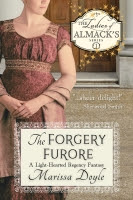
I’ve had an idea for an adult Regency story for years...but some ideas take a long time to marinate. I jokingly say that the girls in the back room had to think about it for a while...and in 2015, they let me know they were ready to get started. The story has turned into a serial, told in novella-length episodes that are complete stories in themselves but include an overarching plot (and developing romance, of course!) that interweaves with the events of the individual stories.

The story takes place over the course of 1810 and will end in 1811, which means I’ve been doing a lot of research about that one year...and it was a pretty interesting one. So I thought it might be fun to examine some of those events that inspired my serial, because we’re all about weird history stories here at NineteenTeen, right?

So what was going on around the world in 1810?  Although my serial of course will focus on England and its concerns, there was a lot of interesting stuff happening elsewhere...
  • Napoleon divorces his Josephine in order to marry Marie Louise of Austria, and adds Holland and the German kingdom of Westphalia to the empire, but French forces under Marshal Masséna are expelled from Portugal
  • Beethoven composes Für Elise
  • Lord Byron, sojourning in Greece, swims the Hellespont 
  •  General Bernadotte, one of Napoleon’s marshals, is elected Crown Prince and heir to the throne of Sweden.
  • Frédéric Chopin, composer and pianist, is born, as were Robert Schumann, English novelist Elizabeth Gaskell (who wrote the wonderful Cranford, among others), and P.T. Barnum.
  • Argentina, Mexico, Venezuela, Colombia, and Chile take varying steps toward independence from Spain.
  • The first steamboat on the Ohio River begins operation . 
  • King George III is declared insane (again.)
  • And for you Regency boxing fans, the great 40-round match between Cribb and Molineaux takes place.
Stay tuned for the first post soon!