Showing posts with label George III. Show all posts

Tuesday, September 6, 2022

Blackmail is Such an Ugly Word…


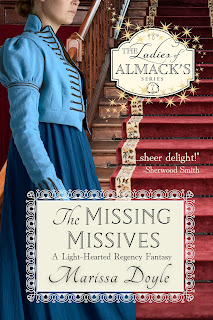
In The Missing Missives, the seventh book in The Ladies of Almack's series, questions are answered...but more are asked.


Poor Annabel is still reeling from the shock of being cut dead by Quin when she receives a summons to a special investigation by the Lady Patronesses of a highly sensitive nature. Someone has stolen letters written by Princess Amelia, George III’s youngest daughter, to her secret love, and is threatening to send them to the king unless a substantial payment is made. Worse yet, the king’s health is so precarious that such a shock might send him back into madness. The Ladies need to find the blackmailer and get those letters, but nothing is as simple as it seems here.

This is a story of contrasts—the high emotion of Annabel dealing with Quin’s rejection and the sheer silliness of the lovelorn pigeon whom Annabel tries to help…and oddly enough (or perhaps not so oddly), everything is somehow connected. There’s a lot going on here, and the foundation for the remainder of the series is revealed—a little. And I should really stop teasing now…

The Missing Missives can be purchased directly from the publisher, Book View Café, in both EPUB and MOBI formats as well as from all the usual online bookstore outlets. Print versions can be found at Barnes and Noble and Amazon via the link below. And you can read a sample here.

Book View Cafe

Barnes and Noble

Amazon

Kobo

Smashwords

Apple

Google (new!)

Other venues


Happy reading!


Tuesday, April 24, 2018

1810, What a Year It Was: the (Final) Madness of King George


We’ve talked about the some of the most noteworthy public events of 1810, from literary to sporting to true crime...but perhaps the most momentous was what happened in its final months: the descent of George III into permanent debilitation.

Everyone’s heard of “mad King George”, and doctors and medical historians have derived endless hours of diversion from trying to figure out just what it was that the poor man suffered from. The most recent thinking seems to be that he was indeed suffering from some form of mental illness, perhaps aggravated by arsenic poisoning (arsenic was commonly used in medical treatments of the day) and not porphyria, a metabolic disease. No matter the cause, the last months of 1810 would also be his last months as reigning monarch.

First, a little history: the king’s first confirmed demonstration of mental illness began in the fall of 1788, when various physical symptoms (rash, rheumatic pains, gastric distress, and fever) manifested, quickly followed by delirium, hysteria, and mania. He talked for hours on end, making grandiose, delusional plans and pronouncements until he was out of breath and foaming at the mouth. Though his physical symptoms eased, his behavioral ones did not (on November 17 he talked for nineteen straight hours), and between his ministers and his family, plans were made for a regency to rule in his stead...a plan that fell through when, early in the new year, he began to recover and was able by March to call himself mostly recovered.  He seems to have suffered a brief relapse in 1794 (though not as severe as the 1788 illness) and again in 1801. After that point, his condition seems to have remained highly fragile, with more relapses and recoveries occurring over the next few years.

By October 1810, George III was 72 years old and suffering from cataracts and painful rheumatism. He’d been devastated by the deaths of two of his children in the 1780s, while they were quite young. But now it appeared that he would be facing the death of an adult child—one whose very existence had helped him over those earlier losses.  Princess Amelia, his youngest daughter, had been a semi-invalid for years, probably suffering from tuberculosis, and by this time, was on death’s doorstep. The king’s poor eyesight had perhaps cushioned him somewhat from the truth—he could hardly see how ill she was—but toward the end even that could not shield him from the reality of his daughter’s condition. As her life ebbed, his old, familiar symptoms began to reappear: nervousness and excitability, over-talkativeness, sleeplessness. In her last week of life, he too slipped away into a twilight world, and was too ill to comprehend that Amelia was dead.

The king had realized, early on, that he was in for another period of illness, and instructed his physicians that he was not to be entrusted to any “medical man specially engaged in the department of insanity,” but the doctor who had looked after him in earlier periods, Robert Willis, was brought in to consult. Poor George had days when he seemed almost normal over the course of November and December, but enough bad days encouraged the revival of the Regency bill that had first been drafted (and nearly passed by Parliament) back in 1789.  Everyone—his family, servants, and ministers—waited with bated breath to see what would happen. More lucid days in January occurred, but while there were hopes that he would once again recover, the Regency bill was voted on and passed Parliament, with George’s knowledge, at the end of the month, and Prince George became Regent with limited powers, to be reviewed in one year’s time (presumably in case the king recovered.)

However, it became clear through the spring that recovery was unlikely: while he still had periods of lucidity, the king slipped inexorably into his delusional world, talking and giving commands to people who weren’t there, and seemed to forget his affection for his family. The lucid periods became fewer, and in the fall it was expected that at the one-year anniversary of the Regency Act in January 1812, the regency would be made permanent. Poor King George would hang on for another eight years, growing blinder and sicker, until his death in 1820.

Tuesday, February 27, 2018

The Children of George III: Augusta


A sister (finally!) for the Princess Royal joined the royal nurseries at Buckingham House on November 8, 1768 in the form of Princess Augusta Sophia, much to the King and Queen’s pleasure.

By all accounts Augusta was a shy child; all the royal children lived sequestered lives, interacting only with members of the royal household. She (and in time her younger sister Elizabeth, to whom she would be close) shared their elder sister’s education at their mother’s knee, studying both academic and more “womanly” accomplishments—lessons which Augusta sometimes shirked in order to keep up a lively correspondence with her elder brothers, whom she dearly loved.  Like the Princess Royal, as she came to adulthood Augusta was a victim both of the political circumstances of the time and of her father’s unwillingness to lose any of his daughters to a foreign marriage. Augusta, who was reckoned quite good-looking by all accounts (her portraits are all charming) received proposals from both the King of Denmark and the Prince of Sweden—both of whom were rejected.

In 1799, when Augusta was 31, the King appointed a new aide-de-camp, an Anglo-Irish general who had served under Augusta’s brother the Duke of York. General Sir Brent Spencer made a strong impression not only on the king, but on his daughter. They seem to have fallen thoroughly in love; in fact, Spencer broke off his engagement to another young woman that summer. Over the next several years they maintained their affection, a period in which Spencer served under fire with high distinction in several military campaigns (and drove poor Augusta mad with worry.) When the king made his final descent into incapacity, Augusta evidently had very serious discussions with her big brother, the Prince Regent, as to whether she and Spencer might be able to contract a “private marriage.”

Unfortunately, the years of dealing with the King’s controlling behavior and his erratic health had soured the temper of the Queen, who continued to cling to her unmarried daughters even while behaving with capricious coldness to them; though legally Augusta could have received her brother's permission to marry, her filial feelings toward the Queen probably made her decide against such a course. Nevertheless, rumors abounded that they had indeed married, and on his death in 1828 Spencer was holding a miniature of Augusta.

And so Augusta lived her quiet life—she was a noted gardener in particular—much loved by all her siblings. She kept up that correspondence with them that she'd begun in childhood as well as with other friends (many former members of the royal household) that show her to have had a lively intelligence and a clear-eyed but kindly appreciation of their faults and foibles. She remained on good terms with Prinny when he became king, and was a favorite of William and his queen Adelaide.  She died in 1840 at the age of 71, a few months after attending the wedding of her beloved niece, Victoria, who seems to also have regarded her aunt with great affection.

Tuesday, January 30, 2018

1810, What a Year It Was...Except When It Wasn’t


Last week I mentioned that I had intended to write a post for my 1810 series about the celebrations in observance of George III’s fifty years on the throne. It was kind of a big deal—only three other monarchs since the Norman Conquest (Henry III, Edward III, and James I—and James only squeaks in because of his years on the throne of Scotland as James VI before he became James I of England) had been fifty years on the throne. I blithely assumed that the king’s jubilee took place in 1810—specifically, on October 25, which was the 50th anniversary of the day he became king on his grandfather George II’s death in 1760. But all my poking around into the events of 1810 made no mention of a jubilee celebration in 1810. Weird, I thought. Maybe it wasn’t celebrated because of the war, or...or something.

And so I continue to think...until last week's research into a darling Jubilee cloak print from La Belle Assemblee made me dig deeper and discover the real reason why there were no jubilee celebrations in 1810... Because they'd all happened in 1809!

I was able to find a fair bit of information about the jubilee observances themselves, but no explanation for why they were held at the start of the 50th year of his reign and not on the anniversary of his assession. The closest I've gotten to an explanation is that it was generally known that the king's health was not good, and it seems that many people were worried that he might die before the anniversary itself. Evidently plans for celebrations were a bit of a last-minute thing They needn’t have worried: in fact he lived for another ten years, outliving Queen Charlotte, though nine of those were spent in a twilight of dementia. By summer 1809 it looked as thought the poor old man would survive, so the tentative plans began to firm up (evidently the first sign of the impending celebrations was a sharp increase in the cost of candles, which were being hoarded for illuminations.)  Sadly, he would not be able to enjoy many of the spectacles that were eventually held in his honor, because his eyesight was almost completely gone by this time.

So how was the jubilee observed?

The King and the royal family attended a service of thanksgiving at Windsor, where the queen later threw a spectacularly splendid fete for the court. But there were plenty of less solemn observances all over the country: many of the nobility had oxen and sheep roasted and basically held barbecues for their tenants and workers, with games and races and bread and ale to go with the meat. Assembly balls for the middle classes in towns and larger villages and fireworks and illuminations in the cities were also widespread. After the fact many communities erected public monuments and statues in honor of the king's anniversary. And of course, there was merchandise. You can still buy George III Jubilee medals on eBay (yes, really), and for the wealthier souvenir hunter there were commemorative dishes, glassware, and my favorite, a child’s game celebrating the glories of the kings of England.

In a way it was probably a good thing that George's jubilee celebrations happened in 1809; by the actual anniversary of his accession in October 1810 he would be in even poorer health—on the verge of his final collapse (the Regency would be declared in January)—and his beloved daughter Amelia on her deathbed. I doubt anyone would have felt much like celebrating.

Tuesday, January 23, 2018

The Mystery of the Jubilee Cloak

It’s wonderful how one thing can lead to another in historical research.

Take this charming print from La Belle Assemblée which I recently added to my collection. The line at top calls it a Jubilee Cloak; it’s certainly a bright, celebratory color, isn’t it?  The bottom text reads “Published for La Belle Assemblee #52 by J. Bell, Southampton Str. Strand.”  No date was given, so I jumped on-line to see if I could track down when this print was published. I guessed it had to be 1810, because that was the 50th year of George III’s reign, and I hoped that the issue of the magazine in which this print appeared would have further information on his jubilee celebrations, because I had not been able to find any information elsewhere and wanted to write a post on his jubilee for my "what happened in 1810" series...a lack of information which seemed odd.

After a good deal of paging through scanned issues of La Belle Assemblée from 1810, I was stymied: there was no Jubilee Cloak in any of them. In fact, the “No. 52” implied that this was from an earlier issue. So on to 1809...and there it was, in the November 1809 issue, listed under “Fashions for December.” (There were also articles on “Authorities touching the actual existence of mermaids” and “Anecdotes of depravity in London from 1700 to 1800”, but that’s for another post. ☺) 

So why wasn’t this listed in an 1810 issue, in which, strictly speaking, it should have appeared since 1810 would have marked his 50th year on the throne? We’ll discuss that—and the Jubilee—next week.

Oh—and the Jubilee Cloak itself? Here’s what La Belle Assemblée had to say:

A simple Village robe of white corded cambric, a walking length, with long sleeves; ornamented round the bottom with four rows of small tucks; made to sit high in the back, and over the shoulders, meeting in front with a gold broach; trimmed round the neck with vandyked ribband, and confined at the waist by a purple velvet girdle.  A Jubilee cloak, of aurora colored merino cloth; lined with royal purple silk, ornamented with gold braiding; tied at the throat with gold cord and tassels. A Turban hat, with a full plume of shaded down. Necklace and earrings of gold or coral. Shoes of purple Morocco. Gloves of York tan.

“Aurora colored merino”—isn’t that a lovely description? And the royal purple silk lining is most appropriate under the circumstances, don’t you think?

Tuesday, November 14, 2017

The Children of George III: Edward


I’m rather glad, for Queen Charlotte’s sake, that she finally got her baby girl in September of1766...because a year later, on November 2, 1767, yet another boy would be arriving in the nursery at Buckingham House. The new baby happened to arrive while his papa’s favorite brother, Edward, Duke of York, was awaiting burial just a short distance away at St. James’s Palace...so it seemed natural to name this newcomer after his late uncle, Edward.

Though he was fond of telling acquaintances later in life about how he’d been destined from birth to lead a life of gloom and struggle, Edward's first seventeen years seem remarkably gloom- and struggle-free. Just as the King’s two eldest sons were paired together, so Edward and his brother William would be: Edward was sent from the nursery at age nine to live with William in a pleasant house on Kew Green, and after William went to sea, Edward had the house and staff and a generous housekeeping budget to himself.

All that changed when he was sent to Germany in 1785 to start his education as a soldier. His governor, a Baron Wangenheim, was evidently a bit of a hard case, and Edward, himself more than a little spoiled, chafed under his tutelage—enough that finally, after receiving his first commission in Geneva, he bolted back to England without leave in early 1790. His highly annoyed father sent him to Gibraltar in disgrace, but at least he’d rid himself of the Baron...and acquired a “chère amie” in the form of a Madame de Saint-Laurent, who would remain faithfully with him for the next twenty-eight years until...but let’s not get ahead of ourselves.

Edward did not make himself loved in Gibraltar; he was a stickler for discipline (thanks to his training under Wangenheim, probably) and ferociously extravagant. The soldiers and shopkeepers of the Rock breathed a sigh of relief when he was sent next to Canada, where he would remain for the next nine years, once again deeply unpopular with the army but wildly popular socially. He was briefly stationed in the West Indies, then sent back to Canada, then back to Gibraltar in 1802 as its governor. But he lasted just a year before being recalled to England because his harsh discipline sparked a mutiny among his troops. His recall home pretty much ended his military career, though he retained some honorary military positions and honors (and the governorship of Gibraltar, though he never set foot there again.)

The next decade and a half were spent in his various houses (he seemed to regard four as the minimum he required) in England with Madame de Saint-Laurent while Edward’s debts only grew—he still hadn’t unlearned his habit of extravagance. He might well have lived out his life in this fashion, spending money and taking an interest in science and political theory, but the unexpected death in childbirth of his niece, Princess Charlotte, in 1817 precipitated him into the great matrimonial race of1818, when the sons of George III scrambled to find wives in order to provide a legitimate heir for the next generation. Edward’s choice landed on Victoire of Leiningen, the widowed sister of Charlotte’s husband Leopold; Edward proposed and was accepted...and according to legend, let his chère amie Madame Saint-Laurent find out about his upcoming marriage by reading about it in the newspaper. (She retired to a convent after their parting.)

Edward settled contently with his new bride at her home in Amorbach, where the cost of living was cheaper than in England, spending money he didn’t have on improvements to the ducal manor. But when Victoire became pregnant, Edward resolved that his child, a potential heir to the throne, should be born on English soil, and accordingly, when Victoire was seven months pregnant, Edward ordered an expensive traveling coach and they trundled across Europe and back to England (despite big brother Prinny telling them not to.) Edward’s daughter was born in May and christened Alexandrina Victoria. He was delighted with the sturdy baby and not at all disappointed in her gender; doubtless he assumed a brother or two would eventually join her in the nursery.

But little Drina would have no further brothers and sisters; when she was but eight months old and the family visiting the Devon coast, her papa caught a cold...and though he'd often declared his health vastly superior to that of his brothers and that he'd survive them all, his cold devolved into pneumonia...and within a few days, in January 1820, he was dead. Though Victoria would later idolize her late father (note the miniature of him she's clutching in the picture at right by Henry Bone), he doesn't seem to have endeared himself to many in his lifetime...and yet, you can't think too badly of a man who remained so faithful to his mistress for so many years.

Tuesday, March 7, 2017

1810, What a Year It Was, Part 4: Poor Princess Amelia


1810 was not a good year for Britain’s royal family. As we saw in this post last year, the Duke of Cumberland came close to losing his life in May; in November his youngest sister Princess Amelia would lose hers...with far-reaching effects.

Amelia was the fifteenth and last child of George III and Queen Charlotte, born August 7, 1783, just as the American Revolution was coming to a close and just a few months after the death of her brother Octavius, who had been the apple of his father’s eye. Amelia (named after the king’s aunt) came to somewhat take Octavius’s place; she was by all accounts a charming, beautiful child, adored by all her older siblings.

Amelia grew up mostly in the company of her elder sisters Mary and Sophia, grouped in a triad as were her eldest three sisters, Charlotte, Augusta, and Elizabeth. They received the what seems to have been a watered-down, less intellectual version of the education their elder sisters had received, and were much less directly supervised by the Queen than their elders had been.

By her mid-teens, Amelia was a tall, buxom, handsome young woman...but her handsome, sturdy appearance was misleading. In the summer of her fifteenth year, she was stricken with an inflamed knee that kept her partially bed-ridden through Christmas. Although she apparently healed, the likelihood is that this illness was the first manifestation of tuberculosis.

Amelia’s life continued its sheltered path, like that of all her sisters...until she fell in love, at eighteen, with one of her father’s equerries, the Honourable Charles Fitzroy. He was more than twenty years her senior, but her affections seem to have been returned. Amelia dreamed of marrying her Charles, but of course this was quite impossible...but that didn’t stop her from carrying on a passionate correspondence with him, holding hands with him under the card table and sneaking whatever private moments they could, or ordering silver engraved with their initials for the home she hoped to have with him someday. She kept her hopes up by planning for her 25th birthday, for according to the Royal Marriages Act, members of the royal family could marry at that age without the king’s permission, so long as they gave Parliament a year’s notice of their intentions. But by that time, the King’s health, both mental and physical, had become sufficiently precarious that she knew she could never go through with it lest the shock destroy him.

Moreover, Amelia’s health remained difficult, necessitating frequent visits to the seaside to recover. By her mid-twenties, royal physicians realized that the princess was indeed consumptive...and by 1809, she was almost incapacitated by a terrible pain in her side, which her doctors tried to cure by inserting a drainage tube.  At the beginning of the new year she was afflicted with a painful skin infection, erysipelas, which just made matters worse. It was clear that Amelia was not long for the world; she made a will, leaving all her worldly goods to her beloved Charles Fitzroy. In September 1810 she begged her physician, Sir Henry Halford, to ask the king if she could be allowed to marry Fitzroy. Halford refused to intercede...and the poor princess continued to decline, ravaged by a further outbreak of erysipelas. Her elder sister (and devoted nurse) Augusta did manage to sneak Fitzroy in for a visit sometime in October, when it was clear that the end was coming.

But Amelia wasn’t the only member of the royal family whose health was of concern. The king, now nearly blind, had been giving his ministers and courtiers great cause for worry, for symptoms of the fits of madness he’d suffered in previous years seemed to be returning. When poor Amelia breathed her last on November 2, the loss of this beloved daughter seemed to provide the final push...and by January, the king would be declared incompetent and a regency declared.

Friday, September 23, 2016

Recounting a Great Recounting

Imagine this: prices are skyrocketing, in part because of import/export laws. People are finding it hard to afford bread. The country is deep in debt. What do you as a member of government do?

Have everyone bring in their coins and give them new ones.

Really, that’s what happened in 1816 and 1817 in England. The so-called Corn Laws were keeping the cost of grain artificially high and preventing other countries from bringing in grain at lesser prices. Things were looking wobbly economically. Parliament in its wisdom decided the best way to stabilize the economy was to standardize the coinage, and to do that they needed new coins.

The Coin Act of 1816 ordered the Royal Mint to put forth new silver coins to replace the old ones. Master of the Mint, William Wellesley-Pole, older brother of the Duke of Wellington, came up with a daring plan. (He added the Pole part of his name as a requirement to receive his inheritance from a distant relative). He had to create new coins, get everyone in the entire country to trade out their old ones, and bring the old ones back for destruction.

Not easy by any imagining. Right away, he ran into trouble. To begin with, the Royal Mint had no record of the coins it had previously cast, so he had no examples on which to build. Joseph Banks, head of the Royal Society, gave him some old coins, and Wellesley-Pole started the Royal Mint Museum, which is still in operation today.

For another, the old coinage had been cast in such a way that the designs and denominations were rubbed off over time, until no one was sure what was worth what (one of the reasons Parliament wanted to have new money minted). Wellesley-Pole used the latest engraving and printing processes.

Then there was the fact that Parliament wanted him to keep this whole endeavor strictly secret until it was time to redistribute the coins. (You can imagine how robbers eyes would gleam if it were known new coins were being transported around the country.)

Finally, there was the matter of the Prince Regent. He had to approve the design of each type of coin. To ensure success, Wellesley-Pole contracted with the great Italian engraver, Benedetto Pistrucci to design the faces of the coins. And they were literally faces—then as now, English coins carried a bust of the reigning monarch. Normally, Pistrucci would have had his subject sit for him to create the bust, but King George wasn’t in any shape to comply. (He was quite mad at this point.) So, Pistrucci set up the coin based on other portraits. Shall we say, they were not his finest work? His initial design has been dubbed the “bull head George” (the coin at the top of the post). I’m sure you can see why. It was roundly criticized, and another design prevailed. This St. George and the Dragon was used then and in 1915, as shown on the coin.

Wellesley-Pole also prevailed. He managed to have cast new silver coins and a new gold coin, the sovereign, which was worth 20 shillings as opposed to the new defunct guinea, which was worth 21 shillings. He also had cast crowns and half crowns. All coins were cast to specific standards, bagged and crated, and distributed by 1,000 agents through banks all over Britain.

The effort at last met with high success. Approximately 57 million coins were exchanged, with no robberies and no riots, over the course of two weeks. And the coins remained in circulation until 1971.

Well done, Wellesley-Pole, well done. I’m happy to recount your triumph.


Tuesday, June 28, 2016

Announcing a New NineteenTeen Series: the Children of George III

Some years back I did a series of biographical posts on the nine children of Queen Victoria. I enjoyed writing it and NineteenTeen readers seemed to enjoy reading it; I mean, imagine growing up with the most influential woman on earth as your mom. Not all of her children were as influential on world events, of course, but it was interesting to learn about them.

So I thought you might find a series on the children of another British monarch interesting as well—and more of those offspring were important on a world level. I’m talking about the fifteen children of King George III and his wife Queen Charlotte. Unlike Victoria’s brood, not all lived to adulthood (in the 18th century, even the King’s children could escape the era’s higher infant mortality rate.) Not all married and had children (unlike all of Victoria’s children, even the sickly Leopold.) But I find them on the whole a more sympathetic and vital group of individuals, with more interesting lives, and I hope you will too.

Before we dive into the life of George’s second child, Frederick, (the eldest of course being our old friend Prinny, perhaps better know as King George IV, has already been a topic of discussion here and here and here) I thought a little background information might be in order.

George III came to the throne in 1760 at age 22—an earnest, somewhat plodding but basically good-hearted young man—and one of his first concerns was finding a wife in order to beget an heir and secure the succession. He’d been briefly enamored with Lady Sarah Lennox, daughter of the Duke of Richmond (and one of the Lennox sisters in author Stella Tilyard’s excellent book Aristocrats) but both his mother and his mentor Lord Bute, who held a great deal of influence over George, felt that an English bride would not be advisable. And so, not quite a year later, he married a foreign bride, one his mother felt she could comfortably bully—a Princess Sophia Charlotte of the tiny German principality of Mecklenburg-Strelitz.

Charlotte was just 18, and had never left her country before (nor would she see it again.) Though her education had been mediocre she was a bright young woman, fond of reading and eager to expand her intellectual horizons. She spoke no English on her arrival...and in fact, within six hours of arriving in London (after a difficult and stormy passage across the North Sea), she met her husband-to-be for the first time, was hastily dressed in her wedding finery, and married to him.

George and Charlotte seemed to have become genuinely fond of each other; they shared an interest in learning and music, and while George made it clear that he expected his wife to keep strictly to home and hearth (so to speak--we're talking 18th century court life here!) and not meddle in government, she was a quiet influence on him. She also admirably fulfilled her duty to her husband and presented him with a son just eleven months later...and fourteen more children over the next twenty-one years. 

Tuesday, February 2, 2016

1810--What a Year It Was

I promised you a new series, didn’t I? Well, today it begins...but first, a little background.

I’ve had an idea for an adult Regency story for years...but some ideas take a long time to marinate. I jokingly say that the girls in the back room had to think about it for a while...and in 2015, they let me know they were ready to get started. The story has turned into a serial, told in novella-length episodes that are complete stories in themselves but include an overarching plot (and developing romance, of course!) that interweaves with the events of the individual stories.

The story takes place over the course of 1810 and will end in 1811, which means I’ve been doing a lot of research about that one year...and it was a pretty interesting one. So I thought it might be fun to examine some of those events that inspired my serial, because we’re all about weird history stories here at NineteenTeen, right?

So what was going on around the world in 1810?  Although my serial of course will focus on England and its concerns, there was a lot of interesting stuff happening elsewhere...
  • Napoleon divorces his Josephine in order to marry Marie Louise of Austria, and adds Holland and the German kingdom of Westphalia to the empire, but French forces under Marshal Masséna are expelled from Portugal
  • Beethoven composes Für Elise
  • Lord Byron, sojourning in Greece, swims the Hellespont 
  •  General Bernadotte, one of Napoleon’s marshals, is elected Crown Prince and heir to the throne of Sweden.
  • Frédéric Chopin, composer and pianist, is born, as were Robert Schumann, English novelist Elizabeth Gaskell (who wrote the wonderful Cranford, among others), and P.T. Barnum.
  • Argentina, Mexico, Venezuela, Colombia, and Chile take varying steps toward independence from Spain.
  • The first steamboat on the Ohio River begins operation . 
  • King George III is declared insane (again.)
  • And for you Regency boxing fans, the great 40-round match between Cribb and Molineaux takes place.
Stay tuned for the first post soon!

Tuesday, January 6, 2015

Happy New Year!...but not in 1811, 1818, or 1819 (and 1820 was pretty lousy too)

Happy New Year to all our readers! Regina and I hope that 2015 will be an historic year for all of you (pun fully intended)!

For the House of Hanover, though, which held the British throne for much of the 18th and 19th centuries, several new years in the early 1800s were not very happy: Novembers and Januarys in particular saw the deaths of several prominent members of the royal family.

And of course, the death of a member of the royal family meant that polite society went into mourning as well. While early nineteenth mourning had not become the extreme pastime it would under Victoria, the expectation was that black would be worn by those who could afford it for a few months, followed by a period of half-mourning. Rules for immediate family members were of course different—mourning was prescribed for a year and a day for spouses, a year for parents or children, six moths for siblings, and lesser amounts of time for aunts, uncles, and cousins. This meant some scrambling as the “little black dress” had not yet been invented: you didn't necessarily have much in the way of black clothing, for black was very specifically the color of mourning. While mourning dress was not much of a hardship for men, who already possessed black clothing, for women it meant hurried trips to the dressmaker for new dresses and accessories (imagine how busy the high society modistes and milliners must have been when royals died!) or making over and/or dyeing an older garment for women of more modest means (there are several references to this activity among the letter of Jane Austen.)

Additionally, the rise of fashion periodicals helped popularize the wearing of a special mourning wardrobe. Let’s have a look at what was en vogue in mourning wear in Ackermann’s Repository.

Princess Amelia, youngest daughter of George III, died in early November 1810 in her late twenties after a long bout with tuberculosis. It’s thought her death exacerbated her father’s descent into his final illness which led to the Regency. As a daughter of the monarch, she seems to have merited only a month of public mourning as January's prints are back to normal.  Note the decorative urn, often a symbol of mourning, with a coronet and picture of a young woman on it. Interesting to note that our model is wearing white gloves; perhaps full mourning was not prescribed? (Ackermann's, December 1810):


Princess Charlotte of Wales, Prinny’s only daughter, died after a terrible two-day labor in November 1817, probably of childbed fever. National mourning for her was deep and sincere, and public mourning seems to have been decreed for two months, as per the prints from December 1817 and January 1818, all from Ackermann's Repository:


In the prints from January 181 below, note the addition of white and gray to the color palette. This denotes half-mourning, when these plus quiet shades of purple and lavender could be properly worn.


Queen Charlotte followed her beloved grand-daughter almost exactly a year later in November 1818. Her death was not unexpected as she had been ill for some time. It's especially interesting to note here that the styles themselves were in the highest fashion--the enormous bonnets and decorative hems that were such a feature of the year--but just rendered in black.


And into half-mourning, for January 1819:


January 1820 was a bad month indeed, as the Duke of Kent, father of the future Queen Victoria, succumbed to pneumonia only to be followed less than a week later by his father, King George III...and the Prince Regent became King George IV.


Friday, June 8, 2012

Public Spectacles, Amusements, and Objects Deserving Notice, June


June was the middle of the Season in London during the nineteenth century. Everyone who was anyone was in town, enjoying weather that tended to be more often on the pleasant side. And they had many choices for outdoor entertainments. For example, Vauxhall Pleasure Gardens generally opened in early June in the earlier part of the century, horse races popped up around the country, and the Thames was full of rowing matches and sailing regattas.

But the big event for most of the first two decades of the century was His Majesty’s birthday celebration, centered around June 4th. Even though George III was growing stranger and his son would end up the Regent and later king, every major city in England, many small hamlets, and every territory and embassy world-wide held events on the King’s birthday.

In London, tradesmen with royal warrants illuminated their shops in the evening. Special illuminations (painted panels with lanterns behind and between them) glowed in public places as well. Mail coaches paraded from the Post Office to the St. James’s Palace and back. Famous composers and musicians held concerts. The King’s Master of Music on occasion even composed a new Ode for the celebration (although that was falling out of favor). Those of particularly high rank and favor were invited to a grand drawing room at the palace.

On the Thames, rowing matches and regattas brought out the boats. Areas of the country where garrisons were stationed held military reviews; ports held naval maneuvers. Church bells rang throughout the nation. Can you tell it was a party? The English loved their “Farmer George”!

Now, more than 200 years later, one organization still celebrates. The students at Eton commemorate the birthday of George III with special lectures, cricket
matches, and a procession of boats on the river. According to the school, no monarch except the Founder (Henry VI) was more involved and took more pride in the school. Eton is located near Windsor Castle, and apparently George III invited students to visit from time to time and was known to pop into the school for a visit whenever he was passing nearby.

May your June be as memorable!

P.S.—I will be taking a short break next week, so look for a post from Marissa on Tuesday, but no post from me until June 22.

Tuesday, March 15, 2011

Fashion Forecast: 1820

What was the well-dressed young lady wearing in 1820?

1820 was quite a year, starting out with two important deaths. In January, poor King George III finally succumbed to old age and ill health, making our friend Prinny the Prince Regent into King George IV. The old king’s death was hardly surprising…what did shock everyone was the death of his son, the Duke of Kent, just a few days before, of pneumonia. The Duke left a wife and a chubby eight-month old daughter, who would grow up to become Queen Victoria. But as these deaths took place late in the month, this Half Dress from the January Ackermann’s Repository doesn’t yet reflect mourning. The deep frill collar is rather pretty…and waistlines are as high as ever:

I have one word for this Carriage Dress from February (now reflecting the mourning that was customary for society after the death of a monarch): cozy! Note the enormous ermine muff on the chair behind her—yes, they’re still in fashion. (Ackermann’s Repository). One other noteworthy event for this month: John Tenniel, the illustrator of Lewis Carroll’s Alice in Wonderland and Through the Looking Glass was born:By April we’ve moved into half-mourning as you can see in this Evening Dress from Ackermann. Note the waist set at the natural waistline...unusual for this year:Also featuring a lower waist is this gorgeous Court Dress from July's Ackermann. That's almost an entire ostrich worth of feathers on her head, don't you think? But the lace overskirt over the blue must have been lovely. Being received at court must have quite a memorable event, especially with the feud between the King and his wife Caroline, now returned from the continent and embroiled in a parliamentary struggle to remove her: This next dress is a bit unusual, and I can't help thinking it's almost more a costume than a dress. Perhaps this Cottage Dress is supposed to be an "at home" kind of dress for when one is feeling rustically domestic--note the apron-like front to the skirt, the scarf tied casually around the neck, and the straw hat (Ackermann's Repository, September issue):
What a charming Ball Dress! The white slip is looped back over the pink underskirt, and the dainty puff sleeves are striped pink and white. The bodice is again very high (Ackermann's Repository, September issue):
I love the flirty rows of ruffles around the hem of this Evening Dress from the October issue of Ackermann's Repository, which goes perfectly with her pose. I wonder what was in the letter she's holding to make her look so coy?:
This Walking Dress ushers in a style we'll see much of for the next several years: day dresses of solid-colored fabric, decorated with appliques, puffs, and ruchings of the same fabric, and topped by a bonnet of some description. This one appears to be asymmetrical in shape, and has rather hysterical little bows sewn inside as well as outside the brim, which must have been very distracting to the poor wearer (Ackermann):
What do you think of 1820's fashions?

Tuesday, February 8, 2011

The Prince Regent, Part 3: Mrs. Fitzherbert

Now in his early 20s, George was ripe for…for something. He’d tried partying, drag-racing…er, phaeton-racing, partying, womanizing, partying, amateur theatricals, partying, clothes shopping, partying, house decoration, and partying. King George refused to give him any role in government to start preparing for his inevitable future as king. Like any energetic, intelligent person, he needed something to do, something to look forward to besides the inevitable partying. However, like any romantic, impulsive person, he had a tendency to fall rapidly in love—remember Perdita Robinson, whom he adored after seeing her on the stage?

After the Perdita affair, George launched on a series of love affairs, some more serious (at least in consequences) than others. He developed a fondness for older women, and his name was linked with several: Lady Melbourne (mother of Queen Victoria’s first prime minister), the Duchess of Devonshire, the wife of a Hanoverian diplomat.

Then in 1783, he fell in love—really in love, it seems—with a lady named Maria Fitzherbert.

Mrs. Fitzherbert was six years older than the 21-year-old George, and had already been twice widowed. She was not a ravishing beauty but had a beautiful complexion, a fine figure, and an expression of extraordinary sweetness that reflected her inner nature. And while she was tremendously flattered and seems to have been genuinely fond of him, she was no stage actress of easy virtue: gently, regretfully, she held the smitten young man at arms’ length for many months.

She might as well have tried dousing a lamp with kerosene; George only became more determined in his pursuit. In July 1784 his determination culminated in an extraordinary scene: Mrs. Fitzherbert was shocked when the distraught royal surgeon appeared on her doorstep, begging her to come with him. It seemed that in his extremity of passion for her, George had stabbed himself and swore he would die unless she came to see him. After an initial refusal, she consented to see him if the Duchess of Devonshire went with her.

It’s thought that the scene was probably staged, but George was a convincing actor…and the result was that he made the distraught Maria promise to marry him. However, the following morning, she fled the country to evade him.

Why? Two reasons; first, Mrs. Fitzherbert was a devout Roman Catholic, and by English law the heir to the throne was barred from marrying a Catholic. Second, George’s father had passed the Royal Marriages Act after dealing with his brothers’ marital vagaries; it stated that no member of the royal family could marry without the king’s consent, unless he waited until the age of 25 and gave the Privy Council a year’s notice (unless Parliament in the meanwhile forbade the marriage.) It also made it a crime for anyone to aid a member of the family in making an illegal marriage. In short, there were a lot of obstacles in the way of a marriage between Maria and George, no matter what their feelings were for each other.

But George would not be deterred. He tried to follow Maria to the continent, but was forbidden by his father to leave the country, so he had to be satisfied with a series of passionate letters sent to her over the next year. Evidently his steadfastness and eloquence over such a long time had their effect, for in the fall of 1785, Maria at last consented to come home and marry him in secret. They were married at her London house by an Anglican priest George bailed out of Fleet Street Prison, with only Maria’s brother and one other man as witnesses.

In the eyes of both the Catholic and Anglican churches, the marriage was valid; by English law, it wasn’t. The couple could not live openly together, but spent as much time as possible together, and for a few years, George was a changed man. But their idyll—and George’s improved behavior—did not last long.

Stay tuned for the next installment: The Prince Regent, Part 4: The Most Accomplished Blackguard?

Tuesday, January 25, 2011

The Prince Regent, Part 2: The Most Accomplished Gentleman?

At the age of eight, like most other well-born lads of the age, George left the nursery and the kindly and sensible Lady Charlotte, and was set up in a separate household where his brothers would eventually join him. There they would be taught to be humble, virtuous, devoted and obedient to their parents and to their religion, and fond of simple living.

It didn’t work out that way.

As I said in the last part, George was intelligent and seems to have worked hard at his studies. Unfortunately, he was also a high-spirited boy, and his tutors had been commanded by the King not to tolerate any laziness or schoolboy silliness on the part of George or his brothers. Any of that met with immediate—and generally harsh—punishment. King George became concerned by the reports of his son’s governor Lord Holdernesse, who seems to have been as earnest and as ineffectual and clueless as the King. This resulted in a steady diet of parental lectures and thrashings, administered in the presence of George’s younger sisters—hardly treatment for a warm-hearted but highly-strung boy.

To make matters worse, in-fighting among young George’s various tutors led to a high turn-over and a lack of continuity. And to top it off, the King continued to make no secret of the fact that he was much fonder of George’s younger brother Fred. It was something of a miracle that the two boys remained devoted to each other, when any scrapes the pair got into were always blamed on the elder.

All of George’s younger brothers eventually got shipped off to join the army (or navy, in William’s case) and therefore had something to do, some focus and outlet. That route was not open to the heir to the throne—yet the King refused to start tutoring George in how to be a king and thereby give him some purpose in life. George had so little knowledge of his future kingly duties that when be became Prince Regent, he even had to be shown how to sign royal documents.

Is there really any wonder, then, that pretty soon there was a full-scale rebellion in the palace?

Though George was forced to remain living with his parents until he was 21, by age 16 he was already figuring out how to sneak out to go partying and how to get other people to cover for him. At 17 he became violently infatuated with the actress Mary Robinson, whom he called “Perdita” after the Shakespearean role in which he first saw her. Affairs with other women soon followed, to his parents’ dismay (and to the cost of their purses, buying these women off). Nor was womanizing the only problem; according to his (almost) lifelong friend, the playwright Richard Brinsley Sheridan, George spend most of the 1780s “frequently drunk”, and his friendship with the rather disreputable Sir John Lade led to daredevil exploits in his phaeton, including driving to Brighton from London and back in under ten hours. Other boon companions in partying too hard were the Dukes of Cumberland and Gloucester, George’s uncles and the King’s brothers, who had also suffered from too much restriction at the King’s hands.

Georgiana, the famous Duchess of Devonshire, left a perceptive word portrait of the twenty-year-old George:

“The Prince of Wales is rather tall, and has a figure which, although striking is not perfect. He is inclined to be too fat and looks too much like a woman in men’s clothes, but the gracefulness of his manner and his height certainly make him a pleasing figure. His face is very handsome, and he is fond of dress even to a tawdry degree, which young as he is will soon wear off. His person, his dress and the admiration he has met with…take up his thoughts chiefly. He is good-natur’d and rather extravagant…but he certainly does not want for understanding, and his jokes sometimes have the appearance of wit….”

So here we have it…a son who turned out to be the exact opposite of what his parents intended. The King tried to curb George by keeping him on a tight allowance; in retaliation, George became an outrageous spendthrift. Once he turned 21, the King could no longer force him to stay living at home, and George acquired his own homes—Carlton House in London (that's it at right), and a seaside villa in the village of Brighton. If the King had been despondent before, George’s next action would push him beyond despair.

Young George got married.

Stay tuned for The Prince Regent, Part 3: Mrs. Fitzherbert