
Showing posts with label evening dress. Show all posts

Tuesday, April 4, 2023

What's the Point?


I think, at least in the case of this Evening Full Dress from July 1809’s La Belle Assemblée, that the point is (or should I say are) quite apparent, despite the not-very-good quality of my print.


Here’s the original description:

THE ELVIRA DRESS. This dress is composed of yellow crape, with a train about half a yard in length; the front of the skirt forming a deep vandyke (to the point of which is suspended a tassel), and is embroidered round the edge in two shades of brown chenille; the sleeves are formed of several rows of plaits crossed on the arm. To complete the whole of this elegant dress, there is worn with it a jacket of yellow satin, which is formed with three deep vandykes behind and two in front; the bosom square, with three straps across the center, which are fastened with diamond brooches; the points of this jacket, front, back, and shoulder straps, are embroidered at the edges the same as the dress, which is worn over a slip of shite satin, likewise embroidered round the bottom, and the sleeves of which appear below the crape over it, and are finished at the bottom with chenille embroidered in form of a vandyke, with the point turned upwards, the center filled up with a sprig.


So many questions, the primary one being, who was Elvira? 😏  Also, the description as written doesn’t quite match the dress, as I see nothing of the straps fastened with diamond brooches on the bodice of the jacket mentioned in the text.


And missing from the text is a description of the accessories—fan, shoes, gloves, pearl jewelry, and headdress—as depicted…and surely that spectacular jeweled diadem and feathers number deserves a few sentences! 


The description of the large triangular points as "vandykes", by the way, comes from the Flemish painter Anthony Van Dyke, who spent most of his career as the leading court painter of King Charles I. He painted a great many portraits of the royal family and nobility...and at the time, lace with deep, indented triangular tongues was highly fashionable, as can be seen in Van Dyke's portrait study of the king (via Wikimedia.)

Looking at the fashion prints from around 1809-1810 in both La Belle Assemblée and Ackermann’s Repository, it is clear that this was a marvelous time to be a modiste: there is such creativity and variability in styles, unlike, say, the early 1820s which were really rather dull. What do you think?


Tuesday, May 17, 2022

Pretty Interesting in Pink

What might you have worn for an evening party 210 years ago? Maybe this?


Er, maybe not. But let’s have a look anyway at this offering from La Belle Assemblée, May 1812:


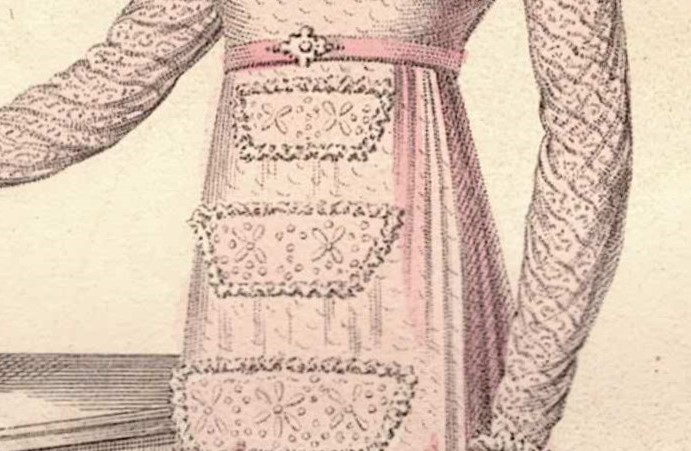
No. 1 - Evening Dress  An embroidered white crape, or fine India muslin frock, with long sleeves, and trimmed round the bottom with fine lace, set on full, worn over a blush colour satin or sarsnet slip; the frock ornamented down the front of the skirt with beads and lace in the Egyptian style. Parisian mob, worn unfastened, of puckered pink, and white crape over pink satin. Small pink satin tippet, with full plaiting of lace. Cestus of pale pink, confined by a clasp of pearl. Pink satin slippers, with white rosettes. The jewellery worn with this dress is the shaded cornelian, or large pearls.


Reading the description, I think this might, in many ways, have been a rather pretty dress: picture very, very fine, sheer white embroidered muslin over a pale pink underdress, so that as the wearer moved, your attention might be drawn by the embroidery one minute, and by the color the next. The oblong panels “in the Egyptian style” (and I’d love to know what makes them particularly ‘Egyptian’) aren’t very attractive by modern standards, though, nor is the pink satin “tippet”, or scarf around the shoulders, unless it drapes in an interesting way or offers some other visual interest in the back. A cestus is a belt; what's noteworthy here is that it appears almost at the natural waist, rather than up under the bust.


The hat—a “Parisian mob” (and now all I can think of is A Tale of Two Cities!) is "interesting" as well—not the mental picture I have of a mob cap, but more almost like a pair of kerchiefs.


All in all, not one of La Belle Assemblée’s more noteworthy efforts, but it has its charms. What do you think?

Tuesday, December 14, 2021

Hello, Sunshine!

We’re only a week or so away from the Winter Solstice here in the northern hemisphere, when the days are shortest and the nights longest. The lack of sunlight can be hard…which is why I thought this fashion print from La Belle Assemblée would be just the thing to brighten the day.

I mean, YELLOW! 


This is an Evening Dress from February 1812; the British know something about gloomy winters, so I can imagine this dress would have brightened things up then just as much as it does now.

The description reads, No. 1.—Evening Costume  An amber crape dress over white sarsnet, trimmed with pearls or white beads, with a demi-train; a light short jacket, rather scanty, with two separate fancy folds, depending about three quarters down the front of the skirt, forming in appearance a kind of Sicilian tunic, and trimmed down each division, like the bottom of the dress, with a single row of pearls: short sleeves, not very high above the elbow, fitting close to the arm, and ornamented at the top with distinct points of satin, the same color as the dress, relieved by pearls; two rows of the same costly material or of beads, according as the robe is ornamented, form a girdle. The hair is dressed in the antique Roman style, with tresses brought together and confined at the back of the head, terminating either in ringlets or in two light knots; a braid of plaited hair drawn over a demi-turban formed of plain amber satin, with an elegantly embroidered stripe of white satin, separated by rows of pearl, and a superb sprig of pearls in front. Necklace of one single row of large pearls; with earrings of the Maltese fashion to correspond. Ridicule aux getons of slate colour, shot with pink; the firm base secured by a covering of pink stamped velvet, with pink tassels. Italian slippers of amber, fringed with silver, or ornamented round the ankle with a row of pearls or beads. White kid gloves. –This elegant dress owes its invention to the tasteful fancy of Mrs. Schabner, of Tavistock-street.

To me, it’s not just the color that makes this dress stand out: it’s the extravagant simplicity of it all. There’s little fuss or bother to this dress, stylistically, though the little peplum at the back of the waist is a nice touch. But the materials say otherwise: though a simple illustration can’t depict it, picture the contrast of the textures of the “crape” and the satin on that sleeve, even though they match in color.


And the pearls! I would hope that beads were used at least for the hem, because that is an enormous number of pearls (which weren’t at that time as common as they are in this day of extensive pearl culturing)…not to mention the likelihood of pearls being trod upon and crushed. Eek!

The headdress, curiously, is the busiest part of this ensemble, with its “elegantly embroidered” band and the ringlets and braid inspired by ancient Roman styles seen in statuary: don't forget that a great deal of fashion in both clothes and home furnishings were heavily influenced by the ancient world.

Also outstanding, though not in a positive sense, is the reticule or “ridicule”; gray and pink do not harmonize well with the yellow in my opinion, but tastes do change…


What do you think of this dress? I hope it brightened your day—in all senses of the word! And as Regina and I will be taking a couple of weeks off over the holidays to spend time with our families, I will also take this opportunity to wish our NineteenTeen readers many, many bright days over the rest of this year and into 2022.

Tuesday, January 12, 2021

Green Sleeves


…and green bodice, and green skirt… 😉


I love this Evening Dress from the April 1809 edition of La Belle Assemblée (which, curiously, is puffing a dress from the previous month rather than a future one—a mistake?) It’s so easy to assume that formal dresses in this era were all in white or pastels...and maybe they were, for young debutantes in their first or second season. But here is glorious, vibrant proof that they weren’t all so insipid.

The original description reads:

No. 2.—EVENING DRESS.  A round robe of green velvet, with antique boddice, and stomacher of blended gold and velvet. Short full sleeve, ornamented à-la-Spanish, to correspond. A plain gold lace placed round the bottom just above the hem, and also round the waist. A shade of Paris net across the back, edged with gold, and fastened on the shoulders with a gold or emerald brooch. A deep antique lace laid flat round the bosom and back, with a drawn tucker above. Hair confined in a gold caul behind and in full curls in front, with the Cleopatra diadem of emeralds and gold. Earrings, necklace, bracelets, and armlets to correspond. Shoes, amber or white satin. Fan of carved ivory. An occasional scarf, or shawl, of cream-coloured or white French silk, with gold or coloured embroidered body.


So…green velvet! Yum! Double yum on the elegant restraint in the trim, as well. I definitely see what is meant by an “antique boddice”—the bodice on this dress is reminiscent of an early 17th century dress, with van dyke lace pointy stomacher and all. The diadem and the “hair confined in a gold caul” also reminds me of the ancient Mediterranean style known as a Phrygian cap. And while it’s not easy to see in the print, I’m tickled by the “shade of Paris net” fastened on the shoulders—rather like a superhero cape!

And one more note: do you know what the item at the left of the image is? I’ll give you a bit of a hint: we talked about them some time ago, right here on NineteenTeen (though this is certainly a fancier version of one than I’ve seen before.)

What do you think of this dress? I know I’m in love with it.

Tuesday, June 30, 2020

Just Because


I think it’s time for some fashionable eye candy, courtesy of La Belle Assemblée. There’s something very relaxing about contemplating many of these prints, and this one, from the January 1810 issue showing fashions for February, is particularly pretty:


Evening Dress

A jacket of pale buff Merino cloth, with antique stomacher, richly embroidered in green chenille, finished with silk tassels; a fine India muslin petticoat and train, embroidered round the bottom with a trimming to correspond, and worn over a white satin slip. A Spanish cap of cloth and green satin, of the same colour as the dress, ornamented with a long green drooping ostrich feather, border similar to the dress. A French shawl of ruby coloured silk. Emerald necklace and earrings. Green kid slippers with silver roses. Limerick gloves. The hair on the forehead in short ringlets, with a long Theresa curl flowing gracefully over the left shoulder.

I’m fascinated by the construction of the “jacket” : it’s very abbreviated, with the front consisting of the stomacher (the decorated piece over the bust and tummy) and a strappy belt. I’ll bet it would have been a pain in the you-know-what to wear—probably shifting all over the place unless one sat or stood very still (or had pinned it into place!)—but it’s quite charming in an illustration (and I like the sneaky way the artist gave us the peplum-ish back view on the lady descending the stairs at right!) The embroidery around the hem of the muslin petticoat completes it nicely. And the tassels—I love tassels. 😍  And then there are her gloves: we learned about tan Limerick glovesmade of exquisitely fine calfskinin the Accessories series.

The hat is quite a confection itself, with the matching chenille embroidery, that ostrich feather (!), and the insouciant long curl “flowing gracefully” over one shoulder; evidently one should not have cut one’s hair into a fashionable crop to sport this look. The image does not include the “emerald necklace and earrings” suggested in the text, but I kind of like the jaunty gold hoops and big pearl necklace—combined with the hat, they have an almost piratical air.  And of course, even though the Peninsular War raged on, a “French shawl” was still acceptable, because fashion.

What do you think of this decorative, if improbable, ensemble? 

And just a quick note: Regina and I will be taking a few days off to enjoy the Independence Day holiday. We hope you'll enjoy your holiday as well!