
Showing posts with label governesses. Show all posts

Tuesday, January 10, 2023

The Sad State of Governesses in 1818, According to “An Observer”

In my upcoming book, Never Beguile a Bodyguard, the heroine is a governess forced by a family scandal to seek protection from an unlikely source. As I was researching (lovely, lovely research) for the story, I ran across an article from the May 1818 European Magazine and London Review. Some of the insights were priceless, so I thought I’d share them with you!

Written by someone identified only as “An Observer,” the title of the piece is “Thoughts on the Present State of Governesses.” It seems the profession, once employed solely by those with wealth and privilege, had proliferated, thanks to the growing middle class. As a result, the status of being a governess appears to have plummeted.

“Let us consider the qualifications and probable fate of the modern governess. She enters (as a necessary recommendation) some fashionable establishment… and she vies with her schoolmates in dress and their indulgences at theatres or splendid parties; to which introductions are the chief care of the modern governess. If, which is equally probable, she springs from the lowest class, she becomes during a few miserable years an apprentice or half-boarder; and combined with the envy excited by her superiors, learns the meanness and stratagems required to gain their favour. Here, if the business of adjusting their frocks and curls allows time, she may possibly learn to paint shells and Ottomans, net purses and empty them at cards, to play a sonata without understanding a single rudiment of its composition, copy the attitudes of a favorite singer, and waltz. At eighteen or possibly sooner she undertakes the tuition of a numerous family or of one favourite child.”

Doesn’t sound like much fun, does it?
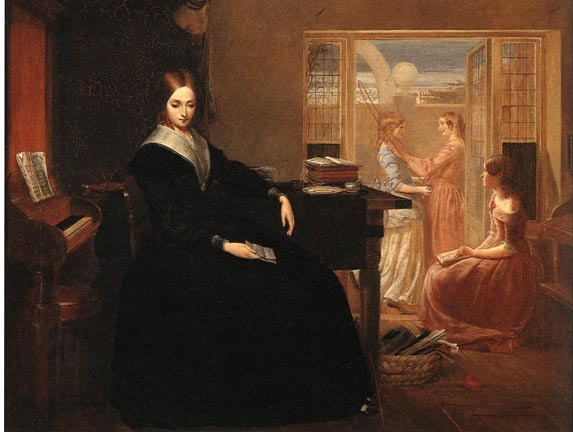

The Observer paints an equally dire future, when everyone from the chamber maid to the child’s mother and siblings view her with scorn and expose her to “a thousand grievances, which have no refuge except silence, and no worldly remuneration but a stipend of the most uncertain kind.”

Well!

I have no doubt some governesses were cherished companions who received a thankful pension when their work was done. The Observer goes on to urge the creation of a plan to aid those who are not so fortunate:

  1. Those governesses who are well off should put some of their money in a fund not only for their future upkeep but for those not so well off.
  2. Mothers who employ governesses should pay for their pensions or at least stop asking them to dress fashionably so that they can put some money aside themselves.
  3. The government should build almshouses for “decayed governesses” and give them charge of female orphans currently in the poor house to teach them, perhaps one on one.

At a time when unions were just beginning to be conceived, these are novel concepts.

Governesses of the world, unite!

Tuesday, June 25, 2019

The Universal Advertising Sheet, Part 3


Let’s see what interesting shreds of personal and social history we can read about, courtesy this week of the Monthly Compendium of Literary, Fashionable, and Domestic Advertisements from the March 1, 1807 edition of La Belle Assemblée...

First, another Jane Eyre moment:


EDUCATION.
The attention of Parents and Guardians is requested. A Lady is desirous of taking ONLY TWO young ladies, from three to eight years of age, to instruct with every comfort and advantage of paternal Education; she does not propose giving any Holidays –Letters (post paid) addressed to A. Z. Post Office, Laytonstone, Essex, will be duly answered.

Well. I said this sounded like a Jane Eyre moment...but from whose point of view? No holidays? That seems a tad harsh for students of pre-school and elementary age, I think; A.Z. was quite the taskmistress.

These advertising supplements are full of ads for hair products (in this issue, there’s one for Russia Oil, for the growth of hair...but here’s one for a stylist, which I found interesting. Cropped hair was still quite fashionable, and would be yet for another few years:

VICKERY
Ladies’ Head Dress Maker and Hair Cutter, No. 6, Tavistock-street, Covent-garden,
has the honour to acquaint the Nobility and Gentry, that he has completed an assortment of elegant Head-Dresses; that need only to be seen to be approved of.
The Royal Crop is a specimen of superior elegance.
Ladies that honour him with their commands, will please to say, if for young, middle aged, or elderly Ladies. The price from two to five Guineas.
Gentlemen’s Crops made to a perfection in fitness very rarely to be met with, at two Guineas and a half.
The Nobility and Gentry’s hair cut with every attention to style and the improvement of their hair.
Ladies and Gentlemen will please to give their servants very particular directions to his house, as Vickery’s name is placed very conspicuously at shops in the neighborhood, with which he has no connection.
Vickery’s establishment, formerly of Bond-street, Bishopsgate-street, and Cheapside, (but now of Tavistock-street only) upwards of thirty years standing.

I suppose that if one was using too much Russia Oil, Mr. Vickery’s services would be frequently required... ;)

Now, this one is the most interesting of the issue:

LADIES.
The delicate and restrained condition which custom imposes on females, subjects them to great dis-advantages, —Mrs. Morris offers to remove them. Ladies or Gentlemen who have formed predilections may be assisted in obtaining the objects of their affection; and those who are unengaged may be immediately introduced to suitable persons; but she cannot assist applicants in any marriage if their characters are not irreproachable, and their fortunes considerable and independent. She will not admit any others.
Apply or address (post paid) at the Bow-window, next door to Margaret Chapel, Margaret-street, Cavendish-square. Ladies who require it, may be waited upon at their own houses.

Oh, my writer’s mind is teeming! Was Mrs. Morris a marriage broker? Did she have the Regency equivalent of an overstuffed Rolodex because she was perhaps a lady of once-high social status now fallen on hard times? Was she in the business of match-making for noveaux riches cits looking to marry into a higher social class?  What do you think?

Tuesday, April 23, 2019

The Universal Advertising Sheet, Part 2


Back by popular demand! Let’s have another look at the advertisements posted in editions of La Belle Assemblée from April  and July 1813—two hundred and six years ago.

This one was interesting:

A Lady
Who has been accustomed to the Private Tuition of young Ladies, wishes for a situation as GOVERNESS in a family of consequence. She is competent to teach the French and English languages Grammatically, Geography, Writing, and Arithmetic; also to superintend the practice of young Pupils in the absence of the Master. Should any genteel family who are going to the East Indies want an Instructress for their children, the advertiser would be ready to treat with them on liberal terms. The most respectable references will be given.—Letters, post-paid, and addressed to M. B. and left at the General Post-office, will be attended to immediately.

N.B. The advertiser would have no objection to engage herself as companion to any Lady, who would render such a situation comfortable.

Oh, I do love the advertisements like these! Jane Eyre immediately comes to mind, doesn’t it? What I find interesting about this one is that M.B. seems quite willing to travel all the way to India—she was certainly no shrinking violet! I wonder if she found employment with a family who were indeed going there...and did she perhaps meet a handsome, up-and-coming East India officer there?  The plot bunnies are a-hopping...

On a related note...from the July advertisement supplement:

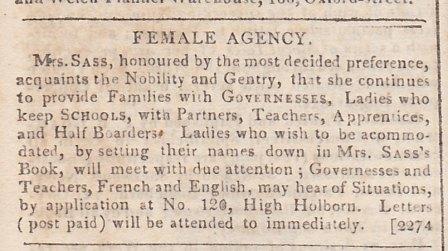
FEMALE AGENCY.

MRS. SASS, honoured by the most decided preference, acquaints the Nobility and Gentry, that she continues to provide Families with GOVERNESSES, Ladies who keep SCHOOLS, with Partners, Teachers, Apprentices, and Half Boarders. Ladies who wish to be accommodated, by setting their names down in MRS. SASS’S Book, will meet with due attention; Governesses and Teachers, French and English, may hear of Situations, by application at No. 120, High Holborn. Letters (post paid) will be attended to immediately.

Maybe our M.B. above should have paid a call on Mrs. Sass and her book. And by the way, here is another respectable profession for a woman—employment agent!

What’s even more interesting is another ad placed in the same issue:

TO THE LADIES. HENRY SASS, corner of King’s-street, Holborn, begs leave to acquaint his Friends and the Ladies in general that he has a large assortment of DRAWINGS, consisting of Figures, &c., on SILK, for Lambs’ Wool Embroidery, ready for sale; also Hearth Rugs, Turkish Cushions, Urn Stands, Table Matts, with Patterns set, and every material for the different Works. Pieces ready worked, and Paintings, on the most reasonable terms, for ready money.—Ladies taught all the different works.

A young Lady wanted as an Apprentice.

***Drawing taught in all its different branches.—Also Painting on China, Glass, and Velvet, in a superior style.—Schools attended.

Ooh, lots to unpack here. First, I assume Henry Sass and Mrs. Sass are related—married? In laws? Second...why hasn’t Henry asked Mrs. Sass to find him a young Lady Apprentice? And third...here is the Regency London equivalent of A.C. Moore—a craft shop! The painting on velvet caught my eye—would they maybe have pictures of Prinny or Lord Byron painted on velvet, instead of Elvis? ;) Lastly, Henry evidently was willing to teach at  schools; a useful service for smaller schools who could not afford a full time art master, or did not want to have one living on the premises along with a bunch of impressionable girls.

What struck you about this week’s ads?

Friday, April 27, 2018

What’s a (Poor) Lady to Do?


We have, over the years, discussed the activities and challenges of the young lady of the Regency period, as well as her somewhat limited career choices. Novels abound of gently reared ladies having to make do when circumstances conspire against them. My Fortune’s Brides series features gentlewomen down on their luck, so I’ve been doing some pondering as to what the actual choices were for such women, particularly those who are not looking to marry and would prefer not to lower her status terribly. Here are a few ideas:

  • Governess—The old standby. If you’ve survived a Season or two, if you learned some history and science along the way, perhaps another language such as French, you probably have what it takes to teach other young ladies. A slight variation on this would be a finishing school teacher, but those were somewhat rare in the Regency (even though I’ve given my heroines that profession in at least two stories 😊).
  • Nanny—I see this frequently, and I’ve certainly used it myself, but I haven’t found too many contemporary sources claiming a young lady who had been raised for finer things took it upon herself to become a nanny. Still, if you had a motherly instinct, if you were raised with many brothers and sisters, and if you were willing to be seen as a servant, you might be able to handle this position.
  • Housekeeper for a relative—this is a difficult one. Technically, a housekeeper is a servant position, although higher on the servant food chain. But if you served a relative who was willing to treat you more like family so that the role was more of chatelaine, this one might do.
  • Lady’s maid—another difficult one. Again, you are a servant, and chances are you won’t be mixing socially with the upper crust. But if you are a dab hand at sewing, know your way around a cosmetic jar, and have a good ear, you could do well here.
  • Companion—another old standby. Families seem to have a plethora of aged female relations who require someone to fetch and carry, to share confidences, to help with daily care and entertainment. And there’s always the off chance that said relative will be kind in her will.
  • Assistant—I’ll be using this one in my fourth Fortune’s Brides series, but it is a challenging one as well. Secretaries and personal attaches were generally men serving men. A lady really cannot spend time alone with a gentleman. But say a prominent lady, who doesn’t want to claim her age requires a companion or needs specialized skills? Perhaps.
  • Sponsored artist—Sometimes your gift could be your livelihood. Wealthy patrons might sponsor a painter, a musician, or a composer. Most of these sponsored positions went to men, and it would look odd for a lady to be sponsored by a gentleman. But, under the right circumstances, I could see a woman sponsoring another woman.
So, what do you think? Have you heard of other ways for an impoverished young lady to keep her head and her dignity above water?

Monday, November 22, 2010

Governesses, Part 2: Educating Lady Agatha

Lady Agatha Crumpwhistle is now nearly five. Her devoted nurse, Mrs. Hoggett, has taught her to not make messes and misbehave and to be respectful of her elders, but there’s a new baby in the Earl of Crumpet’s nursery requiring her attention and it’s time little Agatha began more formal education.

So the Countess of Crumpet moves into action: she lets friends know she’s in the market for a governess, in case anyone has a recommendation—governesses do move from family to family as their charges outgrow them or if they want a change. She also reads the newspapers and magazines; governesses in search of positions often place ads in the papers with brief lists of their qualifications. And if those don’t work, she knows she can write to one of many reputable employment agencies in London. Fortunately, a friend comes through: the daughter of an old acquaintance, a well-brought-up daughter of a vicar, is looking for her first position as a governess and might just fit the bill. The Countess is happy to have her problem solved and writes to the girl.

Little Lady Agatha is not quite sure what to think about this turn of events. Why can't she just stay in the nursery with Hoggy? When her older cousins came to visit last month, Diana told her all manner of dreadful things that governesses might do: keep her tied to a board all morning to improve her posture, or pinch her if she got her French verbs wrong, or, almost as bad, not take care when teaching her so that she'd grow up quite ignorant. But Susan said they could also be very nice and teach her how to paint pretty pictures and play the piano and have grown-up manners so that she might have tea with Mama more often. Maybe this governess business won't be so bad...

In a small country vicarage in Norfolk, Miss Viola Fernall is packing her trunk with her few sober dresses and sturdy calico underclothes, her books and paints, her workbasket, and a few mementos of home. The vicarage is too small and her father’s income too meagre to permit her to stay at home as daughter of the house; now that she’s twenty-two and no potential husbands have appeared on her horizon, it’s time for her to make her own way in the world. She leaves at dawn tomorrow to take up a post as governess to the Earl of Crumpet's young daughter.

Despite her family’s poverty Papa, as a vicar, is considered a gentleman, which makes her a gentleman’s daughter. There aren’t many avenues of employment open to gentlemen’s daughters…at least not if they want to remain respectable. There’s being a companion, or there’s governessing…and Viola would rather teach small children than cater to the whims of an invalid or crotchety old dowager. And the salary is quite respectable at ₤35 per year; Lady Hunt, Mama’s old school friend, must have written her a very good ‘character’ (recommendation).

Viola’s education is not outstanding, but it’s adequate: she writes a fine hand and can speak correct if nasal French and a bit of Italian. Her playing upon the piano is just passable, but in needlework and in watercolor painting she’s quite above average, having a good eye for color. Anyway, the most important part of her job is to make sure her pupil, little Lady Agatha, learns to comport herself as befits her station in life: to speak gently and quietly, to carry herself well, to be, in short, a lady.

Viola sighs and contemplates the fact that once she arrives at Crumpet Hall, life will not be easy. She’s about to enter a twilight world in which she is of higher social status than the servants, but not quite the equal of her employers. She might become almost friends with them, or find herself treated with cold civility (or even rudeness). She might be invited to dine with the family when no guests were present or participate in less formal entertainments…or be expected to eat her dinner alone each night from a tray in her bedroom. If her pupil is sweet and well-behaved, life might not be so bad…but if she’s spoiled and willful, it might be dreadful. Her room might be comfortable and airy, or small and furnished with battered cast-offs; she might have a free afternoon each week and even a full day off each fortnight (two weeks)...or everyone might forget that even a governess needs a little time to herself. If the Crumpet family proves to be a large one, she could be employed for the next twenty years...or find herself looking for a new position in six weeks, if she's not thought suitable.

She sighs again, and closes her trunk.

Any specific questions about the lives of governesses and their pupils? Ask away! And for our American readers, have a warm and wonderful Thanksgiving!

Tuesday, November 16, 2010

Governesses, Part 1: The Original Home-Schoolers

They’re a stock figure in fiction in and about the 19th century, from Charlotte Bronte to Georgette Heyer, who populated many of her stories with ludicrous examples of them. And though in books they might be either the villainess or the heroine, in real life their lives were rarely so interesting. I am talking, of course, about that peculiarly 19th century creature, the governess.

But before we jump in, a little background. Girls’ education, alas, was not a priority in the 19th century. An upper-class young lady was expected to grow up to be an ornament to society and a credit to her future husband…which meant learning how to be a good hostess, wife, and mother. Period. And so most education for girls of the aristocracy and gentry was toward that end: they learned the basics, of course—reading, elegant handwriting (though spelling was optional), simple mathematics (enough to be able to look over household accounts and dressmakers’ bills and make sure they were in order). Beyond that, a knowledge of foreign languages was admired—French definitely (how else could you write out menus at dinner parties?), perhaps Italian if one was inclined to be artsy or German if one had pretensions to intellectualism. No Latin or Greek—those were for boys heading to Oxford or Cambridge. A smattering of knowledge of geography, history, and literature was helpful because it enhanced one’s ability to make conversation. And then of course there were the arts: a girl should be able to play the piano and sing, to dance without knocking her partner over, to do fancy needlework and paint watercolors or other crafty endeavors. Finally, a girl needed to learn how to manage a house (or several!), hire and handle servants, and keep her future husband and family happy.
School was not where most daughters of wealthy families got this type of education in the 19th century. Though girls’ schools existed, they were frequently only attended by girls of the middle class or those whose parents were away—tropical climes like India were thought to be very bad for children, so diplomatic, military, and merchant families sent their offspring back to England. Later in the century in particular there were ‘finishing schools’ where young ladies might receive a final polish to their manners and dancing and French accents before coming out (Swiss ones were the most admired). But in general, school was not an option. So how did our young ladies of gentle birth learn?

At home, of course. Some mothers had the time, inclination, and knowledge to teach their daughters, but others were too busy managing estates or supporting their husbands careers and interests…and that was where governesses come in.

Next week: Governesses, Part 2: Educating Lady Agatha