Showing posts with label guest blogger. Show all posts

Tuesday, August 29, 2023

Guest Blogger Amanda Cabot Explains the Horrors of 19th Century Medicine

Excited to have with us bestselling historical romance author, Amanda Cabot! You may have seen my glowing review for the first book in her series, Secrets of Sweetwater Crossing, After the Shadows. Amanda has learned a thing or two about medicine in the nineteenth century. I'll let her share more.

------

If you’re one of my longtime readers, you may have wondered why a number of my protagonists are involved in the medical profession. The answer is simple: I’m fascinated – and yes, horrified – by the state of medicine in the 19th century, particularly the practice of heroic medicine.

Heroic medicine. That sounds like a good thing, doesn’t it? After all, the hero of a novel is a good guy, so heroic medicine must be good. The reality is, it was anything but good and was in fact considered to be one of the contributing factors in George Washington’s death. Yes, trusted physicians’ attempts to heal him may have actually hastened the death of the father of the American nation. Now that I’ve got your attention, let’s take a step back and define “heroic” so we can understand why that might have happened.

My dictionary has a number of definitions for “heroic” including “exhibiting or marked by courage or daring” and “supremely noble and self-sacrificing.” Those could apply to the heroes we all know and love. But there’s another meaning that’s less benign: “of great intensity, extreme, drastic.” That’s where heroic medicine comes into play.

In the eighteenth century and well into the nineteenth, physicians believed that the body had four humors – blood, phlegm, yellow bile, and black bile – and that disease occurred when one or more of them was out of balance. The goal of all medicine was to restore the balance.

How did they do that? If you’re squeamish, you might want to stop reading right now. There were five elements to heroic medicine: bleeding, purging, vomiting, sweating, and blistering. Any one of those sounds gruesome to me, but when you combine them with the fact that this was heroic in the sense of extreme and drastic, you realize that the cure might well have been worse than the illness itself.

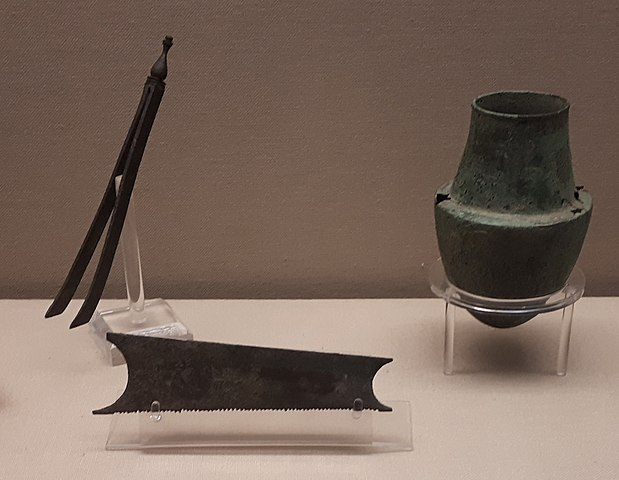
Bleeding was the most commonly used technique, and although it had lost popularity in the eastern United States by 1860, it was still used on the frontier. As you can guess from the name, the goal was to reduce the volume of blood either by applying leeches (shudder) or by cutting veins and letting large quantities of blood drain from the body (perhaps into the bleeding cup in the picture). 
Next came purging, which consisted of giving the victim … er, the patient … large quantities of calomel or jalap. You can guess what happened next.

If that didn’t work, the physician might try to induce vomiting, again by giving the patient ipecac and tartar emetics. In large quantities. Once again, I’m shuddering.

Sweating sounds as if it would be the most innocuous of the heroic procedures until you learn that it was induced by giving the patient Dover’s Powder, a concoction of opium, ipecac, and lactose, which served as a diaphoretic. (I couldn’t resist including that word, since it was a new one for me. As you may have guessed from the context, a diaphoretic is a substance that induces sweating.) I’m still shaking my head over the fact that opium was used so often, although considering the pain that must have been involved in these procedures, it was probably the kindest thing a doctor could offer a patient.

Lastly comes blistering. Hot plasters were placed on the patient’s body with the goal of producing blisters that could be lanced and drained. And, of course, since this was heroic medicine, it was done on a large scale.

This was the world of medicine well into the nineteenth century. Even though new techniques were being introduced, there were still old-timers who believed in the value of heroic medicine … or no medical treatment at all. Add that to the fact that many residents – both men and women – didn’t believe that women should be doctors, and you have the dilemma that confronts Louisa, the heroine of the second of the Secrets of Sweetwater Crossing books. She’s a midwife and doctor-in-training facing more than her share of challenges. Louisa’s story, Against the Wind, is scheduled to release on October 3 and is available for preorder at all the usual places.

Before I end this, I have a question for you. How do you think people will regard 21st century medical practices 150 years from now? Will they shudder when they read about some of our treatments? If yes, which ones do you think will disturb them the most?

Author Bio

Amanda Cabot’s dream of selling a book before her thirtieth birthday came true, and she’s now the author of more than forty novels as well as eight novellas, four nonfiction books, and what she describes as enough technical articles to cure insomnia in a medium-sized city. Her stories have appeared on the CBA and ECPA bestseller lists, have garnered starred reviews from Publishers Weekly and Library Journal, were a Woman’s World Book Club selection, and have been finalists for the ACFW Carol, the HOLT Medallion, and the Booksellers Best awards.

For more information about Against the Wind and buying links, click here. 

And to sign up for Amanda’s monthly newsletter and receive a special gift, click here. 

Tuesday, November 29, 2022

Guest Post: Concerts on the Rock by Alissa Baxter

I had the delight of reading an advance copy of Alissa Baxter's February 2023 book, so I happily invited her to share some of her research for her series on intrepid ladies with us at Nineteen Teen. Enjoy! Regina

I set the second book in my Linfield Ladies series, The Viscount’s Lady Novelist, partly on an estate near Bristol. It was fascinating to research the area as it is not a popular setting in Regency romances. During the course of my research, I found out about the concerts which once were held at St Vincent’s Rock. Here is an excerpt from Chilcott’s Descriptive History of Bristol, Ancient and Modern, Or, A Guide to Bristol, Clifton and the Hotwells by John Chilcott:

“To an observer on the Clifton side of the river, the opposite woods in summer present a most charming appearance: they contain almost every forest tree indigenous to this country; among which the broad-leaved sycamore, the majestic oak, the sombre ewe, the lofty elm, the graceful mountain ash, with many others, are seen blending their hues together, and forming a scene of foliage that for variety and exuberance is scarcely to be equalled. Here it is not uncommon, during fine summer evenings, for a band of musicians to assemble, at which time the opposite side is covered with an attentive crowd. The soft sounds wafted across the water are truly enchanting!”


And here's how it played out in The Viscount’s Lady Novelist:


As Oliver made his way across to her, strains of music began to waft across the river, indicating the musicians had begun their rehearsal. “Have you attended such a concert before, Miss Linfield?”

“Yes, indeed, my lord. You will find it quite remarkable.” She pointed in the direction of the trees. “Inside the recesses of that wood is a cave. On fine summer evenings, a band of musicians assembles within to play by torchlight. The music reverberates over the river in the most delightful way.”

The crowd hushed as the band performed their first piece. The notes carried across the water, multiplied by the endless echoes of the rocks.

“It’s truly enchanting!” Harriet’s glanced up at him, her expression rapt. “Do you not think so, my lord?”

He inclined his head. The venue and the talented musicians provided a unique experience for any music lover. An attentive crowd of men and women stood quietly amongst the rocks while the musicians played a range of melodies, from popular folk songs to more formally arranged pieces by Handel and Vivaldi.

As the concert drew to a close, Oliver murmured, “We are like so many Thracians, but Orpheus never performed so beautifully.”

Harriet smiled. “Indeed. Orpheus may have been able to charm all living things and even stones with his music, but our musicians must surpass even him in the sweetness of their playing.”

You can find The Viscount's Lady Novelist at fine online retailers such as

Amazon US 

Barnes and Noble 

Alissa Baxter wrote her first Regency romance during her long university holidays. After travelling the world, she settled down to write her second Regency novel, which was inspired by her time living on a country estate in England. Alissa then published two chick lit novels, The Truth About Clicking Send and Receive (previously published as Send and Receive) and The Truth About Cats and Bees (previously published as The Blog Affair). Many years later, Alissa returned to her favourite period with her Linfield Ladies Series, a trio of Regency romances that feature women in trend-setting roles who fall in love with men who embrace their trailblazing ways... at least eventually. Alissa currently lives in Johannesburg with her husband and two sons. She is a member of Regency Fiction Writers. Her website is https://www.alissabaxter.com/.

Tuesday, August 30, 2022

Guest Blogger Barbara Monajem on Why the Caricature is Mightier than the Sword

We’re welcoming author Barbara Monajem as today’s guest blogger. I fell in love with her Lady Rosamund Regency-set mysteries because she takes such care to stay true to the history and culture of the times…and writes a darn good story!  An important part of the Lady Rosamund stories are caricatures—basically the political cartoons of the 19th century, though they went far beyond politics to comment on many different aspects of society and life as well. I’ll let Barbara take it from there…

* * * * *

Do you read the tabloids at the supermarket? I don’t, but I can’t help but notice the photos of celebs and royals. Often, the tabloids take a grimace and blow it up into a feud, doctoring the photos to show people screaming at one another. Horrid, isn’t it? And so unkind.

Believe it or not, this is nothing new. The Regency equivalent of the tabloid photographer was the caricaturist. Caricatures were printed from etchings or engravings and distributed all over England. They ranged from social and political commentary to downright scandal. Wealthy patrons might have subscriptions, while others purchased copies at stationers or print shops. Even illiterates benefited from the entertaining spin on current affairs, as the prints were displayed in shop windows, and a literate onlooker might helpfully read the captions aloud.


My favorite of the well-known caricaturists is James Gillray. He was relentless in his satires of the royal family, in particular the Prince of Wales (who, one has to admit, was really asking for it; he wasn’t at all well-behaved). Here is one where the King, Queen and Prince are all eating gold coins, enriching their coffers at the expense of the people. But while the King and Queen hold onto their money in craws attached to their necks, the Prince’s craw is empty, for he wasted vast sums.

Gillray drew a very famous caricature imagining what it would be like if the royal family were ousted, like in France. This enraged the Prince of Wales so much that he paid to have the print suppressed and the original plate destroyed (it wasn’t). Gillray also satirized Napoleon, whose outraged reaction was much like the Prince’s.


Gillray also depicted current issues, such as controversy over the cowpox vaccination to prevent smallpox. His caricature shows vaccinated people with little cows growing out of their arms, heads, bums, etc. Doesn’t sound too different from the vaccine controversies of today!


He also satirized various excesses of fashion, such as tight lacing or preposterously high ostrich feathers. Here is one suggesting that the current style of gown was too revealing.


Other famous caricaturists were Isaac Cruikshank and his sons, Isaac Robert and George. This 1850 drawing by George Cruikshank satirizes the crinoline. Isaac Robert Cruikshank caricatured dandies and their absurdly high collars/cravats.


Lastly, another of my favorites is Thomas Rowlandson. I like this caricature of the Bluestockings – intellectual or literary ladies – who are violently brawling with one another. It probably implies that women are incapable of intellectual pursuits, and that those who attempt to do so are unladylike, and squabble like women of ill repute. But to me it also suggests that when it comes to allowing petty differences to escalate into violence, men and women can be much the same. I suppose it depends on who is interpreting it!  

I guess all this explains why I chose to make a caricaturist one of the main characters in my Lady Rosamund mysteries. It’s just so much fun imagining the spin a clever caricaturist could put on anything he chose. He could comment on the follies of society, poke fun at the rich and famous, and even invent a scandal for the fun of it. (And no one gets harmed in real life, because this is fiction.)

* * * * *

In addition to the Lady Rosamund series, USA Today bestselling author Barbara Monajem is the author of more than thirty novels and novellas. She wrote her first story at eight years old about apple tree gnomes. After publishing a middle-grade fantasy, she settled on historical mysteries and romances with intrepid heroines and long-suffering heroes (or vice versa). Sometimes there’s a bit of fantasy mixed in, because she wants to avoid reality as much as possible. She lives near Atlanta with an ever-shifting population of relatives, friends, and feline strays. Learn more at www.BarbaraMonajem.com.