

Showing posts with label medicine. Show all posts

Tuesday, August 29, 2023

Guest Blogger Amanda Cabot Explains the Horrors of 19th Century Medicine

Excited to have with us bestselling historical romance author, Amanda Cabot! You may have seen my glowing review for the first book in her series, Secrets of Sweetwater Crossing, After the Shadows. Amanda has learned a thing or two about medicine in the nineteenth century. I'll let her share more.

------

If you’re one of my longtime readers, you may have wondered why a number of my protagonists are involved in the medical profession. The answer is simple: I’m fascinated – and yes, horrified – by the state of medicine in the 19th century, particularly the practice of heroic medicine.

Heroic medicine. That sounds like a good thing, doesn’t it? After all, the hero of a novel is a good guy, so heroic medicine must be good. The reality is, it was anything but good and was in fact considered to be one of the contributing factors in George Washington’s death. Yes, trusted physicians’ attempts to heal him may have actually hastened the death of the father of the American nation. Now that I’ve got your attention, let’s take a step back and define “heroic” so we can understand why that might have happened.

My dictionary has a number of definitions for “heroic” including “exhibiting or marked by courage or daring” and “supremely noble and self-sacrificing.” Those could apply to the heroes we all know and love. But there’s another meaning that’s less benign: “of great intensity, extreme, drastic.” That’s where heroic medicine comes into play.

In the eighteenth century and well into the nineteenth, physicians believed that the body had four humors – blood, phlegm, yellow bile, and black bile – and that disease occurred when one or more of them was out of balance. The goal of all medicine was to restore the balance.

How did they do that? If you’re squeamish, you might want to stop reading right now. There were five elements to heroic medicine: bleeding, purging, vomiting, sweating, and blistering. Any one of those sounds gruesome to me, but when you combine them with the fact that this was heroic in the sense of extreme and drastic, you realize that the cure might well have been worse than the illness itself.

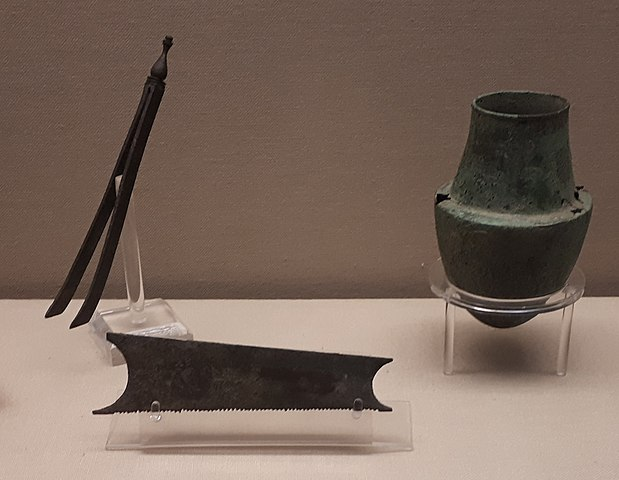
Bleeding was the most commonly used technique, and although it had lost popularity in the eastern United States by 1860, it was still used on the frontier. As you can guess from the name, the goal was to reduce the volume of blood either by applying leeches (shudder) or by cutting veins and letting large quantities of blood drain from the body (perhaps into the bleeding cup in the picture). 
Next came purging, which consisted of giving the victim … er, the patient … large quantities of calomel or jalap. You can guess what happened next.

If that didn’t work, the physician might try to induce vomiting, again by giving the patient ipecac and tartar emetics. In large quantities. Once again, I’m shuddering.

Sweating sounds as if it would be the most innocuous of the heroic procedures until you learn that it was induced by giving the patient Dover’s Powder, a concoction of opium, ipecac, and lactose, which served as a diaphoretic. (I couldn’t resist including that word, since it was a new one for me. As you may have guessed from the context, a diaphoretic is a substance that induces sweating.) I’m still shaking my head over the fact that opium was used so often, although considering the pain that must have been involved in these procedures, it was probably the kindest thing a doctor could offer a patient.

Lastly comes blistering. Hot plasters were placed on the patient’s body with the goal of producing blisters that could be lanced and drained. And, of course, since this was heroic medicine, it was done on a large scale.

This was the world of medicine well into the nineteenth century. Even though new techniques were being introduced, there were still old-timers who believed in the value of heroic medicine … or no medical treatment at all. Add that to the fact that many residents – both men and women – didn’t believe that women should be doctors, and you have the dilemma that confronts Louisa, the heroine of the second of the Secrets of Sweetwater Crossing books. She’s a midwife and doctor-in-training facing more than her share of challenges. Louisa’s story, Against the Wind, is scheduled to release on October 3 and is available for preorder at all the usual places.

Before I end this, I have a question for you. How do you think people will regard 21st century medical practices 150 years from now? Will they shudder when they read about some of our treatments? If yes, which ones do you think will disturb them the most?

Author Bio

Amanda Cabot’s dream of selling a book before her thirtieth birthday came true, and she’s now the author of more than forty novels as well as eight novellas, four nonfiction books, and what she describes as enough technical articles to cure insomnia in a medium-sized city. Her stories have appeared on the CBA and ECPA bestseller lists, have garnered starred reviews from Publishers Weekly and Library Journal, were a Woman’s World Book Club selection, and have been finalists for the ACFW Carol, the HOLT Medallion, and the Booksellers Best awards.

For more information about Against the Wind and buying links, click here. 

And to sign up for Amanda’s monthly newsletter and receive a special gift, click here. 

Friday, June 19, 2020

Don’t Go Near the Waters!


I must admit to some trepidation when I decided to make the hero of my upcoming release, The Artist’s Healer, a physician. Medicine and the medical profession aren’t subjects I delve into much today, so tackling them in the nineteenth century seemed daunting. But once again, I was delighted that my research (lovely, lovely research) turned up some wonderful source materials, including a treatise that was used to teach medicine during the early nineteenth century. My copy was the sixteenth edition, published in 1798 and authored by Dr. William Buchan, Fellow of the Royal College of Physicians, Edinburgh.

Dr. Buchan was something of a celebrity. His treatise was first published in 1769, and the last edition was published in 1871, decades after his death. It was translated into most European languages. The full title (and it’s a whopper!) is Domestic Medicine; Or, A Treatise on the Prevention and Cure of Diseases by Regimen and Simple Medicines, With an Appendix, Containing a Dispensatory for the Use of Private Practitioners. To which are Added, Observations on the Diet of the Common People Recommending a Method of Living Less Expensive, and More Conducive to Health, Than the Present. Phew!

But what tickled me most about the book was the entire chapter devoted to saltwater bathing and drinking mineral waters at a spa.

Dr. Buchman has a number of concerns about spas. “No part of the practice of medicine is of greater importance, or merits more the attention of the physician, as many lives are lost, and numbers ruin their health, by cold [saltwater] bathing, and the imprudent use of the mineral waters.”

According to Buchman, only a physician in residence at a spa will have occasion to both know the properties of the waters and to apply them to cure disease. When used improperly, he claims saltwater bathing can cause apoplexy, fever, and diseases that outlast any benefit. He thinks even less highly of warm water bathing but acknowledges that it is little used in Britain. (Personally, I wouldn’t brag about that!)

He does, however, believe that saltwater bathing is particularly useful for those living in populous cities, who “indulge in idleness and lead sedimentary lives.” He advises it for the nervous, which “includes a great number of the male and almost all of the female inhabitants of great cities.” Humph! He also discusses the practice of throwing cold water over a person coming out of a warm bath. “Though this may not injure a Russian peasant, we would not recommend it to the inhabitants of this country.”

He has more to say about drinking mineral waters. He recommends drinking a little over time, because too much too fast will cause a “purge.” (Anyone who has endured the preparations for a colonoscopy will understand fully.) He prescribes a half pint glass at bedtime and an hour before breakfast, dinner, and supper.

But my favorite recommendation? When one goes to a spa to drink the waters, it is best to relax, breathe the fresh air, stroll the shops, and enjoy the company. My hero physician, and the citizens of Grace-by-the-Sea, would agree.

Friday, February 7, 2020

In Which the Author Cobbles Together Tantalizing Snippets and Calls It a Blog Post

I have a cold. Not miserable. Yet. But I looked at what I had considered blogging about today and decided it was just too much to bear. Party for pity? Yes, please. One only. So, instead, I offer you some enticing tidbits sure to warm any fan of Regency-set fiction.

Author Regina Jeffers has an interesting post on her blog about letters during the Regency period, including information on franking (basically, using something to indicate you didn’t have to pay postage) and seals. 

Author Victoria Hinshaw has a fabulous post about Osterley Park on the Number One London blog. Osterley Park is the basis for Carrolton Park in Never Envy an Earl. The blog has awesome pictures!

And author Elaine Bach, on Caroline Warfield’s wonderful blog, shares the horrifying details about Regency-era medicine. 

I’m taking notes on that one. Book 3 of the Grace-by-the-Sea series features a hero who is the new spa physician. I found a great medical manual dating from the late 1700s, on Google Books. I can tell you, reading it is not for the faint of heart.

Makes a cold seem positively invigorating!

Monday, March 21, 2011

It’s Not That Easy Being Green

Sunday was the first day of spring! It was a very long and snowy winter here in the northeast—emphasis on the “snowy” part—and I for one am happy to see my snowdrops and crocuses poking up...except of course it just had to snow the day after I took that picture!

In the 19th century, it wasn't just the early spring bulbs that could show a hint of green. Young ladies also could take on a verdant tinge, if they were among the many sufferers of what was known as green sickness, also called chlorosis.

So what was it? In 1802 A.F.M. Willich, M.D. published a compendious 5-volume work called Domestic Encyclopedia; Or, A Dictionary Of Facts, And Useful Knowledge: Comprehending A Concise View Of The Latest Discoveries, Inventions, And Improvements, Chiefly Applicable To Rural And Domestic Economy; Together With Descriptions Of The Most Interesting Objects Of Nature And Art; The History Of Men And Animals, In A State Of Health Or Disease; And Practical Hints Respecting The Arts And Manufactures, Both Familiar And Commercial—quite a title, huh? His summary of green sickness calls it “a disorder which frequently attacks females after the age of puberty. It is attended by a depraved appetite and a desire to eat substances that are not food…the skin is pale and discoloured; the face sallow or greenish, but sometimes of a livid hue; there is a deficiency of blood in the veins; with a soft swelling of the whole body, especially the legs during the night; debility; palpitation; and a suppression of catamenia (menstruation).”

Yes, evidently, there was an epidemic among young women which made them turn slightly green and feel weak and exhausted. Fortunately, the good doctor was full of suggestions for treating this condition. For one thing, it was thought that marriage and childbearing provided the best cure; if that was not in the cards, then young women might try a nourishing diet with plenty of wine (but no spirits); moderate exercise, especially horseback riding, or a vigorous full-body rub with a warm flannel morning and evening, sleeping on mattresses rather than on feather-beds; early rising; and cheerful company. In addition, it was thought valuable to “keep the bowels open”, to wear worsted stockings rather than silk or cotton ones, and, as a last resort, to bathe on alternate days in tepid water, if the patient was strong enough to withstand such treatment. A medical professional might be called upon to give patient with severe cases doses of “dephlogisticated air” or oxygen, which would give almost immediate relief.

Sounds dire, doesn’t it?

So what, really, was green sickness? It wasn’t until the 1930s that medicine realized that it was actually a form of anemia—hardly surprising that young women entering puberty should be especially prone to it, then. Interestingly, a physician writing nearly two hundred years before our Dr. Willich also described green sickness in similar terms, and had his own cure for it: iron!

Tuesday, July 28, 2009

Zzzzzzzzzzzz...

It wasn’t an easy weekend around my house, with my son having scheduled surgery and my husband an unscheduled (and painful) trip to the emergency room, but it got me thinking about how we deal with pain in the early 21st century and how 19th century people dealt with it.

My son had his impacted wisdom teeth removed. He had general anesthesia during the surgery, novocaine to deaden the immediate post-operative pain, and oxycodone (an opiate derivative) to take care of the pain after that. He had hi-tech gel packs that can either be frozen or heated in the microwave to keep on his cheeks and jaw to reduce swelling, and antibiotics and a sterilizing mouthwash to keep infection at bay. Impressive stuff...now, what would a 19th century dentist or doctor be able to give his patients to control pain during surgical procedures?

The answer is, during the earlier decades of the century, not much. There was ingesting large amounts of alcohol, or there was laudanum, which is opium dissolved in an alcohol base and which had been in use since the 16th century…but the problem with using these during surgery is that it’s extremely difficult to judge how much the patient should get to remain unconscious during the entire procedure. Surgeons usually had several strong men on hand during operations to hold the patient down in case he or she woke up partway through!

Surgery wasn’t a common practice, and it was usually a last resort treatment because of the problems of dealing with pain. But what about medical events that weren’t surgical—like childbirth? Unfortunately, medical professionals did not feel that alleviating women’s pain during labor and birth was necessary or even desirable; some took the phrase in Genesis "in sorrow thou shalt bring forth children" to mean that women should suffer while giving birth, as punishment for Eve’s transgressions.

But starting in the 1840s, that began to change. Advances in the study of chemistry in the 18th and early 19th centuries led to the study of gases, among them ether and nitrous oxide. American doctors in Boston and in Georgia began experimenting with using ether during surgery, with growing success. Nitrous oxide, after some initial problems (during its first public use in a dental procedure the patient woke up too soon and began to scream) came into wide use. But it was the development and use of chloroform that really opened the field of pain control in surgery. It was developed in 1847 by a Scottish obstetrician named James Young Simpson who wanted to find an anesthetic to give women in labor. Although many doctors fought against its use because of that supposed biblical injunction, its popularity and widespread use were guaranteed after Queen Victoria chose to use it during the births of her son Leopold in 1853 and daughter Beatrice in 1857 and was vocal in its praise, even in the face of censure from Britain's premier medical journal, The Lancet. After having born seven children without the benefit of anesthesia, she knew what she was talking about!

Tuesday, December 2, 2008

Is There a Doctor in the House?

Regina's thankfulness for modern medical care is heartily shared by me. I spent all my Thanksgiving holiday in bed with a feverish cold, and am very grateful for ibuprofin and cough medicine and disposable tissues...none of which existed in 1815. What would a 19th century miss have done in a similar situation?

Not much, as it turns out.

In the first half of the 19th century, medicine was still barely one step up from mysticism and magic. The germ theory of disease was still decades away, as were antibiotics. Human health was still thought in some quarters to be based on the balance of “humors” in the body, and illnesses were thought to be caused by too much or too little of these humors. It was a pretty grim time to get sick, when something as simple as an infected paper-cut could possibly prove fatal.

Medicine, such as it was, was actually practiced by different classes of people, divided in a way that seems to modern eyes quite bizarre. At the top of the pyramid were the physicians, doctors who prescribed drugs (or “physic”, hence their name.) They didn’t deal with external injuries, or even do much in the way of examining patients apart from taking their pulse and examining the state of their urine: rather, they’d let the patient describe symptoms and then prescribe drugs. Physicians were gentlemen, usually with university degrees, and gentlemen did not do labor—in fact, use of the stethoscope, an 1816 invention, was slow to catch on among physicians because use of a tool implied physical labor. Setting broken bones, treating skin or eye diseases, or giving serious physical exams was the job of surgeons. Surgeons usually got their training through apprenticeship, like any other trade, which meant that a surgeon was not a gentleman. And below surgeons were apothecaries, the people who mixed up the medicines that the physicians prescribed but who often did their own doctoring as well, especially for the poor who could not afford the services of a physician.

So back to our young lady with a bad cold--what would she do?

First of all, she was sent to bed—certainly a wise idea, since central heating didn't exist. If she were very ill, a physician might be sent for. If she had a bad cough, he might prescribe her an opium derivative to soothe it (and knock her on her butt so she could rest!)--an ingredient still used today in codeine-based cough medicines. He might suggest that she eat only broths or milk products and avoid heavier foods, especially pastry. If her nursing were left to a faithful old nanny, she might be given herbal remedies. Willow bark tea was an old remedy for fever--and studies of it led to the synthesis of aspirin in 1853 by a French chemist. And she would probably be scolded for having caught the cold in the first place, and exhorted in future to not ride in an open carriage against the wind, nor remain too long in her bath, nor neglect to keep the area between her shoulder-blades sufficiently protected...all thought to be prime causes of catching a cold.

Friday, April 25, 2008

Fashionable Medicine

South Beach Diet. 30-minute workouts. Eat more vegetables. Drink 8 glasses of water a day. There’s always some new wisdom on the best way to stay healthy.

It’s nothing new.

In the nineteenth century, a number of advances in medicine were made, including vaccinations, x-rays, and even washing hands before surgery! But among the general population, medicinal cures changed as quickly as the fashions.

According to La Belle Assemblee, in February 1807, somewhat facetiously: “It would be a mark of extreme vulgarity to make use of a medicine which is out of fashion; and those who have had the misfortune to commit such an error, may, indeed, congratulate themselves on their cure, but they must not boast of it.”

Some of the fads said to cure all ills included:

Hot baths
Cold baths
Bleeding
Wine
Purgatives
Emetics
Electricity
Magnetism
Galvanism
Bark
Indian Chestnuts
Phosphorus
Ice
Gelatin
And 48 glasses of water a day!

Did we mention that for a good part of the century, most people didn’t have indoor plumbing? I don’t want to know where those 48 glasses of water came from.

Or where they went.

But God bless the Denver Airport for putting in WiFi! Otherwise, you wouldn’t be reading this (she said as she waited 8 hours after missing a flight home). Where’s that carriage and four when you need them!