Showing posts with label sailing ships. Show all posts

Tuesday, June 15, 2021

Nineteenth Century Heroines: Taking Command

I recently read The Great Clippers by Jane D. Lyon, who mentions a young wife who took command of a sailing ship as it rounded the Horn in a storm. Of course, I had to learn more! I give you Mary Patten, a true nineteenth century heroine!

Born in Chelsea, Massachusetts in 1837, Mary Ann Brown married at the tender age of 15 to a dashing sailing ship captain named Joshua Patten who was nine years her senior. He was a rising star among captains, so it wasn’t surprising for him to be offered command of an extreme clipper, a more than 1,600-ton sailing ship with massive amounts of canvas, within two years of their marriage. Neptune’s Car was built by Page and Allen of Portsmouth, Virginia, for the line of Foster and Nickerson in New York. Under Patten’s command, she had broke records for the time from Boston around the Horn to San Francisco.

And Mary came along. In her first 17-month journey, she saw the coasts of South America, San Francisco, China, England, and New York. But she was no idle passenger. She used the time to learn navigation and the role of a captain aboard a sailing ship.

In 1856, they started out on another long voyage to San Francisco, racing several other clipper ships. Mary was 19 years old and pregnant with her first child. The trip began much like the previous, with more than some $300,000 of cargo in the hold and a valiant crew, but things began to worsen fairly quickly. For one thing, the first mate proved inept, sleeping through his watches and failing to let down the sails to catch the wind. There was some speculation he had bet on one of the other ships reaching California first. After attempting to reason with him, Joshua relived him of duty and clapped him in irons, then took on the duties of the first mate himself.

Tragedy struck just as they reached Cape Horn. Joshua came down with brain fever and was insensible. (Some accounts say it was tuberculosis.) With the first mate unreliable and the second mate unable to navigate, Mary Patten assumed command. She is credited with being the first female captain of a sailing ship.

It couldn’t have been easy. The Horn is notorious for its gales. Besides ordering the work of the crew, Mary had to devote herself to caring for her sick husband. She studied the medical books aboard to gain ideas of how to ease his suffering. When the first mate tried to instigate a mutiny, she stood up to the crew and rallied them to her cause. They reached San Francisco ahead of all but one of their competitors, and Mary herself piloted the ship into port.

She and Joshua returned home to Boston via another ship, a steamer, but her beloved husband never recovered. It’s likely he didn’t know Mary had given birth, to a son she named Joshua. Having heard of her heroism, the New York Daily Tribune tried to interview her, but she was too humble. The reporter said she was “of medium height, with black hair, large, dark, lustrous eyes, and very pleasing features.”

Sadly, Mary caught consumption and died four years later. She was 23. She has been the inspiration for a novel, and the U.S. Merchant Marine academy named its hospital after her.

One of the most touching things I learned about Mary, however, was the stone she put on Joshua’s grave. It reads, “Are there seas in heaven, Joshua? And is there such a vessel as our Neptune’s Car? If there is, wait for me. And we shall explore the vast and boundless reaches of eternity.”

Now, there’s a nineteenth century heroine.

And I will be so bold as to draw your attention to another nineteenth century heroine, this one fictional. The Unflappable Miss Fairchild, the first book in my Uncommon Courtships series, is available for free through June 16. The ever-practical Anne Fairchild knows the proper way to seek a husband. So why is it one moment in the presence of the dashing Chas Prestwick, and she’s ready to throw propriety to the wind? Chas excels at shocking Society with his wild wagers and reckless carriage racing. But his bravado masks a bruised and lonely heart. Can the sweet-natured Anne convince him to take the greatest risk of all—on love?

You can find her at fine online retailers such as

Smashwords 

Amazon 

Barnes and Noble  

Kobo  

Apple Books 

Friday, May 24, 2019

A Tall Ship in the San Juans


I had the delight of renewing my acquaintance with one of the most beautiful areas of my state recently: the San Juan Islands. My husband and I honeymooned and spent our fifth wedding anniversary there, and I have camped on one of the islands several times in college and during my early career days. But it had been a long time. The verdant green islands rising from a sapphire sea I expected. What I didn’t expect was to combine the visit with one of my true loves: tall ships.

My friends and I were staying in Friday Harbor, the largest city in the archipelago, on San Juan Island. After a sumptuous dinner overlooking the harbor, we strolled the docks looking at the marvelous crafts riding at anchor. (One is even a bed and breakfast—new bucket list item!) I kept seeing these tall cedar masts rising above everything else. We finally found her: the Spike Africa.

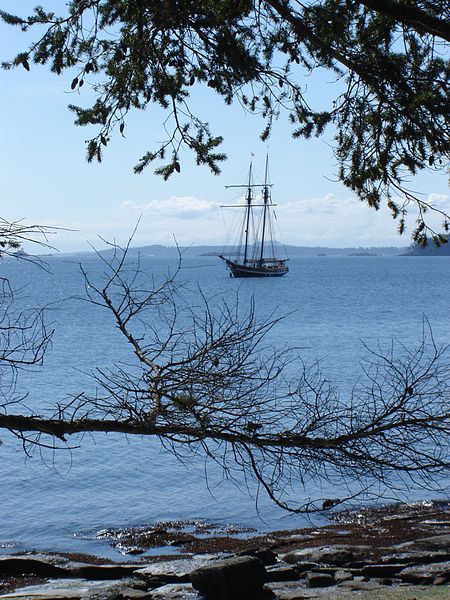
Isn’t she lovely? I envied the owners and crew. Then my wonderful critique partner, Kristy J. Manhattan, discovered that the ship was available to take visitors out on the water during the tourist season. She contacted the owner, who agreed to start his season a week early so we could sail Saturday evening.

Oh, what a lovely sail!

The Spike Africa is a two-masted gaff-rigged schooner. She was originally built in 1977 to designs reminiscent of 18th century coasting schooners. She takes her name from a famous West Coast sailor. She has won racing trophies, served as a support boat for other races, and been featured in a number of films (such as Joe Vs. the Volcano) and television shows. Can you imagine standing on her deck in a gentle breeze?


Olympic Mountains beyond the islands, anyone?


Perhaps another ship passing?


As many of you know, this is the third tall ship I’ve had the privilege of sailing on. She did not have all her sails up at the time of our passage, and one of the crew told us that she was fighting the tide, so the pace was more leisurely than on my previous jaunts. But the view and her sleek movement through the water was nothing less than spectacular.


If you are ever in the San Juans, I highly recommend a sail. You can find out more information at www.schoonersnorth.com. My thanks to the owner and Captain Kenny for allowing me to post pictures.

Friday, June 16, 2017

Watching the Ships Come Sailing In

I have a book due July 31. I have galleys to proof for my 2017 Christmas book with Love Inspired Historical. My editor would like input on the cover for my spring 2018 book. I’m weeks behind in revising The June Bride Conspiracy for reissue. So, how did I spend a good chunk of my day yesterday?

Watching the ships come sailing in.

This week marks Tacoma’s Festival of Sail. More than 20 ships sailed down Puget Sound to join in. They ranged from turn-of-the-century racing yachts to replicas of nineteenth-century square riggers. Even my beloved Lady Washington was in attendance.

Here’s some I caught on camera as they arrived. (The colors appear washed out--that's because it was pouring rain on shore and shrouded with mist at sea. My family and I were some of the few who braved the storm to watch.)


Ah, my Lady Washington, our state’s tall ship. I’ve blogged previously about my short time sailing on her.  Today, she led the Parade of Sail, her canon booming. It’s enough to set a girl swooning.


Here’s the Cutty Sark (though not the original in Britain). This one was built in 1957, the first of ten ships in the Mayflower class. She’s made of teak. Such graceful lines!


And this is the Merrie Ellen, a schooner from 1922. Oh, could she skim the waves!


Finally, the Hawaiian Chieftain, the Lady Washington’s companion ship. I’ve also had the privilege of sailing on her. Such a beauty!

Marissa kindly shared the link to the Boston Tall Ship Festival, which starts this weekend. Even though the East Coast boasts many more distinguished vessels, and some came from South America and across the Pond to visit, Tacoma has one thing Boston cannot claim.

The World’s Largest Rubber Ducky.

Six stories tall. No lie. Those are the perks of living in the wilderness.

Friday, October 7, 2016

Four Things on a Friday

Things come across my virtual desk on a daily basis, and, from time to time, I think, “Oh, I must share!” So, in no particular order, here are four things you as a reader of stories set in the nineteenth century should probably know.

  1. Ever wonder what ladies with names like Albertina, Orilla, or Clementine actually went by in their day? Check out this article on historical nicknames for ladies.
     
  2. Ever wonder where “Rotten Row” might be or what was in Green Park? Read all about it in Kristen Koster’s primer on London parks during the Regency.
     
  3. Are you a fan of the incomparable Georgette Heyer, sometimes called the mother of the Regency romance? Three short stories not seen since the 1930s will soon be reissued. Be still my heart!
     
  4. Finally, you know how much I love sailing ships. Here’s a marvelous site dedicated to the world Patrick O’Brian built with his Aubrey/Maturin series (Master and Commander, anyone?). This page in particular has some fun nautical slang. 
Until next week, enjoy!

Friday, July 29, 2016

Five More Pinterest Boards You Should Know

Have you searched online for pictures recently? Chances are at least some of the results led you to Pinterest, and for good reason. The site has more than 50 billion pins, quite a few from museums, re-enactors, and readers. I covered some earlier, but here are a few more related to the 19th century you should know.

Historical romance author Cheryl Bolen has assembled an amazing collection of interiors and exteriors in Georgian homes of England. Droolworthy! 

Regency author April Kihlstrom’s collection focuses more on clothing and pastimes, as well as an eclectic collection of boards on such things as knitting and Downs Syndrome. 

Likewise, historical romance writer Kristin Koster’s collection is wide-ranging and intriguing. Her Regency landmarks board is particularly useful. 

Stay-at-home mom and veteran pinner Lynn Ann has a beautiful board of Regency garb, much of it made today. 

I’ve been trying to collect pictures around the theme of a Regency summer house party.  Billiards, anyone? And I’ve recently started a board dedicated to cowboys.

And, ahem, my Sailing Ships Ahoy board now has 143 pictures of tall ships. Just saying.

Any boards you’d like to recommend?

Friday, July 22, 2016

Live, from RWA National: Well, Not Quite

I’m back from the Romance Writers of AmericaTM National Conference. Normally Marissa and I blog “live” from there, but this year, I collected all the interesting tidbits and brought them back with me. And I wasn’t even over weight on my luggage!

The day before Conference starts, I usually attend the Beau Monde mini-conference. The day-long affair brings together writers of Regency romance to share their knowledge and love of the period. This year was no exception, with fascinating talks on ciphers, madness, the medical profession, and sailing ships, to name a few. Speakers included Cheryl Bolen, Patricia Coleman, Louisa Cornell, Laurie Alice Eakes, Georgie Lee, and Ella Quinn, with a keynote by the tremendously talented and often hilarious Jade Lee.

That evening brought the Beau Monde soiree, where ladies (and gentlemen) danced and played period card games, and learned who won the Royal Ascot (the chapter’s contest for unpublished manuscripts). The winner this year, Elizabeth King, hails from New Zealand. She also won RWA’s most prestigious contest for unpublished manuscripts, the Golden Heart, in the historical category. This lady will be one to watch!

I didn’t actually go to the soiree myself. I let my “cousin” Sir Reginald attend in my place. Here he is partnering Jes Lyons, an assistant at Prospect Agency. I hear she was an excellent dancer!

I must admit that the hotel was amazing, with lots of overstuffed chairs along the marbled walks for sitting and catching up with old friends and making new ones. And the pool! So beautiful, by day and by night.

I took in a number of workshops at the Conference, but I slipped away one evening to see the sailing ships in the harbor. You see, the San Diego Maritime Museum was only a mile or so walk from the hotel along the boardwalk, with the ships right up against the walkway. I didn’t reach the museum in time to go inside, but I certainly took my time ogling the ships. The Star of India, built in 1863, is the oldest iron-hull merchant ship still sailing. The HMS Surprise is a replica of a 20-gun frigate built in 1757 and was used in the film Master and Commander with Russel Crowe. Le sigh.


All in all, it was a productive, insightful, delightful trip, though I found myself wishing that a certain dear author had been at my side. Here’s hoping for next year!

Friday, October 30, 2015

The Ghost Ship

It’s the day before Halloween in the States, and things have already been going bump in the night on television and in movie theatres. But one of the spookiest things about the nineteenth century were the legends that sprang up, including one about the Mary Celeste.

The Mary Celeste was a merchant ship from America. She sailed with a crew of ten and the captain’s family from New York City in November 1872 on her way to Genoa, Italy, carrying a cargo of industrial alcohol. But after what appeared to be an uneventful journey based on the ship’s log, the vessel was discovered on December 4, 1872, off the Azores, abandoned. She was sailing along, all by herself, with cargo, supplies, and crew’s belongings largely intact, although the navigational instruments were missing and so was the lifeboat. The last log entry was dated 10 days earlier. No one who had sailed on her was ever seen again.

So what happened?

Over the centuries, theories have abounded. Some of the barrels of alcohol were apparently empty. Had the crew drank the foul stuff and mutinied? (Note to conspiracy theorists—have you ever tried drinking denatured alcohol? It isn’t pleasant, and I would think the crew would be too busy throwing up or running to the head to mutiny.) 

Was it piracy? Unless the pirates decided after slaying all the crew that the aforesaid alcohol wasn’t worth the effort to pilfer, not likely. Besides, there was no sign of a struggle, no damage to the hull from canon fire.

Was it insurance fraud? Not a particularly good one. The salvage award wasn’t particularly lucrative, because both the ship and the cargo were in good shape.

Had they abandoned ship because of a natural phenomenon such as submarine earthquakes, storms, or a water spout? None were recorded in the area, and at the time of the ship’s last log entry, the Mary Celeste wasn’t too far from one of the islands. Surely the life boat could have made it to shore.

Even more far-fetched theories have been suggested. Was it a giant squid? Sorry, he was busy that day. Bermuda Triangle? Nowhere near where the ship was found.

Oblivious to the consternation around her, the Mary Celeste continued her career, passing through several hands before being wrecked off the coast of Haiti in 1885. That captain actually was attempting insurance fraud. But her demise didn’t stop the stories. Newspaper and magazine pieces popped up in England and America from the late 1800s through the early 1900s. In January 1884, a young Arthur Conan Doyle, the inventor of Sherlock Holmes himself, told the tale in a British literary magazine, from the point of view of a supposed survivor. He blamed the abandonment on the vengeance of a former slave, who rose against the white crew. The Strand published another “survivor story” in 1913, stating that the crew had fallen into the sea from a temporary platform and either drowned or were eaten by sharks. In the 1920s, other stories from so-called survivors claimed that the crew had colluded with that of the ship which found her to win salvage or the crew had found another ship abandoned with a rich cargo and sailed off on it instead. Radio plays, a stage version, and novels have also been written about the mystery. The Smithsonian sponsored a documentary as late as 2007; it disproved many theories but reached no conclusions.

So what really happened to the Mary Celeste?

The Brits have an answer. It seems their venerated hero the Doctor may have been involved, according to the accepted canon for the long-running Dr. Who franchise. I understand the Daleks were involved.

Now, that explains everything.

Happy Halloween!


Friday, September 11, 2015

On Wings Like the Eagle

Some of you who follow my Facebook page know I’m fond of sailing ships, going so far as to post pictures on Sailing Ship Saturdays. I’ll admit I’m a die-hard tall ship fan, going aboard any chance I get. I’ve spent the day sailing on my state’s tall ship, Lady Washington. I’ve walked the decks of the Constitution. But some years ago now, I had the privilege of touring America’s tall ship, the U.S. Coast Guard Cutter, Eagle.

Eagle is the largest tall ship sailing out of an American port and the only square-rigger in U.S. government service. The steel-hulled barque was built in 1936 in Germany, where she was used as a training ship for Nazi cadets. At the end of the war, she was brought to America as a war prize. According to the Coast Guard site, the German crew actually helped U.S. Coast Guardsmen bring her into her new homeport in New London, Connecticut.


A few things surprised me about her:
  • Though she is made of metal, her decks are actually covered with teak.
  • The massive wheel that is her helm is nearly as big as I am!
  • She can go faster under full sail than she can under more modern power (and her “tank” holds more than 23,000 gallons—how’d you like to fill her up?).
  • Her rigging is 6 miles long, and she boast more than 22,000 square feet of sail.

Today, she serves as a training ship again, taking crews from among the 1,000 men and women who attend the Coast Guard Academy each year. Right now, she just made berth at the Coast Guard Yard in Baltimore for some R&R (renovation and repair). But she generally takes a summer schedule, May through August. If you’re on the East Coast between Boston and Florida, keep a weather eye peeled for tall sails in your neck of the woods next year.

You just might become a fan too.

Friday, March 20, 2015

Nineteenth Century Today: The Dreams of Port Townsend

One of the things I love about my new home is all the history surrounding it.  Anglo-history was a little scarce where I came from, with most of the structures dating to no earlier than WWII.  That’s why it was such a treat recently to visit Port Townsend.

Located at the northwest corner of Puget Sound, Port Townsend was original named in 1792 by Captain George Vancouver for his friend the Marquis of Townshend.  Its sheltered, deep harbor welcomed the sailing ships of the day and inspired the first settlers in 1851 to dream of its being the largest harbor on the West Coast.  In fact, the early settlers called it the City of Dreams for the prosperity they hoped would follow.

The town saw rapid growth throughout the 1800s in anticipation of being the terminus for the Northern Pacific Railroad.  Dozens of homes were built along the hillside overlooking Puget Sound, along with many civic buildings.  Fort Worden was built along one end to protect the entrance of Puget Sound from hostile forces. 

But Port Townsend’s dreams were dashed when Tacoma, more than 80 miles and on the other side of the Sound, was chosen as the end of the rail line. People began leaving down in droves.  Only the opening of a paper mill kept Port Townsend alive.  Now, the town thrives on boat building and a growing tourist trade.

My cousin once removed (known as Aunt Mary to my brother and me) lives in the area and took us on what she called her nickel tour.  Everywhere I looked were fine examples of Victorian architecture.  Like this.


And this.


And this, the district courthouse.


And it doesn’t hurt that the deer come right down into the city and roam, even in broad daylight!


It wasn’t hard for the City of Dreams to set me dreaming about owning one of these homes.  In fact, I picked the perfect house for me.  This beauty stands on a bluff alongside Puget Sound, with a commanding view of Port Townsend Bay and Marrowstone Island.  Can’t you just see me sitting in my office, gazing out at the blue, blue waters, the passing ships?


Hm.  Maybe I ought to stay in my little cottage.  At least then my dreams are more likely to get down on paper as books!

What about you?  Any of these houses set you to dreaming?

Friday, June 14, 2013

All I Ask Is a Tall Ship and a Star to Steer Her By

I don’t know when I first fell in love with sailing ships. Maybe it was the sight of Peter Pan flying off to Neverland in the Disney version of the story.  Maybe it was the adventure in Rafael Sabatini’s Captain Blood or Frank Yerby’s The Golden Hawk. I was already far, far gone by the time the Black Pearl and the Interceptor sailed onto the scene. I’ve watched the parade of ships in Commencement Bay, toured the Constitution and Eagle in port, and crouched aboard the Hawaiian Chieftain while her cannons puffed smoke.  But last Friday, I fulfilled a dream I’ve had since 1989, when the Lady Washington was launched.

I spent 8 hours aboard our state’s tall ship.
 
I was what they call a transit passenger.  The Lady Washington and her companion ship the Hawaiian Chieftain have a number of ports of call along the West Coast, from the sunny beaches of San Diego to the crystal waters off British Columbia.  Every few years, she ventures inland up the mighty Columbia River.  You can make arrangements to sail with her from one port to another.  I embarked at the Port of Umatilla and sailed along the border between Washington and Oregon until the river curves and takes you north to Pasco, 38 miles in all.
 
Eight passengers shivered in the early morning light at the dock.  We were given the choice to sail on either ship.  But when the others saw that the only way aboard the Lady was a rope ladder hanging down her side (she was berthed in such a way she could not lower her gangplank), they opted for the more civilized stairs leading to the Chieftain.  Thus, I had the Lady, and her crew, all to myself.  Because that ladder was not going to stand between me and my dream, however, ungainly I might have appeared going up it!

We set out from the port and headed upriver.  The sails were all furled, and we were running on the Lady’s engine, but that didn’t mean the crew got to relax.  Our first challenge in making it to Pasco lay in the locks of McNary Dam.  The crew heaved on the ropes, canting the yards on the fore and main masts to bring them within the line of the ship’s hull.  That way, they couldn’t be damaged when we navigated the locks, which looked a bit like the gates of Mordor as we approached.
 
As we pulled into the black channel, the Chieftain right behind us, we could see people high on the walls.  Some of the employees of the dam had brought their children with them, and they waved pirate flags at us while their parents snapped pictures.  It’s not every day a sailing ship comes to town.
 
Once through the locks, it was clear sailing for a time, past the dusty hills and black basalt that makes up much of this part of Washington. Up into the rigging scrambled the crew, to hang high over my head as they unfurled the sails.  And out bellied the white from the yards.  It was an inspiring sight in the warm summer air on the peaceful river.  But I kept thinking how much harder it would have been in a driving rain on the Pacific!

At one point, the Chieftain cruised past us.  She has two engines to the Lady’s one; her foremast is a cleverly disguised smokestack.  The crew wanted to pelt her with pancakes left over from breakfast (no lie!).  They had the slingshot rigged and were taking aim, but the captain denied them permission to fire.  There were lady passengers on the other ship, after all. 

I was surprised and not a little pleased to find that of the 12 members of the crew, 7 were women, including the first mate, bosun, gunner’s mate, and purser.  I was also surprised to see so much rope!  Madam Bosun told me that Lady has over 6 miles of the stuff to manage her sails and hold her fast.  Then there’s the helm, only there’s no wheel.  The Lady is steered by tiller.  When you see a wheel on her in the movies, it’s been put on for show. 

We continued on north, the crew working at sanding and oiling woodwork such as belaying pins while I quizzed them unmercifully.  But it soon became apparent by the tight countenances of the captain and first mate that all was not right.  When the Lady Washington first sailed to Pasco 4 years ago, the crew discovered that the information they had on a railroad bridge near the town of Finley was incorrect.  The Lady could, in fact, not pass under her without removing about the top 10 feet of her mast.  You can imagine that was not an easy feat in the middle of the river.  Taking precautions, they had already removed the upper mast at a port downriver.  But information now indicated that the river was running high, and the bridge might be lower than expected.  It was, in fact, quite possible we wouldn’t fit, and we didn’t have any more mast to remove!
 
The engineer and a sailor ventured into the rigging to take measurements, and based on the information we’d been given, we either had 5 feet of clearance, or we would take off the top 2 feet of mast if we tried to go under!  We approached, once more on engine power and going very slowly.  The iron bridge, black with rust from years of use, stood in stark contrast to the graceful lines of the ship. 

The captain wanted to know exactly how much clearance he had, if any.  So the engineer climbed to the very top of the rigging and hung there with a long rod in his hand, with orders to poke the bridge as we passed under it and get a measurement of the difference. 

“Report!” the captain called up as we inched forward.

“I think we’ll make it,” the engineer replied.

“100%?”

Silence for a moment.  Then, “Yes.”

The engine purred.  And we were through with 5 feet to spare.  Phew!
 
We arrived in Pasco as planned.  All in all, it was an amazing adventure, and I have so much admiration for those who give up their lives to sail.  The bosun told me the ship is her home.  Her 12 square feet of bunk space and trunk is all the property she owns in the world.

All she wants is a tall ship and a star to steer her by.

Friday, May 29, 2009

Yo Ho, Yo Ho . . .

Okay, I’ll admit it. I’m a sucker for good, old-fashioned pirates. Pirates of the Caribbean: Curse of the Black Pearl is one of my favorite movies (my favorite is still The Pirate Movie starring Kristy McNichol and Christopher Atkin—we won’t go there). I’ve loved sailing ships since I was a child. So, it was with great delight that I learned that our state’s tall ship, Lady Washington, and her companion ship, Hawaiian Chieftain, were sailing up the Columbia River and right into our little neck of the woods.

If you follow the Pirates’ saga, you may recognize Lady Washington. She starred as the Interceptor in all three movies. She’s a full-scale reproduction of the original Lady Washington built in the British Colony of Massachusetts in the 1750s. She originally carried freight between colonial ports until the American Revolutionary War, when she became an American privateer. So, you see, she has pirate leanings too. In 1787, after the war, she was refitted, and, in 1788, she became the first American vessel to make landfall on the west coast of North America. She was also the first American ship to visit Honolulu, Hong Kong, and Japan. Lady Washington opened the black pearl (aha!) and sandalwood trade between Hawaii and the Orient when King Kamehameha became a partner in the ship. The topsail ketch Hawaiian Chieftain is a replica of a typical European merchant trader of the turn of the nineteenth century..

So, if you’ll so kindly indulge me, let us embark on a journey across the seas (or downriver as it were). Beware, though. Pirates lurk in these waters.

Allow me to be the first to welcome you aboard the Hawaii Chieftain.


Lovely day for a sail, don’t you think?


Our flag is flying proudly.


The crew knows their jobs.


Wait, what’s that?


A ship on the horizon.


Dear me! Is she friend or foe?


She’s priming her guns!


Pour on that sail, me hearties! We can outrun her.


No, she’s coming alongside!


Run out our guns!


She’s firing!


If you hope to save your skins, lasses, haul line!


We’re pulling ahead.


I think we lost her.


Now, bring me that horizon.


(Special thanks to Kris and Meryl for being willing to join a zany writer on her quest for authenticity.)