Tuesday, August 30, 2022

Guest Blogger Barbara Monajem on Why the Caricature is Mightier than the Sword

We’re welcoming author Barbara Monajem as today’s guest blogger. I fell in love with her Lady Rosamund Regency-set mysteries because she takes such care to stay true to the history and culture of the times…and writes a darn good story!  An important part of the Lady Rosamund stories are caricatures—basically the political cartoons of the 19th century, though they went far beyond politics to comment on many different aspects of society and life as well. I’ll let Barbara take it from there…

* * * * *

Do you read the tabloids at the supermarket? I don’t, but I can’t help but notice the photos of celebs and royals. Often, the tabloids take a grimace and blow it up into a feud, doctoring the photos to show people screaming at one another. Horrid, isn’t it? And so unkind.

Believe it or not, this is nothing new. The Regency equivalent of the tabloid photographer was the caricaturist. Caricatures were printed from etchings or engravings and distributed all over England. They ranged from social and political commentary to downright scandal. Wealthy patrons might have subscriptions, while others purchased copies at stationers or print shops. Even illiterates benefited from the entertaining spin on current affairs, as the prints were displayed in shop windows, and a literate onlooker might helpfully read the captions aloud.


My favorite of the well-known caricaturists is James Gillray. He was relentless in his satires of the royal family, in particular the Prince of Wales (who, one has to admit, was really asking for it; he wasn’t at all well-behaved). Here is one where the King, Queen and Prince are all eating gold coins, enriching their coffers at the expense of the people. But while the King and Queen hold onto their money in craws attached to their necks, the Prince’s craw is empty, for he wasted vast sums.

Gillray drew a very famous caricature imagining what it would be like if the royal family were ousted, like in France. This enraged the Prince of Wales so much that he paid to have the print suppressed and the original plate destroyed (it wasn’t). Gillray also satirized Napoleon, whose outraged reaction was much like the Prince’s.


Gillray also depicted current issues, such as controversy over the cowpox vaccination to prevent smallpox. His caricature shows vaccinated people with little cows growing out of their arms, heads, bums, etc. Doesn’t sound too different from the vaccine controversies of today!


He also satirized various excesses of fashion, such as tight lacing or preposterously high ostrich feathers. Here is one suggesting that the current style of gown was too revealing.


Other famous caricaturists were Isaac Cruikshank and his sons, Isaac Robert and George. This 1850 drawing by George Cruikshank satirizes the crinoline. Isaac Robert Cruikshank caricatured dandies and their absurdly high collars/cravats.


Lastly, another of my favorites is Thomas Rowlandson. I like this caricature of the Bluestockings – intellectual or literary ladies – who are violently brawling with one another. It probably implies that women are incapable of intellectual pursuits, and that those who attempt to do so are unladylike, and squabble like women of ill repute. But to me it also suggests that when it comes to allowing petty differences to escalate into violence, men and women can be much the same. I suppose it depends on who is interpreting it!  

I guess all this explains why I chose to make a caricaturist one of the main characters in my Lady Rosamund mysteries. It’s just so much fun imagining the spin a clever caricaturist could put on anything he chose. He could comment on the follies of society, poke fun at the rich and famous, and even invent a scandal for the fun of it. (And no one gets harmed in real life, because this is fiction.)

* * * * *

In addition to the Lady Rosamund series, USA Today bestselling author Barbara Monajem is the author of more than thirty novels and novellas. She wrote her first story at eight years old about apple tree gnomes. After publishing a middle-grade fantasy, she settled on historical mysteries and romances with intrepid heroines and long-suffering heroes (or vice versa). Sometimes there’s a bit of fantasy mixed in, because she wants to avoid reality as much as possible. She lives near Atlanta with an ever-shifting population of relatives, friends, and feline strays. Learn more at www.BarbaraMonajem.com.


Tuesday, August 23, 2022

Twisting History

Did you feel a little twist in your middle at the title of this post? I do my very best to make sure all of my historical novels are historically accurate, from clothing to language, from setting to action. I realize it’s impossible to know every fact, and not all of my heroines conform to the expectations of a young lady of means during that time period. But there are real-life examples, many we’ve covered, that didn’t conform either.

But when it came to actually changing key historical facts to fit the story? Oh, how daunting!

Yet….

Every author plays a game of “what if.” What if a lady who had been betrayed too often learned to rely on how her cat responded to people to decide whether to trust? (Fortune’s Brides) What if a lady was so kind and sensible that she attracted the most ridiculous and heart-broken suitors? (The Unflappable Miss Fairchild) What if Napoleon, who was a devout admirer of science, invested in that science to such an extent that he was able to stay in power and threaten Britain?


And so, Shelley Adina and I twisted history, though not as much as you might think, to write the Regent’s Devices series. The inventions of Jules Verne were exaggerations of things available in his time. Likewise those of H.G. Wells and Edgar Rice Burroughs. In fact, I would propose that it is impossible to write science fiction or fantasy or even a mystery story without a little twisting of reality.

Look for the final twists coming your way in The Lady’s Triumph, launching September 28. More info at my website.

Tuesday, August 16, 2022

A Very Clever Young Lady

 As you know, I’m an avid collector of 19th century dance cards, those delightful little confections of silver and bone and shell that young ladies carried to keep track of their dance partners at balls. As we’ve discussed before, the ones that I collect date to the middle-ish part of the century, from around the 1830s to maybe the 1870s, when printed cards or booklets given out at balls became the standard (and a clever one, too: it gave you a tangible memento of your evening.) It also made sense: it meant you didn’t have to remember that you’d promised the first polka to Mr. Twinkletoes or the galop to Mr. Fleetfoot, because it was all right there in writing. 

I recently found this delightful carnet de bal online. Four and a quarter inches long by one and a quarter wide at its widest, it’s my favorite form—for some reason, I just love the fan-shaped ones. It’s a tad rickety—the chain and ring by which it would have hung from a young lady’s finger or button is gone, as is the pencil—and the coil of brass which would have held the pencil and formed a catch to keep it closed is partially detached from the back panel. The ribbon that held the leaves in place is still there, though detached from the front panel. But what makes this little trinket so marvelous (at least to me) is that its owner was a very organized young lady who also evidently did not like to have to keep track of to whom she’d promised that first polka. Look carefully at the individual leaves:

She carefully inked a heading on each leaf! They read (I apologize for the image qualityit was very hard to photograph!) from left to right, Valses (waltzes), Polkas, Quadrille (that one was a bit hard to make out), Galops, Polka Mazurka, and Schottishe [sic]…and then below that, six numbered spaces for names. Faint traces of names penciled in and erased are there, though alas, too faint and jumbled to read.

Based on the spelling of the dances and the quick research I did on when dances became popular, I’m guessing that this carnet is French, from the 1850s, while the Quadrille was still being danced and the Schottische a popular newcomer. So its owner was evidently well ahead of her time when it came to asset management—er, keeping track of her dance partners. 😊 I like to think that she was a popular young lady who was forced to find a creative way to manage her engagements. Who knows—maybe she helped popularize the printed programs of the future to help her daughters keep track of their swains!

Tuesday, August 9, 2022

Blast from the Past: Nineteenth Century Heroines: Beloved the World Over

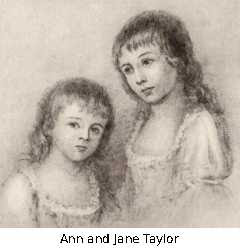
I’ve wanted to be a writer all my life, though I realized fairly early that I probably needed some other vocation to fall back on when those rejection letters piled up.  In the nineteenth century, many young ladies were taught the opposite.  They were told to learn how to be wives and mothers first, and maybe they might have to fall back on a accomplishment like writing well if they ended up spinsters.  That was certainly the case for nineteenth-century writers Ann and Jane Taylor.

Ann and Jane were born in 1782 and 1783, respectively, into an accomplished family. Their father and grandfather were engravers who illustrated books and sometimes set portraits, first in London and then in smaller towns around England.  Ann and Jane had an unusual education: their father taught them at home then started Sunday Schools for poorer children, where they were expected to help teach. They learned reading, writing, math, history, and geography by working through practical problems such as artillery attacks on local towns, engraving issues, and household chores. Between learning and chores, they were busy from sunup to sundown, but that didn’t stop them from writing.

They wrote essays on various topics, they wrote little plays and put them on with the neighboring children, and they wrote poems. At age 15, Jane was invited to join a local society for reading essays and improving the intellect. When Ann was 17, she responded to a puzzle in the Minor’s Pocket Book, an annual publication for children, with a poem, and the editor was so impressed he asked her for more. By 1804, both Ann and Jane were providing poems to the magazine. Over the next few years, they put together collections of children’s poems, some by friends, family, and acquaintances but mostly theirs. When the first book brought in money, their mother decided writing wasn’t so bad. She graciously allowed them a half hour a day to devote to it!

But that seemed to be enough.  Each of their children’s poetry books grew more popular. Their books were translated into French, German, Russian, and many other languages. They were so successful, in fact, that their mother decided to start writing too! She published nine books between 1814 and 1825, all explaining how important it was for women to marry and take care of their families.

Ann Taylor married a minister who had written her a fan letter for her work. She stopped writing for a time to raise eight children, then took up the pen again until her death in 1866. Jane never married and was the more prolific writer. Sadly, she died of breast cancer when she was only 40.

Perhaps because they wrote for children, you don’t often hear their names today. But I’ll wager you know this poem, written by Jane in 1806 and beloved all over the world:

Twinkle, twinkle little star
How I wonder what you are!
Up above the world so high
Like a diamond in the sky.

Did you know it has four more stanzas?

When the blazing sun is gone,
When he nothing shines upon,
Then you show your little light
Twinkle, twinkle, all the night.

Then the traveler in the dark
Thanks you for your tiny spark!
He could not see which way to go,
If you did not twinkle so.

In the dark blue sky you keep,
And often through my curtains peep,
For you never shut your eye
Till the sun is in the sky.

As your bright and tiny spark
Lights the traveler in the dark
Though I know not what you are,
Twinkle, twinkle little star.

Tuesday, August 2, 2022

A Horse of a Different Color: AN EVENT AT EPSOM is here!


Annabel and the lady patronesses of Almack's are about to embark on their sixth adventure, this time venturing farther from London for their latest investigation in AN EVENT AT EPSOM.


It’s June, which means that the fashionable of London are off to Epsom for the annual race meet. A newcomer is favored to win the Oaks Stakes—a mysterious filly who came from nowhere to win the spring races left and right. It will be up to the Lady Patronesses to discover her identity—while Annabel discovers what her true feelings are for Lord Quinceton… 

I knew almost nothing about Epsom and Regency-era horse-racing before writing this story, and barely scratched the surface of racing history. My favorite bit is probably the origin story around the Derby Stakes: in 1778 the Earl of Derby and a group of friends had sponsored the first Oaks Stakes, a race for three-year-old fillies, and decided the following year to establish a race for three-year-old colts--but what to name it? According to legend, a coin toss between the Earl and his friend and fellow racing enthusiast Sir Charles Bunbury decided the matter, though some think that Sir Charles deferred to his host--after all, the race was run on his land. Sir Charles's horse, Diomed, won the first Derby Stakes the following year--not a bad consolation prize!

And the larger story that's been simmering in the background of the series is about to come forward--so fasten your seatbelts!

An Event at Epsom is available directly from Book View Cafe as well as from Amazon, Barnes and Noble, Kobo, Apple Books, Smashwords, and others, as well as in print from Amazon and Barnes and Noble.

Book View Cafe

Amazon (affiliate link)

Barnes and Noble

Kobo

Apple Books

Smashwords

Books2Read

Enjoy!

* * * * *


In other news, What Lies Beneath, my WWI young adult fantasy, has been gaining some exciting recognition: it is a finalist in Georgia Romance Writers' Maggies Award, in Orange County Romance Writers' Book Buyers Best Award, and in the young adult category of the Silver Falchion Award (sponsored by Killer Nashville).