
Showing posts with label A Convenient Christmas Wedding. Show all posts

Friday, October 6, 2017

Must be the Season

File:Woodland path.jpgWe have a lot of seasons these days. There are the four seasons—winter, spring, summer, and fall. Then there’s the television season, which seems to fall in many different periods depending on the network, fill-in-your-favorite-sports seasons, and the holiday season, which is fast approaching. In early nineteenth century England, of course, there was only one Season. Or was there?

We’ve talked about the Season, that time between Easter and the beginning of hunting season (another season!), when the aristocracy flocked to London. Young ladies made their debuts. Marriages were contracted. Almack’s held its famous balls. And Parliament sat.

That, more than anything else, drove the Season. Your dear papa or older brother must take his seat in the Lords, and you came along to see and be seen. But you see, Parliament didn’t always sit just in the spring and summer months.
Older Regency romance novels talk of the Little Season, but many of us authors have looked in vain at period sources to discover what and when that might be. My theory is that the Little Season happened in the fall, when Parliament happened to sit later or arrive earlier than usual.

For example, in 1812, Parliament adjourned on July 30, but a general election was held in October. The newly elected in the House of Commons took their seats on November 24 and continued sitting with the House of Lords until July 22, 1813. Likewise, Parliament began sessions on November 4, 1813, and adjourned July 30, 1814. I cannot imagine every gentleman left family behind the entire time or huddled together over a pint without a ball or two to liven things up. This fall/winter time in London may have been what has been deemed the Little Season.

But at the moment, we seem to be in another type of season entirely. A sale season. Marissa mentioned Tuesday that her award-winning story, Skin Deep, is on sale through today. My publisher has put 500 of its books, including my A Convenient Christmas Wedding on sale for $1.99 from October 7 through 10.

It also so happens that my Art and Artifice, the second book in my Lady Emily Capers, parts of which were published as La Petite Four, is on sale for 99 cents through October 14.

Lady Emily dreams of joining the famous artists of the Royal Society for the Beaux Arts until her longtime betrothed Lord Robert declares his intent to marry her, immediately. What can the fellow be thinking! And why is handsome Bow Street Runner Jamie Cropper dogging Lord Robert’s steps, and Emily’s?  It’s up to Emily to use her art to uncover artifice and discover whether Lord Robert has something up his sleeve besides a nicely muscled arm. Along the way, a duke’s daughter might just form a perilous passion for a most unlikely suitor.

You know, it's always the season to read.

Friday, November 11, 2016

Nineteenth Century Heroines: A Beacon to All

It’s been a while since we talked about a real-life heroine of the nineteenth century, but I hope you agree that Flora Augusta Pearson Engle fits the bill. Flora was one of the Mercer Belles, those ladies who traveled west with Asa Mercer to help civilize Washington Territory. Her sisters and father came on Mercer’s first trip in 1864. Flora, her mother, and her brother came on the second trip that brought my heroines Allegra Howard (The Bride Ship), Catherine Stanway (Would-Be Wilderness Wife), Rina Fosgrave (Frontier Engagement), Maddie O’Rourke (Instant Frontier Family), and Nora Underhill (this month’s A Convenient Christmas Wedding). Flora was only 16 at the time. I wish I had a picture I could post, but you can see one at Find-A-Grave.

Born in Rollinsford, New Hampshire, Flora was the daughter of Daniel Pearson and Susan Brown Pearson. Daniel worked as a supervisor in the local cotton mill until the Civil War interrupted. By 1864, he was unemployed and in poor health, so travelling west must have looked good. The plan was for him and Flora’s sisters Georgie and Josie to move out first, and then to send for Flora, her brother Daniel, and her mother once they were settled.

Right away fate intervened. Georgie and Josie were immediately assigned to teach school on Whidbey Island, in the town of Coupeville, but Josie died suddenly walking home from class one day. Daniel, who had been working across the Sound, moved to Coupeville to be near Georgie. He was appointed keeper of the Red Bluff Lighthouse, what is now known as Admiralty Head. Georgie, then 17, became his assistant lighthouse keeper, the first woman to do so in Washington Territory.

By the time Flora arrived, however, Georgie had a serious suitor. They were married in the lighthouse parlor less than a year later, and Flora stepped into her sister’s shoes as assistant to her father. She earned approximately $625 a year for the post.

For the next ten years, Flora kept the lighthouse log, recording incidents both important and trivial, and sending a report to Washington, D.C., every month. It wasn’t hard for her. She had kept a diary for years, including chronicling the voyage that had brought the Mercer Belles to Washington. She was a society reporter for the local newspaper and later wrote many articles about local history. Legend has it she spelled the town of Coupeville without the middle e, and it took the government to change the name back years later.

According to Lighthouse Friends, Flora occasionally joked in the log, as in this notation from 1875, right before she was married: “By order of Lt. Commander Louis Keurpoff (inspector): Be it hereby known, to whom it may or may not concern: All light keepers, either principal or assistant, in this domain of our beloved Uncle Samuel, are expressly forbidden to depart from the Territory of Single Blessedness and take up their abode in the populous State of Matrimony unless said departure be permitted and sanctioned by the Lighthouse Inspector.”

Sounds to me like Flora had a few suitors herself.

I'm not sure what Flora was looking for in a husband. At that time, she could have taken her pick. In 1876, when she was 26 years old, however, she married a local farmer, William Engle, nearly 20 years her senior. They had a lovely honeymoon in San Francisco. But even the birth of her son, Carl Terry Engle, a year later didn’t stop her from reporting to work. He was born at the lighthouse, and she noted it in the log. She continued working at the lighthouse until her father’s retirement in 1878, staying on one more month to help the new lighthouse keeper get oriented.


Flora and William moved to his farm, but that wasn’t the end of her contributions to the community. She championed the building for the first board sidewalks in Coupeville and led efforts to restore the Davis Blockhouse, a fortified cabin built around 1855. She appears to have been a member of the Ladies of the Round Table, a local club I’m eager to learn more about (future book, perhaps?). When her mother died in 1890, she took in her father until he died seven years later.

Flora lived until she was 85. Her grandchildren and great-grandchildren remembered her as a woman of indefatigable energy. She may have made a name for herself as a lighthouse keeper, but I think it was her light that shined the brightest.

Friday, November 4, 2016

Christmas, Frontier Style?

A Convenient Christmas Wedding, out now from Love Inspired Historical, isn’t my first Christmas story. I’ve written two others, both set in Regency England. Now, admittedly, the characters in my Regency stories and those in my Frontier Bachelors stories not only come from different sides of the Pond but different social strata. So, I was a little surprised by the similarities, and the differences, between how the two celebrated Christmas.

As Marissa and I have shared, Christmas in the early part of the nineteenth century in England wasn’t nearly as elaborate as it became later. But by 1866, when my story, A Convenient Christmas Wedding, takes place, both England and America were fond of celebrating. As you can imagine the grand Christmas tree that might grace an English country home didn’t exactly fit in a frontier cabin. And not everyone who celebrated Christmas came from the English/Scotch/Irish traditions that included plum pudding.

My Wallin family originated in Sweden, though Mrs. Wallin, the matriarch, has some English blood. So it seemed logical to me that their family celebration would be an amalgam of the traditions, with a few American favorites thrown in. So, they bring in the Yule log, as some of my English characters did, but they also hang stockings by the fire on Christmas Eve for Father Christmas (not Santa Clause) as was becoming popular in America. Here’s the scene where Nora, my heroine, first becomes aware of the custom.

“We were just waiting for you and Simon,” Mrs. Wallin said, coming to take Nora’s cloak. “But I think I see something in your stocking.”

She couldn’t help the tingle of anticipation as she looked to the hearth. Sure enough, her stocking bulged. She glanced at Mrs. Wallin, who nodded toward the fire. “Go ahead, dear. See what Father Christmas left for you.”

Nora ventured to the hearth, even as Levi and Beth pounced on their stockings, and the others moved closer to inspect theirs as well. Nora pulled the stocking from the nail and reached inside to find a tangerine, a handkerchief embroidered with her initial, a knit scarf of a familiar-looking purple heather yarn and a book of poetry.

Simon’s stocking, hanging next to hers, looked significantly less thick.

Glancing around to make sure no one was looking, she slipped her hand in his stocking. Her fingers met the rough edge of a rock.

Oh, no. She would not stand for Simon getting coal. She pulled out the rock and tucked it in her pocket. Then she put in her tangerine. She couldn’t very well give him the handkerchief or the scarf, but after a moment’s thought, she slipped in the poetry book as well.

The door opened just then for Simon, a bucket of milk in hand, and Nora scampered back from the hearth. Fleet bounded in on his heels, going from person to person and saying hello. The others were examining their gifts and exclaiming over the thoughtfulness. Mrs. Wallin had a new comb for her hair, edged with pearl beads that looked suspiciously like the ones Beth had purchased. Beth had received the latest issue of Godey’s and was already curled up in her mother’s rocker scanning the pages of the famous ladies’ magazine. John was fingering a fishing lure. A loud metallic hum proved that Levi had found a harmonica in his stocking and was trying it out.

Nora could hardly wait for Simon to peer into his stocking. But he didn’t go near the hearth even after he left the milk in the kitchen. Instead, he came up to her with a smile.

“And did Father Christmas reward you for your kindness?”

“Yes,” she said, holding up her handkerchief and scarf. “Aren’t they lovely?”

“Not as lovely as you,” he murmured.

Nora caught her breath.

“Go on, Simon,” James called. “You haven’t looked in your stocking yet.”

Simon turned and looked to the stocking. Then he frowned and wandered closer.

Nora let out her breath. He was only being kind. She knew she wasn’t lovely. But the words had sounded so sweet.

His mother looked over as Simon scrutinized the book of poetry. “It seems Father Christmas was a bit mixed up this year,” she said with a look to James.

“I’ll say,” James agreed, tossing his tangerine in the air and catching it. “First time in years Simon hasn’t gotten coal. But I’m not sure love poems are any more use to him.”

Love poems? She should have paid more attention to the title!

Simon pocketed the book. “I can assure you, James, that I’ll find a use for them.” He looked to Nora.

Oh, my!
~~~~
Now, that sounds like a Christmas worth celebrating, in any time period. For your convenience, here are the buy links one more time:

Harlequin
Amazon
Barnes and Noble
Kobo
iBooks
A bookstore near you
The Book Depository, free shipping worldwide

Tuesday, November 1, 2016

You Are Invited to A Convenient Christmas Wedding

Christmas and weddings—two special times. Combine them, and my hope is you will find a very special book. Industry review publication RT Book Reviews seems to agree, offering Simon Wallin’s story a coveted 4.5 stars and a top pick for November.

“This is a sweet marriage-of-convenience tale, and Scott’s love of history is apparent. Along with the fully fleshed out storyline and characters, the vivid descriptions and balance between the hero and heroine make this an engaging and truly enjoyable read. The drama will keep the reader turning the pages until the end, which comes all too soon.”

This is the fifth book in my Frontier Bachelor series set in pioneer Seattle, but, if you’re new to the series, you’ll still feel right at home.

Proposing a marriage of convenience to a rugged logger is the boldest move of Nora Underhill’s sheltered life. In return for Simon Wallin’s protection from her overbearing family, the unassuming seamstress offers prime frontier farmland. But their paper marriage changes when Nora’s greedy brother tries to draw her back into a life of drudgery. Her only option: move to Simon’s farm, and into the center of his loving, unruly family.

Years of shouldering responsibility have left Simon cynical and reserved. But little by little, Nora’s warmth opens his shuttered heart to joy. With their marriage claim under threat, can this practical arrangement blossom over the holidays…and become a love for all seasons?

You can find it at fine online retailers starting today and on book store shelves next week:

The Book Depository, free shipping worldwide 

Friday, October 14, 2016

A Seemly Seamstress

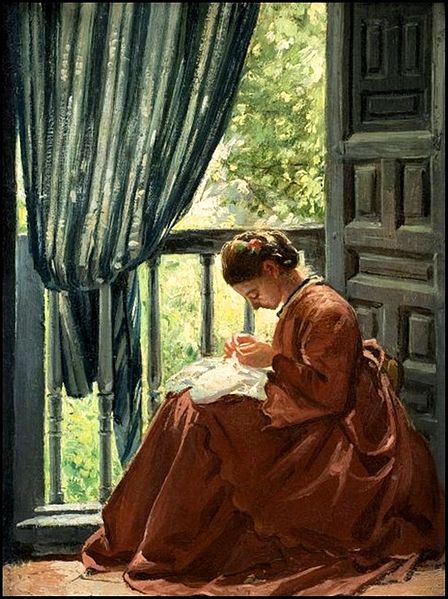
File:GMoreno.Seamstress.jpgOh, I do love looking at Marissa’s fashion prints. And I admit to being a bit of a clothes horse. I can even use a sewing machine to good effect when needed. But I can only bow in admiration to the ladies who plied the needle in the nineteenth century.

You may see various terms for a seamstress. A lady with her own shop in Regency England, for example, might have been called a mantua-maker. Later, the lady was called a dressmaker. You would go to her, look through patterns, and be measured. She might have fabric, or, in some cases, you might bring your own. Once the dress had been pieced together, you might return for an additional fitting. Those with sufficient funds or who lived farther out from the city might pay for a lady to come to them for fittings.

File:The New Dressmaker, 1921, Ill. No. 0101.pngInside the dressmaker’s shop, several ladies might be employed, all hand sewing every inch of those gorgeous dresses Marissa has been sharing with us. Some were allowed to work from home, picking up projects and returning them as they finished. As a needle worker, you might start with simple things like interior seams or hemming and graduate to more fancy work like embroidery. The hours were long, pay not much, and some seamstresses had trouble with eyesight in later years from toiling over a lamp or candle long into the night. Even in pioneer Seattle, the newfangled sewing machines were rare.

Sometimes dressmakers branched out to other areas. Such must have been the case for Mrs. Libby and Steele, who announced in the December 3, 1866, Puget Sound Weekly that they had opened an establishment on Commercial Street in Seattle. They claimed to have millinery, dress making, and ladies furnishings, including bonnets, hats, hoopskirts, ribbons, trimmings, and flowers, along with plain and fancy sewing done to order. Ladies of Seattle and the vicinity were invited to call. Note that the way the words MRS is written in the ad, it is unclear whether it was two misters or two ladies.

Nora Underhill, the heroine of my upcoming book, A Convenient Christmas Wedding, is a seamstress, one of the first in pioneer Seattle. She hasn’t the funds to set up her own shop, but she convinces one of the general mercantiles to allow her to work out of a corner. The customers buy the fabric and notions from the store and come to her for items to be made up.

That is, until Nora decides to buy herself a husband. More on that in November. :-)

Friday, August 19, 2016

Cover Reveal: A Convenient Christmas Wedding and a Guest

You know, getting a book’s tone and feel right has to be a daunting challenge for any artist, but especially for the artists of the Love Inspired lines. How many daring cowboys, Amish brides, and Regency lords can you draw and still keep things original and fresh? Yet, I am continually impressed by how they take an author’s jumbled ramblings about her heroine’s raven tresses and her hero’s manly chin and come up with something that captures the story.

Such is the case with my upcoming release, A Convenient Christmas Wedding (November 2016). This is the fifth book in my Frontier Bachelor series. Set during December 1866 in pioneer Seattle, the story follows Simon Wallin, second son of the logging family introduced in Would-Be Wilderness Wife, and Nora Underhill, the seamstress who befriends Maddie O’Rourke in Instant Frontier Family. But just as the artists got the tone right on the cover, so did my editor nail the book in the blurb:

Proposing a marriage of convenience to a rugged logger is the boldest move of Nora Underhill’s sheltered life. In return for Simon Wallin’s protection from her overbearing family, the unassuming seamstress offers prime frontier farmland. But their paper marriage changes when Nora’s greedy brother tries to draw her back into a life of drudgery. Her only option: move to Simon’s farm, and into the center of his loving, unruly family. 

Years of shouldering responsibility have left Simon cynical and reserved. But little by little, Nora’s warmth opens his shuttered heart to joy. With their marriage claim under threat, can this practical arrangement blossom over the holidays…and become a love for all seasons?

As many of you know, I often have an actress or actor in mind when I’m thinking about the physical characteristics of my hero and heroine. The heroine for this one may not be too familiar to some audiences, so I’ll come right out and tell you. It’s Abby Wilde, of Zoey 101 fame. But I encourage you to guess who my provided the physical look for my hero. In fact, if you guess, I’ll enter your name in a drawing next Friday to win a pack of three autographed books: Renee Ryan’s The Marriage Agreement, Louise M. Gouge’s Cowgirl for Keeps, and my Would-Be Wilderness Wife. Don't worry if someone else already made your guess. Just comment to be considered.

So, here are your hints. While he’s not seen as a stud today, in his early career this actor was such a hot Man he should have been put on Ice. He’s wielded a sword as well as a shot gun. Yes, he was a Real Genius back in the day. Want to take a guess?

But wait, there’s more!
I told you a while ago about how covers can evolve over time as readers and seasons change. I’m delighted to report that my first book, The Unflappable Miss Fairchild, has been reedited and given a new cover for your reading pleasure. This cover was designed by Kim Killion of The Killion Group. She also did the covers for my Lady Emily Capers. You can find the format you prefer on Smashwords.

I think that about covers it for this week. Looking forward to seeing your comments.