Showing posts with label Frontier Bachelors. Show all posts

Tuesday, April 26, 2022

Scouting for The Perfect Mail-Order Bride

When I wrote my Frontier Bachelors series, the Wallin family had a good friend who’d had a rough upbringing but a heart of gold. I still get letters from readers asking when Scout Rankin will have his own story told. So I’m giddy to report that it’s here! The Perfect Mail-Order Bride launched on April 18.

Ada Williamson lived her whole life in the shadow of her charismatic, capricious sister. But when the beautiful Melinda decides to jilt her mail-order groom on the way to meet him in Seattle, Washington Territory, Ada’s conscience demands that she continue the journey and tell Thomas Rankin the truth. After all, she wrote most of the letters the couple exchanged, and she’s already halfway in love with the man herself. Yet somehow, one look at Thomas and the future he offers, and the truth never comes out. Suddenly, Ada finds herself not only out of the shadows, but living the life meant for her sister.

After making his fortune on the goldfields, Thomas “Scout” Rankin found he could buy almost anything he wanted, including the perfect mail-order bride in a territory where women are still few and far between. But past betrayals have left him wary, so he immediately notices that the woman who claims to be his mail-order bride doesn’t quite act the part. Still, someone wrote those letters that spoke to his heart. If getting to know Ada better will reveal the truth, he’s willing to try, even if he must protect his own secrets along the way.

But someone knows both their secrets and aims to use them to advantage. Can Thomas and Ada discover the truth, about their enemy, about their pasts, and about the love they both yearn to share?

The Huntress Reviews gave it five stars! “One thing is certain, if the author, Regina Scott, penned the story, it is sure to satisfy. Marvelous!”

“Scout is everything I remembered and more. He grew into the man that we hoped he would become and someone that we can fall in love with for himself,” said Hott Books.

The Perfect Mail-Order Bride is available in both ebook and paperback at fine retailers:

Smashwords 

Amazon (affiliate link) 

Barnes and Noble 

Apple Books 

Kobo  

Overdrive (request it from your local library)

Indie Bound (an independent bookstore near you) 

Bookshop (with proceeds benefitting independent bookstores) 

The Book Depository (free shipping worldwide) 

Friday, March 9, 2018

Four Little Known Facts about Wallin Landing


As I prepare to say goodbye to Wallin Landing, the setting for my Frontier Bachelors series, I thought you might like to know a few secrets as about the town. Here then are little known facts about the setting:

  1. It wasn’t originally intended to be. When I first started the Frontier Bachelors series, I had envisioned telling the stories of several of the Mercer Belles, those ladies from the East Coast who traveled west with Asa Mercer to civilize pioneer Seattle following the Civil War. But in the second book, Would-Be Wilderness Wife, I fell in love with the Wallin family and the little town they were trying to build on the shores of Lake Union. And so, what was originally planned to be a three-book series grew into an eight-book saga as each of the Wallin siblings met their match.
  1. The stories about it span nearly a decade. So that I could plausibly write about the last three siblings, two of whom were in their teens in Would-Be Wilderness Wife, I had to expand the timeline as well. The books now span from January 1866 to April 1875. Seattle grew by leaps and bounds during that time. So did Wallin Landing.
  1. The town grew with the books. If you’ve read the series, you’ve probably already noticed this one. With the advent of Frontier Matchmaker Bride, the little town has a post office (run by James Wallin), school (with Rina Wallin, his wife, teacher and Dottie Wallin, John’s wife, assistant), church (with Levi Wallin the minister), dispensary (run by Catherine Wallin, Drew’s wife), and general store (James again). Individuals serve the function of blacksmith (John Wallin), seamstress (Nora Wallin, Simon’s wife), music teacher (Callie Wallin, Levi’s wife), and medical professional (Catherine) besides farmer (Simon Wallin) and logger (Drew Wallin). Simon Wallin might even be called an architect of sorts. 
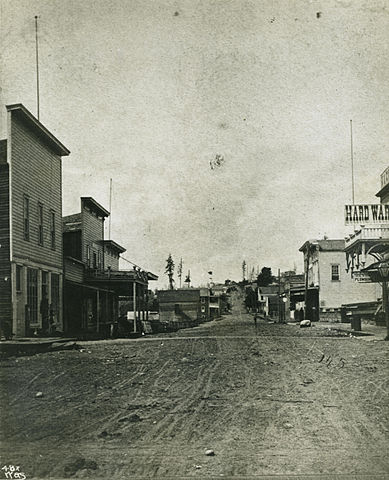
  1. Wallin Landing isn’t Wallingford. There is a neighborhood in Seattle called Wallingford. It is actually the location Pa Wallin wanted to build his town originally. I picture the town of Wallin Landing in the Westlake/East Queen Anne area of the Seattle area instead, across the lake and to the west of Wallingford.
Finally, I’m getting lots of mail from readers asking whether I will return to Wallin Landing one day. I hope so. A certain family friend needs to find his happily-ever-after, and there’s Gillian Howard, Ciara and Aiden O’Rourke, Frisco and Sutter Murphy, and the Wallin children who will need spouses in a few years. However, my current publisher is ending its historical romance line, and other publishers are notoriously leery of taking on a series started elsewhere.

This industry has taught me to beware of saying “never.” Things changes, rights are reverted, readers clamor for more. Wallin Landing will be sitting on the shores of Lake Union, waiting.

And so will I.

Tuesday, March 6, 2018

The Matchmaker Meets Her Match?

It’s always sad to let a series go, but I’m delighted to send off Frontier Bachelors, and my time with Love Inspired Historical, with the story of Beth Wallin. Spunky Beth has cheered her brothers on, and kicked them in the behind, while they courted and married. Those of you who have been following the books may have noticed, however, that Beth has a secret. She’s been reacting strangely the last couple of books to her long-time crush, Deputy Hart McCormick. Here’s why:

She’d just turned one-and-twenty and had filed for her claim. That was what was expected of her, choosing one hundred and sixty acres that would augment the town her family was building at the northern end of Lake Union. She was proud to do it.

She was too proud.

She saw that now. A young lady on the frontier might accomplish much at such an important age—file for her own claim, pursue a career.

She didn’t have to look far. She’d admired Deputy Sheriff Hart McCormick since she was fourteen and he’d ridden out to Wallin Landing the first time. Tall, handsome, worldly even at the age of four-and-twenty then, he’d been the embodiment of the heroes in the romantic adventure novels their father had left her and her brothers. He was the knight Ivanhoe, fighting to save England; the dashing John Alden petitioning the fair Priscilla Mullins to wed. She’d smiled and primped and giggled at him every time he came near. He never seemed to notice.

But when she turned one-and-twenty, she became determined to make him notice. She was certain God had a plan for her life, and it included Hart McCormick. She just needed to give God a little help in moving things along.

She’d dressed in her best gown, a vivid blue with white piping, styled her pale blond curls to spill down behind her. She’d borrowed her brother James’s famous steel dusts and driven the horses in to Seattle to tell Hart how she felt. It hadn’t been hard to locate him. Then as now, Seattle consisted of a few business streets hugging the shoreline with residences and churches on the hillside above, backed by the forest from which they’d been carved. She could scarcely breathe when he’d agreed to walk with her. They’d passed the Brown Church when she’d stopped him, gazing up into his dark eyes.

“I admire you far more than any lady should,” she’d said, voice ringing in her ears. “I don’t suppose you might feel the same.”

He’d gazed down at her a moment, and she’d thought she would slide into the mud of the street, her bones had turned so liquid. She waited for his gaze to warm, his arms to go about her, his lips to profess his undying devotion. That was what happened in her father’s novels. That was the way she’d always dreamed it would be for her.

He’d tipped his black hat to her instead. “That’s mighty kind of you to say, Miss Wallin. But I have no interest in courting you. Best you go on home now.”

Oh!

So, you can imagine Beth’s chagrin when the most important ladies in Seattle seek her out for her matchmaking skills and ask her to find Hart McCormick a bride.

Hart also has a secret, one that keeps him from ever giving his heart again. He may be Beth’s first matchmaking miss, unless they can both admit that she just might be his perfect match.

You can find Frontier Matchmaker Bride in print and e-book at fine retailers such as

An independent bookstore near you 
The Book Depository, free shipping worldwide 

Friday, March 2, 2018

Nineteenth Century Heroines: Taking Center Stage

File:The Old Bowery Theatre (NYPL b13476046-420759).jpgWhen Asa Mercer went east after the Civil War to entice young ladies to come west, he told them they would be bringing culture to the frontier. But the Mercer Belles I write about in my Frontier Bachelors series weren’t the only ones to make the rough-and-tumble West more civilized. This week’s nineteenth century heroine played a large role, in more ways than one.

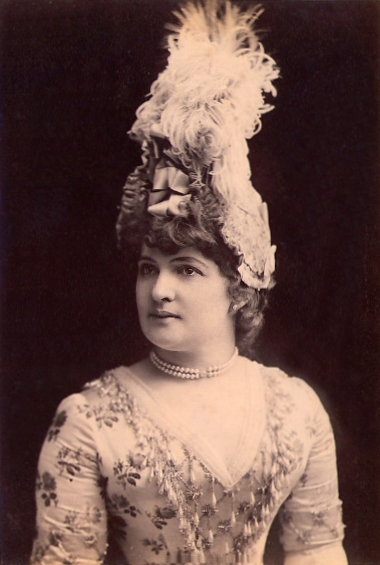
Fanny Morgan Phelps was born in Sydney, New South Wales. We aren’t entirely sure when, but she had already made her American debut at Maguire’s Opera House in San Francisco in 1863 as an established actress under her maiden name of Morgan. She was tall and pretty, with an impressive figure and a commanding presence. Her contemporaries called her an Amazon, and some men found themselves so upstaged by her that they refused to play opposite lest she show them up.

Fanny could not only act but sing, specializing at first in shorter plays that highlighted her comedic talents. Reviewers did not seem to know how to take her, for she was called Irish, Australian, and Scottish at various times. Take this piece from the New York Clipper (courtesy of Music in Gotham: The New York Scene 1862-75) when she played at the Bowery Theatre in 1867: 
In personal appearance she is very prepossessing, and she has the power of covering up the deficiencies of those around her by her admirable rendition of characters in which she appears. Her singing is invariably encored…Her style is free, natural, and full of spirit, and at once wins the favor of her audiences.
Sometime during her first California performances, she met Ralph Phelps, a light comedian, who appears to have been some years her senior. He had debuted in New York 1845 and travelled to California in 1854. By the time Fanny joined the Ward Company in Victoria, British Territories, in 1863, she had married Phelps.

For the next 3 years, Fanny was the star of the company, delighting audiences with most of her performances (although a comedy that poked fun of Westerners was not well received, particularly as those in Victoria saw themselves as more educated, enlightened, and sophisticated than the frontiersmen in the Puget Sound area). Ralph was the theatre manager. But as depression loomed in the area, Ward decided to move his company to Portland. Fanny went along.

She didn’t stay there. She was willing to go wherever audiences had a yearning for the theatre. She played what were considered the smaller towns in the Puget Sound area at the time—Seattle and Port Gamble among them. She played at the larger Olympia, the state capital. In 1872, she is recorded as taking part in a benefit in Hawaii. One of the reasons the frontiersmen loved her was that she was willing to come where they were.

File:Pixley,Annie.jpg
Sources say she leased the Theatre Royal in Victoria in 1874 for 11 months, under her own troupe called the Fanny Morgan Phelps Company. But I know she was touring during at least part of that time, for local papers herald her arrival in Seattle, where she staged the first full-length Shakespearean play ever seen in that frontier town, The Taming of the Shrew, on March 15, 1874, at Yesler’s Hall. In the upcoming Frontier Matchmaker Bride, Beth Wallin and Deputy Hart McCormick attend one of her performances. She stared in several plays before travelling north again. Popular actress Annie Pixley (at the left) shared the stage with her.

Along the way she lost Ralph but gained a daughter who she boarded out with a family near Vancouver. She later married a captain of the Royal Navy.

Fanny Morgan Phelps died in San Francisco in 1901, one of the most famous thespians of the West Coast. It was a role she was born to play.

Friday, February 16, 2018

The Long Road to the Vote in Washington Territory


When researching for the upcoming Frontier Matchmaker Bride (Beth Wallin’s story), I came across some Washington State history I didn’t know. In the United States, the 19th Amendment to the Constitution acknowledged women’s right to vote in 1920. But in some states and territories—Wyoming and Utah among them—women could vote much earlier. Washington Territory, alas, took a while to get there, but it wasn’t for lack of trying.

It helped that prominent pioneers like Arthur Denny of Seattle and Daniel R. Bigelow of Olympia were willing to sponsor bills in the state legislature. The first failed by only one vote. The story goes that the man who voted against it had a Native American wife. If she wasn’t included, he wasn’t supporting it. A new voting law in 1867 specified that all white citizens had the right to vote (bet he didn’t vote for that one either). In theory, that meant women could vote. They tried in the next election. Except for a handful, their votes were summarily dismissed.

File:Portrait of Susan B. Anthony on her 50th birthday.jpg
In the early 1870s, women in the territory rallied around the national suffrage movement when no less than Susan B. Anthony made a western tour. One of her stops was at the home of Henry and Sarah Yesler in Seattle. I like to think some of my heroines in the Frontier Bachelor series attended, even though the local papers took jabs at the women. The local sheriff (and Deputy Hart McCormick) had to provide additional protection for the suffragettes because of rumored attempts by male agitators to stop them from speaking.

During her tour, Susan B. Anthony spoke before the territorial legislature. Perhaps because of her impassioned pleas, once more a bill was introduced. It too failed. And to make sure there’d be no more of this nonsense, the legislature passed a bill keeping territorial women from voting until the issue was decided at the national level.

But remember, Washington Territory was still largely composed of bachelors. Some were fiercely anti-suffragette, others fiercely pro. Bills were introduced and voted down in 1875 in the legislature, 1878 at the Constitutional Convention, and 1881 in the legislature again.

You would think when, in 1883, the legislature finally passed a suffrage bill, that that would be the end of it. However, in 1887, the Territorial Supreme Court overturned the new law on a technicality. It seems the title of the law didn’t accurately describe its contents. The legislature promptly passed a law with a better title in 1888, only to have that overturned by the court for failing to align with what the court felt was the true meaning of the Territory Organic Act—that votes applied only to males. When the territory voted on its state constitution, women’s suffrage was voted down again.

Suffragettes continued working, hoping to amend the Washington Constitution. Working with members of the legislatures, they drafted an amendment that, once signed by the governor, could be put to a vote of the people. Someone stole it! A woman found the correct amendment just in time for the governor to sign. Unfortunately, when put to a vote by the people, the amendment was voted down.

It wouldn’t be until 1910 that Washington women became eligible to vote, still well before the Nation but long after Susan B. Anthony, Sarah Yesler, and Beth Wallin campaigned for it.  

You can find more information on the long road to the vote from the Women’s History Consortium at the Washington State Historical Society, of which I am a proud member. 

And I can vote.

Friday, December 8, 2017

The Nature of a Hero, by Guest Blogger, Beth Wallin

Greetings, Nineteen Teen readers. Mrs. Scott asked me to stop by and opine on the nature of a hero. I think she’s hoping I’ll tell you everything about my brother, Levi Wallin, who is the hero in her December release, His Frontier Christmas Family. Levi thought himself quite the hero when we were growing up. You never heard such bragging! To hear him tell it, he could shoot the farthest, chop down trees the fastest, and capture the most hearts of any fellow for miles around. Silly! Our brother John can shoot the farthest (and I rival him for accuracy), our oldest brother Drew holds the record for number of trees felled in a certain amount of time, and middle brother James has probably captured more hearts than the rest of my brothers combined.

And really, are those traits what make a hero?

I think a hero should be known by the quality of his character and the depth of his sacrifice for others. Take Drew, for example. He’s the quiet sort, when he isn’t bellowing orders to his logging crew or demanding that the rest of us fall into line. But he took over the family when Pa died, and Drew was only 18! He was more of a father to me than brother. He never thought of himself, only us. Talk about character and sacrifice.
 
I don’t think Levi sees himself that way. Certainly he didn’t when he ran off to seek his fortune. Gold. Fah! I quite agree with Callie that such riches are fleeting. Still, I can’t blame Levi for being caught by the lure. Thousands of men are drawn away every year by tales of strikes in the mountains. It’s just that he came back different. The Levi who left was brass, all shine and easily tarnished. The Levi who returned is silver, refined and softened.

Something happened to him on the gold fields. He won’t tell us what. I’m hoping Callie can pry it out of him. He simply must tell her the truth if they’re to make a match of it.

There! I said it. I’d like to see the two of them marry. They truly are perfect for each other. Levi has been to the gold fields, so he understands better than I ever will how Callie grew up, what shaped her, what scares her even now. And Callie is so very practical. Have you seen those trousers she wears? Why didn’t I think of that? Far more useful for mucking stalls and chasing deer. Of course, I’d never give up my dresses, but once in a while …

Levi has hero potential. His character has deepened since he left. He’s willing to sacrifice to bring Callie, her twin brothers, and her infant niece to Wallin Landing, making a place for them in his home. He’s now an ordained minister. Callie has a real chance of winning his heart. She just needs a little help, and I know exactly what to do.

I only wish I knew what to do about a certain lawman. But that’s a story for another time.

I understand you may need these, so here you go. And I look forward to seeing you again in March, for Frontier Matchmaker Bride.

Kobo  
The Book Depository, free shipping worldwide 

Tuesday, December 5, 2017

Welcoming His Frontier Christmas Family

When I first starting writing about pioneer Seattle and discovered the Wallin family, I knew the youngest brother, Levi, would make an interesting hero. Levi was the pesky younger brother, always getting into trouble, always trying to prove himself. When he was nineteen, he struck out to make his fortune, heading to the gold fields of Vital Creek in the Omineca area of what is now British Columbia. Those of you who read Mail-Order Marriage Promise know that he returned years later battered and wiser. And now, Levi is about to find a family of his own.

His Frontier Christmas Family launches this week.

After taking guardianship of his late friend’s siblings and baby daughter, minister Levi Wallin hopes to atone for his troubled past on the gold fields. But it won’t be easy to convince the children’s wary elder sister to trust him. The more he learns about her, though, the more he believes Callie Murphy’s prickly manner masks a vulnerable heart…one he’s starting to wish he was worthy of.

Every man in Callie’s life chose chasing gold over responsibilities. Levi—and the large, loving Wallin family—might just be different. But she can tell he’s hiding something from her, and she refuses to risk her heart with secrets between them. Even as they grow closer, will their pasts keep them from claiming this unexpected new beginning?

Here’s a taste:

As Callie held a squirming baby Mica, Levi positioned the sled, then nodded to Frisco and Sutter to climb on. Once the boys had scrambled into place, he pulled back slightly.

“One, two,” he started.

“Three!” Frisco shouted, and Levi pushed.

They shot down the hill. He had barely straightened before they had reached the bottom and spun to a stop. Leaping off the sled, they looked up at him expectantly.

Levi motioned with his gloved hand. “Well, bring it back up. You ride it, you carry it back. Those are the rules.”

They each grabbed a curved end of a runner to drag the sled back up.

Callie shook her head. “They’re going to wear themselves out.”

Levi shot her a grin. “We should be so fortunate.”

Her chuckle made him feel even warmer.

But while he enjoyed having her beside him, watching the boys’ excitement, he wanted to try something else.

“Care for a turn?” he asked Callie as he positioned the sled for another run.

She shook her head, stepping back. “I’m not putting Mica on that.”

Levi nodded to Frisco and Sutter, who climbed back aboard, then he shoved them to start. Their delighted squeals echoed back up the hill.

Levi straightened. “I wasn’t asking about Mica. I was asking about you.”

Callie eyed her brothers, who were hurrying back up with the sled. “I don’t know. What if it tips over?”

“Then we’ll fall in the snow,” Levi said with a shrug.

She raised a brow. “We?”

“Did you think I was going to wait much longer for a turn?” he teased.

Callie handed Mica to Sutter as he came abreast. “Hold her. I’m going down with Levi.”

Sutter’s eyes widened.

Frisco held the sled in place as Levi helped Callie settle near the front. Then he climbed on behind her, legs straddling hers, chest pressed against her back, arms braced beside her. Her body was tense, but he hoped that meant she was as excited as he was to give it a try.

“Push,” he told Frisco, rocking forward to help the boy.

Frisco shoved, and the sled was away.

Wind whipped past Levi’s cheeks as they flew down the hill. The trees, the snow, everything became a blur, until it was only him and Callie, dashing through the snow. Her laughter tickled his chest as she shouted against the air. He wrapped his arms around her and hung on.

The sled spun to a stop at the bottom of the hill. For a moment, he just held her, resting his cheek against the top of her head. His chest was heaving, but not from any exertion. He didn’t want to move.

But she shifted against him, and he knew he had to get up. Climbing off, he offered her his hand to rise. She scrambled up, eyes shining, cheeks red. There was nothing for it. He pulled her close and kissed her.

And all at once the sled seemed tame. Even the thrill of finding a nugget in the stream was nothing compared to the feel of Callie in his arms. This was what he’d been seeking all his life, this exhilaration, this joy.

Callie pulled back to stare at him, and he couldn’t tell whether she was shocked or delighted.

“Hey!” Frisco’s call echoed down the hill. “You got to bring it back. Those are the rules.”

The rules. The rules said Levi was a minister; Callie was his ward. The rules said he was to treat her like a sister. But there was nothing brotherly about the emotions singing through him.

You can find His Frontier Christmas Family at fine retailers, such as

Kobo  
The Book Depository, free shipping worldwide 

Come back on Friday, when Levi’s sister Beth has her say about the doings at Wallin Landing.

Friday, November 3, 2017

North to ... Omineca?

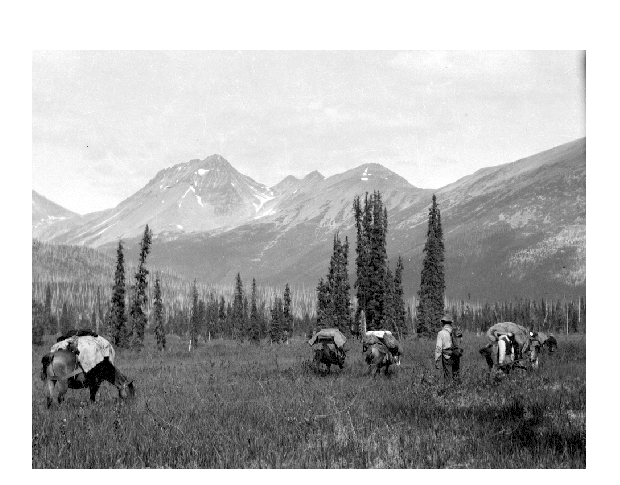
File:Swannell's pack train at the Omineca Mountains.gifWhile my heart will ever belong to early nineteenth century England, I’ve had a lot of fun the last few years delving into nineteenth century history closer to home. Those of you who have followed the Frontier Bachelors series will remember Levi, the youngest fellow in the Wallin clan, and his penchant for getting into trouble. It will come as no surprise that, once he reached manhood, he chafed under family rules and headed out to seek his fortune. Alas, the timeline of the story precluded him from being a 49er (he was born in 1849) or rushing to the Klondike (he would be 47 in 1896). Instead, I had to find another location that would have drawn him for (what he thinks are) easy riches.

I decided upon Omineca.

If you haven’t heard of it, don’t feel bad. (In fact, I can think of one of our loyal readers who might recognize the name. We’ll see if she comments.) The area is in the mountains of a quiet little corner of British Columbia, and the strike was kept relatively quiet compared to other gold rushes. But the location and timing made it possible for Levi to both hear of it and reach it from frontier Seattle.

In 1869, the Peace River Prospecting Party, organized with funding from the colonial government and local businessmen, discovered gold in a bubbling creek in the area. They named the spot Vital Creek after one of the party leaders, Vital LaForce, and vowed to return without alerting any rivals. Unfortunately, between their rush to return to the site in the dead of winter, when most prospectors headed into town, and LaForce’s lavish spending, word leaked out, and papers in towns nearest the strike urged everyone to drop what they were doing and go strike it rich.

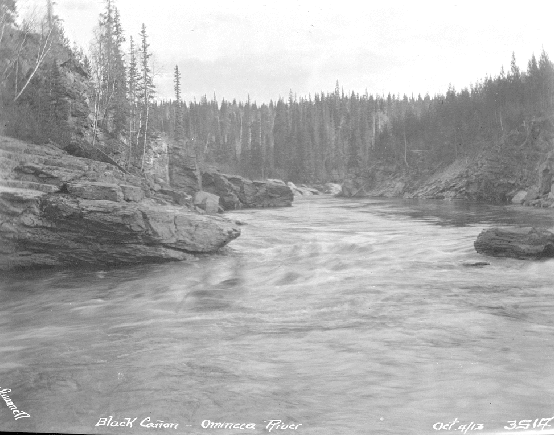
File:Omineca River.gifSoon about 250 people had claims in the area. The colonial government improved roads, laid more rail track to get closer. As the town swelled to 400, industrious types built a bakery, salon, and coffee house. One of these was Twelve-Foot Davis, a legend of a man, who gained his nickname from finding gold on no more than 12 feet of riverbank.

The introduction of sluice boxes increased the daily yield of gold, until nearly everyone was doing rather well. Estimates put peak population at 1,200, and peak gold earnings at $400,000 a year (and I wasn’t clear if that was in today’s dollars or at the time).

Gold continued to be discovered at various creeks and tributaries in the area, and the miners moved on. By the late-1870s, only a handful remained. Even though mining continues to this day, the town of Vital Creek decayed until there was nothing left.

Levi left before then, for he heard another call. More on that in His Frontier Christmas Family, which is available now for preorder and releases December 5.

Friday, September 8, 2017

The Gentlest Wallin of All

Mail-Order Marriage Promise is the sixth book in my Frontier Bachelors series set in pioneer Seattle. Originally, I was only going to have three books in the series—one each for three friends who sailed from the East Coast to the West Coast after the Civil War to become brides for frontiersmen. The friends included Allegra Banks Howard (The Bride Ship), Catherine Stanway (Would-Be Wilderness Wife), and Maddie O’Rourke (Instant Frontier Family). But something funny happened when I wrote Catherine’s story.

I met the Wallins.

Pa Wallin was originally from Sweden. He immigrated to the U.S. and settled in the Great Lakes region, where he met and married Ma Wallin, who had Swedish and English blood. They proceeded to have five boys and a girl, the youngest of which was only four when they set off on the Oregon Trail, ending up in Washington Territory, just north of Seattle.

You see, Pa Wallin had a dream. He envisioned a graceful city along the shores of Lake Union, with parks and bandstands and libraries and schools. He wanted someplace people could feel at home, regardless of where they’d originated. When he died in a tragic logging accident, it fell to his oldest son, Drew, to lead the family and build the town that honored their father’s legacy.

So far, the noble Drew (Would-Be Wilderness Wife), pragmatic Simon (A Convenient Christmas Wedding), and charming James (Frontier Engagement) have had their own stories told. Mail-Order Marriage Promise tells the story of the next brother, John.

John is the dreamer of the family, the peacemaker. John’s strength comes from the books he devours. He  would rather think through a problem then raise his fists and fight to the end. Though Drew, Simon, and James are all within a few years of each other, John is actually 10 years Drew’s junior. He grew up looking at his older brothers as heroes. No one was a strong and dependable as Drew. No one was as smart and logical as Simon. No one was as witty as James. With them for comparisons, it’s no wonder John doesn’t consider himself hero material.

But then, sometimes all it takes is a smile of encouragement, a desperate need no one else can meet, and heroes are made.

I hope you’ll give John Wallin’s story a try. Here are the buy links one last time:

Harlequin   
Kobo  
An independent bookstore near you 
The Book Depository, free shipping worldwide 

Tuesday, September 5, 2017

Keeping a Promise

When you start writing a series for a traditional publisher, there’s no guarantee that you’ll be able to finish it. Tastes changes, priorities shift, lines fade away. Knowing that, I’m pleased that I will be able to finish my Frontier Bachelor series for Love Inspired, telling the stories of siblings John, Levi, and Beth Wallin in 1870s Seattle, beginning with Mail-Order Marriage Promise, releasing today.

Stunned that his sister ordered him a mail-order bride, John Wallin insists he’s not the husband Dottie Tyrrell needs. The scholarly logger knows Dottie will make the perfect wife—for some other man. Yet he’s compelled to invite the lovely widow and her infant son to stay with his family…but only until she can find her own way. 

Dreams of true love are for other women. Betrayed by her baby’s father, Dottie just wants a safe home for her precious child. But who could resist a man with John’s quiet strength? When her secret past brings danger to their door, they may yet find this mail-order mix-up to be the perfect mistake…

Here’s a little taste:

“I can’t deny that the wilderness holds dangers,” John told Dottie, pouring the milk into the steel can. “But my family has worked hard for nearly twenty years to tame the wilderness. If you look closer, you may find things to love about the area.” He set the pail on the floor. “Here, let me show you.”

He held out his hand. She looked at it as if the gesture was foreign to her. Then a shudder went through her. He refused to back down. He couldn’t see her going to sleep this worried.

He almost shouted a hallelujah when she slipped her fingers into his grip.

He led her through the house, pausing in the bedroom doorway to check on Peter, who had indeed fallen asleep, then out onto the porch. The velvet black of the night wrapped around them. He pointed up at the semicircle of stars. “See there?”

He could barely make her out in the darkness, but he saw her shadow move as she must have looked up. “The stars?” she asked.

“Exactly.” He leaned closer, caught that sweet apricot scent. “See that long dip down and across? That’s Ursa Major, the great bear.”

He heard the smile in her voice. “Peter would like that.”

“You might like this one better. See that M shape? That’s Cassiopeia, the queen.”

She must have turned her head to look at him, for he felt her breath brush his ear. “Where did you learn that?”

“I read about it in a book.” He felt a little self-conscious admitting it. Men were supposed to go out and discover things, not sit at home and read about them. “Catherine’s friend Allegra Banks Howard loaned it to me. It had the latest scientific theories about stars and galaxies. Do you know Earth is only one planet among a group of planets, and that group is only one of perhaps millions out there in space?”

“My word.” She sounded as awed as he’d felt when he’d read the book.

“Those stars look like tiny pricks of light to us, but they’re as big, or bigger, than the sun. We’re the ones who are tiny, in the scheme of things.”

“I feel that way sometimes,” she murmured, and he thought she was looking up again.

“But they’re so far away,” John told her. “There’s nothing there to harm us. Now, listen.”

She stilled beside him.

“Do you hear that shush-shush sound? That’s the waves on Lake Union.”


She nodded, and a curl caressed his cheek. “I didn’t know a lake could have waves.”
“I understand larger ones do. Lake Union isn’t that large, but the breeze from the Sound encourages the water to move. Now, take a deep breath.”

She inhaled.

“What do you smell?” he asked.

“Something dry and flowery, and just a touch of brine.”

“The pungent flowery scent is the cedar not far from the house. It’s a massive thing, probably been growing more than a hundred years. I didn’t have the heart to cut it down. I’ll show it to you and Peter. And the touch of brine is Puget Sound, beyond the hill behind us. To me, this is the smell of home.”

She drew in another breath as if she wanted to sense it, too.

He put his hands on her shoulders, turned her to look down toward the main clearing. “Now, see those lights? That’s Drew and Catherine, James and Rina, Beth, Harry, Tom and Dickie. You shout loud enough, and every one of them will come running to help you.” He turned her back to face him. “And so will I.”

“Will you?” Her voice begged him for the truth.

“Always,” John promised. “You’re safe here at Wallin Landing, Dottie.”

He felt her trembling in his grip. He only wanted to assure her that nothing could hurt her, that he wouldn’t let anything hurt her. It seemed only right to lower his head and kiss her.

As he’d expected, her lips were soft and sweet, and something rose inside him, demanding that he protect her, cherish her, take the risk that she could be the one for him.

He’d meant to comfort her, lessen her fears. Why was he the one who was suddenly afraid?

You can find Mail-Order Marriage Promise at fine online retailers and bookstores near you:

Harlequin   
Amazon  
Kobo  
The Book Depository, free shipping worldwide 

Friday, August 25, 2017

The Day Seattle Built a Railroad

The Transcontinental Railroad shaped the course of many a state’s history. The towns it passed through experienced building booms, population booms, business booms, at least in the short term. The towns it bypassed in some cases shriveled up and died. It shouldn’t be surprising, then, that Seattle reacted badly when its leaders learned that the Northern Pacific Railway had chosen Tacoma to the south as its terminus on Puget Sound. 

Arthur Denny read the telegram aloud from the city center to an eager crowd expecting good news. When they heard the decision was for Tacoma, cries echoed against the single-story buildings. The newspapers decried such an unfair decision. Seattle had the better harbor. Seattle had the Territorial University. How could the jewel of the Sound have been overlooked? Right then and there, the city fathers vowed they would not suffer silently.

They’d build their own railroad.

The plan was ambitious. They would lay trestle across the bay and out to the coal fields being developed on the other side of Lake Washington. From there, they would push the tracks up into the mountains, crossing what is now Snoqualmie Pass but what was then no more than sparsely traveled trail, to wend across the eastern half of the territory to Walla Walla. Think of it. The timber, salmon, and coal from Seattle heading to the burgeoning agricultural depot of the state, a major supply center for the gold mines in Idaho. Their fortunes were made.

It didn’t matter that they lacked any expertise in laying track or building the structures needed to span bays, rivers, and mountains. Within a week they had elected commissioners for the Seattle and Walla Walla Railroad and filed articles of incorporation. It didn’t matter that they lacked funding. They issued $10 million in stock. You could buy it for $100 a share, or you could pay in-kind—by working, lending tools, or splitting wood for railroad. They had vision, they had purpose. They had the will of the approximately 800 people who called Seattle home.
File:A.A. Denny, Seattle's first steam locomotive (5017555191).jpg

For nearly a year, the papers kept the story alive. On May 1, 1874, canons boomed and the Seattle band played while every man, woman, and child in Seattle marched out to a spot some 3 miles south of the city to begin felling trees and clearing the way for the track that was to be laid. Everyone, from Mayor Henry Yesler to the most common sawmill worker, helped for free. The men did the heavy work; the women brought food and drink for a massive picnic to keep their spirits and energy up. Together, they managed to clear and grade 1 mile that day, and 12 miles by the end of October, when weather made it more difficult to work.

The Seattle railroad never did make it over the mountain, but it did arrive at the coal mines, bringing tons of the black gold to ships waiting in the harbor. You might say it was a labor not of love but of justification.


And speaking of labor, Marissa and I will be off next week and the week after for Labor Day, but come back September 5 to celebrate a new release in the Frontier Bachelors series, in which the Seattle May Day picnic looms large, Mail-Order Marriage Promise.

Friday, March 17, 2017

All the News That Was, and Wasn't

I’m doing research. Lovely, lovely research. When I’m starting to plot a new Frontier Bachelors book, I read newspapers from the months in which I’m thinking about setting the tale. I like to see what was happening in Seattle, from a citizen’s point of view (or at least an editor on the other side of the Sound). I discovered the germ of the idea for A Convenient Christmas Wedding that way. I was fairly sure Beth Wallin’s story would be set in the spring of 1875, and I’d seen a mention online that there’d been a diphtheria epidemic in March. I never did find mention of the epidemic, but what I did find amazed me.

Much of the news wasn’t exactly news. 

Take this gem from the March 25, 1875, issue of the Puget Sound Dispatch:

“A Philadelphia youth was recently married to a girl who had refused him eighteen times. He wishes now he hadn’t asked her but seventeen.”

Or this

“We call the attention to Mr. Bergh [authority in the school system at the time] to the fact that the wolves are in a starving condition in Wisconsin. Any children sent there will be forwarded from Milwaukee.”

Or this

“Julia Ward Howe is organizing a literary club in Washington [D.C.]. In conjunction with it will be a free night school for carpet-bag representatives who cannot spell words of more than two syllables.”

Ouch!

The Weekly Argus of around the same time included a short story called Eurella, about a girl who put on airs because of her fancy first name and lived to regret it.

Then there was this, supposedly taken from a paper in Vineland, New Jersey:

“Mr. Carruth, editor of a paper published here, was fatally shot this morning by Chas. K. Landis, known as the father of Vineland. The affair rose out of an article in the paper, which Landis tho’t referred to him, but in which no names were mentioned.”

Maybe there’s a reason the Dispatch editor chose to use more stories without local people in them!

That issue does go on to describe massive parades celebrating St. Patrick’s Day in Chicago, Philadelphia, and New York.

So, Happy St. Patrick’s Day!

Friday, January 20, 2017

Nineteenth Century Heroines: Schooling the Others

As many of you know, my most recent series, Frontier Bachelors, involves a number of heroines who were Mercer Girls, ladies who came with Asa Mercer to help settle Seattle after the Civil War. My fictional heroines are among the real-life second batch of approximately 60 ladies Mercer brought in 1866. His earlier trip in 1864 netted him a 11 women, all of whom married and helped civilize the frontier. All, that is, but one. 

I first started researching the Mercer Belles when I was in high school. At the time, one of the reports I found stated something along the lines of the following: “I always wondered why Lizzie Ordway never married. Then I saw her picture.” I thought the comment unkind then. Now I know it’s untrue on every level.

Mary Elizabeth “Lizzie” Ordway, was born on July 4, 1828, in New Hampshire. Perhaps arriving into the world on such an auspicious day imbued her with a certain spirit of independence. Certainly no one would have expected a small woman with somewhat protruding gray eyes and dark hair to be quite so outspoken, but Lizzie was no shrinking violet.

The oldest of Mercer’s group at 34, she came West to be a schoolteacher. Though gentlemen came calling as she stayed with Seattle pioneer Henry Yesler and his wife, Lizzie wanted to work. As her comrades were wooed and wed, she taught at Coupeville on Whidbey Island, then returned to Seattle as the first teacher at the newly built Central School. When more than 100 children showed up the first time she rang the bell, she “sent the youngest home to ripen” and convinced the school board to hire another teacher. After serving in other schools around the area, she ran for Superintendent of Schools for Kitsap County, a remarkable feat for a woman in those days. One of the regional newspapers even ran an editorial claiming that putting a woman in such a position only served to diminish the role. Lizzie was elected nonetheless.

Her other accomplishments are no less impressive. She joined with Susan B. Anthony to found the Female Suffrage Society in Seattle and lobbied in the state capitol for women’s rights. She was part of the County Education Board, examining and certifying teachers. She helped prepare Washington State’s educational exhibit for the 1893 World’s Fair in Chicago.

Lizzie passed away at 69. She is said to have called herself “The Mercer Girl who reserved her affections for her students.” Aptly, an elementary school on Bainbridge Island across from Seattle is named for her.

Friday, November 4, 2016

Christmas, Frontier Style?

A Convenient Christmas Wedding, out now from Love Inspired Historical, isn’t my first Christmas story. I’ve written two others, both set in Regency England. Now, admittedly, the characters in my Regency stories and those in my Frontier Bachelors stories not only come from different sides of the Pond but different social strata. So, I was a little surprised by the similarities, and the differences, between how the two celebrated Christmas.

As Marissa and I have shared, Christmas in the early part of the nineteenth century in England wasn’t nearly as elaborate as it became later. But by 1866, when my story, A Convenient Christmas Wedding, takes place, both England and America were fond of celebrating. As you can imagine the grand Christmas tree that might grace an English country home didn’t exactly fit in a frontier cabin. And not everyone who celebrated Christmas came from the English/Scotch/Irish traditions that included plum pudding.

My Wallin family originated in Sweden, though Mrs. Wallin, the matriarch, has some English blood. So it seemed logical to me that their family celebration would be an amalgam of the traditions, with a few American favorites thrown in. So, they bring in the Yule log, as some of my English characters did, but they also hang stockings by the fire on Christmas Eve for Father Christmas (not Santa Clause) as was becoming popular in America. Here’s the scene where Nora, my heroine, first becomes aware of the custom.

“We were just waiting for you and Simon,” Mrs. Wallin said, coming to take Nora’s cloak. “But I think I see something in your stocking.”

She couldn’t help the tingle of anticipation as she looked to the hearth. Sure enough, her stocking bulged. She glanced at Mrs. Wallin, who nodded toward the fire. “Go ahead, dear. See what Father Christmas left for you.”

Nora ventured to the hearth, even as Levi and Beth pounced on their stockings, and the others moved closer to inspect theirs as well. Nora pulled the stocking from the nail and reached inside to find a tangerine, a handkerchief embroidered with her initial, a knit scarf of a familiar-looking purple heather yarn and a book of poetry.

Simon’s stocking, hanging next to hers, looked significantly less thick.

Glancing around to make sure no one was looking, she slipped her hand in his stocking. Her fingers met the rough edge of a rock.

Oh, no. She would not stand for Simon getting coal. She pulled out the rock and tucked it in her pocket. Then she put in her tangerine. She couldn’t very well give him the handkerchief or the scarf, but after a moment’s thought, she slipped in the poetry book as well.

The door opened just then for Simon, a bucket of milk in hand, and Nora scampered back from the hearth. Fleet bounded in on his heels, going from person to person and saying hello. The others were examining their gifts and exclaiming over the thoughtfulness. Mrs. Wallin had a new comb for her hair, edged with pearl beads that looked suspiciously like the ones Beth had purchased. Beth had received the latest issue of Godey’s and was already curled up in her mother’s rocker scanning the pages of the famous ladies’ magazine. John was fingering a fishing lure. A loud metallic hum proved that Levi had found a harmonica in his stocking and was trying it out.

Nora could hardly wait for Simon to peer into his stocking. But he didn’t go near the hearth even after he left the milk in the kitchen. Instead, he came up to her with a smile.

“And did Father Christmas reward you for your kindness?”

“Yes,” she said, holding up her handkerchief and scarf. “Aren’t they lovely?”

“Not as lovely as you,” he murmured.

Nora caught her breath.

“Go on, Simon,” James called. “You haven’t looked in your stocking yet.”

Simon turned and looked to the stocking. Then he frowned and wandered closer.

Nora let out her breath. He was only being kind. She knew she wasn’t lovely. But the words had sounded so sweet.

His mother looked over as Simon scrutinized the book of poetry. “It seems Father Christmas was a bit mixed up this year,” she said with a look to James.

“I’ll say,” James agreed, tossing his tangerine in the air and catching it. “First time in years Simon hasn’t gotten coal. But I’m not sure love poems are any more use to him.”

Love poems? She should have paid more attention to the title!

Simon pocketed the book. “I can assure you, James, that I’ll find a use for them.” He looked to Nora.

Oh, my!
~~~~
Now, that sounds like a Christmas worth celebrating, in any time period. For your convenience, here are the buy links one more time:

Harlequin
Amazon
Barnes and Noble
Kobo
iBooks
A bookstore near you
The Book Depository, free shipping worldwide

Friday, August 19, 2016

Cover Reveal: A Convenient Christmas Wedding and a Guest

You know, getting a book’s tone and feel right has to be a daunting challenge for any artist, but especially for the artists of the Love Inspired lines. How many daring cowboys, Amish brides, and Regency lords can you draw and still keep things original and fresh? Yet, I am continually impressed by how they take an author’s jumbled ramblings about her heroine’s raven tresses and her hero’s manly chin and come up with something that captures the story.

Such is the case with my upcoming release, A Convenient Christmas Wedding (November 2016). This is the fifth book in my Frontier Bachelor series. Set during December 1866 in pioneer Seattle, the story follows Simon Wallin, second son of the logging family introduced in Would-Be Wilderness Wife, and Nora Underhill, the seamstress who befriends Maddie O’Rourke in Instant Frontier Family. But just as the artists got the tone right on the cover, so did my editor nail the book in the blurb:

Proposing a marriage of convenience to a rugged logger is the boldest move of Nora Underhill’s sheltered life. In return for Simon Wallin’s protection from her overbearing family, the unassuming seamstress offers prime frontier farmland. But their paper marriage changes when Nora’s greedy brother tries to draw her back into a life of drudgery. Her only option: move to Simon’s farm, and into the center of his loving, unruly family. 

Years of shouldering responsibility have left Simon cynical and reserved. But little by little, Nora’s warmth opens his shuttered heart to joy. With their marriage claim under threat, can this practical arrangement blossom over the holidays…and become a love for all seasons?

As many of you know, I often have an actress or actor in mind when I’m thinking about the physical characteristics of my hero and heroine. The heroine for this one may not be too familiar to some audiences, so I’ll come right out and tell you. It’s Abby Wilde, of Zoey 101 fame. But I encourage you to guess who my provided the physical look for my hero. In fact, if you guess, I’ll enter your name in a drawing next Friday to win a pack of three autographed books: Renee Ryan’s The Marriage Agreement, Louise M. Gouge’s Cowgirl for Keeps, and my Would-Be Wilderness Wife. Don't worry if someone else already made your guess. Just comment to be considered.

So, here are your hints. While he’s not seen as a stud today, in his early career this actor was such a hot Man he should have been put on Ice. He’s wielded a sword as well as a shot gun. Yes, he was a Real Genius back in the day. Want to take a guess?

But wait, there’s more!
I told you a while ago about how covers can evolve over time as readers and seasons change. I’m delighted to report that my first book, The Unflappable Miss Fairchild, has been reedited and given a new cover for your reading pleasure. This cover was designed by Kim Killion of The Killion Group. She also did the covers for my Lady Emily Capers. You can find the format you prefer on Smashwords.

I think that about covers it for this week. Looking forward to seeing your comments.

Friday, March 4, 2016

Rushing for the Gold

The 49ers, the Yukon, Fraser River—where I come from, these names evoke images of dirty men, digging and panning feverishly, in hopes of striking it rich. I was poking around a little this week, pondering sending one of my younger Frontier Bachelors to a gold rush, when I discovered research gold. You see, the nineteenth century truly panned out as a mother lode of gold rushes, and not just in the American and Canadian West with which I was familiar.

Turns out, people have been rushing after gold across the world for centuries. As early as the late 1600s/early 1700s, adventurers discovered gold in the Portuguese colony of Brazil. According to some sources, nearly half a million Portuguese were drawn to the area in hopes of leaving wealthy.

The first major gold rush in the United States was a result of a 12-year-old boy’s fascination with treasure. Conrad Reed found a 17-pound gold nugget in 1799 and brought it home. It must not have looked much like gold, for his parents used it as a doorstop for three years. Only when the boy’s father took the rock to a jeweler did he realize his son’s so-called treasure really was gold. And that set off more than 30 years of panning, placer mining, and even deep vein mining in the area.

Next up was Georgia in 1828. The Blue Ridge Mountains had been rumored to be the site of Spanish mining from the 1600s, but no one had been sure of the location of the mines. Nuggets found in various creeks resulted in boom towns springing up. At one time, inhabitants numbered more than 10,000 (the population of Washington, D.C. was only a little more than 13,000 at the time and was the ninth largest city in America).

The 1840s and 1850s saw gold rushes in California, British Columbia, Colorado, Nevada, and Australia. Idaho, northeast Washington, New Zealand, Arizona, Montana, and Oregon followed in the 1860s.

Gold mining flourished in Wales from 1862, with up to 10,000 prospectors journeying into the area. In 1868, gold fever hit the Scottish Highlands. Finland and South Africa followed, with South Dakota and Wyoming right behind. 1883 saw a gold rush in distant Tierra del Fuego, with people coming from all over the world to participate. They built the first towns in the area. Finally, near the turn of the century, the Yukon and Alaska beckoned, with more than 100,000 prospectors all told.


All in all, those following the gold rushes settled new lands and pushed back the frontier. They left parents, wives, sweethearts behind. Some made their fortunes in the rich mineral deposits. Others made their fortunes selling supplies to the needy miners. Unfortunately, they also drove out indigenous peoples and, in some cases, started wars.

All for the sparkle of gold. 

Friday, January 15, 2016

Pioneer Legends: Charles Terry

In Instant Frontier Family, heroine Maddie O’Rourke has reason to doubt the character of the rival bakery owner in Seattle, Charles Terry. But Maddie may have judged too harshly. In fact, according to early historian Clarence Bagley, “Charles C. Terry was recognized as one of the most honorable men and trusted citizens that Seattle has ever known.”

If one word sums up Terry, it would be entrepreneur. He left his home town of Waterville, New York, at age 19 for the California Gold Rush. But the gold must not have been enough for this enterprising young man, for he headed north when he was 21 and met up with the second half of the Denny party, among the first settlers to the Seattle area. Journeying to Washington Territory, he joined his brother Lee, who was already hard at work building the first cabins. Some sources credit Terry with naming their little establishment New York. But someone must have wanted to temper the enthusiasm, but the native word “Alki” to the name, meaning “by and by,” was appended to the name.

According to some chroniclers, Terry had already figured out from the Gold Rush that the path to fortune wasn’t in mining, but in outfitting miners. Accordingly, he set up a store in the new town, conveniently positioned to attract passing ships. He also opened his own sawmill for a time. When gold was discovered in the Fraser River, however, he was among those who rushed farther north for a time, although it is possible he was there to sell equipment, not pan for gold. Regardless, he did so well for himself, that he eventually sold his Alki property for land across the bay, in Seattle proper, as well as a farm on the Duwamish River.

In 1856, at age 26, he married one of the few unwed ladies in the area, Mary Jane Russell. They had five children together. He built her the finest residence in Washington Territory, a white house with brick-a-brack hanging from every eave. It once stood at the corner of Third and James and made Maddie O’Rourke dream of finding similar success. He opened the first bakery, built the first cracker mill. He was one of the first town trustees. And he generously offered land to make up the 10-acre tract required to attract the first Territorial University to Seattle, a school that would become the University of Washington.

Sadly, Terry died young, at only 37, approximately three months after the story ends in Instant Frontier Family. Very likely he had consumption (tuberculosis). He died one of the wealthiest men in the area, and clearly one of the most respected.

I’m sure Maddie would have been his friend long before then.