

Showing posts with label pioneer legends. Show all posts

Friday, January 25, 2019

Nineteenth Century Heroines: Standing in No One’s Shadow

I have written about Ezra Meeker before. He’s something of a hero in my neck of the woods, or at least he was when I was a girl. So I was delighted recently to learn that he wasn’t the only exceptional person in the family. His wife Eliza Meeker deserves as much recognition.

Eliza Jane Sumner Meeker was born in 1833. She and Ezra were childhood sweethearts in Indiana, their parents’ farms being located nearby. Where Ezra appears to have been the visionary, Eliza was the practical one. Ezra told her he wanted to be a farmer, and she agreed to marry him when she was only 18 so long as he agreed to own the land. That proved difficult for the young couple, who had little money. In less than a year, they decided to head west for Oregon Territory. A tiny woman just over four feet tall, she carefully prepared and packed their food for the trip. Unlike many on the Oregon trail, they never ran out, and nothing spoiled in their six-month journey. And Eliza started out the trip with an infant only 7 weeks old.

Ezra was nothing if not mobile. The couple settled first in St. Helens, Oregon, but staked their first claim across the Columbia River in what would become Kalama. But Ezra wanted more, better, and so they headed north, settling on McNeil Island across from the town of Steilacoom. Still not good enough. He sold their claim, which would eventually become the site of the McNeil Island Correctional Facility. He bought land in the south end of Tacoma, what is called the Fern Hill area today but went by the charming name of Swamp Place back then. Eliza managed the garden and orchard he put in. Still not enough. He had the brilliant idea of growing hops for beer, choosing a claim in the Puyallup Valley. And he made a fortune.
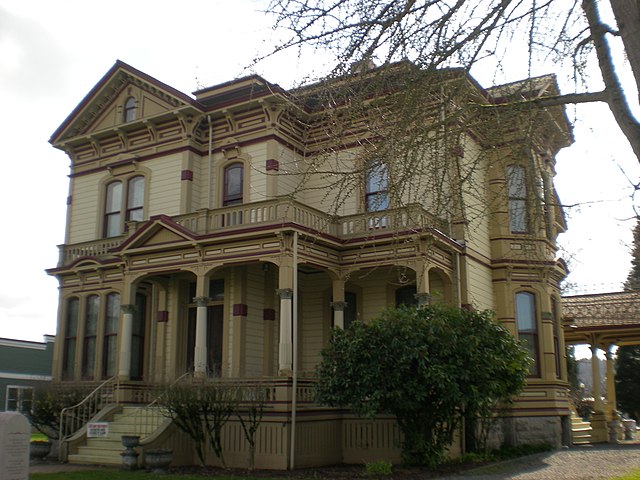
That was enough for Eliza. She asked for half the proceeds of the sale of their last land claim and used the money to build herself and their six children a house, in her name. Not just any house. The Meeker Mansion, which still stands today, cost an astronomical $26,000 then and took 3 years to build. Eliza allowed an Italian painter to live with them for a year while he painted the murals on the ceilings. The house was wired for electricity long before Puyallup had any. Eliza even picked out and arranged for the furniture to be shipped, some all the way from Europe. The year the house was finished, in 1890, she donated their old cabin and land for a city park and served as the first “first lady” of Puyallup when Ezra became the first mayor.

While Ezra was busy running things, Eliza championed the first Puyallup library and was an avid supporter of the suffragette movement. She even attended national meetings. Then a blight went through the hop fields, and they lost everything. Ezra decided to seek his fortune in the Yukon. Eliza had a better idea. She dried 30,000 pounds of vegetables, which Ezra took north to sell in Dawson City. To protect her beloved mansion from being sold to pay their debts, she sold it instead to her daughter Caroline and husband, with the provision that she and Ezra be allowed to reside in the house until their deaths.

Eliza died in 1909, leaving behind a family and a legacy that would not be soon forgotten.

Friday, January 15, 2016

Pioneer Legends: Charles Terry

In Instant Frontier Family, heroine Maddie O’Rourke has reason to doubt the character of the rival bakery owner in Seattle, Charles Terry. But Maddie may have judged too harshly. In fact, according to early historian Clarence Bagley, “Charles C. Terry was recognized as one of the most honorable men and trusted citizens that Seattle has ever known.”

If one word sums up Terry, it would be entrepreneur. He left his home town of Waterville, New York, at age 19 for the California Gold Rush. But the gold must not have been enough for this enterprising young man, for he headed north when he was 21 and met up with the second half of the Denny party, among the first settlers to the Seattle area. Journeying to Washington Territory, he joined his brother Lee, who was already hard at work building the first cabins. Some sources credit Terry with naming their little establishment New York. But someone must have wanted to temper the enthusiasm, but the native word “Alki” to the name, meaning “by and by,” was appended to the name.

According to some chroniclers, Terry had already figured out from the Gold Rush that the path to fortune wasn’t in mining, but in outfitting miners. Accordingly, he set up a store in the new town, conveniently positioned to attract passing ships. He also opened his own sawmill for a time. When gold was discovered in the Fraser River, however, he was among those who rushed farther north for a time, although it is possible he was there to sell equipment, not pan for gold. Regardless, he did so well for himself, that he eventually sold his Alki property for land across the bay, in Seattle proper, as well as a farm on the Duwamish River.

In 1856, at age 26, he married one of the few unwed ladies in the area, Mary Jane Russell. They had five children together. He built her the finest residence in Washington Territory, a white house with brick-a-brack hanging from every eave. It once stood at the corner of Third and James and made Maddie O’Rourke dream of finding similar success. He opened the first bakery, built the first cracker mill. He was one of the first town trustees. And he generously offered land to make up the 10-acre tract required to attract the first Territorial University to Seattle, a school that would become the University of Washington.

Sadly, Terry died young, at only 37, approximately three months after the story ends in Instant Frontier Family. Very likely he had consumption (tuberculosis). He died one of the wealthiest men in the area, and clearly one of the most respected.

I’m sure Maddie would have been his friend long before then. 

Friday, October 2, 2015

Pioneer Legends: Doc Maynard

Those of you who have read Would-Be Wilderness Wife may remember that the heroine, Catherine Stanway, initially worked as a nurse for Doctor David Maynard. I didn’t make him up. Doc Maynard was one of Seattle’s founding fathers, and, in my opinion, one of the most colorful. I wish I had a picture to use, but all were copyrighted. You can find one here at the Museum of History and Industry in Seattle. 

David Swinson Maynard came to Seattle in 1852, before it was even a town, but his story starts on the other side of the country. After earning his medical degree and marrying a pretty lass named Lydia, he moved his young family to Cleveland, where he dabbled in business while running a medical school. Misfortunes in both made him decide to strike it rich in California, but he met two things along the way that would change his life.

The first was cholera. Everyone had it, and anyone who survived after his treatment was more than happy to pay him in food, animals, and money. He’d never made so much money being a doctor before. The second was a widow of one of the men he unsuccessfully treated. Catherine Broshears was beautiful and sweet, and he decided to accompany her to Olympia in what was then Oregon Territory instead of the Gold Fields. Along the way the pair fell in love, but her brother refused them permission to marry. It may have been the fact that Maynard was so quick to fall into and out of fortunes. But it may have had more to do with the fact that her brother suspected that the divorce Maynard convinced the territorial legislature to grant him wasn’t strictly legal.

Either way, Doc relocated to the Seattle area. He started out paying the natives to package up wood and salmon to sell to folks in San Francisco, then used that money to open a store. From there, he claimed a tract of land for himself and his wife before convincing Catherine’s brother to let him marry her. But that was just the beginning of Maynard’s influence on Seattle:

  • He convinced the settlers to name the new town after his friend, Chief Sealth.
  • He was the first Justice of the Peace in King County, and even studied law, being admitted to the bar in 1856.
  • He is responsible for the odd angle of downtown Seattle streets, because he plotted the streets on his claim according to the compass points, while his neighbors insisted on following the line of the shore.
  • He was one of Seattle’s first post masters, hosting the post office at his store (and guaranteeing he’d have regular shoppers).
  • He sold his lots cheaply or gave them away to people he thought would be good for the city, such as Henry Yesler, who built the first sawmill on Puget Sound, and Lewis Wyckoff, a blacksmith and later one of Seattle’s first lawmen.
  • He opened the first hospital in Seattle, an enterprise that failed because he insisted in treating whites and Native Americans alike, and he never demanded payment.
Perhaps one of the most famous stories about Maynard has to do with his wives. It seems that Lydia was never told of the divorce and wrote to him about her share of his acreage. Legalities being what they were, she had to come to Seattle to be part of any settlement. According to historian Murray Morgan, Doc went down to the shore to meet her when she came in on the ship. He told a friend, “You’re about to see something you’ve never seen before: a man out walking with a wife on each arm.” Seattle gawked as Maynard did just that. Lydia stayed with him and Catherine for a while until the legal matters were settled. Sadly, because Maynard had not been married to Catherine at the time of filing, and Lydia had never lived on the claim as is required of a wife, he had to give up half his acreage.

Doc still went out in style. When he died in 1873, Seattle held the largest funeral for that time. And the stories of his exploits are still told with fondness around the shores of Puget Sound.


Friday, August 14, 2015

Pioneer Legends: Daniel Bagley

[The winner of a signed copy of Frontier Engagement is Daisy! E-mail me at reginascott@owt.com, Daisy, and I’ll send it right out to you. Congratulations, and thanks for commenting!]

In middle school and high school, I had two dear friends, sisters who shared a certain last name. Though we lost track of each other for a while, we recently reconnected as a result of the efforts of another friend. One of them told me that she was delighted to find their last name gracing a “character” in my Frontier Bachelors series. But I didn’t make up minister Daniel Bagley, who has a key scene in Frontier Engagement. He was one of those real-life characters who made Seattle great.

Daniel Bagley was born into a farming family in 1818 Pennsylvania, but he must have had an urge to wander from an early age, for he married when he was only 22 and promptly whisked his wife Susannah off to settle an Illinois prairie. He was ordained a Methodist minister in 1842 and took on the role of circuit preacher, riding all over the state. Ten years later, he was on a wagon train heading west to settle near Salem, Oregon. There he served as a missionary establishing churches.

The legend goes that his wife’s health drove him north to seek the “clean air” of Puget Sound. I’m not entirely sure how Puget Sound is any cleaner than Salem at that point in history. Supposedly they came by horse-drawn buggy, but I’m finding that one difficult to believe since it appears there were no roads leading north from the Portland area to Seattle until much later than 1860, when Daniel and his wife and 17-year-old son Clarence arrived. However, he reached Seattle, and whatever encouraged him to come, he started out as an agent of the American Tract society, passing out pamphlets to those who needed to repent, until he oversaw the building of what would become known as the Brown Church (as opposed to the only other church in town, which was painted white). Daniel was its first minister, preaching on Sundays and performing marriages, christenings, and baptisms for many of Seattle’s founding families.

But Daniel wasn’t content to minister only to their souls. He wanted to minister to their minds as well. He was one of the driving forces behind locating the territorial university in Seattle (what would become the University of Washington). When the legislature was persuaded to make the offer, he encouraged local landowners to donate sufficient land to make the dream a reality. He also served as president on the university board of commissioners and appointed Asa Mercer as the first university president.

And it seems he supported young Asa in other ways. He had known Asa through Asa’s brother Thomas, who originally journeyed west in the same group as Daniel. Asa worked as a laborer to craft the first building for the fledgling university. But Asa too had a dream: bringing brides to wilderness bachelors.

As we’ve seen, there are two schools of thought on Mr. Mercer’s attempts to bring young ladies from the East to “civilize” Seattle. Some thought him a visionary; others a cunning confidence man. Either way, his second voyage was plagued with rumors of financial improprieties. When a number of the women refused to marry gentlemen who claimed to have paid for their passage, Seattle erupted in controversy.

Mercer hired the use of Yesler Hall (also known as the sawmill’s cookhouse) to make his case to the good citizens of Seattle. Daniel oversaw the meeting. Supposedly Mercer’s persuasive arguments and the backing of several of his lovely charges swayed Seattle to see things his way. Daniel later married Asa Mercer to Anne Stephens, one of the women he’d brought with him. Very likely Daniel officiated at more than one marriage of Mercer’s Belles.

But he didn’t stop his wanderings. He managed the Newcastle coal mines on the east side of Lake Washington for a time, then went back to circuit riding, preaching at a number of churches in the area. He died at age 87 and is buried beside his wife in Seattle. Their son Clarence went on to become one of the area’s earliest historians, penning multivolume histories of Seattle and King County, histories to which I owe much of the information in my Frontier Bachelors stories.

So you see, I owe a lot to the name of Bagley, in fiction and in real life. As Rina likes to say, no one ever replaces a true friend. But if we are very fortunate, we may add to their number. Here's hoping you are very fortunate indeed!

Friday, May 15, 2015

Pioneer Legends: Ezra Meeker

Marissa and I originally started this blog because we kept finding cool things in our research for our stories that we had to share!  As I’m researching my Frontier Bachelors series set in early Seattle, Washington Territory, I’m coming across a number of interesting real-life characters that I know you’ll love.  This post starts an ongoing series on some of these men and women who made the Pacific Northwest what it is today.

The Oregon Trail is a legend unto itself.  Thousands of men, women, and children traversed the country to claim land on the West Coast.  Ezra Meeker and his wife Eliza were among them.  Ezra eventually settled in the Puyallup area south of Seattle, where his hop raising made him rich enough to build his wife a mansion that still stands today.  He later lost all his money and tried to recoup it by selling supplies in the Klondike Gold Rush.  But that’s not the most intriguing part of the story.

You see, when Ezra was up in years (70 to be exact, in 1900), he became concerned that people didn’t know or appreciate what the pioneers had accomplished in traveling the trail. Farmers were plowing over the land once crossed by wagon wheels, merchants were building businesses where campfires had kept away the night.  He became obsessed with preserving the trail, wanting to see granite monuments erected all along the route.  After careful planning, he decided to travel backwards along the trail, by ox-drawn covered wagon, to raise awareness and funds to purchase the markers.  He set out in 1906 with his trusty oxen Dave and Twist, an amiable collie named Jim, and, eventually, a driver and cook named William Mardon, to speak about the trail and convince towns to place his markers. 


The way wasn’t easy.  Some towns refused to support him, unwilling to help an “old man” die out on the Plains or in the mountains.  Twist did die along the way, and no other cow or ox would pull with Dave until Ezra lucked into a similarly sized ox named Dandy. When speaking fees failed to pay for his travels, he started selling postcards of pictures taken on the journey.  Some towns put in markers while he was there; others put them in after he’d left.


It took him nearly two years to make it across the country, traveling beyond the start of the trail into Pennsylvania and New York.  Though he was nearly arrested in New York City, he ended up getting his picture taken on Wall Street and driving across the Brooklyn Bridge. He then headed to Washington D.C. where his state congressional delegation had arranged a meeting with President Roosevelt, who was pleased to discuss Meeker’s vision.  At that point, Meeker had earned enough money after his expenses to send the wagon and team home by boat and train, with only a few miles of pulling across land.


But that wasn’t his last trip along the trail.  When Congress began discussing appropriating money for markers in 1910, Ezra spent another two years charting the path so the markers could be placed accurately.  He continued promoting the trail at every major event along the Pacific Coast for another decade.  When Dave and then Dandy passed away, he had them stuffed and donated them to the Washington State History Museum.  He traveled the trail again by automobile in 1916 and met with President Wilson and again in 1924 by airplane and met with President Coolidge. In 1925, he spent some months driving an ox team for a wild west show. He even published a romance novel about the Oregon Trail.  He was on his way once more along the trail, in an automobile designed for him by Henry Ford, when, in 1928, he died of pneumonia just short of his 98th birthday.

I grew up hearing stories of Ezra Meeker’s exploits.  Every year in elementary school, we would tour the Washington History Museum and gaze in awe at Dave and Dandy.  Although I understand the wagon is no longer strong enough for display, the valiant oxen remain standing, teaching new generations about the triumphs of the Oregon Trail. 

I think Ezra Meeker would be pleased.