
Showing posts with label pastimes. Show all posts

Friday, March 16, 2018

Let's Bat That Around


A craze swept 1875 Seattle, a game of skill and stamina dating from ancient times. It was played from the fine houses on the hill to the logging camps in the woods. The game you ask?

Battledore and shuttlecock.

Likely the forerunner of badminton and popular in India and China, battledore and shuttlecock was far simpler. All one needed to play was a small racket made of wood either covered with parchment or strung with gut (the battledore) and a cork stuck with feathers (the shuttlecock). One could play alone, but it was commonly played in pairs.

The idea was to keep the shuttlecock in the air as long as possible, so you needed to take into account the height and reach of your partner and well as your own. You might also consider the wind, which could catch the shuttlecock and send it spinning away. Supposedly the record for number of hits in the nineteenth century was set in Somerset, England, at more than 2,000 times!

Battledore and shuttlecock was a children’s game during Regency England and well into the late 1800s. Jane Austen played the game with her nephews. As I was looking for pictures to accompany this blog, I stumbled across this one dating from the 1700s:


Supposedly, the satirical cartoon makes fun of ladies' fashions with feathers and hooped skirts. I couldn’t help wondering if there was a deeper meaning. Russia and England playing with France, for example?

Even though England embraced badminton beginning in the early 1870s and the game eventually made its way to America, battledore and shuttlecock remained popular on the frontier for some time.

I’ll give you something else that might be popular on the frontier—I’m guest blogging today on Petticoats and Pistols, a blog devoted to romancing the West, yesterday and today. Stop by and say hi. 

Friday, February 2, 2018

More Than Pretty Pictures

File:Lyme Park 2014 01.jpgLast week I had the privilege of sitting in on a Regency architecture class given by the incomparable author Cheryl Bolen. Her collection of pictures illustrating both exterior and interior styles, as well as landscapes, are nothing short of brilliant. And you can find them all here on Pinterest. Cheryl has curated pictures of furniture, paintings, various rooms in the country houses and town houses of the rich and famous in England during the early years of the nineteenth century. She even has floor plans. Well worth the look.

And while you’re on Pinterest, might I recommend the following author's and their boards:

Joanna Waugh. Joanna has collected a number of interesting Regency era illustrations, including pictures of Almack’s, Regency performers, arts and crafts, and beekeeping. 

Cora Lee’s Regency Women’s Fashion. All of Cora’s boards are fun (she had me at Historical Dr. Who), but the fashion page is particularly top notch. 

Ann Glover’s Regency pastimes. You’ll find a wealth of information from author and blogger Ann as well, but I loved this board with some pastimes you might not have expected. 

And may I mention that I now have a Regency pets board, with portraits from the late 1700s and early to mid-1800s of people and animals? 

All in all, these are far more than pretty pictures. They are treasures to those who love to read, and write, about the nineteenth century.

Photo by Mike Peel (www.mikepeel.net).

Tuesday, August 15, 2017

Retro Blast: Summer Amusements

Since this post was originally from December 2014, the Goya exhibit is no longer at the Museum of Fine Arts...but roller skates will never go out of style. ☺

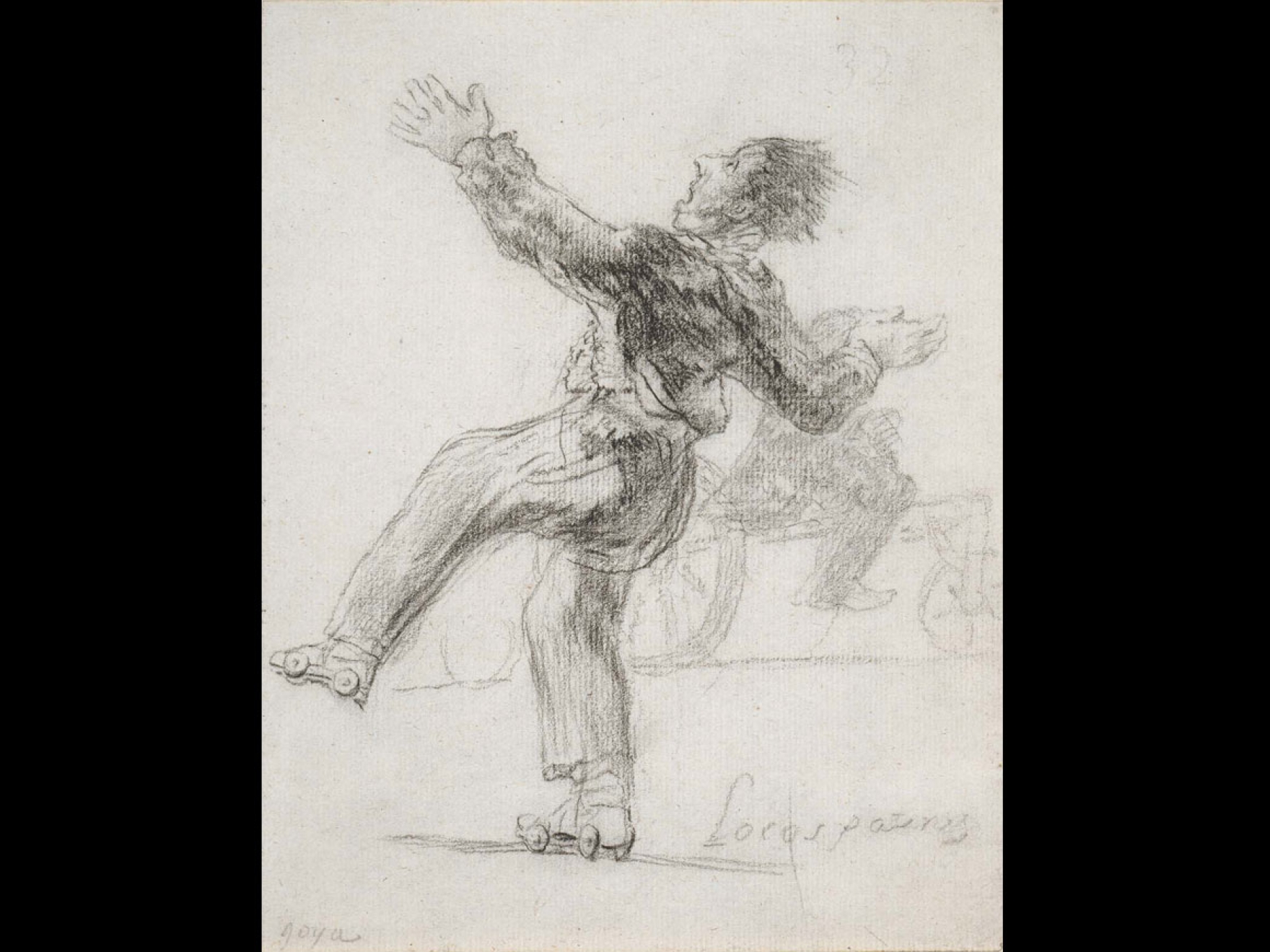
A few days after I discovered (to my enormous glee) that yo-yos were all the thing in the 1790s, I happened upon an article in the Boston Museum of Fine Arts magazine MFA Preview. There’s a very fine exhibit of the work of Spanish artist Francisco Goya on display there right now, but what really grabbed me was a reproduction of a sketch he made some time in the mid 1820s that’s part of the exhibit—I don’t have permission to reproduce it here, but you can see it in the exhibit preview slideshow on the Museum of Fine Arts website. The sketch was made sometime between 1824 and 1828, when Goya was living in Paris, and is entitled “Locos Patines”... or “Crazy Skates”—and it shows a rather alarmed gentleman wearing roller skates. Yes, roller skates—and if you look carefully at the background, you’ll see someone riding a hobby-horse, the precursor of the bicycle.

So of course I had to look into the history of roller skates, which actually date back to the mid-18th century and were first seen either on the London stage in 1743 (presumably in a dance number!), or in the Netherlands at some point in mid-century on the feet of an anonymous gentleman who wished to go ice skating in the summer, depending on whom you ask. A John Joseph Merlin seems to have been making an early form of in-line skates in England in 1760, and the first patented skates appeared in France in 1819, also with an in-line wheel configuration (which makes sense, if you consider that people were indeed trying to ice-skate without ice.) An English patent followed in 1823 for the Volito, another in-line skate design, with wheels in graduated sizes which enabled easier turning (that's it, above right.) By the late 1850s, public roller skating rinks were opening in London.

Curiously, all the internet sources I researched state that skates with four wheels situated two on either side of the foot weren’t invented until the 1860s in New York...but there in the Goya sketch in the 1820s we have skates with just that configuration. I have the feeling there was a great deal of experimentation going on with their design...but who knew that roller skating was another popular 19th century pastime!

I wonder if the young Princess Victoria ever tried roller skates? :)

Tuesday, December 20, 2016

Fish, Precioussssss...

Ah, holiday customs. At my house, we’ve developed a new one over the last year or two: after exchanging presents and eating Christmas dinner and pulling crackers (we lurrrrve Christmas crackers!) and nibbling at dessert, we usually play a rollicking game of Cards Against Humanity (my 81-year-old mom is a huge fan!)  Although I would dearly love to write a Regency version of CAH some day (imagine the scurrilous things one could come up with to say about Prinny’s personal life!), Regency family games were themselves somewhat less, er, naughty...and also a lot prettier.

Those of you who obsess over details in books (umm, like me) might remember certain references in Pride and Prejudice to family games: “...Lydia talked incessantly of lottery tickets, of the fish she had lost and the fish she had won....”  and in Georgette Heyer’s The Grand Sophy: “...Gertrude...and Amabel...cast themselves upon their brother, with loud professions of delight at seeing him, and rather louder reminders to him of a promise he had made them to play at lottery-tickets the very next time he should spend an evening at home....The card-table had been set up, and Amabel was already counting out the mother-of-pearl fishes on its green-baize cloth.”

(Pause to re-read the hilarious ending of The Grand Sophy.  Ahem.)

No, Lydia was not crowing over winning anchovies. Nor was Amabel handing out minnows, but these handsome little guys. The game was called “lottery tickets,” and was a game of pure chance; utilizing two decks of cards, it was played in rounds, and fish-shaped markers were used for placing bets (sort of), with the winner of each round getting the fish.

Aren’t they lovely? These are of mother-of-pearl (which is darned difficult to photograph well, I’ll have you know!), likely made in China, but they were also made of bone and ivory. Nor were they restricted to just fish shapes (I haven’t been able to discover ‘why fish?’)  Here are several circular ones from my collection—again, Chinese mother-of-pearl, some very elegantly engraved. The wealthy would have theirs custom-carved with their coats of arms or other heraldic devices.

And more, not round. Squares, rectangles, and other shapes are also seen:

I wonder if there's any way to incorporate my fishy collection into our upcoming Cards Against Humanity game on Christmas? Hmm...

While I ponder that question, I hope all NineteenTeen readers will enjoy a splendid upcoming holiday week full of your own happy family traditions, whether they involve fish or not. 


Tuesday, December 2, 2014

And Speaking of Bandalores...

A few days after I discovered (to my enormous glee) that yo-yos were all the thing in the 1790s, I happened upon an article in the Boston Museum of Fine Arts magazine MFA Preview. There’s a very fine exhibit of the work of Spanish artist Francisco Goya on display there right now, but what really grabbed me was a reproduction of a sketch he made some time in the mid 1820s that’s part of the exhibit—I don’t have permission to reproduce it here, but you can see it in the exhibit preview slideshow on the Museum of Fine Arts website. The sketch was made sometime between 1824 and 1828, when Goya was living in Paris, and is entitled “Locos Patines”... or “Crazy Skates”—and it shows a rather alarmed gentleman wearing roller skates. Yes, roller skates—and if you look carefully at the background, you’ll see someone riding a hobby-horse, the precursor of the bicycle.

So of course I had to look into the history of roller skates, which actually date back to the mid-18th century and were first seen either on the London stage in 1743 (presumably in a dance number!), or in the Netherlands at some point in mid-century on the feet of an anonymous gentleman who wished to go ice skating in the summer, depending on who you ask. A John Joseph Merlin seems to have been making an early form of in-line skates in England in 1760, and the first patented skates appeared in France in 1819, also with an in-line wheel configuration (which makes sense, if you consider that people were indeed trying to ice-skate without ice.) An English patent followed in 1823 for the Volito, another in-line skate design, with wheels in graduated sizes which enabled easier turning (that's it, above right.) By the late 1850s, public roller skating rinks were opening in London.

Curiously, all the internet sources I researched state that skates with four wheels situated two on either side of the foot weren’t invented until the 1860s in New York...but there in the Goya sketch in the 1820s we have skates with just that configuration. I have the feeling there was a great deal of experimentation going on with their design...but who knew that roller skating was another popular 19th century pastime!

I wonder if the young Princess Victoria ever tried roller skates? :)

Friday, August 1, 2014

The Surprising Game of Lawn Tennis

Lawn tennis sounds like such a genteel game.  Can’t you see the ladies in long dresses and gentlemen in natty jackets lobbing balls back and forth across the net on a summer’s afternoon in the nineteenth century?  I fully intended to write a post with the same languid feel to it.  But what I learned about lawn tennis, and its predecessor, “real tennis,” surprised me.

For one thing, the game called real tennis was almost exclusively relegated to royalty in the middle ages.  Kings in Europe and England were rather determined in their pursuit of the sport, building courts and challenging other gentlemen to matches.  And it turns out to have been a rather deadly sport.  King Louis X of France died from a severe chill received while playing.  Charles VIII of France died from striking his head on the way to a game.  When assassins arrived to kill James I of Scotland, he attempted to flee through the sewer, only to find that the drain had been blocked to prevent tennis balls from going astray on the court above it.  Alas, the assassins did not go astray.

For another thing, the courtly sport of real tennis died out with much of European royalty around the time of Napoleon, but lawn tennis, the tennis we know today, began to take form.  Various versions were played around England, but more as an enjoyable pasttime.  However, around 1874, the activity and its terminology became more codified with the publication of rules and the creation of the first tennis club.  Popularity continued to increase, and tennis championships soon followed.  And the ladies soon joined the gentlemen on the court.

That women played tennis competitively so early also surprised me.  The first women’s championships were held in 1879, one in England and one in Ireland.  In 1884, the All England Championships began including events for women players.  Held at Wimbledon, the singles match was won by Miss Maud Watson, who played her sister Lilian Watson for the title.  She won a silver flower basket valued at 20 guineas, while her sister won a silver-backed mirror and brush.  Miss Bingley (grand-daughter or great-daughter of Mr. Bingley, perhaps J) advanced to the quarter finals that year, but won in 1886.  She won again in 1888, but by that time, she had married and was billed as Mrs. G.W. Hillyard.  Those are the lovely Watson sisters in the picture, along with Ernest Renshaw and Herbert Fortescue Lawford, both champions in their own right.  Another important player at the time was Lottie Dod, who won the ladies singles five times between 1887 and 1893.


Ladies doubles were first played at Buxton in 1885, with Mrs. Watts and Miss Bracewell taking the championship.  Another surprise, however, was that ladies and gentlemen played with each other.  For example, in 1888, Mrs. G.W. Hillyard won the mixed doubles championship with her partner Ernest Renshaw.  One gentlemen reminiscing of the early days of tennis recounted how Lottie Dod (at left there) had even bested Ernest in a singles match.

Ernest was the twin brother to William Renshaw, both tennis professionals who played in England and France in the summers and hit the Mediterranean in the winter.  They had a court build on their property to practice.  Ernest appears to have been the lesser light.  He lost to William at Wimbledon three times.  William, on the other hand, won twelve Wimbledon titles, seven for singles, five for doubles partnering Ernest.  One commentary noted that that record for singles has only been matched by Pete Sampras and Roger Federer.

Yeah, about that languid playing? I’m thinking not so much.


Friday, January 24, 2014

Stranded Indoors and Bored? Beggar My Neighbor!

Oh, but it's cold and snowy in many parts of the country!  Here, we're back to our usual bleak, gray winter days, when it seems the sun is never going to shine again.  Winter in nineteenth century England could be as dreary, keeping ladies and gentlemen indoors for days at a time.  While some braved the cold to make calls, others languished at home with family members.  One of the ways to pass the time was playing cards and parlor games.  We've talked about whist and consequences. But there was another, rather all-or-nothing card game that could get, well, a bit tense, if you had the wrong frame of mind.

Beggar My Neighbor.

According to expert Barry Rigal, author of Card Games for Dummies, Second Edition, the game could also be called Beat Your Neighbor Out of Doors and Strip Jack Naked.  Sounds friendly, doesn't it?  This was a game played at a "round table" as opposed to the four-sided whist table for more serious players.  Up to six people could join the game.  One player dealt the cards as evenly as possible among the group.  The other players didn't take up a hand, but squared up his or her cards, face down, on the table.

The player at the left of the dealer turned over the top card on the individual pile.  If it was a numbered card, play would continue on to the next player.  If it was a face card or an ace, the next player had to turn over a certain number of cards--four for an ace, three for a king, two for a queen, and one for a jack.  If none of those cards was a face card or ace, the first player took away all the cards facing up.  If one of them was a face card, the play progressed to the next player, who had to do the same thing.  The player who ended up with all the cards won.

As you can imagine, play could get a little boisterous.  If you've ever played the modern game of Uno with cutthroat intensity, you will understand.  Me, I advocate Patience.

The game.  Patience was another name for solitaire in nineteenth century England.  When it comes to Beggar My Neighbor, I'm an all-or-nothing kind of gal.

And if you are looking for something interesting to do in the cold, allow me to draw your attention to the new gadget to the upper left on the blog.  I was under the impression that "followers" to the blog received our posts via e-mail.  I have lately been informed that such is not the case.  Therefore, Marissa and I have added an e-mail subscription option to the blog.  Put your e-mail address in the box, and Feedburner will send you all our posts from NineteenTeen.  I've signed up myself, just to see how it all works.  I do not believe we have access to your e-mail address or any other information about you, but I will let you know if I discover otherwise.  Given that it's taken me nearly seven years to figure out that we don't have an e-mail subscription, I can say with confidence that your e-mail addresses will be safe from me for some time to come.  :

Now where are those cards?

Friday, August 2, 2013

How to Win the Lottery, Nineteenth Century Style

Millions of dollars at stake, thousands of people lined up for tickets, dozens of schemes covering which tickets to buy and whether to share tickets in a pool of people for maximum impact--sound familiar?  It wasn't unfamiliar to those in early nineteenth century England either.  The government regularly held lotteries from 1566 to 1826, all to help fund state programs such as the development of the British Museum.

In the beginning, the state lottery was actually more of an investment program.  Only so many tickets were sold, and many to wealthy families.  The government held the money in trust and drew interest on it for up to 3 years, then each ticket holder received a share of the prizes.  Imagine--no losers!  Prizes might include silver plate and china as well as money.  But all that changed in the late 1700s to a system more like what we have today--merely a chance to win a certain amount of money.

At the same time, the government awarded contracts to brokers to sell the tickets.  These brokers in turn hired agents who could be rather bold in their attempts to sell the tickets.  Broadsheets advertised the opportunities, and many were quite creative.  One lamented that love was difficult to come by, but money wasn't--just buy a lottery ticket!  Lottery "insurance" men went around badgering people to subscribe, offering the lure of quick riches to a populace sunk in poverty.  Some called the desire to participate "lottery influenza" because it was widespread and pernicious. 


If you couldn't afford the price of a full ticket, you could buy a half, quarter, eighth, or sixteenth, with your prize being commensurately lower.  Though August was a favorite month, with a drawing every Monday and Thursday, other lotteries were held at other times of the year, such as Valentine's Day (not my idea of a romantic way to celebrate!). 

Some felt it immoral to gamble on the lottery.  Others took advantage of the practice.  An entire side industry grew up allowing people to wager on various aspects of the lottery, such as which ticket was more likely to win.  Police advocate and magistrate Patrick Colquhoun estimated that the money raised by such secondary schemes was equal to what the government was getting from the lottery.

Evangelical protests finally led to a change in policy, with the last state lottery of this sort held in England in 1826.  However, the previous activities had influenced the Colonies.  America used a lottery to help fund the War for Independence, which was not quite the winning outcome England had hoped for. 

And if you'd like a chance to win a free book, come back next week for the launch of The Courting Campaign!

(Picture of lottery ticket by Ron Shelley and used under a Creative Commons License)

Friday, June 28, 2013

A Pleasing Silhouette

Has your summer started oddly?  Ours has.  Normally we are at a sunny 90 degrees F by now, but we’ve rarely topped 70 and it’s been raining!  Now I’m told we’ll jump to the triple digits by Monday.  That’s not really conducive to summer activities either.  So what would a young lady do in the early nineteenth century to pass the time?  She might have drawn a silhouette.

There's something elegant about a silhouette, as if the person’s character shines through when details are kept simple. Creating a proper silhouette, an outline of a person’s head and perhaps shoulders, was both a pleasant evening activity for friends and family and a lucrative business for some talented artists.  The very best silhouette makers could look at a person and cut directly on black paper to match features.  Some silhouettes were incredibly detailed, showing curls within hairstyles and even eyelashes. 

For those more inclined to do it themselves, whether from limited funds or a spirit of adventure, silhouettes could be created at home.  All that was needed was a piece of pale paper either tacked to the wall or affixed in a screen and a source of light such as a candle or fire.  The subject sits between the light and the paper, and an enterprising friend or family member traces around the lines made by the shadow cast on the paper.  Once the shape was cut from the paper, you could either put the white silhouette on black paper, or trace around it on black paper and put the transferred silhouette on white paper.

While silhouettes are becoming a lost art, you can still find artists at country fairs, popular shopping malls, and entertainment venues.  This silhouette is of me when I was a baby. 

This one is of my husband when he was a boy. 


This is one of our youngest son, who is obviously a silhouette, er chip off the old block.


If you decide to try silhouettes this summer, be sure to let us know!  And Marissa and I would like to let you know that we are going to take a little vacation for a couple weeks.  Look for a short post on July 12 before we head for our annual girls week out, er I mean the Romance Writers of America National Conference.  This year we’ll be Southern peaches in Atlanta, and we promise to bring you all the news. Until then, enjoy your silhouette, and your summer!

Friday, January 11, 2013

Uphill in the Snow, Both Ways

January sometimes seems rather bleak and quiet after the glitter of Christmas. Writers in nineteenth century England record that the weather then tended to be bright with frost, foggy, or snowy. Young ladies and gentlemen, forced indoors, might have been known to gaze out the window and sigh. Perhaps their moping even occasioned a scold from a parent on how to persevere. “Why, when I was a lad, I walked to school in the snow, uphill, both ways!” Certainly the author of the January 1817 “The Naturalist’s Diary” in Time’s Telescope and Complete Almanac took great pains to describe the importance of snow in winter, as if trying to justify nature’s chill. Snow, he says, is good for growing vegetables:

“The great use of snow is to furnish a covering to the roots of vegetables, by which they are guarded from the influence of the atmospherical cold, and the internal heat of the earth is prevented from escaping. The internal parts of the earth are heated uniformly to the 48th degree of Fahrenheit’s thermometer. This degree of heat is greater than that in which the watery juices of vegetables freeze, and it is propagated from the inward parts of the earth to the surface, on which the vegetables grow.”


Note that this fact would not have been encouraging to the teens in my house. Perhaps wondering whether his own teens would feel the same way, he goes on to prove to them that winter in England is a great deal better than winter other places, such as Lapland, which, he says, has the following calendar:

“June 23. Snow melts.
July 1. Snow gone
July 9. Fields quite green
July 17. Plants at full growth.
July 25. Plants in full blow.
August 2. Fruits ripe
August 10 Plants shed their seeds
August 18. Snow.”

And, of course, there’s Russia:

“There is nothing more extraordinary in Russia (observes Dr. Clarke), than the transition of the seasons. The people of Moscow have no Spring: Winter vanishes and Summer is! This is not the work of a week, or of a day, but of one instant; and the manner of it exceeds belief. We came from Petersburgh [sic] to Moscow in sledges. The next day snow was gone. On the 8th of April, at mid-day, snow beat in at our carriage windows. On the same day, at sun set, arriving in Moscow, we had difficulty in being dragged through the mud to the commandant’s. The next morning the streets were dry, the double windows had been removed from the houses, the casements thrown open, all the carriages were upon wheels, and the balconies filled with spectators. Another day brought with it the warmth of summer."
So how does he recommend that young ladies and gentlemen spend their time in January? Spreading manure on the family fields, threshing the barley in the barn, felling trees, and going ice skating.

I think I’d try the ice skating, though not uphill, either way.

Friday, August 5, 2011

Hobby Horse Hijinks

A young gentleman of my family calls himself a skater. Oh, he doesn’t strap wheels to his feet; he stands on a board and glides along streets, leaping curbs, grinding down stair rails, and twisting around trash cans in mid-air. I think he and his friends would have had a good laugh at how nineteenth century young men got around town for a short time. I give you the hobby horse!

Looks a bit like a bicycle, doesn’t it? But there are no pedals. The hobby horse, invented in Germany in 1817, was made of iron and wood with a padded seat and sometimes a rest for your chest. The idea was that you straddled the horse and pushed with your heels on either side in a walking motion, setting it to rolling. Then you sat back or laid back and let it roll for a time before pushing it again. The running machine, as the baron called it, could reach speeds up to nine miles an hour on a good road. The baron envisioned them for military as well as civilian use.


A coach builder named Denis Johnson is credited with bringing the fad to England, where it was soon a hit. Johnson refined the design and marketed it to the elite. London dandies embraced the concept to such as extent that some people began to call the device the Dandy Horse. Johnson custom-built each one to the size and shape of its owner and painted it in whatever colored the owner fancied. He even made a version for the ladies, who apparently stood on a lower step and pushed off with one foot only, much like a scooter, then sat sidesaddle to roll. You could even rent them by the day or the hour to get around London. Prints and pamphlets advised on the proper way to ride the vehicles. Mr. Johnson went so far as to open a Pedestrian Hobbyhorse Riding School on the Strand, charging a shilling a lesson.

Like any young gentleman handed a new toy, the nineteenth century youth were excited to see how far they could take the things. All over Europe, towns held races. Legend has it that a hobbyhorse beat a coach and four from London to Brighton. Hyde Park became overcrowded with packs of the things whizzing along.

Unfortunately, they became such a menace in London that the magistrates had to ban them. By 1840, they had become a quaint memory.

I know a few shopkeepers who wouldn’t mind skateboards meeting the same fate.

Friday, February 22, 2008

When It Rains, Drizzle

One of the areas you asked us to talk about was what the young ladies did for fun in the nineteenth century. There’s the usual card games, needlepoint, watercolors, which we’ll cover at some point, but I just couldn’t wait to share one of the more bizarre pastimes: drizzling.

When you drizzled, you took cloth that was embroidered with gold and silver threads and pulled out the threads. The cloth could be old tapestries, brocaded gowns, tassels and braids from military uniforms, or lace. See all the gold thread in the portion of tapestry to your left? You very carefully tugged and pulled and wiggled it out, winding it on spools. There were even lovely boxes, some of tortoise shell, made to hold your drizzling spools. Never mind that the cloth was irreparably ruined afterward. This was supposed to be FUN.

Of course, some people did it for money, because you could then sell the gold and silver thread to a jeweler. Emily Hendrickson, author of over 40 novels of nineteenth century England and the Regency Reference Book, says that drizzling showed off the graceful turn of young lady’s hands while she worked. So, I guess you could call it a flirtation device when you drizzled in front of young gentlemen. On the other hand, Prince Leopold on the right here, who Marissa mentioned as the beloved uncle who attempted to champion the young Victoria, was an avid drizzler, and he certainly didn’t have to show off his hands. He spent hours of his free time tugging away at the threads. I can only imagine it provided a focused respite from the affairs of court.

I could use a respite now and then. But if you see me tugging gold threads out of the gowns in my costume collection, I want you to grab my hands, no matter how graceful, and stop me immediately!