

Showing posts with label summer fun. Show all posts

Tuesday, August 18, 2020

Retro Blast: Fun in the Sun...Not


Not being fond of being out in the sun, I very much embrace wearing one of my large, floppy hats whenever I stir outside in summer. Maybe I should consider a parasol as well; it would certainly help with physical distancing. This post originally appeared in 2008...enjoy!

* * * * *

This parasol is not Victorian—I’m guessing it’s ca. early twentieth century—but the tassel and beautiful repoussĂ© silver handle (I wish it showed up better in the photo) are a definite reminder of earlier days.

The ideal of feminine beauty up until the early twentieth century was a fair, white complexion. To some degree, this probably had its origins in economics: if you were pale and soft-skinned, it meant you didn’t spend your time out of doors working in the fields or taking care of farm animals...which meant your family could afford to have other people do that work for you.


Of course, that didn’t mean you never stirred out-of-doors...but it did mean that when you did go out for a stroll around the garden or a gentle trot down the Ladies’ Mile in Hyde Park, or for a visit to the seashore, you used a parasol, wore a hat (and often a veil swathed over your face) and wore gloves to keep the skin of your hands equally white. Like this young lady of 1815, attired for walking.

And if (oh, horrors!) you were negligent and let your parasol drag behind or used it to keep obnoxious suitors at bay, then you rushed home to apply one of the dozens of commercially prepared lotions, like “Godfrey’s Extract of Elder Flowers...To be had of any respectable Perfumer or Medicine Vendor in Bottles at 2s. 9d. each” which promised to “...communicate a refreshing coolness and softness to the skin, and completely remove Tan, Pimples, and cutaneous Eruptions....”

By the late nineteenth/early twentieth century, this attitude had changed. As more young women of the lower economic classes took jobs in factories and shops and offices, having a tan (a light one, mind you—just a glow) implied that you had the leisure time to engage in healthy outdoor pursuits like tennis or golf or riding and weren’t stuck indoors all day, working for a living...in other words, a completely opposite attitude!

Friday, June 5, 2020

Picnic Plethora


Summer is coming, and the days are calling for barbecues, grilling over the fire, and picnics. Eating out of doors was done in the early nineteenth century as well, but not always the way we might picture it.

As I was researching for this post, I ran across a number of excellent blogs, where my sister authors and other lovers of history had already covered picnics wonderfully well. So, I thought I’d share.

Maria Grace, Austen Variations, shares the origin of picnics, how they were treated in the Regency period, and even a menu.

Thither Jane Austen, a site for costuming and resources related to Jane Austen and her work offers another great set of recipes, and the pictures are to die for. I want to be on that hillside, right now!

The Jane Austen Centre in Bath describes details from the picnic scene in Emma.

Hampshire Cultural Trust has a lovely Jane Austen-inspired picnic pack you can download.

A few years ago Houghton Lodge Gardens, also in Hampshire, hosted a Regency picnic. Though the event is over, the pictures are delightful.

Okay, now I really must go find a blanket and a shady spot and dream of England.

Friday, August 23, 2019

Blast from the Past: Doggett's Coat and Badge

Life's been more hectic than usual lately, so here's a little blast from the past, 2012, in fact. I'm stilling trying to find Pickle Herring. Enjoy!

August could be a sweltering time in London in the nineteenth century. Anyone who could got out of town, to their country estates, to the seashore, to the Lake District. The Picture of London, which for many years was an annual volume of places to see and things to do in the capital, called the month a “dull season for amusement.” So what was a young lady or gentleman to do if the family chose not to rusticate?

On August 1, one might head to the Thames for the annual race called Doggett’s Coat and Badge. It had been instituted in the 1700s by Thomas Dogget, an Irish comedian who also jointly managed the Drury Lane Theatre. In keeping with the times, he endowed a wager: a crimson coat and a silver badge to the winner of a rowing race up the Thames, from The Swan at London Bridge to The Swan at Chelsea, a distance of 4 miles and 7 furlongs that could take anywhere from 30 minutes to 2 hours to row, depending on the tide and the weight of the boat. 

Only six men could compete, and only if they were watermen within the first year of finishing their apprenticeships. You could put in your name and the Fishmongers Company, who had agreed to administrate the race, would draw the name of the six lucky rowers.

And not just any rowers. Watermen were like taxi drivers. Their job was the row people from one side of the river to the other in boats that ranged from sculls to heavy-bottomed wherries. Many had set routes or locations from which they rowed: Wapping Old Stairs, Westminster, and Putney, for example. One of the winners was from Pickle Herring. I want to find that spot. 

The Thames is a tidal river, meaning that the current and depth changes constantly over the day. Rowing upriver could be extremely challenging. People crowded the bridges, flocked to spots that overlooked the river, even thronged on larger boats and barges just to watch the prodigious feat.

The winner got his own parade and a banquet at the Fishmongers Hall. And the badge? It was a huge piece of silver, about the size of a dinner plate, that you wore on your upper right arm. It was engraved with symbols representing the House of Hanover, as Doggett had been a big supporter of King George.

The race is still run today, although generally in late July. This is the winner from 2010, Daniel Arnold, along with previous winners, courtesy of the Fishmongers Company's press release.

As you can probably tell, then as now, winning was considered quite the honor.

Especially if you were from Pickle Herring.

Tuesday, August 22, 2017

Retro Blast: Big White Horses

Although this week is all about shadows (did you get to see the eclipse yesterday? )summer for me summons thoughts of sunshine and green...and, occasionally, big white horses. Enjoy this retro blast from 2011.)
 
Our first summer excursion is to Wiltshire, a county southwest of London about halfway to Cornwall. Wiltshire is home to Salisbury Plain and Stonehenge, probably Great Britain’s most famous prehistorical site; it’s a place of rolling, open hills, called downs, with little farming due to the poor nature of the soil.

But it’s the nature of that poor soil that makes Wiltshire—and other places across southern England—the first stop on our Summer Tour. Forming the hills under that thin soil is chalk—yes, the white stuff formerly used to write on blackboards in classrooms. And at some point back in prehistory, someone figured out that you could cut shallow trenches in the soil to expose the underlying chalk, and create enormous pictures spreading across hillsides…like this:That’s the 374 ft. long White Horse of Uffington, (nearby in Oxfordshire, by the way, not Wiltshire) dating back to about 3000 years ago. But in historical times, chalk cutting became a popular pastime for landowners, and Wiltshire is home to several of them. There’s the Westbury White Horse, carved in the 1770s for a Mr. Gee (though it may have covered an earlier figure—mention of a horse carving there dates back to 1742):
And here’s another, the Cherhill White Horse, carved in 1780 by a Dr. Alsop and measuring about 160 feet across:The somewhat smaller--62 ft--Marlborough White Horse was carved in 1804 by schoolboys from a nearby school, and refurbishing it was a yearly school tradition. These chalk figures require upkeep—weeding and replenishing the chalk—at frequent intervals: So what inspired people to spend a great deal of effort to dig trenches hundreds of feet long to form these pictures? The 18th century was really the first great period of English landscape gardening, and carving chalk figures into hillsides was one way to play with the landscape, if you happened to own hundreds of acres in chalk down country. I am sure our young 19th century tourist misses, on their way perhaps to view the stately homes at Longleat or Fonthill Abbey (which I shall write about later this summer), enjoyed side trips to view these images, startlingly white against the green summer grass.

And enormous horses aren’t the only chalk carvings around; huge figures of men also exist such as the Wilmington Figure (which may also date to prehistoric times) and the Cerne Abbas Giant, probably carved during the English Civil War as a sort of satirical cartoon of Oliver Cromwell! The practice continues even today, as a White Horse was created just in 2003 at Folkestone in Kent, overlooking the terminal for the Channel Tunnel. And they remain a tourist attraction in the 21st century; visit http://wiltshirewhitehorses.org.uk/ to learn more about Wiltshire’s White Horses.

Tuesday, August 15, 2017

Retro Blast: Summer Amusements

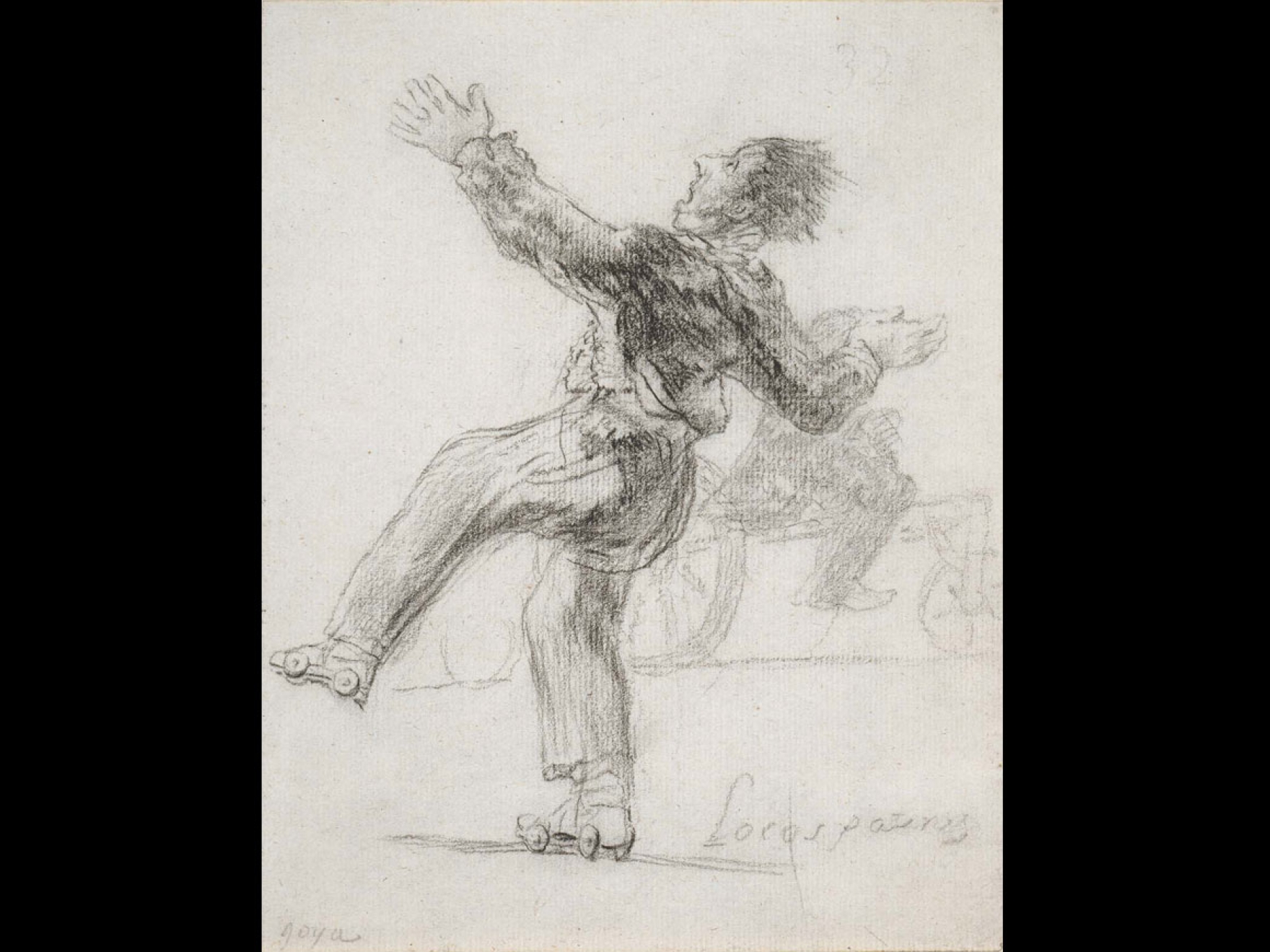
Since this post was originally from December 2014, the Goya exhibit is no longer at the Museum of Fine Arts...but roller skates will never go out of style.

A few days after I discovered (to my enormous glee) that yo-yos were all the thing in the 1790s, I happened upon an article in the Boston Museum of Fine Arts magazine MFA Preview. There’s a very fine exhibit of the work of Spanish artist Francisco Goya on display there right now, but what really grabbed me was a reproduction of a sketch he made some time in the mid 1820s that’s part of the exhibit—I don’t have permission to reproduce it here, but you can see it in the exhibit preview slideshow on the Museum of Fine Arts website. The sketch was made sometime between 1824 and 1828, when Goya was living in Paris, and is entitled “Locos Patines”... or “Crazy Skates”—and it shows a rather alarmed gentleman wearing roller skates. Yes, roller skates—and if you look carefully at the background, you’ll see someone riding a hobby-horse, the precursor of the bicycle.

So of course I had to look into the history of roller skates, which actually date back to the mid-18th century and were first seen either on the London stage in 1743 (presumably in a dance number!), or in the Netherlands at some point in mid-century on the feet of an anonymous gentleman who wished to go ice skating in the summer, depending on whom you ask. A John Joseph Merlin seems to have been making an early form of in-line skates in England in 1760, and the first patented skates appeared in France in 1819, also with an in-line wheel configuration (which makes sense, if you consider that people were indeed trying to ice-skate without ice.) An English patent followed in 1823 for the Volito, another in-line skate design, with wheels in graduated sizes which enabled easier turning (that's it, above right.) By the late 1850s, public roller skating rinks were opening in London.

Curiously, all the internet sources I researched state that skates with four wheels situated two on either side of the foot weren’t invented until the 1860s in New York...but there in the Goya sketch in the 1820s we have skates with just that configuration. I have the feeling there was a great deal of experimentation going on with their design...but who knew that roller skating was another popular 19th century pastime!

I wonder if the young Princess Victoria ever tried roller skates? :)

Tuesday, July 25, 2017

Off to Orlando!


This week’s posts on Nineteen-Teen are going to be abbreviated, because as you read this both Regina and I are on our ways to Orlando, Florida for the Romance Writers of America annual National Conference...and our annual girls’ sleepover. I mean, we live on opposite sides of the country, so this is our chance to communicate by non-electronic means (which means we're going to talk and talk and talk.) We promise to post all the deets next week...but this week, we’re busy. Not that we might not post the odd photo or two...

However, before I catch my plane I just wanted to announce that Book View CafĂ©’s short story anthology Nevertheless, She Persisted which features stories of women who overcome challenges—from society, from beloved family and friends, and even from their own fears (and which includes my YA historical story titled "Alea Iacta Est")—is now up for pre-order with a release date of August 8! You can find it at Amazon, Apple iBooks, Barnes and Noble, and Kobo...and a print version will be available in August as well. We’re pretty excited about this anthology--I hope you'll check it out!

Friday, August 1, 2014

The Surprising Game of Lawn Tennis

Lawn tennis sounds like such a genteel game.  Can’t you see the ladies in long dresses and gentlemen in natty jackets lobbing balls back and forth across the net on a summer’s afternoon in the nineteenth century?  I fully intended to write a post with the same languid feel to it.  But what I learned about lawn tennis, and its predecessor, “real tennis,” surprised me.

For one thing, the game called real tennis was almost exclusively relegated to royalty in the middle ages.  Kings in Europe and England were rather determined in their pursuit of the sport, building courts and challenging other gentlemen to matches.  And it turns out to have been a rather deadly sport.  King Louis X of France died from a severe chill received while playing.  Charles VIII of France died from striking his head on the way to a game.  When assassins arrived to kill James I of Scotland, he attempted to flee through the sewer, only to find that the drain had been blocked to prevent tennis balls from going astray on the court above it.  Alas, the assassins did not go astray.

For another thing, the courtly sport of real tennis died out with much of European royalty around the time of Napoleon, but lawn tennis, the tennis we know today, began to take form.  Various versions were played around England, but more as an enjoyable pasttime.  However, around 1874, the activity and its terminology became more codified with the publication of rules and the creation of the first tennis club.  Popularity continued to increase, and tennis championships soon followed.  And the ladies soon joined the gentlemen on the court.

That women played tennis competitively so early also surprised me.  The first women’s championships were held in 1879, one in England and one in Ireland.  In 1884, the All England Championships began including events for women players.  Held at Wimbledon, the singles match was won by Miss Maud Watson, who played her sister Lilian Watson for the title.  She won a silver flower basket valued at 20 guineas, while her sister won a silver-backed mirror and brush.  Miss Bingley (grand-daughter or great-daughter of Mr. Bingley, perhaps J) advanced to the quarter finals that year, but won in 1886.  She won again in 1888, but by that time, she had married and was billed as Mrs. G.W. Hillyard.  Those are the lovely Watson sisters in the picture, along with Ernest Renshaw and Herbert Fortescue Lawford, both champions in their own right.  Another important player at the time was Lottie Dod, who won the ladies singles five times between 1887 and 1893.


Ladies doubles were first played at Buxton in 1885, with Mrs. Watts and Miss Bracewell taking the championship.  Another surprise, however, was that ladies and gentlemen played with each other.  For example, in 1888, Mrs. G.W. Hillyard won the mixed doubles championship with her partner Ernest Renshaw.  One gentlemen reminiscing of the early days of tennis recounted how Lottie Dod (at left there) had even bested Ernest in a singles match.

Ernest was the twin brother to William Renshaw, both tennis professionals who played in England and France in the summers and hit the Mediterranean in the winter.  They had a court build on their property to practice.  Ernest appears to have been the lesser light.  He lost to William at Wimbledon three times.  William, on the other hand, won twelve Wimbledon titles, seven for singles, five for doubles partnering Ernest.  One commentary noted that that record for singles has only been matched by Pete Sampras and Roger Federer.

Yeah, about that languid playing? I’m thinking not so much.