
Showing posts sorted by relevance for query balloon. Sort by date Show all posts

Friday, July 10, 2015

Retro Blast: Up, Up and Away

Ah, the warm days of summer roll on, and my eyes are drifting to the skies, where I'll soon be flying off to our writers conference, otherwise known as Regina and Marissa's annual sleepover. In the meantime, I couldn't help revisiting another mode of flight--ballooning. Enjoy!

The nineteenth century saw the birth of many inventions we take for granted today, but few were viewed with greater awe and anticipation than the hot air balloon. Crowds gathered every time the basket and uninflated balloon arrived on a wagon and watched as the bag was filled and the balloon rose into the sky. Ascensions, as they were called, were plentiful around London, from the various parks and Vauxhall Pleasure Gardens. Young ladies swooned over the prospect of being lifted aloft, and young men dreamed of being aeronauts. One of the most practiced in the art was Charles Green.

Green was the son of a fruit merchant. But he grew interested in ballooning in school and went on to build his own balloons and fly them. He also had a theory that coal-gas would be a more convenient and safer fuel than hydrogen gas, which was widely used at the time. At the request of the government, Green ascended from one of the London parks on George IV’s coronation day (July 19, 1821) in the first balloon filled with coal-gas. The crowds went wild.

But Green wasn’t finished with stunts. In August 1828, he took a pony aboard with him, ascended from the Eagle Tavern in London, and came down thirty minutes later in Kent. The proprietors from Vauxhall were so impressed they commissioned him to build them a balloon for the delight of their customers. He liked it so much he bought it back from them but continued to ascend from Vauxhall, taking groups of people around England.

In 1836, Robert Hollond, a member of Parliament representing Hastings, funded Green to fly the balloon from Vauxhall to Germany. Hollond and his friend Thomas Monck Mason had both dreamed of being aeronauts but had settled for more prosaic occupations. The two joined Green at Vauxhall for a grand send off, crossed the channel to Dover, and reached the countryside on the outskirts of Weilburg in Germany. They had traveled a total of 500 miles over land and sea in 18 hours. The record would not be broken until 1907. Green’s fame was assured.

But however much the crowds idolized the aeronauts and dreamed of flying themselves, ballooning was not for the faint of heart. Green set the record for a time for height, reaching more than 27,000 feet, with temperatures well below freezing. He fought his way through thunderstorms and rode the winds aloft at times nearly 100 miles an hour. He piloted a balloon where one of the first parachutes was tested (at the loss of life of the man testing it!). Once someone severed the ropes attaching the basket to the balloon, and he and his passenger had to climb onto the mesh of the balloon to survive. Still, by the time he retired, he had ascended more than 500 times!

The British Balloon and Airship Club still awards the Charles Green Salver for exceptional flying or contributions to the field of ballooning.

Me? I’m afraid I’m one of those terribly practical people who prefer their feet to remain safely on the ground!

Friday, May 3, 2013

Nineteenth Century Heroines: Lighter Than Air

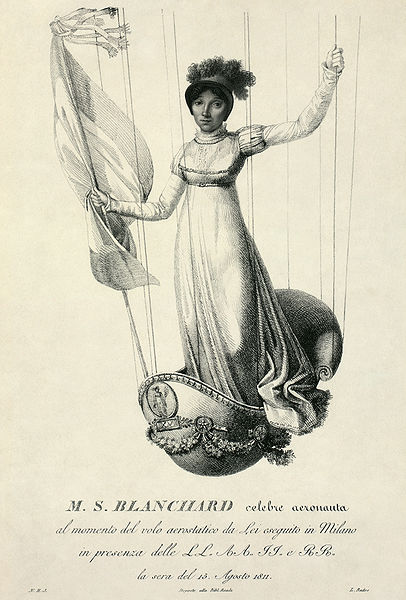
Some of you will remember a series I did a while ago at QNPoohBear's suggestion of real-life nineteenth century ladies who were inspiring enough to be heroines in a book.  We talked about Caroline Herschel’s stargazing, Ada Byron’s mathematical computing, and Mary Anning’s dinosaur hunting.  I recently stumbled upon another lady I simply had to add to the list:  the commander of Napoleon’s balloon army, Sophie Blanchard.

You wouldn’t think ballooning would be a career for a lady in the late eighteenth, early nineteenth century, much less leading a squadron of armed forces for a major power.  Sophie was one of a handful of women who ventured up in balloons, and one of the only ones skilled enough to go up alone.  Born in 1778 in France, Sophie was a nervous girl who disliked riding in carriages and startled at loud noises.  We don’t know a great deal about her early life, but somewhere between the ages of 16 and 26, she married one of the premiere balloonists of the day, Jean-Pierre Blanchard. 

Jean-Pierre was a showman who had already toured Europe and America, helped pioneer the parachute, and set records around the world.  Unfortunately, he hadn’t a lick of business sense and was always in debt.  In hopes of recovering, he added Sophie to his act, and the two were popular sights for coronations, royal birthdays, the opening of major buildings, and the like.  Sophie was undaunted by the dangers of balloon flight, claiming at one point that she’d rather sleep in a balloon than on land.  She flew high enough that she nearly passed out from lack of oxygen, she risked freezing at the cold temperatures aloft, and once she almost drown when her balloon landed in a swamp. 

She performed so many times for Napoleon, both with her husband and solo, that he made her the Aeronaut of Official Festivities.  Determined to reach England by any way possible, he also appointed her the Chief Air Minister of Ballooning and asked her to draw up plans for how he could fly his army over the Channel to attack.  Sophie is reported to have had little faith in the venture.  Balloons at that time had few ways to control them, and she recognized, even if Napoleon did not, that the wind generally blew the wrong way.

Tragedy struck the couple in 1809 when Jean-Pierre had a heart attack while performing and fell from his balloon to his death.  Sophie, however, continued to perform.  Despite the fact that she was afraid of loud noises, she perfected an act in which she lighted fireworks and tossed them by parachute from her balloon to the delighted crowds below.  Her vehicle of choice was a hydrogen-filled balloon with a tiny basket below.  She flew to celebrate the marriage of Napoleon to Marie-Louise of Austria in 1810 and on Napoleon’s 42nd birthday in 1811.  She flew over Paris and threw down leaflets proclaiming the birth of Napoleon’s son.  She also performed in Germany, Rome, and the Alps.

I wish I had a happy ending for you.  Unfortunately, it seems Sophie and Jean-Pierre had no children, or at least none that survived beyond infancy.  In July 1819, Sophie was performing at the Tivoli Gardens in Paris when her balloon caught fire and she too fell to her death, entangled in the cords of her basket.  All proceeds from the event were used to build her a monument in a Paris cemetery. 

But Sophie wasn’t forgotten.  Jules Vernes mentioned her in Five Weeks in a Balloon, proving that, nearly 50 years after her death, her amazing accomplishments lived on.

Tuesday, July 11, 2023

The Ups and Downs of Ballooning

Balloon ascensions were an exciting part of the nineteenth century. Some daring individual would set up a balloon in a public space like Hyde Park, and crowds would gather to watch the intrepid adventurer take off and ascend into the skies. In most cases, the balloon would fly a short distance and come down in some field. In a few cases, the event was an attempt to set a record. For example, in 1785, Jean-Pierre Blanchard and John Jeffries left Dover in the first successful attempt to cross the Channel by balloon.

But sometimes, things did not go as planned.

I discovered the following 1895 graphic not too long ago. It was originally an uncut set of 10 cards showing the early history of ballooning. As you can see, the emphasis appears to be on disasters!

Starting from top left, we have Joseph Louis Gay-Lussac and Jean-Baptise Biot, who ascended to 4,000 meters to conduct scientific experiments on gas. They lived. So did the second fellow, André-Jacques Garnerin, who, despite the illustration, made the first successful parachute jump from a balloon in 1797. He owed much to the third fellow, Louis-Sebastien Lenormand, who had conceived the idea of a parachute and jumped from a building with his umbrella-like contraption in 1783.

The fourth card on the top row has ideas for every steampunk author! These are purportedly utopian dreams of flight from the “last century.” Some very interesting flights of fancy! Next to it we have Commander Jean-Marie Coutelle at the Siege of Mainz in 1795, where he used a balloon for reconnaissance (and seems to have earned the wrath of the enemy in the process!).

The first card on the bottom row is a balloon commemorating Napoleon’s achievements. Interesting that he is still revered nearly 80 years after his ultimate defeat. I was both delighted and saddened to see my beloved Sophie Blanchard featured on the next card. Of course the artist had to include the queen of aeronauts. But perhaps they might have shown something besides her fiery death!

Next to her is Count Franceso Zambeccari, who flew the first unoccupied balloon in England in 1783, but instead of commemorating that achievement, the artist decided to cover his crash in the Adriatic in 1804. A number of balloons took off from the Vauxhall Pleasure Gardens, but the artist chose to depict the one from which Thomas Harris fell in 1824. Finally, we have the rescue of Francois Arban by Italian fishers in 1846, after he too had crashed into the Adriatic Sea.

Doesn’t exactly make you want to jump into the next balloon, doesn’t it?

Tuesday, May 31, 2022

Guest Post: Ballooning and the Lunardi Craze, by Shelley Adina

Nineteen Teen is delighted to welcome back Shelley Adina, author extraordinaire and Regina's co-author on the Regent's Devices series, for a discussion of ... balloon fashion. Yes, really!

Balloon flight at once intrigues and terrifies me. I’ve been up in a Zeppelin airship, but that was much more exciting than frightening. The technology probably gave me a false sense of security, with its cockpit, two pilots, and propellers galore. Going up in a balloon with only a fire to heat the air and a wicker basket between me and death makes me want to adhere most positively to the ground!

Balloon flight was not invented during the Regency, but in France by the Montgolfier brothers. They had been experimenting with ascents for some time, but achieved the first free-floating manned flight in 1783. As little as a year later, a positive craze for hot-air ballooning had spread to England, where in London “the daredevil aeronaut,” Vincenzo Lunardi, went aloft with a dog, a cat, and a pigeon in a cage. (It is not clear what purpose these companions were to serve.)

As often happens, novelty and massive, fascinated crowds combined to inspire a fashion craze. Balloons might become part of one’s gown, one image showing them on the sides like external panniers, in place of the usual drawn-up outer gown. The caption in French reads, “The coquettish physicist.” And the hats! In the coquettish physicist’s hair is fixed a base that looks like a fairground, the balloon floating up out of it.  

These mad embellishments were not restricted to women—-men wore clothes with decorative homages to the new fad. One drawing of a man wearing rigging similar to that on the top of a balloon says in French, “The man of balloons, or, the folly of the day,”  A creative woman might embroider her gown’s fabric with balloons, or paint its cotton panels.


Like many fads, something that was meant to be highly visible but not very comfortable didn’t last long. The hat lasted the longest, but not the kind with actual balloons ascending from it. The Lunardi bonnet is seen in a painting dated 1782. This style lasted well into the Regency, and is fetchingly worn by Kate Winslet as Marianne Dashwood and Gemma Jones as Mrs Dashwood in Sense and Sensibility (1995). Want your own Lunardi bonnet? A very nice version is available on Etsy!

Resources:

https://www.janeausten.co.uk/british-ballooning/

http://ultimatehistoryproject.com/flying-fashion.html

https://nineteenteen.blogspot.com/search?q=balloon

Tuesday, February 7, 2023

A Lot of Gas…or Was It?


My dear nephew (thanks, Ian!) sent me the following item, which first appeared in the Northampton Mercury on July 23, 1808, and again on the blog of the website britishnewpaperarchive.co.uk roughly two hundred years later. I cannot vouch for its veracity (one of the principals being named "Monsieur Le Pique" does ring a few quiet BS-o-meter alarms in my head), but by gosh, what a story!

I’ll let you be the judge:

Novel Duel.—A very novel species of duel has lately taken place at Paris. M. Grandpree and M. Le Pique having quarreled about Mademoiselle Tirevit, a celebrated opera dancer, who was kept by the former, but was discovered in an intrigue with the latter, a challenge ensued. Being both men of elevated minds, they agreed to fight in balloons, and in order to give time for their preparation, it was determined that the duel should take place on that day month. Accordingly on the 3rd of May the parties met in a field adjoining the Tuilleries [sic], where their respective balloons were ready to receive them. Each, attended by his second, ascended his car, loaded with blunderbusses, as pistols could not be expected to be efficient in their probable situations. A multitude attended, hearing of the balloons, but little dreaming of the purpose: the Parisians merely looked for the novelty of a balloon race. At nine o’clock the cords were cut, and the balloons ascended majestically amidst the shouts of the spectators. The wind was moderate, blowing from the north north west, and they kept, as far as could be judged, within about 80 yards of each other. When they had mounted to the height of about 900 yards, M. Le Pique fired his piece ineffectually; almost immediately after the fire was returned by M. Grandpree, and penetrated his adversary’s balloon; the consequence of which was its rapid descent, and M. Le Pique and his second were both dashed to pieces on a house-top, over which the balloon fell. The victorious Grandpree then mounted aloft in the grandest style, and descended safe, with his second, about seven leagues from the spot of ascension.

See the original post here: https://blog.britishnewspaperarchive.co.uk/2012/08/24/the-first-duel-fought-in-hot-air-balloons-paris-1808/

What do you think? Did it really happen, or did an editor at the Northampton Mercury think that the July 23 issue needed a little sprucing up and concocted the tale out of whole cloth, journalistic rigor not yet having the importance it does in modern times?

Whether it did or not, dear readers, this is what makes studying history so much fun!

Tuesday, March 15, 2022

Free to Fly, Free to Read

Nearly 10 years ago (how time flies, like this nineteenth century heroine!), I introduced you to Marie Madeleine-Sophie Blanchard, Napoleon’s Chief Air Minister. Sophie’s story refused to leave me alone, so I’ve continued to research her and her accomplishments. They have only made her more fascinating!

Sophie was a nervous little thing—afraid of loud noises, afraid of riding in carriages. But she found her strength in an unlikely place—taking death-defying rides in hydrogen balloons! She was the only female balloonist at the time to take solo flights. She was one of the only aeronauts to toss out fireworks from her balloon to the thrill of the crowds. She went higher and farther than many male balloonists. Her one failure?

She could not give Napoleon what he most wanted—a balloon invasion of England.

England ruled the waves at the time. Crossing the Channel by ships filled with the vast French forces Napoleon needed to invade would have seen many if not all of the vessels, and their occupants, sinking below the water. But if balloons could be launched, Napoleon reasoned, they might be set down on the very shores of England, if not the Prince Regent’s front lawn!

Sophie knew better. The prevailing winds ran up the Channel, not across it. Only a few, her famous husband, Jean-Pierre Blanchard among them, had crossed the Channel by balloon, and always from England to France. The state of ballooning at the time, with little way to maneuver the craft aside from rising or falling to catch the wind, meant there was no way to fight the air currents. Jean-Pierre’s Channel crossing craft had had wings on the sides, allegedly to pilot the craft. Sophie knew they had been for show only. Her husband had been a visionary, but few of his devices ever worked.

Until their daughter made them work. Yes, I am delighted to report that my research into Sophie Blanchard is about the bear fruit. Look for Celeste Blanchard to star alongside intrepid British inventor Loveday Penhale in May’s The Emperor’s Aeronaut!

Napoleon is determined to conquer the world with his steam-powered weapons. Nothing in England can stop him … except two young lady inventors.

In 1819, France is surrounded by armies. With Russia in the north, the Karlsruhe Confederacy in the east, and a pirate kingdom in the south, Napoleon cannot break out, nor can the English Navy seem to break in. Europe  teeters on the edge of a sword. Whichever side rules the air will win.

Celeste Blanchard, daughter of the Emperor’s disgraced Air Minister, is running out of time to develop an air ship that can carry his armies to England and restore her mother to glory. But on a daring and desperate test flight, she is blown off course … and washes up, half drowned, on the shores of Cornwall, in the heart of enemy territory.

Loveday Penhale, cosseted daughter of gentry, has her own inventions to build, even as pressure mounts to behave like a proper young lady and seek a husband instead of a design for a high-pressure steam engine. But when Arthur Trevelyan, heir to the neighboring estate, Gwynn Place, asks for her help in rescuing an unconscious young woman on the beach, Loveday discovers an aeronaut and an inventor as skilled as she is. Between them, a friendship blossoms, and Loveday wonders if they might even pull off the impossible and invent an air ship that will catch the eye of the Tinkering Prince Regent, who has offered a prize to anyone who can help England break the impasse. Celeste’s loyalties are torn in two. If she is caught working secretly for France, she will lose her friend, the love of an honorable man—and her life. But if Napoleon learns she has betrayed him, she will be executed on sight. 

Can friendship prevail in the face of war? Or is there a third solution—one where everything hinges on the bravery and daring of a Cornish debutante and the Emperor’s aeronaut?

Available for preorder at

Amazon 

Apple Books 

Kobo 

Barnes and Noble 

Google Play 

In the meantime, I am also delighted to report that The Matchmaker’s Rogue is free from now through March 22 at fine online retailers.

The admired hostess of the spa in the little village of Grace-by-the-Sea, Jesslyn Chance plays matchmaker to those who come to take the waters, promenade through the shops, and dance at the assembly. But when a rogue returns from her past, Jess finds herself suddenly at sea. Larkin Denby is back on a mission: to identify the mysterious Lord of the Smugglers who takes England’s secrets to France. As Jess works with Lark to uncover the fellow, the matchmaker may find that the best match for her is the rogue who stole her heart years ago.

Smashwords  

Amazon 

Barnes and Noble 

Apple Books 

Kobo 

Feel free to fly!

Friday, April 14, 2017

The History of County Fairs by Linda Ford

My book The Rancher’s Surprise Triplets features a county fair which the Lone Star Cowboy League hopes will raise money enough to fund their many projects. Ironically enough, I have another book out in July 2017 that also includes a county fair.  I suspect most, if not all of us, have attended a county fair, a state fair, or even a local fair.

I hadn’t given the history of fairs much thought, but my curiosity was aroused. The earliest record of a fair that I could find was in Ezekiel Chapter 27."Tarshish was thy merchant by reason of the multitude of the kinds of riches with silver, iron, tin and lead, they traded in thy fairs." But from the description, it sounds more like our modern-day farmers markets. Other research verifies this, such as this picture by Flemish artist Gillis Mostaert 1590 (as found on Wikipedia).


According to my research, the first known agricultural fair in North America took place in Windsor, Nova Scotia, in 1765 and continues to this day. The first American fair is thought to have been organized in Pittsfield, MA, in 1807 by Franklin Watson. It became known as the Berkshire County Fair and still operates as such today.

Over the years the fair developed into local exhibitions of new agricultural implements and techniques, and plowing contests and horse pulls.
Entertainment soon became part of the scene with horse racing, balloon ascensions, games of chance, and midway rides.

I couldn’t find definitive dates as to when the fair began to include exhibition and competition of domestic products such as jams and jellies, handicrafts, baked goods, and garden produce. The prizes were usually rosettes –blue for first, red for second, and green or white for third.

I find the bench show fascinating. There are samples from gardens, flower arrangements, pickles, and jams. There's baking—pies, bread, rolls, biscuits, cookies, and cakes (all with a bit taken out for testing). There's sewing. The quilts are beautiful, the crafts unique. And there's artwork—paintings, drawings, and photography. The adult entries leave me overwhelmed, but the children's entries blow me away. The level of expertise in their work, the creative energy evident is amazing. One entry I once saw was a Lego model depicting Main Street with the parade going by. There was such detail—a man in a wheelchair, children picking up candy, a garbage can at the corner—imagination and attention to detail evident in every piece. I find the bench show a veritable feast for the senses. The animal and machinery display not quite so interesting to me.

The fairs began and continue as a means of informing others of developments and local availability of goods and services. They include tribute to those who excel in various crafts and skills. I love a fair. 

Friday, August 16, 2013

Happy (Belated) Birthday, George!

Today, I am reminded of birthdays.  For one, we have a little one who will be celebrating his first birthday shortly in my family.  For another, my grandmother would have been 102 today.  And August 12 marked one of the biggest birthday celebrations in the early nineteenth century, for it is the natal day of His Royal Highness George, the Prince of Wales, affectionately known as Prinny.
Marissa covered the interesting life of the man who would one day become George IV in several posts beginning here.  He could be as inquisitive and as capricious as a child, which is no doubt one of the reasons he sometimes insisted on a major blowout of a party on his birthday. 

For example, in 1814, he commissioned activities in all the public parks in London.  In Hyde Park and Green Park, he had booths and tents erected for a major fair with food, music, and dancing.  Little ships enacted a mock Naval battle on the Serpentine, and a balloon ascended from Hyde Park. The night ended with fireworks from an illuminated "temple." 

Meanwhile, over in St. James's Park, boats paraded in a regatta, and the military held an encampment through which the fashionable might promenade.  A Chinese pagoda built over the canal launched fireworks at the end of the night.


And while all this entertainment was open to everyone of any class for free, certain advertisements of the event stressed that the wealthy might purchase tickets:

"The rich may purchase the accommodation of a less occupied space, while the amusements of all will be equal and indeed universal," promised the Tradesman, an economic journal of the time.  "And the fund raised by the sale of the tickets (issued only, to be understood, for the due accommodation of certain classes) will be appropriated to some great and benevolent endowment, suited to the occasion and commemorative of it."

The rest of the cost, noted the Tradesmen, would be taken out of government funds, with each department contributing.  I guess that's one way to fund a birthday party!

And speaking of parties, Marissa and I will be doing something a little different than celebrating for the next two weeks as we prepare to tackle several important familiar milestones like the first year of college for two very special young ladies.  So, there will be no blog posts between now and September 6.

Time for a party, perhaps?

Friday, November 2, 2007

Losing Their Marbles

Like anyone on summer vacation, the young ladies and gentlemen let loose in nineteenth century London during the Season (see previous post) wanted to see the sights. Thrill seekers might visit the Tower Zoo, cringe through the feeding of the tigers at the Royal Menagerie in the Exeter ‘Change, or watch a balloon ascend over Hyde Park. For those of more historical or artistic pretensions, a visit to the Elgin Marbles was a must.

Before the marble sculptures even arrived in England, they were the center of controversy. Thomas Bruce, Seventh Earl of Elgin, actually made off with them while serving as ambassador to the Ottoman Empire in Greece. He claimed these sculptures, which once decorated the Parthenon in Athens, could be better protected in England. Seems some people (not Greeks) were breaking off the noses of statues as souvenirs.

Unfortunately, Elgin didn’t do a very good job of protecting the sculptures. One of the pieces removed from the Parthenon fell and was crushed into dust. The first shipment sunk to the bottom of the Mediterranean and had to be salvaged. Then Elgin and his family were kidnapped on the way home from Greece and held as political hostages for three years!

Meanwhile, the arrival of the marble sculptures in England between 1803 and 1812 helped ignite the passion for Greek designs. Woman piled up their hair like the hairstyles in Greek pottery. Dresses turned to classic lines and draperies. Columns and friezes decorated buildings. Artists from all over England and as far away as Italy and America came to ogle the pieces and weep that their own work was so pitiful in comparison.

Not everyone was so thrilled. Several members of Parliament expressed concerns about how the sculptures had come to be in Elgin’s possession. In his Childe Harold, one of the bestsellers of the period, Lord Byron attacked Elgin for plundering history.

Elgin had hoped the British Museum would purchase the collection, but the museum offered less than what he asked. When he had to move from his Park Lane home, he stashed the sculptures in the rear yard of palatial Burlington House, where they were stacked in and around the coal shed. They remained there until 1816, when the British Museum increased their offer. It was still lower than Elgin wanted, but he was getting desperate and Burlington House had been sold, so he accepted the offer.

Today, the Elgin Marbles are still the center of controversy. They remain on display at the British Museum, but Greek patriots and English supporters continue to lobby for their return to their homeland.

And Elgin? His nose rotted off. No lie.

Friday, September 13, 2019

And Many More!


It’s that time of year again: NineteenTeen is having a birthday!

Time for party hats...

(Hey, we’re Nineteen-Teen. Our concept of party hats may be a little out of the usual way, but did you expect anything else?)

 
Time for balloons...

(What? Wrong kind of balloon? But latex and mylar are so, like, twenty-first century!


And of course, time for cake!

(Lots and lots of cake, please. Especially like this one, without frosting--just pure cakey goodness. Not very historical, but one must make sacrifices where chocolate is concerned.)

This year we’re celebrating twelve years of blogging. Yeah, twelve—we can hardly believe it ourselves. It’s been a busy twelve years: between us, Regina and I have posted one thousand, one hundred and fifty-seven times (including this post), with an average of just under a hundred posts per year.  

We’re writers; story is what we’re all about. But we’re also about the stories behind the story--and that’s where our history geekitude comes in. Sharing the stories behind the stories is what NineteenTeen is all about...and we thank you for listening to our stories for the last dozen years.

Have some cake. 💖 😊

Tuesday, January 22, 2008

The Fashionable Miss, Part III: 1821-1830

If the clothes of the first two decades of the 19th century were classically influenced (all those long white dresses that were supposed to resemble the columns of a classical temple), I’m not sure what the clothes of the next two decades were influenced by, apart from controlled substances. Think color--lots and lots of them in prints and stripes and even plaids--and richer, heavier fabrics like silks, merinos, and crepe. Hats moved from the demure turbans and bonnets of the last decade to a size and form of ornamentation that would not be rivaled in sheer goofiness until the 1890’s. Tasteful and restrained? Um, no. Easy to wear? Probably not. But fun to look at? Heck, yes!

The clothes of the years 1821 to 1830, during most of which the Prince Regent now ruled England as King George IV, now totally left classical simplicity behind. Those high waists began to creep downward toward the natural waist, and tighter lacing of corsets came back in as well. Busy was “in”: in the earlier years of the decade, the lower parts of skirts could have everything from heavy embroidery and poufs to lace flounces and artificial flowers, like the fancy ball dress on this young woman from 1821 (left). Note that her waist is still way up there, just under her breasts.

By 1825, the waist had migrated south, as you can see in this pretty yellow ball dress at right. Hems were still getting star treatment, though. I wonder if all that fluff around her feet, made of large puffs of fabric (though some dresses actually had stuffed hems!) made it harder to dance?

Over the next few years, sleeves and bodices got in on the embellishment act as well. Isn’t this 1828 ball dress at left, with its embroidered tulle skirt over an underdress of Feodore blue (named for Victoria's sister, perhaps, who got married this year), just adorably dainty and feminine?

Within a year or two dainty gave way to silly as sleeves began to balloon out into astonishing size, often requiring whalebone supports or down cushions to maintain their shape and size. And the hats! Here is a print from 1829 that will give you an idea of the size of both. And this was just the start.

On next Tuesday I’ll give you at peek at the clothes of a fashionable miss from 1830-1840, when restraint went out the window, the last vestiges of classical simplicity gave way to utterly froo-froo romanticism, and women had to go through doors sideways.

Wednesday, July 14, 2010

Losing Their Marbles

Traveling, book deadlines, blog posts, Vacation Bible School: sometimes I think I'm losing my mind! But marble, as in the magnificient stone, wouldn't be that easy to lose, you'd think. That's not what I found in this post from November 2007. Looking forward to chatting with you all next week about Bright Star!

Like anyone on summer vacation, the young ladies and gentlemen let loose in nineteenth century London during the Season wanted to see the sights. Thrill seekers might visit the Tower Zoo, cringe through the feeding of the tigers at the Royal Menagerie in the Exeter ‘Change, or watch a balloon ascend over Hyde Park. For those of more historical or artistic pretensions, a visit to the Elgin Marbles was a must.

Before the marble sculptures even arrived in England, they were the center of controversy. Thomas Bruce, Seventh Earl of Elgin, actually made off with them while serving as ambassador to the Ottoman Empire in Greece. He claimed these sculptures, which once decorated the Parthenon in Athens, could be better protected in England. Seems some people (not Greeks) were breaking off the noses of statues as souvenirs.

Unfortunately, Elgin didn’t do a very good job of protecting the sculptures. One of the pieces removed from the Parthenon fell and was crushed into dust. The first shipment sunk to the bottom of the Mediterranean and had to be salvaged. Then Elgin and his family were kidnapped on the way home from Greece and held as political hostages for three years!

Meanwhile, the arrival of the marble sculptures in England between 1803 and 1812 helped ignite the passion for Greek designs. Woman piled up their hair like the hairstyles in Greek pottery. Dresses turned to classic lines and draperies. Columns and friezes decorated buildings. Artists from all over England and as far away as Italy and America came to ogle the pieces and weep that their own work was so pitiful in comparison.

Not everyone was so thrilled. Several members of Parliament expressed concerns about how the sculptures had come to be in Elgin’s possession. In his Childe Harold, one of the bestsellers of the period, Lord Byron attacked Elgin for plundering history.

Elgin had hoped the British Museum would purchase the collection, but the museum offered less than what he asked. When he had to move from his Park Lane home, he stashed the sculptures in the rear yard of palatial Burlington House, where they were stacked in and around the coal shed. They remained there until 1816, when the British Museum increased their offer. It was still lower than Elgin wanted, but he was getting desperate and Burlington House had been sold, so he accepted the offer.

Today, the Elgin Marbles are still the center of controversy. They remain on display at the British Museum, but Greek patriots and English supporters continue to lobby for their return to their homeland.

And Elgin? His nose rotted off. No lie.

Tuesday, January 29, 2008

The Fashionable Miss Part IV: 1830-1840

Are you ready? We have a lot of fashion ground to cover today!

The clothes of the fashionable miss of the 1830s were influenced heavily by technological advances in dyes and cloth manufacture. As a result, bright colors and printed fabrics were quite popular throughout the decade, as you can see in this cheerful cherry-red dress trimmed with fur from 1830. The exuberance we saw in hats at the end of the 1820s is visible here in hairstyles...but I have to wonder what her hair looked like after an evening of lively dancing.

I see ladies' fashion of this decade also falling into two stages: the horizontal period lasting from 1830 to 1836, and the vertical period which finished off the 1830s and extended into the 1840s. Clothing doesn't get more horizontal than this green dress from 1833! Notice the cape-y, overgrown collar thing she's wearing over her shoulders? That's another distinctive feature of dresses from this period. They went by names like pelerine, canezou, mantelet, and fichu, and hypenated versions signifying their style like pelerine-fichu (what our lady in green is wearing at left). About this time, the amazing hats of the late 1820s gave over in popularity to bonnets, like the one shown here. However, as the decade went on, they too increased in size.

1835 was the height (or width) of horizontal fashion. The costume historian C. Willett Cunningham calls the 1830s a time when women's fashions went from being "exuberantly romantic" to "droopingly sentimental". I don't think you can get more exuberant than this flower-print dress at far right, with ballooning sleeves (sometimes referred to as "imbecile sleeves"!), pelerine covering the shoulders to the elbow plus a lace and cambric collar, and full round skirt. Don't forget that this is before the crinoline of the 1850s and 1860s, so the fullness in her skirt was due in large part to a lot of fabric held up by a lot of fluffy petticoats.

Between that and the enormity of the sleeves, you have to wonder how anyone could move, even to play the piano as these ladies in the print at left seem to want to do.

But in 1836, as you can see from the dress at right, the balloon (sleeve) burst and plummeted out of fashion in the matter of a few short months. In a letter to a friend written in 1837, a young debutante says this: "I hope you who are so fashionable a person have already made all your sleeves quite tight to your arm--but the question is useless for I know you would not think of going out with such an old-fashioned thing as a full sleeve at present..." Instead of being hugely wide, sleeves became snug to the upper arm (though the lower part of the sleeve could be fuller).

The droopy, sloping shoulder look came into fashion, bodices developed even more prominent points in front, and the whole look makes me wonder if the earth's gravitational field didn't sudddenly get stronger. Doesn't this 1839 miss in the picture at left look rather on the limp, languishing side?

I have to confess that after this decade, my interest in nineteenth century clothes drops off rather precipitously (along with my collection of fashion prints) because they stop being quite so much fun. So it may be a while before we continue our clothing series to later decades. However, we promise future posts on "supporting role" aspects of fashion--shoes, millinery, acccesories, and hair.

Friday, April 27, 2012

Things You Don't Expect to See in Hyde Park

After penning more than 20 books set in early nineteenth century England, I can safely say that I’ve written about Hyde Park more than the average person. I’ve described riding scenes, walking scenes, and scenes in carriages. I’ve covered shivering in February and fluttering of fans in June. I’ve spun the tale of that favored time, two to five in the afternoon, when pedestrians, equipages, and riders thronged the park. And for this blog, we’ve shared military spectacles and mentioned balloon ascensions. So recently, when faced with writing another scene in Hyde Park, I wanted to do something different. Naturally, I decided to do some research. (Oh, lovely, lovely research!) That research confirmed the favored time (particularly on Sunday, apparently) and the various paths I’ve written about so many times: the sandy riding track that was Rotten Row, the pebbled paths around the glittering waters of the Serpentine, the longer amble across the lawns toward Kensington Palace. However, I discovered a few things I didn’t expect to find in Hyde Park.
  • Cheesecake: Apparently eating cheesecake in Hyde Park has been a treat since the time of Elizabeth I. The main location to purchase it was a little house near the Serpentine. You’d buy a bit for you and your sweetie and either sit and munch while watching the crowds stroll by or take it with you on your own stroll or drive.
  • Ancient glory, gone to seed: In the 1600s and 1700s, the aristocracy still thronged Hyde Park, but their favorite location was “The Ring,” a circle of track surrounded by tall elm trees. Compared with the stretches of ground used in the 1800s, the place was tiny. Not surprisingly, one of the ladies who frequented it called it a “dry, dusty horse circle.” Picture those horsey rides at state fairs, where the ponies plod in circles, and you won’t be far off, except the vehicles carrying the riders would have been far more gilded. Early mornings, the Ring was also the favored place for duels. By the middle of the nineteenth century, the stately elms, some as old as 300 years, had mostly been cut down and burned, the track grassed over. But as late as 1837 people still pointed it out as they drove through the park.
  • Reservoir: Near Park Lane, the Chelsea Water Works erected a stone basin with a diameter for 200 feet. The water, pumped from the Thames, helped supply Kensington Palace. The reservoir must have presented a lovely site, situated in the center of a grand Walnut-Walk, now also gone. However, it was capped with Portland stone to prevent suicides. Ug!
  • Powder magazine: This surprised me the most. During the Napoleonic Wars, the Army actually mixed and stored gunpowder in Hyde Park. According to one source, the powder magazine stored more than one million balls and blank ammunition, ready for use at a moment’s notice. I suppose having such a store close at hand was a comfort to those who feared Napoleon would come storming across the Channel, and it was also probably handy for all those military reviews in the park. Then too, I would think the danger of accidental explosions was less among the green lawns and towering trees than in crowded stone buildings of the metropolis. But given the unstable nature of the powder back then, I still shudder.
I think I’ll head back for more cheesecake.

Tuesday, March 14, 2023

Twenty-Five Years Ago This Month

I have wanted to be an author since about third grade, when I first realized that the wonderful stories I was reading were written by someone, and I could be that someone! But it wasn’t until many years later, with the tough-love encouragement of my husband, that I submitted my first Regency romance to Kensington. I was working as a communications manager for the environmental arm of a large research and development laboratory at the time. My husband had gone home for lunch and listened to a message on our answering machine (yes, those used to be a thing). He promptly called me and held the phone to the machine so I could hear it too.

“This is John Scognamiglio of Kensington Books. I’d like to talk to you about your manuscript.”

I knew enough to know that when an editor calls, it’s with an offer.

I was a mess. I ran around the corner of the building to where my critique partner worked and blabbered out my excitement.

“By the time you get home, New York will be closed,” she said. “Go now. We’ll cover for you.”

I went. And I called, and he offered me a two-book deal.

And so, 25 years ago this month, The Unflappable Miss Fairchild was published. She has had a couple of updates since, as you can tell by the covers, but she’s still one of my favorites, and readers tell me she’s one of their favorites as well.

The ever-practical Anne Fairchild knows the proper way to seek a husband. So why is it one moment in the presence of the dashing Chas Prestwick, and she’s ready to throw propriety to the wind? Chas excels at shocking Society with his wild wagers and reckless carriage racing. But his bravado masks a bruised and lonely heart. Can the sweet-natured Anne convince him to take the greatest risk of all—on love?


You can get her ebook for 99 cents

Directly from me through my store 

Smashwords 

Amazon 

Barnes and Noble  

Kobo  

Apple Books 

Already have her? What about The Emperor’s Aeronaut, the first book in my Regency-set steampunk trilogy co-authored with Shelley Adina? Until March 25, the ebook is free on all major retailers. It will be up on my store later in the week.


In 1819, Celeste Blanchard, daughter of the Emperor’s disgraced Air Minister, is blown off course in a daring and desperate test flight to prove a balloon can reach England and washes up in the heart of enemy territory. Loveday Penhale, cosseted daughter of gentry, has her own inventions to build, even as pressure mounts to behave like a proper young lady. But when she helps rescue an unconscious young woman on the beach, she discovers an aeronaut and an inventor as skilled as she is. Could their collaboration result in the first air ship? And does this war hinge on the bravery and daring of a Cornish debutante and the Emperor’s aeronaut?

“A witty and whimsical flight of fancy.” Booklist

Amazon   

Apple Books 

Kobo 

Barnes and Noble 

Google Play 

Happy anniversary!

Tuesday, March 30, 2010

Fashion Forecast: 1814

So what was the well-dressed young woman wearing in 1814?

She was certainly keeping cozy in this Promenade Dress from the January 1814 issue of Ackermann's Repository. Enormous fur muffs remain in fashion (as they will for several more years.) Perhaps she's off to the bookstore to pick up a copy of Lord Byron's latest release, The Corsair, which sold 10,000 copies on its first day:

Or perhaps she's off to a elegant private party in this lovely Evening Dress (Ackermann, February 1814). I liked this dress so well that it will be making an appearance in my upcoming book--note the cute little frill around the back of the bodice--and I love that green! Note that the waistline has crept back up again on both this dress and the pelisse above. By the way, February 1814 was the last time the Thames froze over sufficiently to permit a Frost Fair, a sort of giant impromptu festival/carnival held on the frozen river's surface. Changes to the bridges crosing the Thames after 1814 meant that the river flowed faster, and therefore never froze solid again:

Short capes were definitely "in" this year--several of Ackermann's 1814 fashion plates feature them. This is one is for a Walking Dress, featured in the April edition. By the way, April saw the abdication of Napoleon Bonaparte in France, and kicked off the most glittering and exciting social season London had seen in years:

If the young lady in this Morning Dress looks a little tired, no wonder: London was one enormous party just now, celebrating the end of the war. In town to help whoop it up were Tsar Alexander of Russia and his sister the Duchess of Oldeburg (on the prowl for a new husband) and King Frederick William of Prussia. But the most popular visitor was probably the Prussian general Gebhard von Blucher, who could barely show his face in public without being mobbed (Ackermann's Repository, June 1):

August 1814 saw more excitement in London: the huge public celebrations of the end of the wars and commemoration of the 100th anniversary of the accession of the Hanoverian dynasty. Among the events were a recreation of the Battle of the Nile on the Serpentine in Hyde Park, balloon ascensions, and fireworks. Perhaps a young lady might have worn this Walking Dress to take some of it in. I especially like the charming hat (Ackermann's, August 1):

Autumn saw a return to quiet in London, but in Vienna the art of the party got carried to extremes with the opening of the Congress of Vienna in early October. This giant negotiation to re-form Europe after Napoleon's defeat was as famous for its balls as for its political machinations...which often occurred simultaneously. I wonder if this contemplative young lady wished she were there? (Walking Dress, Ackermann's Repository, November 1814):

This Walking Dress from the December issue of Ackermann's Repository is just such fun! The plum color is gorgeous, and check out the multi-layered collar. That's a borrowing from the coachmen's coats of the day, which were made with several layers of shoulder capes to help shed rain (don't forget, the coachman sat out in the open when driving.) So this is meant to be a very dashing outfit!


What do you think of 1814's fashions?