Showing posts with label paper. Show all posts

Friday, February 15, 2019

Dissecting a Valentine

Sounds rather macabre the day after the holiday devoted to love, doesn’t it? But I was recently reminded that I have a wonderful late nineteenth century/early twentieth century Valentine courtesy of the great-great aunt who left me her postcard collection, and I wanted to share.


Here it is in all its glory:


A few things to note:

  • It’s built in layers of paper. Each layer isn’t as thick as card stock, but definitely thicker than typical stationery. They are mounted on accordion hinges of the same sort of stock. Alas, everything is pretty flat after nearly a hundred years in a photo album, but you can see where this was once a rather impressive three-dimensional anthem to love.
  • The pieces surrounding the center cherub are made from different materials. The red ribbon is silk, the white a kind of cross-grain fabric. The gilding appears to have been hand-applied. And some of the white lace is fabric bric-a-brac.
  • Nothing on the back or front indicates who created it or where.
  • Inside is a lovely poem promising life-long devotion, but no signature. I don’t know whether my great-great aunt received it from someone she loved or bought it and never sent it. Oh, the story possibilities!


All in all, it’s about 11 inches tall and 8 inches wide, and I don’t think the colors have faded much with time. Any lady would have been pleased to receive it. I am quite delighted my great-great aunt thought to leave it for me.

And now you! Happy belated Valentine's Day!

Tuesday, April 17, 2018

Ackermann Goes Holographic!


Okay, not really. But this is really cool—you’ll see.

As well as publishing the Repository of Arts, we know that Mr.Ackermann designed carriages and owned a print store where he sold prints, paper, and art supplies. He advertised his paper goods at times just as he did those delicious fabric samples we look at occasionally, but most of those ads seemed to occur in earlier issues of the Repository (both of the ones we’ve seen were from 1810.) So imagine my delight when I ran across this paper sample page featuring BRUNELL’S PATENT METALLICK PAPER.


Shiny, isn’t it? It doesn’t scan very well—it looks more like metallic camouflage than anything else—but it was evidently pretty snazzy stuff for the time.  The gold and bronze-colored papers at Nos. 1 and 2 have help up quite well, but the red one at No. 3 evidently didn’t get along well with the tissue paper covering this plate—it more or less dissolved the paper, which in turn left a cloudy haze on that sample. No. 4, in dark brown, also survived well and bears a good resemblance to tortoise shell.

So what is this stuff?  Happily, the original text is present, and reads:

The ornamental crystalization [sic] on tinned surfaces, exhibited in many shops, being confined in its application to articles of the japanner’s trade [japanning being a European form of Asian lacquering], it became a great desideratum to have a similar result elicited on a substance, which, like paper, could be easily employed in covering articles of almost any description.

The metallic paper which is now offered to the public, is the produce of a new discovery made by M. J. Brunel, Esq., F.R.S. &c.

The matchless beauty of this substance, the character  and variety of its crystalization, exceed in effect and brilliancy what has yet been obtained on tin plates, over which it possesses an additional advantage in the dimensions of the sheets, which can be made as large as 4 feet by twenty inches.

It has already met with a most favourable reception on the Continent, where it is likely to open a new channel for British industry. The Report made before the Society for the Encouragement of Arts, &c. in Paris, on the 10th Feb. last, by their Comité des Arts Chimiques, is evidence of the opinion entertained there of this discovery as an article of trade....
                                                
This metallic paper is now used by skilful artists with great success in decorating apartments and furniture. R. Ackermann, at his Repository of Arts, has introduced it with great taste into a variety of fancy work, where it displays an uncommonly novel and rich appearance. It is sold, in various shades, as seen by the annexed patterns, in sheets of the following sizes and prices: Large, 23 by 19 inches, 6s.; small, 19 by 11 ½ inches, 3s.—Nothing but a strong paste made of good flour is required to fasten it to wood, paper, &c. &c.

It’s fun, isn’t it? But what’s even more fun—and interesting--is the man who invented this pretty stuff. M. J. Brunel was Marc Isambard Brunel, a French engineer born in 1769 who fled France during the Revolution, went to New York and became an American citizen before returning to France to marry his English sweetheart and moving with her to England. He was responsible for all kinds of engineering feats—from inventing a machine that could make pulley blocks for the British navy to, eventually, building a tunnel under the Thames (on which project he was aided by his 18-year-old son who would become an even more famous engineer, Isambard Kingdom Brunel.) 

Queen Victoria would eventually knight Papa Brunel for that feat, but it was still in his future...he would first work on a series of not-very successful ventures and wind up in debtor’s prison for a couple of months (and was bailed out by the government when they heard that he was negotiating moving to Russia to work for the Tsar.) I can’t help wondering if this paper might have been one of those projects that led to his stint in King’s Bench Prison...but I also can't help wondering if the enthusiastic crafters of 1819 weren't head over heels with it.

What do you think?

Tuesday, March 14, 2017

Not Regency Fabric, Part 2

Since Rudolf Ackermann sold not only prints in his shop but art supplies as well, it’s hardly surprising that he should make use of his own magazine to get a little advertising in for that side of his business. Back in April of last year we saw samples of fancy papers for crafters; in this issue, we have samples of paper for artists. I don’t pretend to the least technical artistic knowledge, but I’ll comment to the degree that I can to give you a better picture (I hope!) of the thickness and texture of these papers...and maybe the artists among you can chime in. Don’t forget that painting in water-colors was thought to be a necessary skill for young ladies pretending to any degree of gentility, to demonstrate their refinement and properly “feminine” education (I hope that Regina will say a word or two about that!)...definitely the audience Ackermann was targeting.

The overall condition of the page and samples is excellent, considering it is over two hundred years old. I operate under the assumption that the now-cream-colored paper samples were once much whiter but have yellowed due to the acid content of their material, just as the pages of Ackermann’s Repository themselves have done.

In the annexed print, No. 1, is a newly manufactured white cartridge paper, of very superior quality. Those of our readers who have practiced painting in water colours, know that the two great faults of drawing papers are, either that the surface is so smooth, and the texture so hard, that a wash cannot be repeated without disturbing the tint beneath; or, that the paper is partially absorbent, and dries in spots and patches. These evils are completely removed in the paper referred to: it is sufficiently absorbent, it receives the colour freely, and it dries in the flattest tints; and yet, from its granulated surface, it enables the artist to introduce all those accidental varieties, which give to a work of art so much of the sentiment and character of nature. We cannot too warmly recommend this paper, as we are confident, from experience, that it will give universal satisfaction.


My comments:  First things first, what is cartridge paper? It's a heavy paper used for drawing and illustration, according to the dictionary...but was originally used to make cartridges for firearms before metal cartridges came into use...who knew?  This paper sample is definitely textured--it reminds me almost of some of the hand-made craft papers I've seen--but the texture is very even. The weight is similar to cover-stock.

No. 2 is an excellent brown cartridge, which will be found occasionally useful, though not so generally serviceable.


My comments: Pardon my cynicism, but I’m guessing this paper was sold more cheaply than the first. ☺ It’s actually a bit sturdier and heavier in weight than the first sample, with a less uniformly fine texture.

No. 3 is a wove vellum paper, of excellent quality. It is here introduced to prevent any misunderstanding on the subject of the first paper. It must be obvious, from the coarseness of the textures of the cartridge, that it cannot be used for any subject which requires accurate detail and delicate execution. Fruit, flowers, shells, and other objects of that nature, then, will require a paper of this kind and quality.


My comments: Definitely much smoother in texture than the first two samples, comparable in weight to, say, a lightweight cover stock (and a little bit lighter than No. 1.) It almost reminds me of construction paper.

In No. 4 we have given a specimen of a good silk paper, for chalk or crayons. It is of an agreeable negative hue, and, by means of red, black, and white chalk, a flesh tint may be produced, the colour of the paper furnishing the harmonizing ground.


My comments: Another sturdy paper, not as smooth as No. 3 but not as heavily textured as the other samples. I'd love to know if this has faded with time or not--right now it's a nice darkish gray color, and would be lovely for chalks or pastels.

Would any artists out there care to comment?

Tuesday, April 26, 2016

Not Regency Fabrics, Part 2


Last Tuesday we had an up close and personal look at paper samples published in Ackermann's Repository. That page of samples was accompanied by the following article, which I thought NineteenTeen readers might find interesting. It’s a little long, but bear with me:

OBSERVATIONS ON FANCY-WORK, AS AFFORDING AN AGREEABLE OCCUPATION FOR LADIES

It is not long since needle-work was considered, in our schools for young ladies, as one of the greatest accomplishments; and if a girl had gone home for the half-year holidays without either an alphabet, a map, a name, a flower, or perhaps some wretched figure, the parents would have looked upon the system of the school as extremely deficient, and miss would certainly not have been sent back to so imperfect a seminary. Exclusive of the injurious effects of this branch of education on the health of children, when kept for hours together stooping over one object during the whole six, and, in a larger piece, perhaps twelve months, how was it possible that, with the vivacity natural at that tender age, they could be otherwise than disgusted with continually looking at the same thing over and over again! Consequently, nothing but force and threats on the one had, and promises of going home for the holidays on the other, could prevail on them to apply to such tedious occupations.

It is impossible to congratulate our fair countrywomen too warmly on the revolution which has of late years taken place, when drawing and fancy-work of endless variety have been raised on the ruins of that heavy, unhealthy, and stupefying occupation, needlework.

Drawing, the ground-work of refined taste in the arts, is now considered, and very justly, as an indispensable requisite in the education of both sexes. In that of females in particular, it has opened a prodigious field for the excursions of imagination, invention, and ingenuity. Here the young mind is not easily tired, because fancy-works are frequently begun one day and finished the next; and perhaps the completion of the most considerable job will not take a fortnight.  What pleasure it must afford to a young lady to see her work advance so rapidly! Sometimes she sits to it, and at others stands; and by way of ascertaining its effect, she steps to the distance of some yards, returns with a new idea; and frequently before one object is half finished, her fertile imagination has suggested an additional ornament for the parlour or drawing-room of her beloved parents, or for distant friends or relatives.

Let us also for a moment reflect on the good consequence which a fondness for fancy-works is calculated to produce in future. Ladies who have once engaged in this innocent and amusing occupation, which daily affords such abundant scope for new inventions, will never relinquish it. From ornamental subjects they are led imperceptibly to the making of useful articles; so that it is no uncommon thing to enter a drawing, breakfast, or dining-room, where the fire-screens, card-racks, chimney-ornaments, boxes, picture-frames, and a variety of other objects of utility or embellishment, are made, painted, and decorated by the ingenious mistress of the house or her daughters.

To enumerate all these different productions of female industry and invention would be an endless task; but we shall occasionally recur to some of them in our future numbers. The annexed wood-cut, with patterns of various fancy-papers and borders, is here introduced for the convenience of those ladies, who either cannot go out shopping themselves, or reside in a part of the country where they cannot meet with such articles as they want. The insertion of such patterns from time to time, will, it is presumed, facilitate the procuring of the materials for fancy-works*, and also make their various uses and the method of applying them more generally known.

*It is requested, when orders are given, to specify the number or description of the pattern, as well as the number of the Magazine.

Okay, that article was a tad self-serving...after all, Mr. Ackermann was selling these fancy papers, right? Furthermore, needlework certainly hadn’t gone out of fashion—Ackermann’s as well as most of the other popular magazines were regularly publishing needlework patterns.

But it’s also a pretty cool link between the present and the past: girls and women were being “crafty” even then, and I’m sure would have been all over DeviantArt and Etsy with their paper crafts if they’d had the internet. Now we know where all the “fancy-work” that was sold in the endless church and Ladies’ Aid Society bazaars and jumble-sales to support missionaries came from...something I’d always assumed was more a Victorian phenomenon, but evidently not! And it illuminates that after-dinner conversation from Pride and Prejudice when Jane is taken ill at Netherfield and Lizzie comes to stay to nurse her at the invitation of the good-hearted Mr. Bingley and his less-than-goodhearted sister Caroline:

"It is amazing to me," said Bingley, "how young ladies can have patience to be so very accomplished as they all are."

"All young ladies accomplished! My dear Charles, what do you mean?"

"Yes, all of them, I think. They all paint tables, cover screens, and net purses. I scarcely know anyone who cannot do all this, and I am sure I never heard a young lady spoken of for the first time, without being informed that she was very accomplished."

I wonder if those very accomplished young ladies of Mr. Bingley’s acquaintance purchased their screen-covering papers at Ackermann’s? ☺

Tuesday, April 19, 2016

Not Regency Fabrics, Part 1

I’ve been having lots of fun posting in my series on Regency Fabrics with the amazing ads from Ackermann’s Repository that have actual fabric samples glued into them, and I hope you’ve enjoyed them as well.  But what’s even cooler is that fabric isn’t the only commodity to have received this treatment: Mr. Ackermann featured other items as well, including different types of paper which they themselves sold as in this page of "Fancy Papers and Borders". Note the inscription below the samples:

The Public are respectfully informed, that besides the above Specimens of Fancy Papers and Borders, R. ACKERMANN manufactures a great variety of other Fancy Articles; and publishes almost daily, new plates of Fancy Prints, Medallions, Drawing Books, Transparencies, &c. &c. &c. The number already published is near 4000, so that he is enabled to supply Merchants, Dealers, and Schools, on better terms than any other house in the Kingdom.
N.B. Ackermann’s Superfine Water Colours, in such high Estimation, and all other drawing materials, are furnished at his Repository of Arts, 101, Strand, Wholesale and Retail.

Next week we’ll discuss just why Ackermann’s “fair readers” might be interested in “Fancy Papers”...but first, let’s look at the samples themselves. Just as I do with the fabric samples, I’ll do my best to describe each piece.

Explanations of the Patterns of Fancy Papers and Borders

No. 1, denominated fancy gold-paper, may be had of all colours, and about fifty different designs. The pattern here exhibited goes by the name of honeycomb; is principally used for covering boxes, card-racks, and hand and fire-screens. It measure 17 inches by 11; is sold at 1s. 6p. a sheet in gold, and 2s. in silver. It is put down with paste, which ought to be spread very even, and lie about two minutes, to time for the paper to stretch: when put down, pass the hand over a paper laid upon it.

My comments: Such a lovely, vivid turquoise color! The weight of the paper itself is somewhere between that of heavy writing paper and light card stock; the finish is very smooth.

The patterns marked 2, are two gold-embossed borders; with which, when well displayed, articles of the greatest elegance and richest appearance are produced. There is not a single object for the interior of a room, boudoir, or cabinet, to which these borders are not applicable. They are of various widths, from 1/8 of an inch to 2 inches, and 18 inches long. They are to be had in bright and dead gold, ditto silver, in bronze, and in all colours; and are sold, according to width and quality, from 2s. to 27s. per dozen. Embossed borders are laid down with a strong gum, which must be passed sparingly on the edges, otherwise the embossed work would be drawn down, and its beauty destroyed.

My comments: These are fairly similar to embossed gold foil-covered paper that you might find at a craft store—a little stiffer than the honeycomb paper in the first sample. The embossing is quite lovely and detailed.

No. 3 is called copper-plate paper. Of this there are about fifteen different designs, printed in various colours. The annexed pattern, which goes by the name of open-basket-paper, is much used for screens, boxes, card-racks, and for covering ladies’ portfolios. This paper measures 16½ inches by 10, and is sold at 9d. per sheet.

My comments: This is lighter in weight than the first sample, rather like a stiff wrapping paper, and not quite as smooth in texture.

No. 4 is red morocco paper. It is the closest and finest imitation of the leather which it represents, and may be had in all colours. It is also much used for screens, boxes, card-racks, portfolios, and shew-books; is applied with paste, and should lie at least ten minutes before it is laid down, as the oil colour employed in its manufacture prevents it from extending so soon as other papers. Great care should be taken to rub it outward from the center, otherwise blisters and windbags will be the consequence, and these will utterly spoil the neatness of the work. The paper measures 22 inches by 17, and is sold at 2s. or a smaller size at 1s. 6p. a sheet. The large is preferable, because the paper is stronger, and of course preserves the grain better in the pasting.

My comments: This was a pretty good attempt to approximate a leather texture. As the paper is quite stiff and heavy and shiny, I’m wondering if this wasn’t made from a thin layer of lacquer on the paper.

The circular pattern in the enter is called cypress paper, and has a most delicate appearance when worked up in screens, boxes, and portfolios. The design and colours may be varied ad infinitum. It is applied with paste; and great care is necessary, otherwise the gloss is taken out. The paste ought not to be too thin, or to lie longer than two minutes on the paper before it is laid down. It must then be rubbed outward fro the center, and a thin sheet of paper ought to invariably be laid over that which is to be rubbed down, so that the hand may never touch the paper which has received the paste. It measures 21 inches by 16½, and is sold at 1s. per sheet.

My comments: Tie-dyed paper!  Well, not really, but that’s what it looks like. It’s almost as stiff and shiny (if smooth) as the red morocco paper

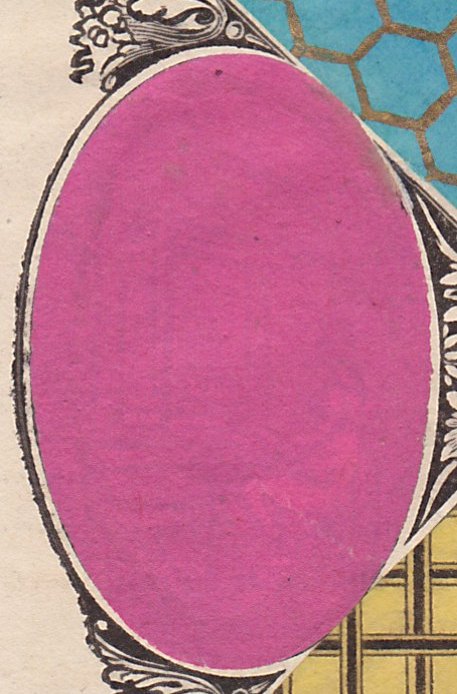
The oval pattern on the left hand is a beautiful Indian pink paper, principally used for lining the inside of boxes. It measures 48 inches by 20, and the finest colours are at present sold at 2s. per sheet. Being extremely thin, this paper must be very delicately used. It ought to be fitted beforehand to the place for which it is intended, and put down the moment the paste (which must not be very thick) is laid on. To work it well into the corners, an ivory folding-knife is necessary; but it must be used very carefully, otherwise the paper will tear.

My comments: The warnings are a good idea—this is comparable to a heavy tissue paper weight-wise. But it’s quite opaque and the color is beautifully vivid.

The right hand oval is green milled paper. It is manufactured in all possible colours and shades, and is used both for lining and covering boxes, card-racks, hand and fire-screens, and a variety of other purposes. It measures 16 inches by 13, and is sold at the following prices: French green 4d. deep scarlet and crimson 6d. and all other colours at 3d. per sheet. It is also applied with paste, which should not be put on it more than two minutes before it is laid down.


My comments: Comparable to No. 3 in weight, smooth without shine.  Though I’m wondering what the source of the green in the dye is...

Included also are directions for paste, which I thought might interest you:

A few directions for making good paste, and also preparing a strong cement, for the gold papers, embossed borders and ornaments, may not perhaps be unacceptable to some of our fair readers.

To make good paste, take about half a pint of water; stir and mix well in it a table-spoonful of the best and finest flour. When no more lumps of flour are perceptible, and the whole appears like milk, set it on a gentle fire, in an earthen pipkin or tin saucepan. Stir it well till it just begins to boil; then take it from the fire; and when cold, it is fit for use. This paste will keep in winter about a week, in summer not above two or three days.

For a cement for gold-paper borders, &c. take one ounce of the best picked and clear gum arabic [the hardened sap of the acacia tree, still in use today for various purposes], pound it to powder; pour on it sufficient water to cover it, set it in a warm place, and stir it three or four times a day. In about two days it will be dissolved and fit for use; and when bottled will keep about a month in winter, in summer not above half that time: may be had in bottles ready prepared, as well as all the foregoing articles, at R. Ackermann’s Repository of Arts, 101, Strand, London.

All right, NineteenTeen readers: any paper crafters out there? What do you think of these papers?

Tuesday, February 2, 2010

Txt, 19th c stl: Pt 1

Texting. Facebook. Twitter. E-mail. These days it’s almost too easy to stay in touch, too easy to know what’s going on everywhere and what everyone thinks of it, to easy to get sucked into the latest news when one ought to be getting some work done (she typed with a guilty grin.)

This was not a problem 19th century teens had to deal with.

Up until the telegraph, letter-writing was the only way to stay in touch with far-flung friends. We talked a bit about letter-writing some time ago here and I thought it was time we addressed the topic a little more closely.

Letter-writing really was an art form, I think: not only your words, but your choice of paper, handwriting, and more could carry a subtle message as well.

First, there was the choice of paper one wrote on: thin or thick? Plain or decorated with a heraldic device (your family’s coat of arms) or with some other emblem? Scented with your favorite perfume or not? Was your family mourning the death of a relative? If so, time to pull out the box of black-bordered writing paper like that shown at right. And using more than one sheet of paper meant the letter would cost more in postage.

One’s choice of pen and ink also mattered. No gel pens or even fountain pens yet—at least not until the mid-late 19th century, when improvements in materials and inks made them more common (forms of the existed as far back as the early 18th or late 17th century) century. No, you probably wrote with a quill pen: goose and turkey feathers were most commonly used, though swan feathers were much admired. Contrary to what you might think, most of the feathery part of the quill was stripped away from the shaft of the quill; a small, sharp knife was always kept at hand to trim quills when they began to fray (hence the “penknife”). The main type of ink used was iron gall ink, made from iron salts and vegetable tannins (often derived from oak galls); though it made a nice dark ink, it is also very acidic and chemically unstable—which is why most of the writing in letters and documents from the 19th century and earlier have faded to brown.

Then there was one’s handwriting. Writing an elegant hand was an accomplishment much admired. However, if one was trying to conserve space in order to cram in as much news as possible into one page, then the flourished capitals and sweeping ‘y’ or ‘g’ at the end of words was best kept to a minimum. If you wanted to cram even more words onto a page, you could fill the page then turn it ninety degrees and fill it writing in that direction as well. “Crossing the page” often made for difficult reading, but it did save postage costs. (That's a letter written by Jane Austen herself, by the way, showing not only crossing lines but also other ways to shoehorn as many words onto one page as possible.)

If you were being cost-conscious, elegance of phrasing might also have to fall by the wayside. 19th century letters are full of abbreviations like wd and shd for would and should, vy for very and yr for your…sound familiar? However, I do not believe I’ve ever seen gr8 for great.

So your letter is written, on one side of the page only: you might sprinkle it with sand to help dry the ink or blot it with thick, absorbant paper, or just wave it around for a few minutes. When it was dry, you folded it carefully to conceal the writing and sealed it: envelopes did not come into widespread use until the middle of the 19th century (see Jane's letter above and note how it's folded). To seal your letter, you might use sealing wax (red was a popular color) or a wafer, which was a thin disc of glue and starch which was moistened and used to glue shut the letter (a forerunner of the modern sticker, though some objected to having other people's saliva mailed to them!), or both wax and a wafer. And so your letter was ready to send.

Nest week we'll look at how letters were sent. And don't forget, in two weeks we'll be having the inaugural meeting of the Young Bluestockings Book Club, discussing Patricia C. Wrede's Mairelon the Magician. Have you all been able to get your hands on copies?