Showing posts with label valentine. Show all posts

Tuesday, February 14, 2023

Blast from the Past: Today, My Heart Belongs to . . . the Letter Carrier

[I originally penned this post 10 years ago around Valentine’s Day, but I thought it was time to bring it to the forefront. Happy Valentine’s Day!]

Valentine’s Day was eagerly awaited by many a young nineteenth century lass and lad in England. Thousands of Valentine letters were exchanged in London alone. In fact, the 1835 Post-Master General’s report cites an additional 50,000 or 60,000 pieces of mail through the London Twopenny Post around Valentine’s Day. The hundred or so letter carriers in London had to be given additional money for refreshments just to see them through their arduous work. In a bigger city, they might make deliveries as many as six times a day!

However, even with their help, figuring out how to get your Valentine from your fingers to your true love wasn’t for the faint of heart. You could hand it to the postman, if you caught him on one of his rounds, or you could take it to the Post Office near you, which could be at a shop or an inn if you were in a smaller town or village. Later in the century, post boxes appeared to collect letters in certain areas. Some villages didn’t even have post offices or boxes, requiring you to walk miles to post a letter or to take the chance of paying a private firm to deliver your message for you. Many such firms went bankrupt before letters were even delivered.

Then too, each sheet of paper cost money to send, to be paid by the person who received it. While England was at war with France, postage costs kept increasing. Postage was also higher the farther the letter had to travel. As you can imagine, the cost put a burden on the average working man or lady, not to mention the underemployed teen.

So, letter writers got creative. Instead of using more than one sheet, they wrote on both sides of the one, vertically, horizontally, and then kitty corner! Such cross writing was notoriously difficult to read, particularly squinting over candlelight. Then too, some friends or family who lived far apart arranged a code. If a letter arrived from the friend with your name misspelled or perhaps the address lettered wrong, why you knew that the friend was well and you could refuse to pay for the letter. There were also tales of people writing with milk along the margins of newspapers, which were free to mail, so that a friend could read the note over the heat of a flame. 

Letters that were refused ended up in the Dead Letter Office. I can imagine it looking something like the Library of Congress in Indiana Jones and the Raiders of the Lost Ark, although this is what one looked like in America in the early twentieth century. (Tires?  Really?) Post Office employees often had to open the mail to determine how else it might find it rightful home. But in the early nineteenth century in England, Post Office employees were allowed to open and read your mail under other circumstances too, such as if you were suspected of being a traitor to England (“Dear Napoleon—I love you!”), evading Customs (“Dear Aunt Charlotte, that case of Brussels lace is safely stored in the cave under Peasbury Abbey.”), or involved in a robbery (“Dear Susan, I am delighted to relate that I was able to make away with that diamond ring you always wanted.”). If you were in jail for bankruptcy, the Post Office even sent all your mail to the solicitor in charge of prosecuting the case!

I’m just thankful for mail carriers today. They deliver author copies, fan mail, royalty statements, and all manner of things designed to make a writer’s heart go pitter-patter, even when it isn’t Valentine’s Day.

Friday, February 14, 2020

Enjoy the Day of Love!

Happy Valentine’s Day! I’ll be spending the evening with my favorite fellow. I have a candlelight dinner planned, ending in angel food cake and strawberries. I hope you have a chance to celebrate with those you love!

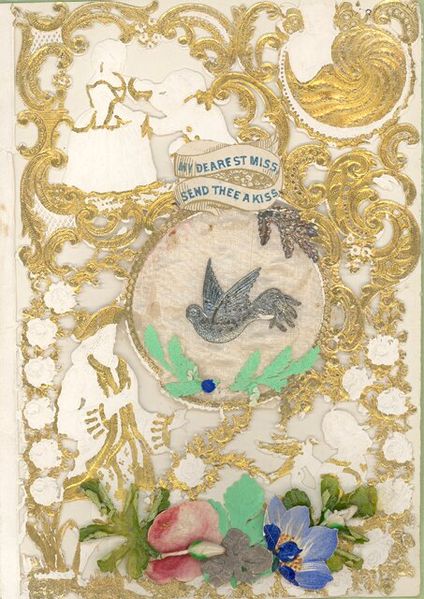
We’ve talked about Valentine’s Day in the nineteenth century a number of times, including here, here, here, and here. This year, I thought you might enjoy seeing some Valentines from the era. The one at the top is a lovely Kate Greenaway version. I think it's supposed to be depict medieval times, but aren't the dresses perfect for the Regency?

The one below is by Esther Howland, dating from about 1870. She truly had a knack.


This is from 1884. Such a demure young miss!

And this is certainly something, from 1862.


Oh, and one more Valentine, from me to you. The first book in my Lady Emily Capers, Secrets and Sensibilities, is on sale until the 21st for 99 cents. The boxed set of Secrets and Sensibilities, Art and Artifice, and a special short story not available elsewhere is two dollars off at $3.99.

Kobo  

Enjoy!

Friday, February 15, 2019

Dissecting a Valentine

Sounds rather macabre the day after the holiday devoted to love, doesn’t it? But I was recently reminded that I have a wonderful late nineteenth century/early twentieth century Valentine courtesy of the great-great aunt who left me her postcard collection, and I wanted to share.


Here it is in all its glory:


A few things to note:

  • It’s built in layers of paper. Each layer isn’t as thick as card stock, but definitely thicker than typical stationery. They are mounted on accordion hinges of the same sort of stock. Alas, everything is pretty flat after nearly a hundred years in a photo album, but you can see where this was once a rather impressive three-dimensional anthem to love.
  • The pieces surrounding the center cherub are made from different materials. The red ribbon is silk, the white a kind of cross-grain fabric. The gilding appears to have been hand-applied. And some of the white lace is fabric bric-a-brac.
  • Nothing on the back or front indicates who created it or where.
  • Inside is a lovely poem promising life-long devotion, but no signature. I don’t know whether my great-great aunt received it from someone she loved or bought it and never sent it. Oh, the story possibilities!


All in all, it’s about 11 inches tall and 8 inches wide, and I don’t think the colors have faded much with time. Any lady would have been pleased to receive it. I am quite delighted my great-great aunt thought to leave it for me.

And now you! Happy belated Valentine's Day!

Friday, February 9, 2018

Nineteenth Century Heroines: Designing Love

Valentine’s Day is approaching. My sweetie and I are trying to determine how to celebrate. Millions of people from school-agers to senior citizens will be purchasing or making cards to share with loved ones. To a large part, this nineteenth century heroine made that possible.

Esther Howland was born in 1828 in Worcester, Massachusetts, into a family that owned a prosperous book and stationery store there. She graduated Mount Holyoke Female Seminary in 1847. After receiving a valentine from an associate of her father’s, she decided she could do better.

And she did.

Now, there were Valentine’s Day cards made before Esther started, but she was the first to create them on a commercial scale in America. She used lace, gold, and colored prints to bring her creations to life. For those who might not be able to express themselves sufficiently, she even published a valentine writer with suggested verses. (We covered those here.) 

Her work was so in demand she had to start her own business and hire friends, creating an assembly line. She designed, her employees copied, and together they produced valentines that were considered elegant, refined, and of the highest quality. Simple cards went for 5 cents each. The most elaborate, with secret pockets for engagement rings or personal messages, cost as much as $50 dollars!

She trained hundreds of women through the years, most of whom worked from home for reasonable wages. Esther herself worked from a wheelchair the last 15 years she was in the business. She died in 1904, unmarried but highly successful, having grossed more than $100,000 a year many years (an amount close to $3 million in today’s dollars). She is known by many as the Mother of the American Valentine.

She simply loved her work.

Friday, February 13, 2015

A Valentine’s Day Present for Romance Lovers

I've been trying to find the perfect Valentine’s Day present for my husband, and he’s tiptoeing around as if he’s trying to do the same for me. As we've discussed here, here, here, and here, Valentine’s Day was very popular in the early nineteenth century, both in England and America.  And as a writer of romance novels, it ranks pretty high as a holiday for me as well.  But I have another reason to celebrate this Valentine’s Day.  This week saw the publication of a very special anthology, with one of my stories included.

Premiere is the first anthology from Romance Writers of America to showcase the diversity of the romance genre.  My story, set at Christmas in Regency England, represents inspirational romances.  Stories by Sabrina Jeffries and Courtney Milan are also set in nineteenth century England and represent historical romance.  Additional stories cover contemporary, romantic suspense, paranormal, erotica, and LGBT, among other subgenres. 

The stories are all built around the theme of “wrong number.”  My story, “A Light in the Darkness,” is based on that horror for Regency hostesses, wrong number at table.  It was considered the very worse faux pas to have an uneven number of ladies and gentlemen at a dinner party. That mistake ends up reuniting two lost lovers.  Can the light of Christmas guide them back to each other?

Here’s an excerpt:

~~~

With Harriet safely caught up in conversation, Ellie could focus on Percy.  How easily time slipped backward.  From the day they’d met, there was nothing they could not share, except the love for war.  They both preferred their books to be rousing romantic adventures, their politics verging toward Whig, and their faith in the Lord to lead them.  Now they shared as easily, their lives since they had parted, the activities of old friends, the loss of loved ones, his mother and her father.

Conversing with Percy was unlike talking with anyone else.  He gave her his full attention, leaning toward her, smile playing about his lips, gaze intend on hers.  He was quick to laugh at her jests, could be counted on to nod approval to her heartfelt choices.  He was always ready to ride to the rescue should she need him but equally willing to let her solve the matter to her own satisfaction.  Just sitting beside him made breath and thought come easier.

Yet when he shared his stories about life with Wellington, she heard something behind the words, saw it in the shadow that crossed his face.  There was tension in him, like a spring never released.  She could only wonder at its source.

Somewhere in the world beyond the glow of Percy’s smile came the tolling of church bells.  Percy rose and drew back the drapes as his sister and the others gathered around.  Through the wreath that hung against the glass, starlight brightened the countryside.  In the distance, squares of colored light showed where the village church was preparing to celebrate services.

“It’s midnight,” Amelia said with the delicious shiver of a child anticipating sweets.  She stood on tiptoe and pecked her husband on the cheek.  “Happy Christmas, my love.”

He wrapped an arm about her waist.  “Happy Christmas, dear.”

Even Harriet and Edmund reached for each other’s hand and stood a moment gazing out at the night, where a single star shown brighter than any other.

Warmer was the way Percy gazed at Ellie. 

~~~

Premiere is currently available in e-book, print, and audio versions.  Learn more on the Romance Writers of America website. 

It just might be the perfect Valentine’s Day gift for romance lovers.  Hm, maybe I should tell my husband.

Friday, February 14, 2014

My Materialistic Valentine

Ah, Valentine’s Day--when we think of scarlet hearts, succulent candy, and stolen kisses.  We’ve talked in the past about how popular the day was in the nineteenth century, with posts on celebrations, the art of penning love poems, and watching for the letter carrier.  As I went looking for inspiration for today’s post, however, I found another sort of Valentine, one purportedly dating from 1849.  It seems that master of British caricature, George Cruikshank, poked a little fun at the day in this valentine:


The gentleman sending this particular note wants to make sure his lady love knows what she’ll be getting should she marry him.  Oh, he’s young, rich, and handsome, good-tempered and well-educated.  That goes without saying (although he isn’t so humble that he doesn’t say it).  That’s not what distinguishes him from other suitors.  He’s willing to lay it all on the line for love.  Here’s what he’s offering:

  • Unlimited bonnets and dresses
  • 300 pounds of pin money a year (pin money was a lady’s spending money.  Note that at this time, a person could live frugally in London on around 150 pounds a year.)
  • Smuggled French gloves and perfume to spare
  • A splendid set of jewels
  • A box at the opera
  • Champagne and cheesecake (interesting combination!)
  • A grand piano
  • Annual trips to Europe
  • A handsome carriage
  • A townhouse and a country house.
Be still my beating heart!  What lady could possibly refuse?

Me, for one.  If I had to think about marriage materialistically in the nineteenth century, I’d add a few items to the list:

  • A large library and sufficient funds to keep expanding it
  • My own study adjoining said library
  • Escort to all literary functions of my choosing
  • Annual subscription to the Royal Society presentations on the latest advancements in science.
What about you?  Any materialistic items you’d advise your valentine to consider before proposing?

Friday, February 15, 2013

Today, My Heart Belongs to . . . the Letter Carrier

I hope you had a lovely Valentine’s Day yesterday! It was a day eagerly awaited by many a young nineteenth century lass and lad in England. Thousands of Valentine letters were exchanged in London alone. In fact, the 1835 Post-Master General’s report cites an additional 50,000 or 60,000 pieces of mail through the London Twopenny Post around Valentine’s Day. The hundred or so letter carriers in London had to be given additional money for refreshments just to see them through their arduous work. In a bigger city, they might make deliveries as many as six times a day!

However, even with their help, figuring out how to get your Valentine from your fingers to your true love wasn’t for the faint of heart. You could hand it to the postman, if you caught him on one of his rounds, or you could take it to the Post Office near you, which could be at a shop or an inn if you were in a smaller town or village. Later in the century, post boxes appeared to collect letters in certain areas. Some villages didn’t even have post offices or boxes, requiring you to walk miles to post a letter or to take the chance of paying a private firm to deliver your message for you. Many such firms went bankrupt before letters were even delivered.

Then too, each sheet of paper cost money to send, to be paid by the person who received it. While England was at war with France, postage costs kept increasing. Postage was also higher the farther the letter had to travel. As you can imagine, the cost put a burden on the average working man or lady, not to mention the underemployed teen.

So, letter writers got creative. Instead of using more than one sheet, they wrote on both sides of the one, vertically, horizontally, and then kitty corner! Such cross writing was notoriously difficult to read, particularly squinting over candlelight. Then too, some friends or family who lived far apart arranged a code. If a letter arrived from the friend with your name misspelled or perhaps the address lettered wrong, why you knew that the friend was well and you could refuse to pay for the letter. There were also tales of people writing with milk along the margins of newspapers, which were free to mail, so that a friend could read the note over the heat of a flame.

Letters that were refused ended up in the Dead Letter Office. I can imagine it looking something like the Library of Congress in Indiana Jones and the Raiders of the Lost Ark, although this is what one looked like in America in the early twentieth century. (Tires? Really?) Post Office employees often had to open the mail to determine how else it might find it rightful home. But in the early nineteenth century in England, Post Office employees were allowed to open and read your mail under other circumstances too, such as if you were suspected of being a traitor to England (“Dear Napoleon—I love you!”), evading Customs (“Dear Aunt Charlotte, that case of Brussels lace is safely stored in the cave under Peasbury Abbey.”, or involved in a robbery (“Dear Susan, I am delighted to relate that I was able to make away with that diamond ring you always wanted.”). If you were in jail for bankruptcy, the Post Office even sent all your mail to the solicitor in charge of prosecuting the case!

I’m just thankful for mail carriers today. They deliver author copies, fan mail, royalty statements, and all manner of things designed to make a writer’s heart go pitter-patter, even when it isn’t Valentine’s Day.

Tuesday, February 14, 2012

Happy Valentine’s Day, My Dear Sweet Rogue!

Happy Valentine’s Day, my dears! Today is a very popular day, now and in the nineteenth century, when postal carriers groaned under the weight of missives from those in love. And it’s special day to me this year because my 21st book officially debuts today. The Rogue’s Reform is the first in a miniseries, as my publisher calls it, about the Everard Legacy. Three handsome cousins set out to claim their inheritance, and find love is their greatest reward. Here’s a summary:

Jerome Everard expected to inherit his wayward uncle’s estate. Instead, all has gone to a daughter his uncle never bothered to mention! Only by disproving his young cousin’s claim can Jerome save the family’s legacy from a schemer. So why would he find himself drawn to the girl’s lovely governess, Adele Walcott, the woman who holds the key to all his uncle’s secrets?

With Adele’s family fortune, and her marriage prospects, long gone, her goal in life is to secure her charge’s happiness, even if that means taking on her new cousin. Jerome is surely a rogue like his uncle, for he seems intent on charming her, and making her dream of love again. When she learns his true motives, will she be able to forgive his past and reform his heart, to make it hers forever?

As you can tell, my hero, Jerome Everard, is a bit of a charmer. He’s used his gilded tongue to get himself out of any number of scrapes over the years and win people around to his way of thinking, just like the early Valentine writers tried to sway their loves. So, in his honor, we’re having a Valentine contest!

Below are two examples of Valentine poems from the nineteenth century. Compose a poem of your own (even a couple of lines!) and post it in the comments, and you will be entered to win an autographed copy of The Rogue’s Reform.

“Soft Spring returns with all her Train,
To crown with Joy the happy Plain;
The Nymphs and Swains to Love incline,
To welcome in St. Valentine.”

“Our fortunes I believe are equal.
Let’s join to make a pleasing sequel.
At least such is my fond design
If you’ll consent, dear Valentine.”

Come back on Friday for another way to win, when we interview the cause of Jerome’s troubles, his newly discovered cousin, Samantha Everard.

Amazon
Harlequin
Barnes and Noble
Powell’s
Indiebound
Book Depository, free shipping world-wide

Friday, February 11, 2011

He Loves Me, He Loves Me Not

We are nearing the time of year when hearts start fluttering: Valentine’s Day is just around the corner. As we’ve discussed, celebrating that day was highly popular in the nineteenth century, with plenty of cards and letters exchanged. But almost as popular was trying to determine who exactly your “true love” might be. After all, if you had a number of beaux flocking to your door, how were you to know which one to encourage?

Nineteenth century young ladies devised any number of schemes that were sure to tell them what they needed to know. Now, don’t try any of these at home. With the exception of the first, I highly doubt any of these will do more than keep you up at night!

  • Saying a prayer before going to sleep. The first man you saw the next morning was your true love. Note that anyone who lived in your house was exempt, which is a good thing or we would likely have had far too many cases of young ladies eloping with the footman!


  • Pinning bay leaves to your pillow. You pinned one leaf to each corner of your pillow and one in the center, and, when you slept, you would dream about your true love. Another version of this tradition has it that if you had a true love already and you dreamed of him, you were sure to marry him before the year was out. I don’t know about you, but laying my head on a pillow that smelled a bit like spaghetti sauce would probably have set me dreaming of Italian food rather than my one true love (although for some those might be the same thing!).

  • Eating a rather nauseating egg. You hard-boiled an egg, broke it in half with the shell in place, removed the yolk, and filled the space with salt. Then you ate the egg, shell and all, and refrained from speaking afterward before you fell asleep. You would then dream of your true love. Or perhaps a nice cup of chamomile tea.

  • Consulting floating paper. You took tiny scraps of paper and wrote the names of the gentlemen with whom you were acquainted. You then wrapped each piece of paper individually in clay and dropped them in water. Whichever one floated to the top first was the name of your true love. Another variation required the young lady to simply drop the paper pieces into the water and read the one that turned upward first. This variation sounds a little havey cavey to me: wouldn’t the ink just bleed once the paper hit the water?

Me? I think I’d have to rely on prayer and the whispers of my heart. Gosh, I guess that’s why I married my husband! That and the fact that he listens, he encourages, and he stands up for me. And he’s cute too (but don’t tell him I said that—he hates being called cute!).

Happy Valentine’s Day!

Friday, February 15, 2008

Valentine's Day, Part II

Think Valentine’s Day was all hearts and romance for nineteenth century teens? Think again. You put a lot of effort in creating your own special valentine for your sweetie, from the design to the sentiment. Purchased valentines might include poems, but often they only had a spot for you to write in your own personalized verse. Being a wit was highly prized during the nineteenth century. What was the poor average lad or lass to do when faced with that blank sheet of paper?

Buy a Valentine Writer. Some enterprising souls actually stood on street corners or sold these little books to stationery stores. The books contained verses for sending a valentine, as well as verses to use to respond to a valentine sent to you. Some verses were highly sentimental. Other books contained comic or even lewd verses. There were verses for widowed folks, young people, older people, sailors, and soldiers. Here’s one for a widow:

A widower to a widow sues
And hopes his suit she’ll not refuse.
You have a child and so have I.
They may cement affection’s tie.
Our fortunes I believe are equal.
Let’s join to make a pleasing sequel.
At least such is my fond design
If you’ll consent, dear Valentine.”

Now here’s where it gets really interesting. During much of the nineteenth century, postage was paid by the recipient. In other words, if you send me a valentine, I get the privilege of paying for it. You can probably guess some of the problems with this practice. A pretty girl might get dozens of valentines, all of which her poor papa has to pay for. That might not be so bad, considering that one of those valentine senders could turn out to be a wealthy suitor and eventually son-in-law. However, there is a less romantic side to this practice. It seemed a grand joke to send insulting valentines to plain girls, telling them how ugly and ungainly they were, and their fathers had to pay the cost of seeing their daughters abused! The fathers frequently appealed to the Post-Master General or the Minister of the Post Office. In most cases, appeals were denied. However, when the valentine in question was found to particularly rude or lewd, postage was refunded.

I’d like to see a Valentine Writer come up with a poem to answer one of those! It might go something like this:

Dear sir, since you lack taste and wit
Your sad note mattered not a bit.
But if I see you in the street
Or if perhaps we chance to meet
I do advise you, pray take heed,
That your pompous self will likely need
The services of a surgeon’s skill
Or else the penning of a Last Will.
For your downfall I’d likely plan.
At least I would, were you a man.

Friday, February 8, 2008

Beloved Valentine, Part I

Now, here’s a holiday to make the most hardened heart go pitter patter. Valentine’s Day was highly celebrated during the nineteenth century. Any young lady or gentleman could send a valentine to a sweetheart, either delivered by hand or by penny post. These weren’t cards as we know them today, but sheets of regular writing paper about 9 by 12 inches. Earlier in the nineteenth century they were mostly white (or cream—whatever color the paper happened to be), with a drawing in the center and a few words of poetry penned around the drawing. Sometimes the words would be above and below the drawing, sometimes around the edges of the sheet. Like the clothes we’ve been discussing the last couple of weeks, the deeper you go into the century, the more elaborate the valentines became.

An enterprising young lady could either make her own valentines or purchase them ready made. Many were hand-colored using colored pencils or water color paints. Flowers, doves, vines or trees, and hearts were common motifs. Another was the endless knot of love or True-Love Knot, something like what we call a Celtic knot, only words were written within the double lines, requiring the recipient to turn the valentine to read the sentiment.

The more artistic you were, the fancier the valentine. A few well-placed snips of the scissors and edges begin to look like basketwork. A few more, and you have silhouettes. The handwork was incredible. They also used pins to make tiny holes in sections of the paper to make it look embossed or bigger holes to make it look like lace.

The most elaborate type of valentine was known as a puzzle purse. The general idea is very similar to the “fortune tellers” children make where you slip your fingers up inside folded paper and move them back and forth in time to a rhyme or counting, then lift up flaps to reveal the answer to your question. Our nineteenth century young ladies didn’t ask questions, but they had to figure out how the flaps unfolded to learn the actual message of the valentine. The trick was to uncover the center flap, because that’s where your admirer would have hidden a secret message to you (unbeknownst to your watchful governess and parents). The center fold was just large enough to hide a lock of hair, a love note, or some other small token of affection.

Next Friday I’ll share some of the outrageous stunts pulled on Valentine’s Day. In the meantime, don’t forget that you have until Monday evening to guess Marissa’s mystery object and win an advance reading copy of her book, Bewitching Season. And if you just can’t wait to read more about the nineteenth century, you might want to drop by Belgrave House’s Regency Reads site, where another of my reissues is now on sale as an electronic book. The Bluestocking on His Knee tells the tale of charming fortune hunter Kevin Whattling’s quest to marry heiress Eugennia Welch, one of the most intelligent women in London. But will her disciplined mind overrule the dictates of her heart?