Tuesday, September 22, 2015

Regency Fabrics, Part 6

Here’s another post in our ongoing series on Regency fabrics.

As I have in previous posts, I’ll be examining actual fabric samples glued into several earlier editions of Ackermann’s Repository, samples supplied by the manufacturers and published by Ackermann in order to boost the British cloth-making industry at a time when exporting British goods to Europe was almost impossible because of the Napoleonic war. I'll give you a close-up scan of each sample, the published description if available, and my own observations of the color, weight, condition, and similarity to present-day materials, to give you as close a picture as possible of what these fabrics are like. So here we go!


We have four fabrics from October 1809; overall condition is very good, considering their age, apart from some browning on sample one where it was glued to the page.


No. 1. An entirely new corded muslin for morning and afternoon dresses, particularly adapted for the intermediate style of decoration for the morning wrap, or simple evening frock. Footing lace, or beading, is better calculated to ornament this article than needle-work. Many ladies, indeed, wear it without any embellishment, the rich and striking contrast of the cord being of itself a sufficient relief. Children’s trowsers, formed of this material, have a very neat and appropriate effect. It is sold by Messrs. Brisco and Powley, 103, New-bond-street, at 6s. per yard.

My comments: This is a very fine, lightweight fabric, but I expect that with the cording it will drape nicely. Because of its sheerness, it definitely requires a lining and/or a petticoat underneath.

No. 2. The Brazilian corded sarsnet, for robes, pelisses, and spencers. This article is also of novel production, and possesses a richness and consequence, which advance it, in point of elegance, beyond the plain sarsenet. The weight of the cord occasions it to fall with graceful adhesiveness over the figure, and divests it of that liability to crease, which is generally complained of in the plain sarsnet. We have seen Circassian robes, and short dancing dresses, formed of this tasteful article, to produce a most pleasing and attractive costume. It is half a yard wide, and 7s. 6d. per yard, and is sold by Mr. J. George, 19, Holywell-street, Strand.

My comments: I wish my scan had reproduced it better--this is lovely stuff indeed! It’s heavier and more opaque than the first sarsnet, with a soft sheen and very attractive pale buff color. But at only a half-yard wide, it would take a lot of it to make a gown—at 7definitely an upscale item.

 No.3. A pomona green shawl print, in imitation of Indian silk, calculated for morning wraps or pelisses, as well as for gowns and robes. We beg leave to call the attention of our correspondents, not only to the taste and union of its pattern and shades, but also to the peculiar delicacy and silky softness of its fabric. It is ell-wide, and from 5s. to 5s. 6d. per yard; and may be purchased at Messrs. Brisco and Powley’s, 103, New-Bond-street.

My comments: Ah, pomona green, that most Regency of colors (if you're a Georgette Heyer fan, that is!) Again, the pattern reminds me of nothing so much as 1930s quilt fabric; what isn't as visible in this scan is that the fabric is finely diagonally ribbed. It's a little heavier in weight and indeed has a very silky hand due to the fineness of its threads and the tight weave.

No. 4. A rose-colored printed book-muslin, best calculated for the ball-room or evening party. It is formed in simple round dresses, or French frocks, trimmed with lace, white beads, or blended-white satin, and must be worn over white sarsnet, satin, or glazed cambric. This simple article will recommend itself, as well from the reasonableness of its price, as from its lively and animated effect. It is ell-wide, and 4s. per yard, and may be had at any respectable linen-drapers at the west end of this town.

My comments: This is nowhere as nice a fabric as the print above, being of  a coarser weave (though the threads are finely woven)--no wonder readers are cautioned it must be worn over another fabric! It does not strike me as a fabric for a ball or evening dress, but evidently tastes have changed!

Friday, September 18, 2015

What We Want for Our Birthday—Your Comments!

Wow, where did the time go? This month Marissa and I begin our ninth year blogging at Nineteen Teen. Happy birthday to us! And thank you for your comments, your subscriptions, and your suggestions, encouragement, and commiserations. May we have more of the same?

In short, this is your chance to tell us what you like.

What would you like to see more of in the coming year? More posts on historical tidbits we uncover? More insights into the life of a writer who sometimes dabbles in the nineteenth century? More pictures of Marissa’s bunnies? Regina’s beloved sailing ships?

Shall we watch another movie together? Read another book? Which ones?

What guest authors would you like to have visit? (Yes, we tried for Marion Chesney. Alas, she was too busy to respond. L)

At the very least, stop by, have a slice of virtual cake and punch (ours is much better than ratafia, we promise!), and wish us happy birthday as we hop (or sail) into a new blog year.

Happy birthday, Nineteen Teen!

Tuesday, September 15, 2015

Green and Pleasant Land, Part 5: Lyme Regis

We hated to leave Dartmoor. We really did. But I’d promised Daughter #2 some fossil-hunting on the beach in Lyme Regis. Those of you who are Jane Austen fans will recognize that name, I’m sure...so we once again set forth, this time for the shore.

Best pub name spotted en route: The Salty Monk. ☺

Lyme Regis itself is a charming little town, clinging closely to the shore. And I don’t use the term “clinging” lightly—there’s a heck of a drop from the main road through town to the beach itself. Blessedly, there’s plenty of visitor parking, though it did involve a very steep walk down to the shore—not bad on the way down, but uphill was definitely a challenge. Thank goodness for all those hours I’ve spent on the elliptical!

The climate of the immediate south coast of England is amazingly mild. We hardy New Englanders were astonished to see fuchsia grown as a hedge, rather than a summer-time potted plant doomed to death in the first good October frost!

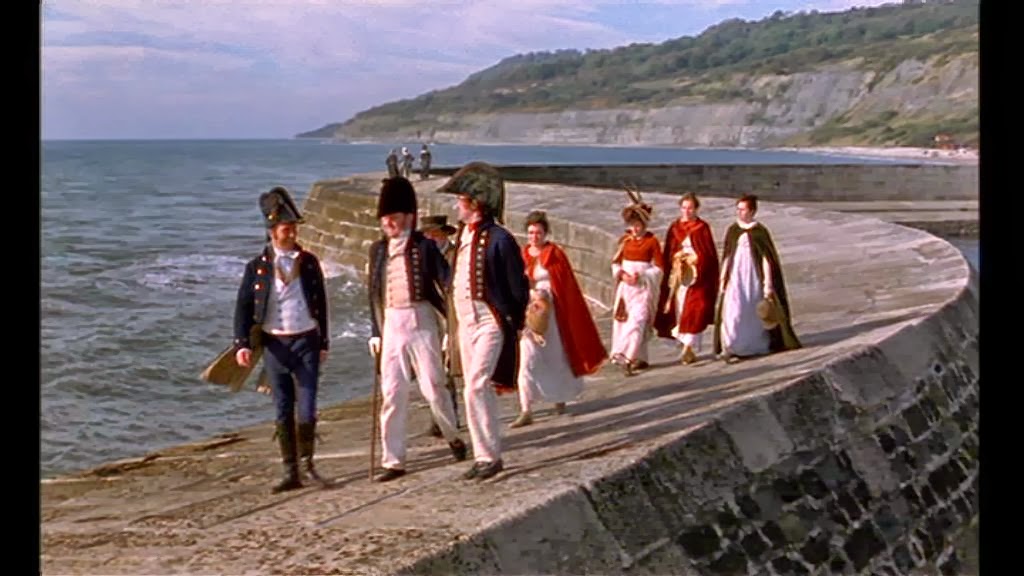
As we trundled down the hill, we were delighted with this view of the famous Cobb... famous, of course, as the location of an important scene in Persuasion—where Louisa Musgrove imprudently jumps the stairs leading down from its top. The Cobb is a partial breakwater, creating a small, protected harbor for the local fishing fleet—though now, the main denizens appear to be pleasure craft.

What I found interesting about the Cobb was the angle at which it was built: good for allowing breaking waves to run off, but a little unnerving to walk on, especially in a brisk breeze (that's Daughter #1, walking at an angle!) But even more interesting was the thought that Jane Austen knew this town and this very place—a bit of a shiver down the spine moment!

Being good Jane Austen fans, my son and husband and I spent a good long time debating which of the stairs leading down from the Cobb were the ones that Louisa jumped from. In the end, we decided it must be these (also known by the name "Granny's Teeth"!), as they were the most suitably archaic and untrustworthy looking (honestly, if I’d been Louisa, I might have preferred jumping rather than trying to negotiate them in a stiff breeze in a long skirt!

Next, it was time to go fossil hunting. This whole 95-mile section of the south coast is called England’s “Jurassic Coast”. Going east from Orcombe Point to Old Harry Rocks is like traveling in time, from the early Triassic period onward. Lyme Regis is located in the oldest part of the coast, its formations dating to 200 to 195 million years ago. Down the beach from the Cobb a great cliff face looms up, made of very crumbly black shale, the remains of an ancient ocean bed (you can see it in the pictures above of the Cobb.) And as gravity and the weather erode it, the fossils of creatures that died and left their remains in the oozy black mud of that old ocean end up on the beach, where they can be picked up from amongst the clitter of rocks and flints by geeky American tourists like us.

Here's part of our haul.
What you see here are ammonite fossils, distant and extinct relatives of today’s squid and nautiluses; the little star-shaped one is possibly an echinoid, a relative of today’s starfish and sea urchins. It was a lot of fun, actually, and reminded me of my long-ago days as an archaeology student doing field surface surveys. We had a lovely if late lunch at a pub close to the Cobb, then dragged ourselves back up the hill to our car, to go to our next destination. But I’ll be back to the Jurassic Coast some day.

Next installment: Not the Isle of Wight, sadly, but a few other sites of interest.

Friday, September 11, 2015

On Wings Like the Eagle

Some of you who follow my Facebook page know I’m fond of sailing ships, going so far as to post pictures on Sailing Ship Saturdays. I’ll admit I’m a die-hard tall ship fan, going aboard any chance I get. I’ve spent the day sailing on my state’s tall ship, Lady Washington. I’ve walked the decks of the Constitution. But some years ago now, I had the privilege of touring America’s tall ship, the U.S. Coast Guard Cutter, Eagle.

Eagle is the largest tall ship sailing out of an American port and the only square-rigger in U.S. government service. The steel-hulled barque was built in 1936 in Germany, where she was used as a training ship for Nazi cadets. At the end of the war, she was brought to America as a war prize. According to the Coast Guard site, the German crew actually helped U.S. Coast Guardsmen bring her into her new homeport in New London, Connecticut.


A few things surprised me about her:
  • Though she is made of metal, her decks are actually covered with teak.
  • The massive wheel that is her helm is nearly as big as I am!
  • She can go faster under full sail than she can under more modern power (and her “tank” holds more than 23,000 gallons—how’d you like to fill her up?).
  • Her rigging is 6 miles long, and she boast more than 22,000 square feet of sail.

Today, she serves as a training ship again, taking crews from among the 1,000 men and women who attend the Coast Guard Academy each year. Right now, she just made berth at the Coast Guard Yard in Baltimore for some R&R (renovation and repair). But she generally takes a summer schedule, May through August. If you’re on the East Coast between Boston and Florida, keep a weather eye peeled for tall sails in your neck of the woods next year.

You just might become a fan too.

Tuesday, September 8, 2015

Mr. Pocock Rides Again (Sort of)

It’s amazing what you can find when you clean out a bookcase.

Recently my mother was doing just that, and found an old issue of Heritage, the British history magazine, from February/March 1990. Naturally she saved it for me so that I could put it in my overburdened bookshelves...and while flipping through it, I ran across an article entitled “Pocock’s Flying Carriage”. The story was wonderful, and the name was familiar. Hmm, yes, we have met a Mr. Pocock before, haven't we...however, it seems to have been a different Mr. P.

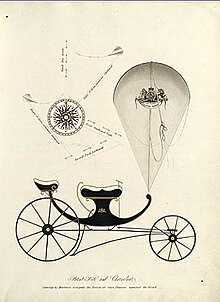
That Mr. Pocock (William) was, it seems, a London furniture-maker and known for his interest in patent furniture—designs that involved clever, ingenious mechanizations, as we saw with his Reclining Patent Chair. Perhaps there’s something to the name that dooms its bearers to be inveterate tinkerers, because another Mr. Pocock, this time a George, was inventing at the same time...and went far beyond furniture. You see, that Mr. Pocock was the proud inventor, in the 1820s, of the Charvolant, or Flying Car.


George P. (1774-1843) was a schoolmaster in Bristol who liked to invent things on the side. One of his inventions, a spanking machine (the “Royal Patent Self-acting Ferule”) which could punish several misbehaving schoolboys at once, had something to do with his teaching vocation (I wish I could find a picture of it!)...but evidently, Mr. Pocock was also fascinated by kites. He spent his youth experimenting with the power of kites, and induced a trusting friend to squat on a makeshift sled attached to kites. The friend ended up dragged away faster than George could follow on foot and was eventually tumbled into a quarry (uninjured, fortunately) but young George was even more hooked by kite power.

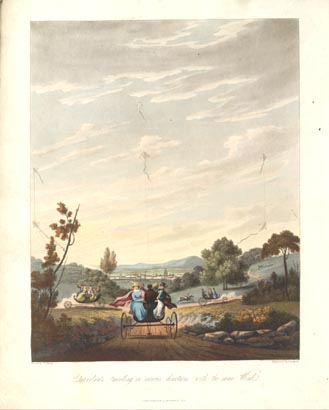
More experimentation followed, fortunately with no fatalities—that included launching his own daughter 300 feet into the air in a kite-drawn chair. Of course, you knew what would come next: kite-powered carriages. He spent several years working on his Charvolants, and finally in 1826 registered a patent. In 1828 he demonstrated a Charvolant at Ascot to King George IV, and was soon running demonstration races, beating the London coach in a race from Bristol to Marlborough by twenty-five minutes (after giving the coach a 15 minute head-start.) His Charvolant could travel as fast as twenty miles per hour, and the ride was much smoother and quieter than a horse-drawn vehicle—in fact, a Charvolant driver blew a bugle to warn vehicles it was overtaking, because of its quietness.

Charvolant travel was also much cheaper than travel utilizing horses: wind was free, after all, while horses were expensive to maintain and had to be changed on journeys of more than fifteen to twenty miles. And, amusingly, Charvolants could travel the turnpikes free. Tolls were charged at toll-gates based on the number of animals drawing any given vehicle...and Charvolants were notably draft animal-free. Though critics scoffed that a Charvolant would be grounded on a windless day, Mr. Pocock remained unruffled and replied, “Ships might be objected to on this principle—that there were sometimes calms, or contrary winds.”

Alas for Mr. Pocock, though, his timing was bad. Despite the interest his Charvolants generated, another new mode of transportation generated even more interest and would soon doom the Charvolant to a sidenote in transportation history: the railway.

Friday, September 4, 2015

Last Retro Blast of the Summer: Looking Out for Pedestrians

[In May 2012, I originally published this post after attending a track meet. One of the comments on the post came from our own QNPoohBear, alerting me to a mother/daughter team from my state who took pedestrianism to a whole new length (pardon the pun). I’ve included some details on them at the end of the post.]

A certain young man of my acquaintance thoroughly enjoys competing in track and field events and recently made it to the regional level of competition.  While running as a competition has been around since the early Olympic games, we don’t often think of the young ladies and gentlemen of nineteenth century England spending time rushing about a track.  Instead, they might become Pedestrians.

A Pedestrian was a professional walker.  He either competed against other pedestrians for a prize or worked for the winnings from wagers on his/her ability to walk a certain distance in a certain amount of time.  A popular feat was to walk 100 miles in less than 24 hours; those who succeeded were called Centurions.  Crowds of up to 10,000 people lined the roads to watch, and cheer. 

One of the most famous Pedestrians of nineteenth century England was Captain Barclay (Robert Barclay Allardice).  In 1809, he set a record that became the one to beat for nearly a century:  He walked for 1 mile an hour for 1,000 hours without stopping, starting on June 1 and ending on July 12.  And all this dressed like a gentleman in top hat, cravat, and wool suit!

But it wasn’t just the men who got into the act.  As a young girl, Mary Wilkinson of Yorkshire walked 250 miles to London in less than four days.  She repeated the feat at age 90 with a keg of gin and provisions strapped on her back, but in five days and three hours.  (Must have been the gin.)  In 1823, at only 8 years of age, Emma Matilda Freeman walked 30 miles in 7 hours and 57 minutes through pouring rain.  Her feat was reported as far away as America. Now there’s a determined young lady!

But I will admit complete admiration for two Pedestrians from my home state of Washington. Helga Etsby and her teenage daughter Clara walked from Spokane, Washington, to New York City over the course of many months in 1896 to claim a prize of $10,000 that would save their mortgaged farm. Although their family story didn’t end happily, and the sponsor reneged on the prize, that doesn’t diminish their accomplishment. Their story can be read in Bold Spirit by Linda Lawrence Hunt, now available in e-book.   

I’d stand in the rain and cheer for them.

Friday, August 28, 2015

Politically Bowdlerized

I admit it. I prefer my romances to be, well romantic, with nothing more than sweet kisses, clasping of hands, and the fervent meeting of glances. But I do believe there is room in the world for romances of a more, er, passionate nature. Unfortunately, in the nineteenth century, my views would have been seen as far too liberal, and my books might have been edited to remove portions unsuited to young audiences. Even the classics like Shakespeare were deemed too risqué for women and children in some circles.

That’s where Thomas Bowdler came in. He was a physician who took ill early in his career and decided not to practice medicine any longer. Instead, he devoted himself to good works, including working for prison reform. Along the way, he decided it would be good for families to be able to read Shakespeare and other classics, if only there weren’t so many naughty words and irreverent concepts in them.

So, in 1807, he published a collection called the Family Shakspeare (which apparently was the way the name was spelled then), which claimed to have removed any term thought to give offense to women and children. Included in these terms were curses, acts of violence such as Ophelia’s suicide in Hamlet, and entire characters with unsavory professions. The book took a while to gain a following, but as the Victorian period came into full swing, sales increased. The book saw more than 11 editions by 1850. Some reviewers were appalled and labeled it pap in its worst form. Others lauded the publication as making the Bard accessible to a much broader group of readers.

Here is what Mr. Bowdler said to justify the changes:
If a presumptuous artist should undertake to remove a supposed defect in the Transfiguration of Raphael or in the Belvidere Apollo and in making the attempt should injure one of those invaluable productions of art and genius I should consider his name as deserving never to be mentioned or mentioned only with him who set fire to the Temple of Diana. But the works of the poet may be considered in a very different light from those of the painter and the statuary. Shakspeare, inimitable Shakspeare, will remain the subject of admiration as long as taste and literature shall exist and his writings will be handed down to posterity in their native beauty although the present attempt to add to his fame should prove entirely abortive. Here then is the great difference. If the endeavour to improve the picture or the statue should be unsuccessful the beauty of the original would be destroyed and the injury be irreparable. In such a case let the artist refrain from using the chisel or the pencil; but with the works of the poet no such danger occurs and the critic need not be afraid of employing his pen for the original will continue unimpaired although his own labours should immediately be consigned to oblivion.
Interesting argument, no? I’m fairly certain that I would not have the same tender feelings toward someone “improving” my work. But here’s something else interesting about Bowdler’s version of Shakespeare.

It appears he didn’t do the editing. His sister did.

Now, if a lady editing a book to remove things no lady should read doesn’t make you scratch your head, consider this: Henrietta, called Harriet in her family, was an author in her own right. Perhaps her best known work, published anonymously, was Sermons on the Doctrines and Duties of Christianity, which supposedly went through nearly fifty editions, to the delight of ministers across the Empire (who had no notion she wasn’t an elderly clergyman). She was also accorded by some the title of bluestocking, those well-read ladies who delight in literature. Yet it does not seem to have troubled her to have changed someone else’s writing, without request or permission, all in the name of making it more palatable to a group of people.

Slippery slope.

Is it any wonder bowdlerize has come to mean to change a work, whether book, play, or movie, by removing parts that would offend people?