Tuesday, November 15, 2016

So That’s What One Looks Like

I’m going to post a word, and I want you to tell me what mental image you get when you read it. Ready?

Penknife.

So what picture did you get in your mind? Maybe an object with short blades that fold up out of a protective cover? Or a Swiss Army knife with seventeen other bits and bobs on it beside a blade or two?

Well, had you been a nineteenth century miss, this is what you would have thought of:


Not much like today’s penknives, is it?  That’s because it wasn’t. In the 19th century, a penknife was exactly that—a knife used to make or trim pens.

Up until the mass production of the steel-nib dip pen in the early 1820s (though metal pens had been around since the early 18th century), the chief type of pens in use were made from quills, usually the primary flight feathers of large birds like geese, hawks, eagles, or turkeys. They actually make good pens; the hollow shaft of a quill serves as an ink reservoir, and a properly prepared quill can last a long time (though not as long on today's wood-pulp based paper which can quickly wear down tips; they do best with parchment and vellum.)

Unlike what you might see in movies, a quill prepared for writing usually has most of the fluffy bits—the barbs—removed, so that they don’t chafe the writer’s hand. The shafts are heat-treated, which makes them stiffer (different methods can be used, from placing the quills in hot water or heated sand or ashes from the fire.) Then, one gets out one’s penknife and prepare the tip. There’s a great explanation of how to trim a quill here, for the truly curious...and it explains the fine, thin shape of a penknife’s blade since the blade was inserted into the quill at one point. Note on the photo of my penknife the shape of the handle—curved to fit comfortably against the fingers when shaving off bits of quill.

So that’s what a penknife is. And though I’m very happy with my laptop for writing, I can’t help sighing a little for the pretty desk accoutrements of the nineteenth century.  Maybe I could find someone to make me a pretty mother-of-pearl cover for my mouse?
 

Friday, November 11, 2016

Nineteenth Century Heroines: A Beacon to All

It’s been a while since we talked about a real-life heroine of the nineteenth century, but I hope you agree that Flora Augusta Pearson Engle fits the bill. Flora was one of the Mercer Belles, those ladies who traveled west with Asa Mercer to help civilize Washington Territory. Her sisters and father came on Mercer’s first trip in 1864. Flora, her mother, and her brother came on the second trip that brought my heroines Allegra Howard (The Bride Ship), Catherine Stanway (Would-Be Wilderness Wife), Rina Fosgrave (Frontier Engagement), Maddie O’Rourke (Instant Frontier Family), and Nora Underhill (this month’s A Convenient Christmas Wedding). Flora was only 16 at the time. I wish I had a picture I could post, but you can see one at Find-A-Grave.

Born in Rollinsford, New Hampshire, Flora was the daughter of Daniel Pearson and Susan Brown Pearson. Daniel worked as a supervisor in the local cotton mill until the Civil War interrupted. By 1864, he was unemployed and in poor health, so travelling west must have looked good. The plan was for him and Flora’s sisters Georgie and Josie to move out first, and then to send for Flora, her brother Daniel, and her mother once they were settled.

Right away fate intervened. Georgie and Josie were immediately assigned to teach school on Whidbey Island, in the town of Coupeville, but Josie died suddenly walking home from class one day. Daniel, who had been working across the Sound, moved to Coupeville to be near Georgie. He was appointed keeper of the Red Bluff Lighthouse, what is now known as Admiralty Head. Georgie, then 17, became his assistant lighthouse keeper, the first woman to do so in Washington Territory.

By the time Flora arrived, however, Georgie had a serious suitor. They were married in the lighthouse parlor less than a year later, and Flora stepped into her sister’s shoes as assistant to her father. She earned approximately $625 a year for the post.

For the next ten years, Flora kept the lighthouse log, recording incidents both important and trivial, and sending a report to Washington, D.C., every month. It wasn’t hard for her. She had kept a diary for years, including chronicling the voyage that had brought the Mercer Belles to Washington. She was a society reporter for the local newspaper and later wrote many articles about local history. Legend has it she spelled the town of Coupeville without the middle e, and it took the government to change the name back years later.

According to Lighthouse Friends, Flora occasionally joked in the log, as in this notation from 1875, right before she was married: “By order of Lt. Commander Louis Keurpoff (inspector): Be it hereby known, to whom it may or may not concern: All light keepers, either principal or assistant, in this domain of our beloved Uncle Samuel, are expressly forbidden to depart from the Territory of Single Blessedness and take up their abode in the populous State of Matrimony unless said departure be permitted and sanctioned by the Lighthouse Inspector.”

Sounds to me like Flora had a few suitors herself.

I'm not sure what Flora was looking for in a husband. At that time, she could have taken her pick. In 1876, when she was 26 years old, however, she married a local farmer, William Engle, nearly 20 years her senior. They had a lovely honeymoon in San Francisco. But even the birth of her son, Carl Terry Engle, a year later didn’t stop her from reporting to work. He was born at the lighthouse, and she noted it in the log. She continued working at the lighthouse until her father’s retirement in 1878, staying on one more month to help the new lighthouse keeper get oriented.


Flora and William moved to his farm, but that wasn’t the end of her contributions to the community. She championed the building for the first board sidewalks in Coupeville and led efforts to restore the Davis Blockhouse, a fortified cabin built around 1855. She appears to have been a member of the Ladies of the Round Table, a local club I’m eager to learn more about (future book, perhaps?). When her mother died in 1890, she took in her father until he died seven years later.

Flora lived until she was 85. Her grandchildren and great-grandchildren remembered her as a woman of indefatigable energy. She may have made a name for herself as a lighthouse keeper, but I think it was her light that shined the brightest.

Tuesday, November 8, 2016

Regency Fabric, Part 12

Here’s another post in our ongoing series on Regency fabrics.

As I have in previous posts, I’ll be examining actual fabric samples glued into several earlier editions of Ackermann’s Repository, samples supplied by the manufacturers and published by Ackermann in order to boost the British cloth-making industry at a time when exporting British goods to Europe was almost impossible because of the Napoleonic war. I'll give you a close-up scan of each sample, the published description if available, and my own observations of the color, weight, condition, and similarity to present-day materials, to give you as close a picture as possible of what these fabrics are like. So here we go!


Today we have four fabrics from May 1810; their overall condition appears to be good, though a few show brown age stains.

No. 1. A French knotted muslin, calculated for morning wraps and the Austrian frock. No introduction of needlework or lace can be admitted with propriety into this rich article, except an edging round the bottom of the latter, and down the sides of the former. This novel article is sold by Messrs. Waithman and Everington, corner of New Bridge-street, Fleet-street.


My comments: Being white muslin, of course any dress made of this material would require an underdress or lining...but the ground fabric itself is of a fine, fairly tight weave. I wish I knew more about the manufacture of fabrics, because when I look at the reverse side, I wonder if the knotting was hand or machine done. I suspect hand done since there are no threads between the groups of French knots, which would make this a rich article indeed!

No. 2. A fancy convent striped muslin; an article entirely new, and offering a neat and appropriate change for the morning or domestic habit. Pelisses for young ladies are occasionally formed of this simple material, and for undress are, perhaps, more genteel than when composed of sarsnet. We are indebted for this article to the house of Messrs. John Satterfield and Co., Manchester (where only it can be had), and who, our readers may recollect, furnished us with a beautiful cotton velvet introduced in our last January number.


My comments: The faint diamond pattern woven into this fabric makes it look almost like a waffle-weave fabric, but it’s anything but that—indeed, it is very smooth and finely woven, and quite light-weight—lovely for a summer frock.

No. 3. An imperial waved lilac shot sarsnet. This very fashionable and seasonable article is alike calculated for the military spencer, pelisse, and robe. The high gown, with Arminian stomacher and collar, or with French aprons of Paris net, are exceedingly attractive when formed of this article. It is sold by Messrs. D. and P. Cooper, Pall-Mall.


My comments: The color is more dusty rose than lilac, but that may be due to fading—after all, this is an over two hundred year old piece of fabric! The pattern is handsomely woven, the hand silky, and though it is light-weight I expect it would drape beautifully.

No.4. A permanent green shawl print for gentlemen’s waistcoats. The extreme delicacy and coolness of this fancy article is too obvious to need a comment; we shall therefore only add, that the extra-ordinary demand for the permanent green print, since its first introduction in out number for February has been unprecedented in any newly manufactured article, and arises from the utility and qualities, as well as from the novelty of the article, which is highly creditable to the taste and perseverance of the inventors, Messrs. Kestevens and Co., York-street, Covent-Garden, where only it is sold.


My comments: A very sturdy, slightly stiff, ribbed fabric, almost the weight of what we would use today for trousers (though not actually a twill); the printing is clear and sharp and has an almost a foulard-like appearance. Very dapper indeed for gentlemen’s waistcoats!

Friday, November 4, 2016

Christmas, Frontier Style?

A Convenient Christmas Wedding, out now from Love Inspired Historical, isn’t my first Christmas story. I’ve written two others, both set in Regency England. Now, admittedly, the characters in my Regency stories and those in my Frontier Bachelors stories not only come from different sides of the Pond but different social strata. So, I was a little surprised by the similarities, and the differences, between how the two celebrated Christmas.

As Marissa and I have shared, Christmas in the early part of the nineteenth century in England wasn’t nearly as elaborate as it became later. But by 1866, when my story, A Convenient Christmas Wedding, takes place, both England and America were fond of celebrating. As you can imagine the grand Christmas tree that might grace an English country home didn’t exactly fit in a frontier cabin. And not everyone who celebrated Christmas came from the English/Scotch/Irish traditions that included plum pudding.

My Wallin family originated in Sweden, though Mrs. Wallin, the matriarch, has some English blood. So it seemed logical to me that their family celebration would be an amalgam of the traditions, with a few American favorites thrown in. So, they bring in the Yule log, as some of my English characters did, but they also hang stockings by the fire on Christmas Eve for Father Christmas (not Santa Clause) as was becoming popular in America. Here’s the scene where Nora, my heroine, first becomes aware of the custom.

“We were just waiting for you and Simon,” Mrs. Wallin said, coming to take Nora’s cloak. “But I think I see something in your stocking.”

She couldn’t help the tingle of anticipation as she looked to the hearth. Sure enough, her stocking bulged. She glanced at Mrs. Wallin, who nodded toward the fire. “Go ahead, dear. See what Father Christmas left for you.”

Nora ventured to the hearth, even as Levi and Beth pounced on their stockings, and the others moved closer to inspect theirs as well. Nora pulled the stocking from the nail and reached inside to find a tangerine, a handkerchief embroidered with her initial, a knit scarf of a familiar-looking purple heather yarn and a book of poetry.

Simon’s stocking, hanging next to hers, looked significantly less thick.

Glancing around to make sure no one was looking, she slipped her hand in his stocking. Her fingers met the rough edge of a rock.

Oh, no. She would not stand for Simon getting coal. She pulled out the rock and tucked it in her pocket. Then she put in her tangerine. She couldn’t very well give him the handkerchief or the scarf, but after a moment’s thought, she slipped in the poetry book as well.

The door opened just then for Simon, a bucket of milk in hand, and Nora scampered back from the hearth. Fleet bounded in on his heels, going from person to person and saying hello. The others were examining their gifts and exclaiming over the thoughtfulness. Mrs. Wallin had a new comb for her hair, edged with pearl beads that looked suspiciously like the ones Beth had purchased. Beth had received the latest issue of Godey’s and was already curled up in her mother’s rocker scanning the pages of the famous ladies’ magazine. John was fingering a fishing lure. A loud metallic hum proved that Levi had found a harmonica in his stocking and was trying it out.

Nora could hardly wait for Simon to peer into his stocking. But he didn’t go near the hearth even after he left the milk in the kitchen. Instead, he came up to her with a smile.

“And did Father Christmas reward you for your kindness?”

“Yes,” she said, holding up her handkerchief and scarf. “Aren’t they lovely?”

“Not as lovely as you,” he murmured.

Nora caught her breath.

“Go on, Simon,” James called. “You haven’t looked in your stocking yet.”

Simon turned and looked to the stocking. Then he frowned and wandered closer.

Nora let out her breath. He was only being kind. She knew she wasn’t lovely. But the words had sounded so sweet.

His mother looked over as Simon scrutinized the book of poetry. “It seems Father Christmas was a bit mixed up this year,” she said with a look to James.

“I’ll say,” James agreed, tossing his tangerine in the air and catching it. “First time in years Simon hasn’t gotten coal. But I’m not sure love poems are any more use to him.”

Love poems? She should have paid more attention to the title!

Simon pocketed the book. “I can assure you, James, that I’ll find a use for them.” He looked to Nora.

Oh, my!
~~~~
Now, that sounds like a Christmas worth celebrating, in any time period. For your convenience, here are the buy links one more time:

Harlequin
Amazon
Barnes and Noble
Kobo
iBooks
A bookstore near you
The Book Depository, free shipping worldwide

Tuesday, November 1, 2016

You Are Invited to A Convenient Christmas Wedding

Christmas and weddings—two special times. Combine them, and my hope is you will find a very special book. Industry review publication RT Book Reviews seems to agree, offering Simon Wallin’s story a coveted 4.5 stars and a top pick for November.

“This is a sweet marriage-of-convenience tale, and Scott’s love of history is apparent. Along with the fully fleshed out storyline and characters, the vivid descriptions and balance between the hero and heroine make this an engaging and truly enjoyable read. The drama will keep the reader turning the pages until the end, which comes all too soon.”

This is the fifth book in my Frontier Bachelor series set in pioneer Seattle, but, if you’re new to the series, you’ll still feel right at home.

Proposing a marriage of convenience to a rugged logger is the boldest move of Nora Underhill’s sheltered life. In return for Simon Wallin’s protection from her overbearing family, the unassuming seamstress offers prime frontier farmland. But their paper marriage changes when Nora’s greedy brother tries to draw her back into a life of drudgery. Her only option: move to Simon’s farm, and into the center of his loving, unruly family.

Years of shouldering responsibility have left Simon cynical and reserved. But little by little, Nora’s warmth opens his shuttered heart to joy. With their marriage claim under threat, can this practical arrangement blossom over the holidays…and become a love for all seasons?

You can find it at fine online retailers starting today and on book store shelves next week:

The Book Depository, free shipping worldwide 

Friday, October 28, 2016

It Has a Ring to It

Oh, that precious ring, the one handed to our beloved in pledge of eternal devotion. While engagement and wedding rings are commonplace today, young ladies and gentlemen of the nineteenth century generally only had a single ring, the band of gold for the wife only. However, I was surprised to find that the October 1810 issue of La Belle Assemblée, that arbiter of all things fashionable, had much to say about rings and the mindset of the day.

It was the custom at Rome, to send to the bride, before marriage, a present from the bridegroom of an iron ring, without any stone, to prove how long lasting, durable, and firm their union ought to be, and the frugality requisite to be observed in the married state, in order to provide for a family: but luxury soon gained ground; the old custom was abolished, and the iron rings gave place to those of more cash and expence.
Not sure how I’d feel about being given what amounts to a shackle. But there are certainly ladies who hold out for a diamond, the bigger the better.

The Roman knights were distinguished from the senators by their gold rings, and it was customary, as a mark of honour, to present ambassadors with them when they received orders from the senate to depart for foreign states. After the regal power was put aside in Rome, gold rings were worn as a sign of liberty; and Hannibal, when he had gained a signal victory, sent to Carthage a bushel of gold rings taken from off the fingers of the Roman nobles and knights who were slain in the field of battle.
Okay, TMI.

Though the first inhabitants of England, Ireland, and Scotland, and the ancient Gauls were accustomed to wear the wedding ring on the forefinger, the use, at last, prevailed amongst all nations, to place it on the next to the little one on the left hand, called the annulary finger; because, according to the opinion of the Egyptians, a small nerve runs from this finger to the heart.
You can see who’s taking the credit here, all mentions of Egyptians aside.

The piece goes on to talk about an old tradition of making sure the precious stones were set in such a way that the jewel itself touched the finger. The reason? Some jewels were supposed to possess virtues:

  • Diamond—preserves against poison and the plague, expels anger, and ensures victory
  • Ruby—banishes sorrow and averts ill thoughts
  • Amethyst—gains the wearer the favor of princes
  • Jacinth—fortifies the heart and preserves against thunder and lightning
  • Emerald—cures epileptic fits and renders harmless the bite of any venomous animal
  • Opal—preserves against infectious air and prevents fainting fits.

Queen Victoria’s oldest son Edward Albert (King Edward VII) had another idea about the purpose of wedding and engagement rings. The engagement ring he gave his bride, Princess Alexandra of Denmark, carried six precious stones: a beryl, an emerald, a ruby, a turquoise, a jacinth, and a second emerald. The initial letters of the gems spelled out his nickname: BERTIE.

Perhaps he should have consulted La Belle Assemblée.

All these reputed virtues, whether real or imaginary, serve to shew that the first wearing of rings had in it something holy, honourable, and talismanic: the small golden fetter which binds the wife to the husband, is now reckoned the most sacred of all. The mourning ring, for a departed and dearly valued friend, or relative, claims the next place; and though valuable rings are often given as pledges of love, respect, and amity, yet there are only two, the wedding and the mourning ring, which possess and retain, through every age, the symbolic solemnity of their first institution.

Tuesday, October 25, 2016

Accessories, Part 5: Fans

We’re back for another installment in our fashion series on NineteenTeen focusing not on dresses and gowns (gorgeous as they are) but on the little things that complete a fashionable ensemble—hats, shoes, gloves, purses, and other accessories.

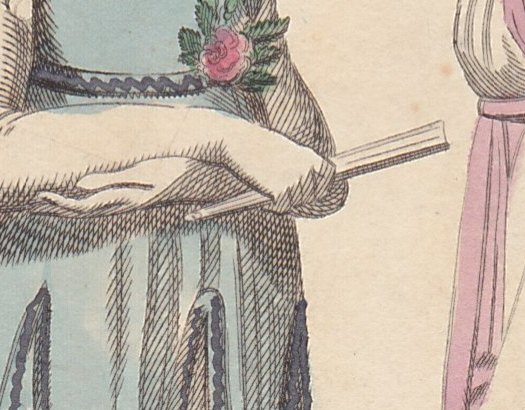
Our accessory of the week is the fan, that indispensable and multi-purpose item in any upper class woman’s fashion arsenal. Fans were vastly useful: one could flirt with them (or use them to signal the profoundest disdain!), use them as a weapon, or even—shockingly—use them to cool one’s self down after a lively set of dances. Just as the reticule was mostly a daytime accessory, the fan is only seen in prints of evening, ball, and opera dresses

Look for lots of images rather than commentary, though I’ll try to supply original text if I have it—the point is to be able to examine multiple examples of each item. Images are drawn from my collection of prints from British publications including Ackermann’s Repository, La Belle Assemblée, The Lady’s Magazine, Phillips’ Fashions of London and Paris, and others. However, Ackermann’s had the most detailed plates, so the majority of images you’ll see will be from that publication.  These date from 1799-1821. 

Happy accessorizing!

London Full Dress, from Fashions of London and Paris, June 1799


Parisian Winter Dress, from La Belle Assemblee, March 1807


"white gloves and fan"  Half Dress, from Ackermann's Repository, February 1809


Evening or Opera Dresses, Ackermann's Repository, April 1810


"fan of silver-frosted crape"   Half Dress, Ackermann's Repository, November 1810


Evening Dresses, Ackermann's Repository, January 1811


Evening Dress, Ackermann's Repository, October 1811


Ball Dress, Ackermann's Repository, April 1812


Evening Dress, Ackermann's Repository, November 1812


"Fan of richly frosted silver crepe"  Evening Dress, Ackermann's Repository, December 1813


"Small ivory fan" Evening Dress, Ackermann's Repository, October 1818


Evening Dress, Ackermann's Repository, May 1820


Court Dress, Ackermann's Repository, July 1820


Evening Dress, Ackermann's Repository, January 1821


Hmm. Apart from variations in size, fans just weren't very interesting, it seems...or at least, not very colorful. Even when I have the dress description for a plate, mention isn't always made of what sort of fan the illustration depicts. That makes sense in some ways--one fan of ivory or frosted crape will go with many outfits. But it would seem to me that collecting different fans for different dresses would be half the fun--don't you agree?

As it happens, fans get much more interesting later in the 1820s, as we shall see in the next Accessories post...soon.