Tuesday, January 26, 2021

Regency Fabrics, Part 31

Here’s another post in our ongoing series on Regency fabrics.

As I have in previous posts, I’ll be examining actual fabric samples glued into several earlier editions of Ackermann’s Repository, samples supplied by the manufacturers and published by Ackermann in order to boost the British cloth-making industry at a time when exporting British goods to Europe was almost impossible because of the Napoleonic war. I'll give you a close-up scan of each sample, the published description if available, and my own observations of the color, weight, condition, and similarity to present-day materials, to give you as close a picture as possible of what these fabrics are like.


Today’s three samples are from the June 1813 issue of Ackermann’s Repository. The overall condition of my copy is excellent; the page itself is free of foxing and is only slightly toned. The samples have not fared quite as well: the chintz seems to have suffered some toning (I think), and the patterned one has frayed.

No. 1 and 2. A neat and useful article, from Allen’s celebrated furniture warehouse, Pall-Mall, where may be seen the most extensive and elegant assortment of chintz, and other articles of furniture in this line. Mr. Allen has recently built and opened a most spacious and elegant saloon, where, by a very ingenious invention, the printed and cotton furniture is displayed at one view, to the greatest advantage, and so as to afford an easy decision as to effect. The present specimen, though very neat, is by no means on a par with those displayed at this celebrated warehouse. Light blue, bright yellow, and full pink, or rose-colour, with corresponding fringes, are the linings best calculated to exhibit this print to advantage.

My comments: This is a very heavily glazed chintz, to the point that it feels almost like vinyl shelf paper. I’m not quite able to decide whether the somewhat mottled background behind the printed designs is intentional or not: all the other versions I’ve seen of this page are similar, so it is either intentional or they all have faded or toned in the same fashion. The fabric itself is finely and tightly woven, with evenly spun threads. And I would like to know exactly what the “ingenious invention” was for the display of their fabrics!

No. 3 A specimen of British King Cobb; a new article with which we have been favoured by Mr. Milland, of the East India warehouse, Cheapside. It is an exact imitation of that splendid article worn by the Great Mogul. It is calculated for evening robes, producing a most pleasing effect by candle-light. Pelisses, à la Persian, lined with sarsnet, of a tastefully contrasted shade, and ornamented with feather-trimming, and worn with Asiatic turbans of the same, produce a very unique and becoming effect.

My comments:  I’ve not been able to discover what “King Cobb” is, but this is a lovely piece of fabric—a very handsome twill woven silk with a raised diagonal stripe, printed with a floral pattern (unfortunately, the stripes arent showing up well in this scan.) It is light in weight but reasonably opaque due to the fine, tight weave.

No. 4 is a sample of the new Imperial cotton twine shirting. Many of our readers having wished to obtain specimens, together with the price of this very useful article, we have procured one from the proprietor, just as it comes from the bleach-field. It is sold, stamped, at Millard’s East India warehouse, Cheapside, and at no other house. The present quality is 2s. 6d. per yard; and, in due proportion, at 3s. 6d., 3s.,2s., and 1s. 6d., being not more than half the price of Irish linens, &c. and of equal fineness of texture. It is wove in 7-8th widths for ladies, and 4-4ths for gentlemen’s wear, and is particularly well adapted for slips.—At this warehouse may also be purchased, muslins of the lowest value, for draperies only, up to the Indian shawl of 100 guineas. The most curious Indian muslins, up to the exquisitely fine Saccarallie, are regularly selling at this extensive establishment, where the ingenious manufactures of Valenciennes, Brussels, Germany, Russia, China, the Indies, and the sister kingdoms (both for use and ornament), are to be met with.

My comments: This is, to me, the most interesting of the fabric samples this month, just because it was used for such basic garments as men’s shirts and ladies’ slips and underdresses. In close-up it greatly resembles linen as the threads are just slightly unevenly spun, giving it more of a texture. It feels quite sturdy, which only makes sense considering its use.

What do you think of this month’s fabrics?

Tuesday, January 19, 2021

Catching Living Manners, and a Free Book

As I was researching last week (lovely, lovely research), I happened upon the following caricature by James Gillray, who loved poking fun at everyone and anyone in the late 18th century and early nineteenth century. I simply had to share it with you. The title is “And catch the living Manners as they rise” (a quote from a poem by Alexander Pope).


Several things intrigued me about this. Various museums and art sellers have copies of this print, but whoever hand-tinted the colors had a jolly time of it. I always thought tinters were advised to stick with a specific color scheme for all prints, but not this one. Depending on the print, those massive ostrich plumes might be magenta, emerald, buttercup, or turquoise, and some had tips of either gray or slate blue. Likewise, her turban and the ribbon under her breast ranged from cream to rose. One of the prints had the bodice of her dress a peachy color, causing the owner to claim she was nude from the waist up!

Another interesting thing about this print was the names of those who created it and sold it. While it is widely credited to Gillray, at least one of the prints mentioned that it was from a design by “Miss Aynscombe.” This was likely Charlotte Aynscombe, a talented artist in her own right. The piece was sold by Hannah Humphrey, a publisher and printseller, from her establishment at No. 18 Old Bond Street. I can imagine the fine ladies and gentlemen strolling that shopping mecca and stopping to stare at the print in the window. More than one lady likely refrained from touching the ostrich plumes in her cap.

Finally, I’m intrigued the gentleman’s outfit. I have not seen styles showing a gentleman whose waistcoat is so long that it actually connects with his pantaloons, but we can certainly recognize the style of a far-too-wide cravat and the rosettes on both his pantaloons and his shoes. Interesting to read the item described in his hand as a “bludgeon.” Hitting people over the head with his fashion style, perhaps?

I’d love to hear your thoughts on this picture.

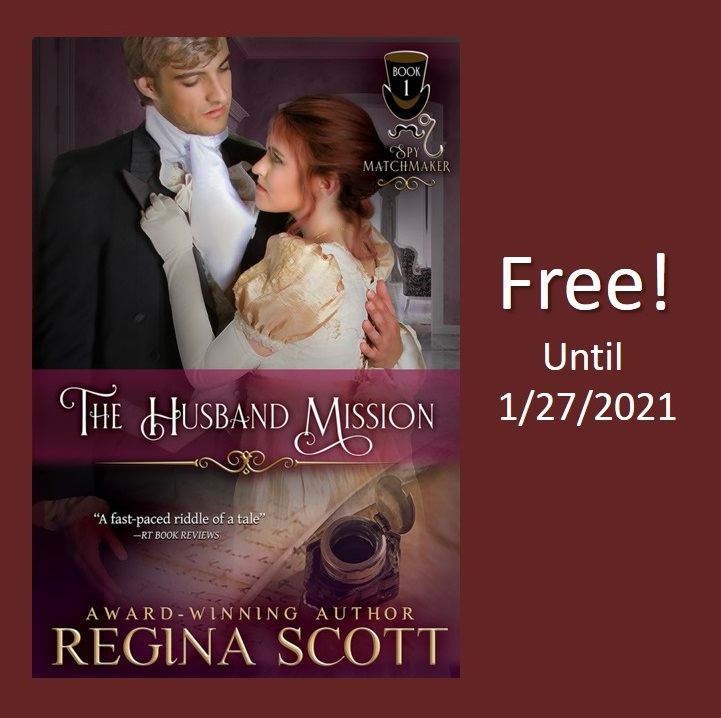
In the meantime, if you haven’t read the Spy Matchmaker series or know a friend who might enjoy it, you should know that the first book in the series, The Husband Mission, is free through January 27, 2021.

Katherine Collins is on a mission. The spirited spinster is financially beholden to her stepsister, who will inherit a fortune--if she marries in the next six weeks. Katherine even mounted an espionage campaign to locate the perfect husband, Alexander Wescott, Viscount Borin. Alex cannot understand why he’s under surveillance, but it seems to have something to do with the intriguing Katherine. Rejected for service by England’s spymaster, he ought to be searching for a wife. But what wife can compare to the excitement of international espionage? Unless, of course, she’s up for a little espionage herself.

Smashwords
Amazon
Barnes and Noble
Kobo
iBooks

Tuesday, January 12, 2021

Green Sleeves


…and green bodice, and green skirt… 😉


I love this Evening Dress from the April 1809 edition of La Belle Assemblée (which, curiously, is puffing a dress from the previous month rather than a future one—a mistake?) It’s so easy to assume that formal dresses in this era were all in white or pastels...and maybe they were, for young debutantes in their first or second season. But here is glorious, vibrant proof that they weren’t all so insipid.

The original description reads:

No. 2.—EVENING DRESS.  A round robe of green velvet, with antique boddice, and stomacher of blended gold and velvet. Short full sleeve, ornamented à-la-Spanish, to correspond. A plain gold lace placed round the bottom just above the hem, and also round the waist. A shade of Paris net across the back, edged with gold, and fastened on the shoulders with a gold or emerald brooch. A deep antique lace laid flat round the bosom and back, with a drawn tucker above. Hair confined in a gold caul behind and in full curls in front, with the Cleopatra diadem of emeralds and gold. Earrings, necklace, bracelets, and armlets to correspond. Shoes, amber or white satin. Fan of carved ivory. An occasional scarf, or shawl, of cream-coloured or white French silk, with gold or coloured embroidered body.


So…green velvet! Yum! Double yum on the elegant restraint in the trim, as well. I definitely see what is meant by an “antique boddice”—the bodice on this dress is reminiscent of an early 17th century dress, with van dyke lace pointy stomacher and all. The diadem and the “hair confined in a gold caul” also reminds me of the ancient Mediterranean style known as a Phrygian cap. And while it’s not easy to see in the print, I’m tickled by the “shade of Paris net” fastened on the shoulders—rather like a superhero cape!

And one more note: do you know what the item at the left of the image is? I’ll give you a bit of a hint: we talked about them some time ago, right here on NineteenTeen (though this is certainly a fancier version of one than I’ve seen before.)

What do you think of this dress? I know I’m in love with it.

Tuesday, January 5, 2021

Nineteenth Century Today: In My Own Backyard

As you can imagine, I spend a lot of time envisioning life in England in the early nineteenth century. So, finding touches of nineteenth century England in the Pacific Northwest is quite exciting! And to find them in my own backyard, here south of Tacoma, Washington, is priceless.

My search took me to the north end of Tacoma today, to Wright Park. In 1886, Charles Wright, through his company, donated approximately 20 acres of land in what was then the center of town for a public park. The idea was to mimic Central Park in New York. He even stipulated that at least 300 ornamental shade trees were to be planted in the first four years. The city hired a landscape architect to design the park and set about clearing stumps and bush. At first, the “park” looked like nothing so much as bare ground, but the second landscape architect on the project saw to the planting, beginning in 1890, of more than 350 varieties of trees from all over the United States and eventually the world. Many of the trees in Wright Park today are more than 100 years old.

But trees weren’t the only things to spring up in Wright Park. Tacoma businessman Colonel Clinton P. Ferry encouraged the city to include classical art in the park as well. In 1891, he brought back from Europe nine statues patterned after those sculpted by Italian masters and cast in a sandstone/concrete composite. Five still survive today.

Here’s where the early nineteenth century and England come into the picture. Two of the statues are of “dancing girls.” The originals were sculpted by Antonio Canova between 1806 and 1810. He is the highly celebrated artist who sculpted Napoleon as Mars the Peacemaker, which was given to the Duke of Wellington after his victory at Waterloo; the statue currently resides in the museum that was once Wellington’s home in London. I’ve had the honor of viewing it there. Canova himself visited England in 1815 to view the Elgin Marbles and was instrumental in the British Museum's purchase of them.

One of the two statues in Wright Park is a copy of “Dancing Girl with Hand on Chin.” You might notice in the picture above that her hand is most definitely not on her chin. Apparently, it was when she arrived and was installed in 1892. Since then, she was broken (haven’t found anyone willing to fess up to how and by whom). Whoever fixed her (also unknown), put her hand across her waist instead.

There’s a historical reason behind their nicknames as well, for they were quickly called Annie and Fannie. Annie Wright was the daughter of Charles Wright. Her name also graced a girls’ seminary nearby. The heroine of my October 2021 book, A View Most Glorious, was graduated from that school. Fannie Paddock donated land for a hospital that would bear her name until it was transferred to Tacoma General Hospital.

Of course, once I learned this history, I had to go visit them. When the nineteenth century comes this close, you embrace it. Or at least marvel.

Tuesday, December 22, 2020

We Wish You a Merry (Victorian) Christmas!

What is it that makes me get sort of goofy and sentimental about the Victorians and how they elevated the celebration of Christmas to a fine (if florid) art? The candles, the decorations, the food—the sheer coziness—and the emphasis on home and family…it paints a very beguiling mental picture, doesn’t it?

But it certainly isn’t just me (and feel free to comment and make me feel less sheepish. 😉) I’ve found some splendid bits around the interwebs by other just as beguiled and fascinated by Victorian Christmases as I am, such as this video about Victoria’s Christmas dinners by history blogger/filmmaker Lindsay Holiday:

Now, you probably know by now that I’m all about the 19th century clothes... While I’m usually more excited by clothes from the earlier part of the century, I couldn’t help being delighted by a video by CrowsEye Productions about Queen Victoria being dressed for an evening Christmas party, as depicted in this popular engraving from 1848 as seen above right at the beginning of the post. The dress isn’t exact, but close enough:

And just because it’s really neat, here’s Prince Albert getting ready for the same party:

While I expect that I’ll be dressed in a considerably more casual fashion on the 25th (because of course I’ve given my lady’s maid the day off), I’ll be enjoying the holiday...and Regina and I hope that you will be doing the same. A very happy Christmas to you, dear NineteenTeen readers, and we’ll see you in the new year. 😘


Tuesday, December 15, 2020

Always Kiss at Christmas (and Enter Giveaways Too)

Are presents starting to appear under your tree? They are here. I’ve finished wrapping the ones I bought for family, and packages from friends have been arriving.

So has a book! Two years ago, I published a novella about the origin of the love story between Meredith Thorn (born Mary Rose) and Julian Mayes in a Yuletide Regency collection with five other authors. I’m pleased to say I could bring it out this Christmas all on its own, in both print and ebook, as an addition to the Fortune’s Brides series: Always Kiss at Christmas. It’s available now at 99cents.

Mary Rose has one goal for her mother’s annual Christmas Eve party: convince her childhood friend Julian Mayes to marry her. She has always admired Julian. Surely one moment under the kissing bough will convince him they were meant to be together. Newly hired by a prestigious London law firm, Julian is ready to shake the dust of the countryside off his polished boots. But he’s always had a soft spot for Mary. As the danger to her future becomes clear, will one kiss be enough to prove to him how far he will go to protect her?


If you’d rather listen to your love stories, Never Marry a Marquess is now out in audiobook. The amazing Jannie Meisberger once again lends her talents to finishing the Fortune’s Brides series in style.

And, if you act quickly, you have two opportunities to introduce yourself to some fine reads.

TODAY ONLY—December 15, 2020, you can still enter this giveaway to travel the world, from the comfort of your cozy chair. Multiple winners will take home a print bundle of 13 sweet historical novels by some of the most beloved authors in the field, including Karen Witemeyer, Rachel Fordham, Jen Turano, Laura Franz, and Heather B. Moore. US readers only. Enter here.


Through December 27, 2020, fourteen different authors are sharing about their sweet reads for Christmas. To learn more about the stories and enter for a chance to win a $70 Amazon gift card, go here.  

Lots of ways for your Christmas reading to be merry and bright!

Tuesday, December 8, 2020

Marissa's Bookish Doings: Past, Present, and Future


First, some award news: I’m delighted to report that Evergreen won first place in the Young Adult category of the 2020 International Digital Awards, sponsored by Oklahoma Romance Writers of America. Between Silk and Sand won the same category back in 2018, incidentally.


In other award news, Evergreen is a finalist in the Paranormal category of the 2020 Golden Leaf Award, sponsored by New Jersey Romance Writers…and yes, other books of mine have been honored in this contest, including Skin Deep winning the Paranormal category in 2017 and both Betraying Season and Courtship and Curses being finalists in the Young Adult category.

I’ve discovered that I really enjoy making “book trailers”—teaser videos for books, much like movie trailers. Whether they’re much good is another issue. 😜 Still, it’s exciting, as an author, to find images that resonate with my vision of my stories…and after all, it’s just another form of storytelling. All of which is a roundabout way to get to showing you the video I created for an older book of mine, By Jove:


What do you think?

And finally, some future bookish news. Between a family bereavement at the beginning of the year and the weight of the present pandemic, my writing has slowed to a snail’s pace. But even snails eventually reach their destinations: in 2021, look for a new young adult book from me as well as a new story in the Leland Sisters world featuring Persy and Pen (and Charles!)…and a new venture: I’ll be co-editing an anthology of ghost stories for Book View Café, due out in September. Stay tuned!