Tuesday, January 25, 2022

Regency Fabrics, Part 34

 Here’s another post in our ongoing series on Regency fabrics.

As I have in previous posts, I’ll be examining actual fabric samples glued into several earlier editions of Ackermann’s Repository, samples supplied by the manufacturers and published by Ackermann in order to boost the British cloth-making industry at a time when exporting British goods to Europe was almost impossible because of the Napoleonic war. I'll give you a close-up scan of each sample, the published description if available, and my own observations of the color, weight, condition, and similarity to present-day materials, to give you as close a picture as possible of what these fabrics are like.


Today’s three samples are from the October 1813 issue of Ackermann’s Repository. The overall condition of my copy is excellent, though (like our last fabric print) a little closely trimmed on the outside edge; the page itself is free of foxing and is only slightly toned on the edges. The samples themselves are in very good condition, with perhaps a bit of discoloration from the glue used to affix it to the page in the top sample.

Here we go!


No. 1 and 2 is an olive chintz for furniture, designed by Mr. Allen expressly for her Grace the Duchess of Bedford, and is to ornament several of the rooms in the cottage now building in Devonshire. The linings best adapted to this lively and elegant article, are, blue, pea-green, and rose colour, with variegated fringes to correspond. We offer this pattern as a sample of those numerous and beautiful articles for furniture, which are exhibited at the splendid gallery of Mr. Allen, of Pall-Mall; where purchasers may meet with the most fashionable variety, and at the most reasonable prices.

My comments: It’s a little hard to see the original olive color here because of the brown foxing, but it was a clear, light-ish shade complemented by the various pinks of the flowers. It’s also possible to see, if you hold the sample about two inches from your nose, that the green of the printed leaves in the floral cluster was created by printing in blue and then yellow (or the reverse—it’s difficult to say) rather than with green dye, which, as we have seen in other posts, was not an easy color to obtain before the advent of artificial dyes. The weave is fairly even and tight (as is usual with chintz), and the glazing is not too heavy but has a nice sheen to it.


No. 3 is a new Manchester manufacture for gentlemen’s waistcoats. The lively contrast of the stripe and ground, will sufficiently recommend this article for autumnal wear. It is sold by Kestevens and Co. York-street, Covent-Garden.

My comments: I like this very well indeed. It’s a sturdy fabric: the warp threads are three-ply while the weft is single. The wider, pale apricot stripes of the ground fabric are about a half-inch wide, and the red and blue stripes are set off by a few threads of white that add some dimensionality to them. It would indeed make a handsome waistcoat; a hundred or so years later, I could see this as a shirtwaist dress worn by a Bright Young Thing for a luncheon party.


No.4 is a rich lilac-shot figured sarsnet, calculated for spencers, pelisses, mantles, and bodices. It admits trimmings of silk of the same shade, thread lace, white net, and white beads; which judgment and taste will appropriate to the article, composed so as to produce a becoming and consistent effect. It is sold by Mr. King, silk-mercer, Pall-Mall.

My comments: Oh, this is lovely fabric! Not so much the color—I still haven’t decided if “lilac” was the term used for this dusty shade of pink that we’ve seen in other fabric samples, or if the pigment in the dyes has aged and changed from something more purplish to this. But the silk is exquisite: rich and buttery, heavy enough to drape beautifully but light enough, I would imagine, to float and flutter when made into a pelisse (though a lining would tame that tendency.

What do you think of this month’s fabrics? Fancy a dress in one?


Tuesday, January 18, 2022

The Looooong Regency

Every so often, I have a reader ask me when the Regency period was. When I tell them February 5, 1811, to January 29, 1820, I frequently get wide eyes and the response, “That’s it?”

Yes, technically, the Regency period encompasses the time when Prince George was Regent for his father, King George III. He was made Regency by an Act of Parliament in 1811, and he ascended to the throne on his father’s death in 1820 (although he would not be crowned until a year and a half later). It is one of the most popular periods for setting historical romances and historical mysteries. But the same aspects of the beloved Regency lasted longer than that short 9-year period.


The high-waisted women’s fashions and dapper men’s fashions that typify the Regency came into style around 1794, following the French Revolution, and women’s waistlines didn’t start to fall until the 1820s and then only gradually. The Gothic Revival movement in architecture started in the 1740s. The ideas of freedom for all from tyranny flourished from the 1750s onward.

Regency Fiction Writers, the professional organization for those who write books set in the Regency period, recognizes the years 1780 to 1840 as the extended Regency period. The organization celebrates the publication of new works set during those years through its monthly Regency Reader newsletter. If you love the Regency, you can subscribe here.

Because who doesn’t want a little more Regency?

Tuesday, January 11, 2022

Baby, It's Cold Outside


After a very mild autumn, my neck of the woods is finally getting a sharp dose of winter today, with temperatures hovering in single digits (which is why I did anything that needed doing outdoors yesterday.) Of course, in today’s world we have central heating and insulated homes and amazing fabrics that keep us warm…and while winter temperatures in England aren’t generally as severe as those in the more northerly parts of North America, the world was still in the grip of the Little Ice Age and the Thames still occasionally froze over. So what did a Regency miss do when winter dogged her heels and nipped at her nose?

I’ve one word in answer to that question: fur.

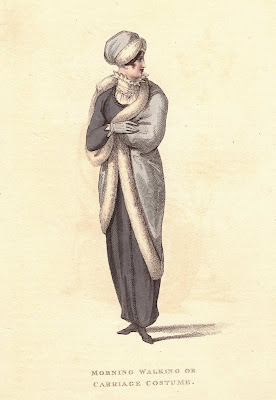
Since down jackets and Gore-tex had yet to be invented, the warmest thing in outerwear that one could wear was fur…and our hypothetical Regency lady took full advantage of it. She might wear fur-lined pelisses and cloaks like some of these:

Carriage or Promenade Dress, Ackermanns Repository, January 1810. Incidentally, this print and the next are among the only illustrations Ive seen of fur used in millinery in Ackermanns Repository; the other is a print from La Belle Assemblee that we looked at in detail a few years ago.
Morning Walking or Carriage Costume, Ackermann
s Repository, December 1810


Carriage Dress, Ackermanns Repository, February 1820


Or maybe just settle for fur trim, as in this Walking Dress from the March 1822 Ackermanns Repository.


She might cuddle up in a fur tippet (or what we call a boa) to keep her neck warm. (A Walking Dress, or Carriage Costume, Ackermanns Repository, February 1811.)


And of course, there were those enormous, eye-catching muffs that were popular for decades...and no wonder: gloves were worn year round, but when glovemakers boasted of the fineness of the kidskin they used, something more would definitely be wanted in winter to keep the hands and forearms warm. (Promenade Dress, Ackermanns Repository, January 1814)


Promenade Dress, Ackermanns Repository, December 1822.


So what kind of fur was worn?

Looking over years of Ackermann’s Repository images gives the impression that a lot of ermine (white fur decorated with the tufts of black tail fur) was worn. But actually reading the text accompanying the images tells a different tale (ahem): for example, the fur-lined mantle above from January 1810 is made with (are you ready?) “spotted American squirrel skin”! A coat from January 1811 (not shown here) was trimmed with blue fox fur. The February 1811 Walking Dress with the tippet and fur trim uses “astracan” (more commonly spelled astrakhan), or lamb. Other plates mention red fox, mole, leopard, sable, and chinchilla in addition to ermine.

While these prints are fascinating to look at, I have to say that Im very grateful that we dont have to follow their example any more. Now if youll excuse me, I think I’ll go have some quality time with my Primaloft quilt...


Tuesday, January 4, 2022

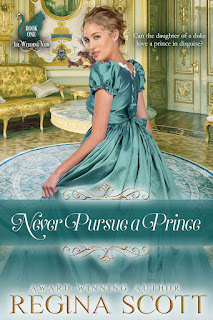
Launching a Prince

The daughter of a duke, bound by duty.

A prince in disguise

A matchmaking cat.

Yes, if you recognized the last as Fortune, you’re right! Fortune had a hand, er, paw, in matching up all the heroines in my Fortune’s Brides series, starting with Never Doubt a Duke. Now she’s back, with the next generation of young ladies, and she has help. http://www.reginascott.com/neverdoubtaduke.html

Lady Abelona, youngest daughter of the Duke of Wey (Belle to friends and family), is ready to make her debut in Society, but, oddly enough, her two older sisters, Larissa and Callie, and best friend, Petunia Bateman, have yet to find their happily-ever-afters, despite three Seasons in London. So Belle makes them vow to see all four of them wed by harvest. Fortune will have her paws full!

Though Larissa promises to help (after all, no one says no to Belle), she’s all but given up on finding her own groom. What gentleman could possibly be good enough to meet her late mother’s and grandmother’s expectations. She has a hard enough time meeting those expectations for poise, propriety, and perfection. But a chance encounter brings the most marvelous gentleman to her attention. A shame he is merely a captain of the Imperial Guard of Batavaria and in no way the suitable husband for the daughter of a duke.

Prince Otto Leopold Augustus of Batavaria has one goal: to win back his country from those who ousted his family. But someone seems intent on stopping him, for danger stalks the corridors of their palace in England. So why not trade places with his identical twin brother, the leader of the Imperial Guard? Leo might just uncover their enemies before someone is hurt. And having an ally in the thoroughly proper and pretty duke’s daughter can only help.

The more Larissa and Leo are thrown together, the more secrets come to light and the more their attraction grows. Would the daughter of a duke dare to throw off propriety, if it means winning the heart of the most princely of men?

Available now in ebook from fine online retailers and print from Amazon and an independent bookstore near you:

Smashwords 

Amazon (affiliate link)

Barnes and Noble

Apple Books

Kobo

And look for Callie’s story, Never Court a Count, coming in February!

Tuesday, December 14, 2021

Hello, Sunshine!

We’re only a week or so away from the Winter Solstice here in the northern hemisphere, when the days are shortest and the nights longest. The lack of sunlight can be hard…which is why I thought this fashion print from La Belle AssemblĂ©e would be just the thing to brighten the day.

I mean, YELLOW! 


This is an Evening Dress from February 1812; the British know something about gloomy winters, so I can imagine this dress would have brightened things up then just as much as it does now.

The description reads, No. 1.—Evening Costume  An amber crape dress over white sarsnet, trimmed with pearls or white beads, with a demi-train; a light short jacket, rather scanty, with two separate fancy folds, depending about three quarters down the front of the skirt, forming in appearance a kind of Sicilian tunic, and trimmed down each division, like the bottom of the dress, with a single row of pearls: short sleeves, not very high above the elbow, fitting close to the arm, and ornamented at the top with distinct points of satin, the same color as the dress, relieved by pearls; two rows of the same costly material or of beads, according as the robe is ornamented, form a girdle. The hair is dressed in the antique Roman style, with tresses brought together and confined at the back of the head, terminating either in ringlets or in two light knots; a braid of plaited hair drawn over a demi-turban formed of plain amber satin, with an elegantly embroidered stripe of white satin, separated by rows of pearl, and a superb sprig of pearls in front. Necklace of one single row of large pearls; with earrings of the Maltese fashion to correspond. Ridicule aux getons of slate colour, shot with pink; the firm base secured by a covering of pink stamped velvet, with pink tassels. Italian slippers of amber, fringed with silver, or ornamented round the ankle with a row of pearls or beads. White kid gloves. –This elegant dress owes its invention to the tasteful fancy of Mrs. Schabner, of Tavistock-street.

To me, it’s not just the color that makes this dress stand out: it’s the extravagant simplicity of it all. There’s little fuss or bother to this dress, stylistically, though the little peplum at the back of the waist is a nice touch. But the materials say otherwise: though a simple illustration can’t depict it, picture the contrast of the textures of the “crape” and the satin on that sleeve, even though they match in color.


And the pearls! I would hope that beads were used at least for the hem, because that is an enormous number of pearls (which weren’t at that time as common as they are in this day of extensive pearl culturing)…not to mention the likelihood of pearls being trod upon and crushed. Eek!

The headdress, curiously, is the busiest part of this ensemble, with its “elegantly embroidered” band and the ringlets and braid inspired by ancient Roman styles seen in statuary: don't forget that a great deal of fashion in both clothes and home furnishings were heavily influenced by the ancient world.

Also outstanding, though not in a positive sense, is the reticule or “ridicule”; gray and pink do not harmonize well with the yellow in my opinion, but tastes do change…


What do you think of this dress? I hope it brightened your day—in all senses of the word! And as Regina and I will be taking a couple of weeks off over the holidays to spend time with our families, I will also take this opportunity to wish our NineteenTeen readers many, many bright days over the rest of this year and into 2022.

Tuesday, December 7, 2021

Nineteenth Century Christmas Wish List, 2021 Edition

Many people I know started their Christmas shopping early. If you are one of them—good for you! If you aren’t, no worries! Here are a few things to inspire those who love the nineteenth century or to just inspire in general!

Banks by Grantlee Kieza 
Naturalist Sir Joseph Banks dominated the sciences in Regency England. I’ve used him a time or two as a supporting character. This biography by an award-winning journalist shines new light on the man himself, calling him “a fearless adventurer” whose “fascination with beautiful women was only trumped by his obsession with the natural world and his lust for scientific knowledge.” Sounds like a great read to me!

Becoming Future You: Be the Hero of Your Own Life by Mel Jolly 
Everyone has a dream, but sometimes we aren’t entirely sure how to reach it or why we haven’t reached it yet. Having worked with authors and other creative entrepreneurs for nearly two decades, Mel knows what it takes to move forward in your life. And her warm, encouraging prose will make you feel like your best friend is walking right there with you.

Jewels Through Time on Etsy 

Can I just say I’m in love? This amazing shop has wonderful reproductions of jewelry worn in historical movies. You’ll find pieces that look like they came off the set of Emma, Persuasion, Pride and Prejudice, Poldark, and more, at reasonable prices. For example, you can get a reproduction of this piece worn by Jennifer Ehle as Elizabeth Bennett in the 1995 miniseries adaptation of Pride and Prejudice (with Colin Firth as Darcy). Gorgeous! (My husband has already purchased a piece for me for Christmas.)

Cuddly, Period-Inspired Throw on CafePress
This lovely plush fleece throw blanket is based on Regency dress fabric. Perfect for cuddling up with a good book!


And speaking of books, December 3 through 10, you can get the first book in the Marvelous Munroes series, My True Love Gave to Me, free in ebook form. The print book and series bundle are also discounted.

If you sign up for my newsletter, you’ll also know when a book is on sale or up for preorder. I send an exclusive Christmas story only to newsletter subscribers each year. Sign up before December 20, and you’ll receive it too. 

Happy Christmas shopping!