Friday, May 17, 2013

Patrice Kindl: Why the Regency Romance?

We're delighted to welcome Patrice Kindl back today as she contemplates the eternal lure of the Regency.

What is it about the English Regency era that writers and readers find so compelling? The period only lasted from 1811 to 1820 – nine years, an even shorter period than the one enshrined in countless cowboy movies and novels, the twenty year time-span of cattle drives and the open range in the United States.

Both eras have a lasting aura of romance: the cowboy hero offers a masculine archetype and the Regency heroine a feminine archetype. These are largely mutually exclusive worlds; it is difficult to imagine what Hopalong Cassidy and Lizzy Bennett would have to say to one another. One genre celebrates civilization, the other strips civilization away.

It is easy to understand that modern men might like an escape from mortgage payments and committee meetings, imagining living out under the open sky with only a faithful horse for company. It is not so easy to understand why modern women, who have achieved a great deal of freedom and power in comparison with their Regency counterparts, would look back on this time with such nostalgia. So, what gives?

I can tell you, at least, some of the things that appeal to me as a writer. For one thing, there’s Jane Austen. I fell in love with this incomparable writer as a teen when I realized that the books were very funny, and were at least as much about money as about love. Then, romance is a durable genre not simply because it involves important human needs and desires, but because it has a shape, a natural story arc. Marriage is a beginning, but it is also the ending of a courtship. Having spent the novel exploring the characters of the two parties involved, it is possible to believe that one can predict their future together.

A romance novel can take place in any age; human beings have bonded and formed families since before they were even human, and presumably will go on doing so in space colonies on alien worlds. However, the Regency Era is, to my mind, precisely balanced on the fulcrum of women’s history. Before this period women had very little choice in marital matters, being disposed of as chattel; after it they eventually came to have so much choice that the decision of whom to marry lost some of its power for good or evil. An unhappily married woman of 2013 can cut her losses and try again. A woman of 1813 was literally taking her life into her hands when she said, “Yes, sir, I will marry you.”

And then this was such a stylish time! The attire for both men and women was classic. Frankly, a hoop-skirted woman negotiating a narrow hallway, or the bearded and mustachioed Victorians who resembled Yetis more than gentlemen, or Marie Antoinette advancing beneath one of those three-foot-tall hairstyles: any of these inspire more derision in moderns than admiration, but the modish Regency couple is all simple elegance. The styles looked better on the young and slender, but what fashion has ever favored the elderly and stout?

Romance is best when the stakes are high, the lovers are drop-dead gorgeous and the path to happiness perilous. The endless rules of behavior and class distinctions are an absolute gift to writers. Pity the poor author who tries to come up with a barrier to romance for a modern couple! Different class, different religion, different race, same sex? No problem! Whereas in the early 1800s there were so many hurdles to leap it was a wonder anybody managed to reproduce at all.


I am working on a sequel to Keeping the Castle, set in a Female Academy in Lesser Hoo, called A School for Brides. The research only reinforces my recognition of how little power these women had. For instance, the backboard, a device nominally intended to improve posture (shown above in the satirical illustration of a school for young ladies), was actually a way to train a girl for a life of subservience and obedience, physically restraining her for many hours a day. Marriage would either be her salvation or her doom, and for the first time in history, she had the ability to choose.

Thank you, Patrice! It's been a pleasure to have you visit this week (I'm still giggling at Victorian yetis). For more info on Patrice and her books, including Keeping the Castle and the upcoming A School for Brides, please visit her website at www.patricekindl.com

Tuesday, May 14, 2013

NineteenTeen Welcomes Patrice Kindl

This week at NineteenTeen we're delighted to welcome Patrice Kindl, author of a number of award-winning novels for young adults. Patrice has shared her home in upstate New York with monkeys, parrots, cats, dogs, reptiles and small mammals, as well as the occasional bird of prey, one son and a very indulgent husband. Her books include Owl in Love, The Woman in the Wall, Goose Chase, Lost in the Labyrinth, and the 19th century set Keeping the Castle and A School for Brides (forthcoming).


NineteenTeen: Welcome to NineteenTeen, Patrice! Keeping the Castle is not your first work of historical fiction…what inspired you to write a Regency-set story?

Patrice: I was reading yet another historical novel in which the spunky heroine scorned marriage for the opportunity to pursue some fascinating and perilous career. Yes, I like those books too, but very few seem to me to have to do with being female in any age but our own. For most of history women had precious few career options, and marriage was by far the best.

Although I definitely consider myself a feminist, I felt like we were rewriting history with a feminist slant that misrepresented reality. Being the sort of writer I am, I also thought that a more accurate assessment might be kind of funny. The Regency period is excellent for this sort of thing because it was a time when women were just beginning to have some slight amount of autonomy and power of choice, particularly as to their choice of spouse.

I have long felt that, “I love you – you are so beautiful!” is morally equivalent to, “I love you – you are so rich!” It is assumed that women will be flattered at being valued primarily for their physical attributes, even though few men would enjoy being seen almost exclusively as a source of income. Sure, men show off their net worth with expensive cars just as women dress to emphasize their best features, but both also long to be known and appreciated for other, less superficial qualities. From the opening pages of Keeping the Castle I wanted to make it clear that, to me at least, marrying for money alone is no worse than marrying for physical attractiveness alone. Actually, marrying for money makes more sense: it may reflect intelligence and ability, while beauty is simply the result of genetic roulette.

NineteenTeen: There are strong Jane Austenish overtones in the plot of Keeping the Castle—a poor but proud young woman trying to find a husband who also likes to dabble in matchmaking—Emma Bennett, if you will. :) Is Jane Austen a favorite of yours?

Patrice: First of all, of course I adore Jane Austen! I know the novels practically word for word. However, I am not sure I entirely agree with the first sentence above. I wouldn’t call Althea proud, exactly. We first see her as quite willing to marry anybody at all who can offer her a respectable family and a sizeable income. It is only as the novel progresses that she finds she does care about more than money and position. I consider her a practical and unsentimental young woman who is doing the best she can with the resources available. Miss Austen’s heroines were considerably more nice-minded than mine; they had been trained to hide their baser emotions and desires behind a screen of manners. My Althea is not a true Regency lady; she forgets to pretend.

NineteenTeen: Who was your favorite character to write in Keeping the Castle?

Patrice: Oh, Mr. Fredericks, definitely! I missed him so when I had to send him off to London. On the other hand, I am terribly fond of Miss Charity Winthrop, now Baroness Boring in the book I am working on now. And, of course, Althea. And I really like Miss Vincy. Hmm. Hard to say.

NineteenTeen: Being that we're history geeks, we have to talk about research. What was your best research moment--the one that made you smile and rub your hands together (metaphorically, of course)? What is the most interesting thing you learned as you wrote Keeping the Castle?

Patrice: Don’t you absolutely love the Internet? It used to be that I had to save up research questions and make special trips to large libraries in order to find out this stuff, and then I never got every question answered.

Okay, shall I choose the lead paint with which ladies used to coat their faces? I had fun with that. Or the discovery that Sir Arthur Conan Doyle had mislead me about quicksand (remember the bogs sucking people and moor ponies right up, never to be seen again, in “The Hound of the Baskervilles”)? I had planned to use a pool of quicksand to swallow up poor little Alexander Crawley instead of a tin mine, but it turns out that it is quite easy to get out of quicksand if you keep your head. Look it up on You Tube. Oh, and while reading War and Peace (same time period), I realized that young ladies who kept collections of morbid and depressing quotations were quite common at the time, so I gave this hobby to Prudence Winthrop.

I also found my characters on eBay. I love the miniature portraits that were exchanged between spouses and betrothed couples at the time. I was thinking of treating myself to one, when I suddenly saw one of my characters and just started screaming with laughter. It was Miss Charity Winthrop, and I own her likeness today. You can see them at: http://mybookthemovie.blogspot.com/2012/06/patrice-kindls-keeping-castle.html

NineteenTeen: What were your favorite books as a teen reader? Are there any more recent YA books that you wish you could have read when you were a teen?

I loved Jane Austen, as already mentioned. The Once and Future King (T.H. White) was very important to me. I was a bit of an Anglophile. Oh, of course there are so many wonderful YA books I’d love to have read back then – I grew up in the era of Nurse Cherry Ames and Nancy Drew, Girl Detective. There weren’t a tenth of the great books for teens that we have now. Diana Wynne Jones and Margaret Mahy are two favorites (both gone now, alas!).

NineteenTeen: I do wish Margaret Mahy were better known in the US.  So what’s next for you? Will you be writing more 19th century set work, or exploring other times and places?

Patrice: As foreshadowed above in the question about my favorite Castle character, I am about half-way through a manuscript titled, A School for Brides. This begins about eight or nine months after where we left off in Keeping the Castle. Miss Winthrop and Miss Hopkins have formed a finishing school for young ladies in Lesser Hoo, and we follow the various trials and tribulations of the students there.

NineteenTeen: Hurrah for sequels! Where can our readers learn more about you and your books?

Patrice: Please do visit my website: www.patricekindl.com. Also, Keeping the Castle has a Facebook page: http://www.facebook.com/KeepingTheCastle

Friday, May 10, 2013

Going A-Mothering

Mother’s Day is coming here in the U.S. I have been told with good authority that my Mother’s Day present will consist of something cinematic with dinner to follow. They know I like to be prepared. But some young ladies and gentlemen in the early nineteenth century in England also liked to be prepared, for Mothering Sunday.

From the seventeenth century, Mothering Sunday was celebrated on the fourth Sunday of Lent (which was March 10 in 2013). The original idea appears to be to celebrate services with the largest church, or mother church, in the area, like a cathedral, or at least to return to the church in which you were baptized. The practice was called going a-mothering. Most likely, however, in going to this church, you spent time with family, especially your mother. This tradition gradually evolved (with some help after World War I) into a celebration of mothers in general.

The practice was waning in the nineteenth century, but it still wasn’t uncommon for young servants and apprentices to be given Mothering Sunday off to go visit their families. It was said that many a young lad gathered flowers in the fields along the way to take home to his mother. As Mothering Sunday can fall as early as the beginning of March, I’m not entirely sure there were always many flowers blooming except daffodils, but it’s a lovely sentiment all the same.

In some households, apparently, cooks allowed the youngsters to bake a cake to take home to Mother. In some parts of England, the cake is called a Simnel cake, for the fine flour from which it was baked. It involves marzipan, fruit, and frosting, and had eleven knobs on the top to represent the eleven apostles who stayed true. I must admit, it looks particularly tasty to me. Some people felt it appropriate to break the Lenten fast to partake (oh, me! me!); some saved the cake for Easter Sunday. Other parts of England had sweet buns called Mothering Buns that were frosted and covered with sprinkles.

Okay, so maybe I should request that Mother’s Day present to involve cake. Who’s with me?

Tuesday, May 7, 2013

Good News, of Various Sorts

Bit of Good News #1: A few weeks ago I dropped a cryptic hint or two about a mystery that I was keeping secret...and now, to my delight, I can stop being all cryptic and mysterious and let you all know that I’ve signed a contract with Entangled Publishing for three new books for their Entangled Select line. The first book will be an adult contemporary fantasy...yes, I know, that’s a bit of a change from my usual fare. But it’s fun as an author to stretch out in different directions, and while I know that my adult books might not be of interest to all NineteenTeen readers, rest assured that I haven’t given up on Young Adult or historical fiction...not by a long shot! No details yet on release dates, but once more is settled, I’ll let you know. I’m very excited, and thrilled to be working with Entangled and Liz Pelletier!

Bit of Good News #2: Courtship and Curses has been getting some love from the Romance Writers of America, finaling in two RWA chapter contests this spring. A happy lead-up to its trade paperback release, which will be happening this summer (on July 30 to be exact, from Square Fish/Macmillan)

Bit of Good News #3: After a lot of thought, brainstorming, and private hand-wringing, I'm happy to announce I've got a title for the novella I asked for your help with a few weeks ago.  Look for Charles Bewitched sometime this summer...and I can't wait to show you the wonderful cover designer and YA author Lisa Amowitz is creating for it!


Bit of Good News #4: We’re tickled to be welcoming a guest blogger next week in the form of author Patrice Kindl and her enormously fun YA historical romance, Keeping the Castle. Please stop by next week and say hello!

Bit of Good News #5: The Young Bluestockings Book Club will read again! In honor of the 200th anniversary of the publication of Pride and Prejudice, Regina and I thought it only proper that the Young Bluestockings Book Club should do a group reading of the oft-imitated-but-never-equaled Jane Austen masterpiece. The discussion week will begin May 28, so you can spend some time in a hammock over Memorial Day weekend re-reading it.

And speaking of re-reading...there are numerous editions of Pride and Prejudice out there, of course, but there are a couple that I’d like to call special attention to; both are annotated, which will enhance the experience of readers not thoroughly steeped in the minutiae of early 19th century life. The first is The Annotated Pride and Prejudice, annotated and edited by David M. Shapard. This goes into great detail on a page by page basis, with notes covering everything from vocabulary and changes in word usage and grammar to bigger historical and cultural context...and includes lots of black and white illustrations. And then there’s Pride and Prejudice: An Annotated Edition, edited by Patricia Meyer Spacks. I haven’t seen this one in person, but it’s a large and lavishly color-illustrated edition, and looks to be worth a bit of a splurge if you’ve got a gift card burning a hole in your pocket. So get reading...and we’ll look forward to a lively discussion at the end of the month.

There, I think that’s enough good news for now, or I shall have to resort to my vinaigrette.

Friday, May 3, 2013

Nineteenth Century Heroines: Lighter Than Air

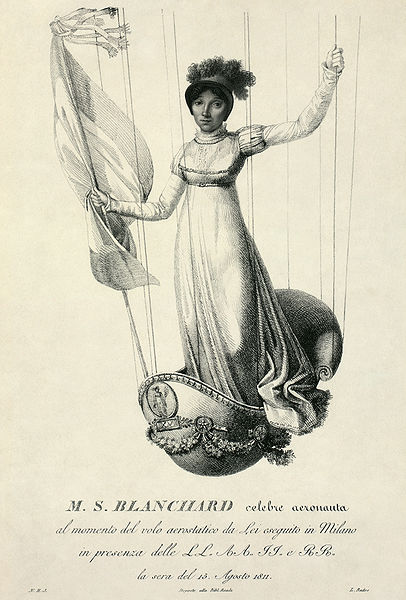
Some of you will remember a series I did a while ago at QNPoohBear's suggestion of real-life nineteenth century ladies who were inspiring enough to be heroines in a book.  We talked about Caroline Herschel’s stargazing, Ada Byron’s mathematical computing, and Mary Anning’s dinosaur hunting.  I recently stumbled upon another lady I simply had to add to the list:  the commander of Napoleon’s balloon army, Sophie Blanchard.

You wouldn’t think ballooning would be a career for a lady in the late eighteenth, early nineteenth century, much less leading a squadron of armed forces for a major power.  Sophie was one of a handful of women who ventured up in balloons, and one of the only ones skilled enough to go up alone.  Born in 1778 in France, Sophie was a nervous girl who disliked riding in carriages and startled at loud noises.  We don’t know a great deal about her early life, but somewhere between the ages of 16 and 26, she married one of the premiere balloonists of the day, Jean-Pierre Blanchard. 

Jean-Pierre was a showman who had already toured Europe and America, helped pioneer the parachute, and set records around the world.  Unfortunately, he hadn’t a lick of business sense and was always in debt.  In hopes of recovering, he added Sophie to his act, and the two were popular sights for coronations, royal birthdays, the opening of major buildings, and the like.  Sophie was undaunted by the dangers of balloon flight, claiming at one point that she’d rather sleep in a balloon than on land.  She flew high enough that she nearly passed out from lack of oxygen, she risked freezing at the cold temperatures aloft, and once she almost drown when her balloon landed in a swamp. 

She performed so many times for Napoleon, both with her husband and solo, that he made her the Aeronaut of Official Festivities.  Determined to reach England by any way possible, he also appointed her the Chief Air Minister of Ballooning and asked her to draw up plans for how he could fly his army over the Channel to attack.  Sophie is reported to have had little faith in the venture.  Balloons at that time had few ways to control them, and she recognized, even if Napoleon did not, that the wind generally blew the wrong way.

Tragedy struck the couple in 1809 when Jean-Pierre had a heart attack while performing and fell from his balloon to his death.  Sophie, however, continued to perform.  Despite the fact that she was afraid of loud noises, she perfected an act in which she lighted fireworks and tossed them by parachute from her balloon to the delighted crowds below.  Her vehicle of choice was a hydrogen-filled balloon with a tiny basket below.  She flew to celebrate the marriage of Napoleon to Marie-Louise of Austria in 1810 and on Napoleon’s 42nd birthday in 1811.  She flew over Paris and threw down leaflets proclaiming the birth of Napoleon’s son.  She also performed in Germany, Rome, and the Alps.

I wish I had a happy ending for you.  Unfortunately, it seems Sophie and Jean-Pierre had no children, or at least none that survived beyond infancy.  In July 1819, Sophie was performing at the Tivoli Gardens in Paris when her balloon caught fire and she too fell to her death, entangled in the cords of her basket.  All proceeds from the event were used to build her a monument in a Paris cemetery. 

But Sophie wasn’t forgotten.  Jules Vernes mentioned her in Five Weeks in a Balloon, proving that, nearly 50 years after her death, her amazing accomplishments lived on.

Tuesday, April 30, 2013

Victoria’s Grandchildren: Marie Louise of Schleswig-Holstein

So far, the grandchildren of Queen Victoria that we’ve met have lived fairly dramatic lives as heads of state or embroiled in tumultuous times. But some of them lived much quieter, though in their own way, equally dramatic existences. One of those was Princess Marie Louise of Schleswig-Holstein.

Despite her Germanic sounding title, Marie Louise (christened Franziska Josepha Louise Augusta Marie Christina Helena) was born and raised in England, the fourth and last surviving child of Princess Helena and her husband, Prince Christian of Schleswig-Holstein, who (as you may recall) had consented to stay in England so that the Queen would not lose the services of Helena as a sort of glorified secretary. And so Marie Louise (born August 12, 1872) and her two older brothers and older sister Helena Victoria (called Thora--that's the two of them at right) grew up at Cumberland Lodge near Windsor, with the typical privileged upbringing of the time and an education focusing on speaking French and German nicely and a smattering of history and literature, with more focus on dancing, sketching, and deportment. There were visits to country houses, to Balmoral and Osborne to stay with Grandmama the Queen and to various relations in royal families around Europe—Marie Louise was especially close to her cousin Alix of Hesse, who would one day become the last Tsarina of Russia.

And then in 1889 when she was eighteen, Marie Louise went to Berlin for yet another cousin’s wedding and met a tall, handsome young cavalry officer, Prince Aribert of Anhalt. To the bedazzled girl’s delight he paid her a great deal of flattering attention, and she fell head over heels in love. Though her cousin Emperor Wilhelm tried to fix her up with another royal suitor, Ferdinand of Roumania (who would go on to marry another English Marie), Marie Louise had made up her mind, and Wilhelm good-naturedly arranged matters so that Aribert proposed the following year. They were married in July 1891.

Anhalt was a not-terribly important duchy in east-central Germany, and was delighted to get a grand-daughter of Queen Victoria (and cousin of Emperor William) as its future duchess. Marie Louise loved her new mother-in-law and was fond of her father-in-law the Duke, though she regarded him as not very bright. Etiquette was very strict in her new home and throughout Germany, which rather chafed the lively young woman, accustomed to a more relaxed family life at home in Cumberland Lodge. She took refuge in travel, sometimes with Aribert and sometimes without, and took extended visits to Italy, Tunis, and Algiers. That she traveled without Aribert became more and more common: almost from their wedding day, Aribert always seemed busy elsewhere, and weeks might pass without their seeing each other. It’s hardly surprising that the couple had no children, which might have reconciled Marie Louise to her loneliness—instead, she continued to travel and busy herself with her network of friends (and no, that did not include any romantic entanglements. Marie Louise remained a faithful wife.) So when on her doctor’s orders she took a long sea voyage to visit the United States and Canada, she went only with her lady-in-waiting…and was surprised to receive a curt telegram in Ottawa from her father-in-law, ordering her home at once. It was rapidly followed by one from Queen Victoria reading, “Tell my granddaughter to come home to me. VR.”

Marie Louise went home to Grandmama—and found out to her shock that in her absence, her father-in-law had declared her marriage to Aribert annulled, because Aribert felt he could no longer live with her. There has been speculation that he was perhaps gay, but no one will ever know…and now, for all intents, poor Marie Louise was once again single. Though legally her marriage had been dissolved, Marie Louise still regarded herself as a married woman in the eyes of the church, and never remarried—nor did Aribert.

And that was that. She moved home again, continued to travel extensively (that's her at right on a trip to the Gold Coast in the 1920s), took up enameling and jewelry making as a hobby, and gave generously of her time to various charitable endeavors, including nursing and hospital work, a home for lepers, a Girls’ Club in a poor section of London, and other poor relief projects. She also headed up the doll house project for her childhood friend, Queen Mary. After her parents’ deaths, she and Thora (who never married) lived together, busy with their friends and family and charitable activities. Marie Louise lived long enough to see the present queen, Elizabeth, crowned in 1953, published a charming memoir called My Memories of Six Reigns, and died in 1956.

Friday, April 26, 2013

Translating the People in My Head

No, I’m not planning to write in another language.  I’m simply delighted that once again the artists at Love Inspired were able to take the characters in my head and translate them into a viable cover for my August book, The Courting Campaign.  This book starts a new series for me, where the staff from four estates in Derbyshire play matchmaker for their masters. 

When I start writing a book, I generally have an idea in my head as to how the main characters look.  But my head can get a little cluttered with the many characters hanging around, so I often go looking for a picture of a real-life person who’s a good approximation.  (Example of the cluttered brain?  A dear lady came up to me in church the other day and said, with a big grin, “Don’t ya know, don’t ya know, don’t ya know.”  I stared at her rather stupidly for a moment, until I remembered I had a character named Stanley Arlington with a distressing habit of using that phrase in my book Perfection.  Guess what she’d been reading.) 

So I was rather pleased with what the grand artists for Love Inspired came up with for the cover for The Courting Campaign.  And I love the back cover copy:
 
Emma Pyrmont has no designs on handsome Sir Nicholas Rotherford--at least not for herself.  As his daughter’s nanny, she sees how lonely little Alice has been.  With the cook’s help, Emma shows the workaholic scientist just what Alice needs.  But making Nicholas a better father makes Emma wish her painful past didn’t mar her own marriage chances.
Ever since scandal destroyed his career, Nicholas has devoted himself to his new invention.  Now his daughter’s sweet, quick-witted nanny is proving an unexpected distraction.  All evidence suggests that happiness is within reach--if only a man of logic can trust in the deductions of his own heart.
The young lady in my head for The Courting Campaign’s heroine, Emma Pyrmont, is an actress who has starred in two movies loosely based on Victorian society.   And she took The Vow never to be one of those Mean Girls.  My hero Sir Nicholas Rotherford, on the other hand, may be a widower with a young daughter in the book, but he is closer to Mr. Spock than Dr. Spock in real life, and he is also associated with another group of Heroes. 

Anyone want to guess who they were based on?